Yes, sun lamps can absolutely grow plants, and I've done it successfully with everything from basil seedlings to cherry tomatoes in a spare bedroom. The catch is that the term 'sun lamp' is mostly a marketing phrase, not a technical standard. What actually matters is whether the lamp delivers enough light energy in the right wavelengths that plants can use for photosynthesis. A purpose-built full-spectrum LED grow light will do that reliably. A SAD therapy lamp or a cheap 'daylight' desk bulb probably won't, at least not for anything more demanding than a low-light houseplant. The rest of this article is about understanding the difference and making it work in practice.
Can Sun Lamps Grow Plants? A Practical Guide for Gardeners
Marcus Holloway
23 Jul 2026
How plants actually use light (the science that matters)
Plants do not care about brightness in the way your eyes do. Lumens and lux measure how bright a light looks to humans, and our eyes are most sensitive to green and yellow wavelengths. Plants, on the other hand, respond to photons in the 400–700 nm range, a band called Photosynthetically Active Radiation, or PAR. Within that range, blue light (roughly 400–500 nm) drives chloroplast development, compact growth, and stomatal opening. Red light (600–700 nm) powers the photosynthesis reactions most efficiently and, along with far-red at around 700–750 nm, controls flowering signals and leaf expansion through receptors called phytochromes. And green light, which people used to dismiss as 'wasted,' actually penetrates deeper into leaves and canopy than red or blue does, contributing meaningfully to whole-plant photosynthesis.
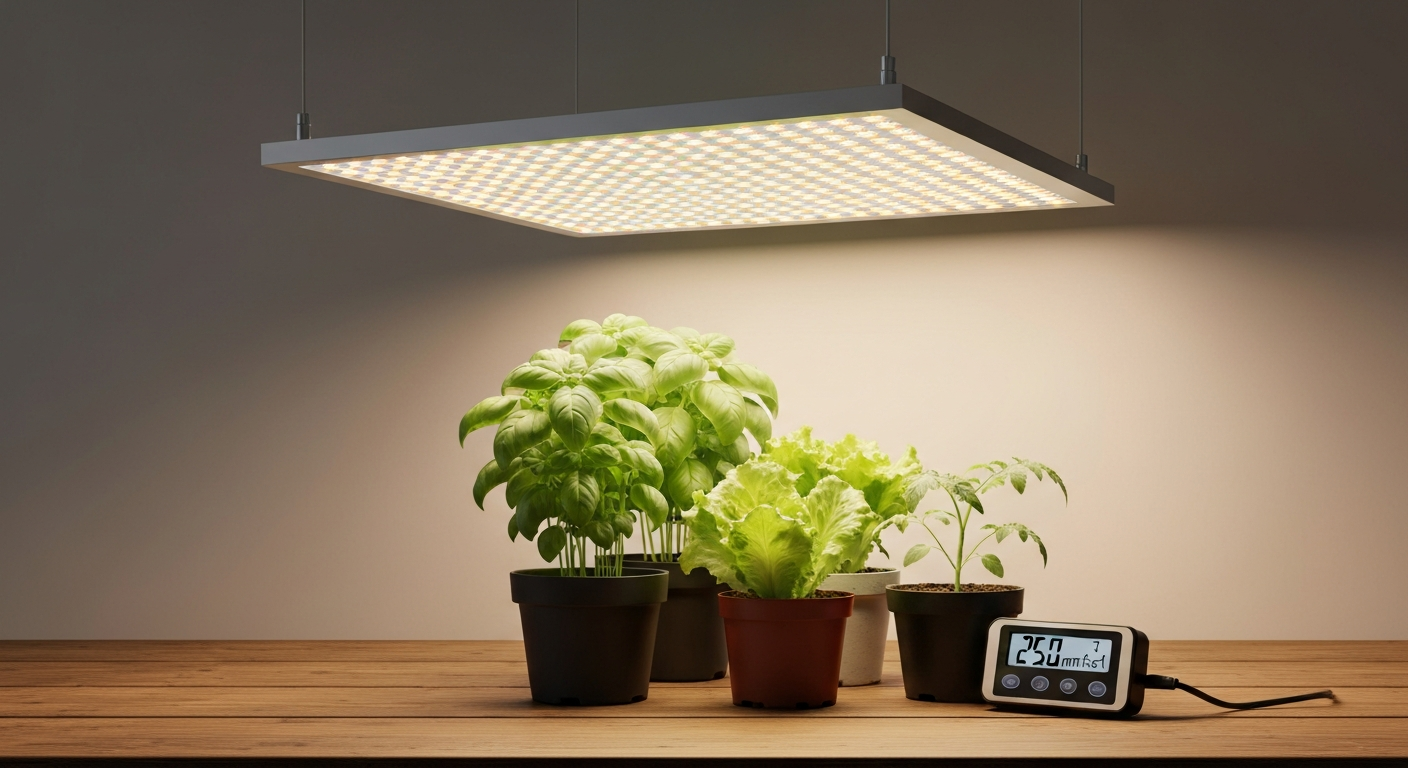
The practical metric you want is PPFD: Photosynthetic Photon Flux Density. It counts how many PAR photons land on one square meter of leaf surface every second, reported in µmol·m⁻²·s⁻¹. Think of it as the 'dose rate' of plant-usable light. The related number DLI (Daily Light Integral) is the total photon dose over a full day, calculated as PPFD × hours × 0.0036, reported in mol·m⁻²·d⁻¹. A seedling that gets PPFD 200 µmol·m⁻²·s⁻¹ for 16 hours accumulates a DLI of about 11.5 mol·m⁻²·d⁻¹, which is a solid starting target. Watts and lumens tell you almost nothing useful about whether a plant will thrive under a given lamp, which is why I stopped looking at wattage claims years ago and started asking manufacturers for their PPFD maps and PPE (photosynthetic photon efficacy) figures instead.
Spectrum myths worth busting
The phrase 'full spectrum' has no single authoritative technical definition. Vendors use it to mean anything from 'has a high CRI' to 'covers 380–780 nm' to 'looks like daylight to humans.' Recent research has also pushed the boundary of what plants respond to: far-red photons above 700 nm, applied alongside standard PAR light, can increase canopy growth, and some researchers now propose measuring 400–750 nm as 'ePAR' to capture this. The practical takeaway is not to buy a lamp because the box says 'full spectrum.' Instead, look for a spectral power distribution chart on the datasheet and check that it has meaningful output across both blue and red wavelengths at minimum.
A plain-language tour of lamp types
Not all lamps are created equal for plant growth, and the differences are significant enough to determine whether your plants thrive, survive, or just slowly give up. Here is an honest rundown of every type you are likely to encounter.
LED grow lights
Modern horticultural LEDs are the best all-around option for most home growers right now. They have high photosynthetic photon efficacy (PPE), meaning they convert electricity into plant-usable photons efficiently, produce relatively little radiant heat compared to HID or incandescent sources, and last 50,000 hours or more (rated at L70, meaning they still produce 70% of initial output at that point). Purpose-built LED fixtures come with PPFD maps, spectral data, and are often certified to DesignLights Consortium (DLC) horticultural standards, which gives you a way to compare specs across brands on equal footing. They are also the most versatile: you can find LEDs for a 2×2 ft seedling tray or a 4×8 ft flowering canopy.
Fluorescent lights (CFL and T5)
T5 fluorescent fixtures and CFL bulbs were the home-grower standard before LED prices dropped, and they still work well for seedlings, clones, and low-to-medium-light plants. They produce a reasonably balanced spectrum and run cool enough to place close to plants. The main limitations are lower PPE than quality LEDs, limited intensity for high-PPFD crops like fruiting tomatoes, and the bulbs degrade in output before they visibly burn out, so you need to track hours and replace them. For propagation trays and herb gardens, a T5 HO (High Output) fixture at 2–4 inches above the canopy is still a practical, affordable choice.
Incandescent and halogen bulbs
These produce light by heating a filament, which means most of their energy output is infrared heat rather than PAR photons. They are very inefficient as grow lights. A standard incandescent bulb might convert only about 5% of its energy into visible light, and its spectrum skews heavily toward red and infrared with relatively little blue. Plants under incandescent-only light tend to get leggy, weak, and etiolated because of the poor blue-to-red ratio. You can use them as a minor light supplement in combination with other sources, but using them as a primary grow light is a waste of electricity and will disappoint you.
HID lights (HPS and Metal Halide)
High-Intensity Discharge lights were the commercial growing standard for decades. High-Pressure Sodium (HPS) delivers high PPF per fixture in the red and yellow range, making it effective for flowering and fruiting. Metal Halide (MH) skews bluer and is better suited to vegetative growth. Both run hot and require a ballast, which adds cost and complexity. For home growers with small spaces, HID is overkill and the heat management is genuinely challenging. In a dedicated grow tent or room where you can run extraction fans, an HPS fixture still produces excellent results for flowering plants, but modern LEDs have largely closed the efficacy gap while running cooler.
Purpose-built full-spectrum 'sun lamps'
These are LED or fluorescent fixtures marketed specifically as grow lights or 'plant lights,' often using the term 'sun lamp' or 'full-spectrum grow lamp' to signal that they cover the visible range broadly. The best ones genuinely deliver adequate PPFD and a useful spectrum, and they are what I would recommend to a beginner. The worst ones are low-power desk ornaments with more marketing than output. Always check the published PPFD at your intended mounting height; a reputable brand will show a PPFD map in the product documentation or on its website. If you cannot find PPFD data for a 'sun lamp' you are considering, treat that as a red flag.
Heat lamps
Heat lamps, such as infrared reptile bulbs or brooder lamps, are designed to produce warmth, not photosynthetically useful light. Their output is dominated by infrared radiation well above the 700 nm PAR boundary. They will raise soil and air temperature around plants, which can be useful for germination or in a cold environment, but they will not meaningfully drive photosynthesis on their own. Can you use a heat lamp to grow pot? No, heat lamps give heat but very little PAR, so they won't support the photosynthesis cannabis needs; use a proper grow light for light and a heat mat or controlled room temperature for warmth. Do grow lights keep plants warm? Read a focused explanation on whether grow lights raise air and soil temperature and how to manage heat for seedlings. If you need to keep seedlings warm, a seedling heat mat under the tray is a far more targeted and energy-efficient tool than a heat lamp overhead. If you’re wondering 'do heat lamps help plants grow', read our short explainer on how heat lamps affect plant growth and when a heat mat is a better choice.
Which lamp works best for what you are growing
| Lamp Type | Seedlings | Foliage / Herbs | Flowering / Fruiting | Notes |
|---|---|---|---|---|
| Full-spectrum LED (horticultural) | Excellent | Excellent | Excellent | Best all-round; check PPFD map and PPE spec |
| T5 HO Fluorescent | Excellent | Good | Marginal | Run cool; good at 2–4 inches; replace tubes at 10–12k hours |
| CFL (compact fluorescent) | Good | Acceptable | Poor | Best as supplemental light or for very small areas |
| HPS (High-Pressure Sodium) | Poor (too hot, wrong spectrum) | Acceptable | Excellent | Proven for flowering; hot and requires ballast |
| Metal Halide (MH) | Good | Good | Fair | Better blue spectrum than HPS; usually paired with HPS |
| Incandescent / Halogen | Poor | Poor | Poor | Mostly heat; low PAR output; not recommended |
| Heat lamp (infrared) | Not useful for light | Not useful for light | Not useful for light | Useful only for temperature management |
| 'Sun lamp' (SAD/therapy) | Poor to marginal | Marginal | Poor | High lux for humans, but often low PPFD; check specs carefully |
My personal recommendation: if you are starting out and have a budget of $50–$150, a quality T5 HO fixture or a mid-range horticultural LED panel will serve seedlings and herbs extremely well. If you want to grow fruiting plants like tomatoes or peppers indoors under sole-source lighting, invest in a proper horticultural LED rated for at least 400–600 µmol·m⁻²·s⁻¹ at canopy height. Anything less will give you flowering plants that are permanently underwhelmed.
How to choose a grow light: a practical checklist
Shopping for grow lights is confusing because the market mixes genuinely useful horticultural fixtures with under-powered consumer novelties, all using similar language. Here is what I actually check before buying.
- Spectrum: Look for a spectral power distribution (SPD) chart on the datasheet. It should show meaningful peaks or output across blue (400–500 nm) and red (600–700 nm). Bonus if it includes far-red (700–750 nm). Reject any fixture that only gives you a CRI number and no SPD.
- PPFD map: The manufacturer should publish a PPFD footprint diagram showing µmol·m⁻²·s⁻¹ values at multiple mounting heights (e.g., 12, 18, and 24 inches). Match this to your grow space size and the target PPFD for your crop.
- PPE (Photosynthetic Photon Efficacy): Reported in µmol·J⁻¹. Current high-quality LEDs deliver 2.5–3.0+ µmol·J⁻¹. Below 1.5 µmol·J⁻¹ signals an outdated or low-quality fixture.
- Coverage area: The PPFD map tells you where usable light falls. A fixture claiming to cover 4×4 ft might only deliver adequate PPFD in the center 2×2 ft. Read the map, not the marketing copy.
- Input wattage: A useful reality check. Divide the fixture's total PPF (µmol·s⁻¹) by its input watts to get PPE. This lets you estimate running costs and compare efficiency.
- Rated lifetime: Look for L70 or L90 ratings (the point at which output drops to 70% or 90% of initial). Reputable LED fixtures will specify this. Quality horticultural LEDs typically exceed 50,000 hours at L70.
- Certifications and testing: DLC Horticultural V3.0 listing, UL listing, or ETL certification means the fixture has been tested to a recognized standard. It is not a guarantee of greatness, but it rules out dangerous counterfeits.
- IP rating: If you are growing in a humid environment or misting plants frequently, check for an IP54 or higher rating, which means the fixture is protected against dust and water splashes.
- Plug and size compatibility: Check the fixture dimensions against your tent or shelf, and confirm it runs on standard 120V (or 240V if you are in a country that uses it). Some high-power fixtures require a dedicated 20-amp circuit.
Setting up your grow light the right way
The most common mistake I see from new growers is hanging a light at a random height and hoping for the best. Placement matters more than almost anything else in an indoor grow setup.
Height and distance
Light intensity drops sharply as you move away from the source, roughly following an inverse-square relationship. Moving a lamp from 12 inches to 24 inches above your plants does not halve the PPFD: it drops it to roughly one quarter. Always follow the manufacturer's PPFD map for your specific fixture and crop stage. As a general starting point: most LED panels for seedlings work well at 18–24 inches; T5 fluorescents can go as close as 2–4 inches; HID fixtures typically need 18–36 inches minimum to avoid heat stress. Adjust based on what your plants tell you. Bleached or crispy leaf tips mean too close; stretching, thin stems mean too far.
Mounting, coverage, and reflectors
Grow tents with reflective Mylar lining dramatically improve light use efficiency by bouncing photons back toward the canopy that would otherwise hit walls and be absorbed. If you’re wondering 'can you use mirrors to grow plants', mirrors can help redistribute light but are usually less effective than purpose-made reflective materials and should be used with an understanding of their limits. If you are growing on a shelf or in a room, hanging reflective material (or even matte white paint) behind and around your grow area can meaningfully improve uniformity. To check coverage, I take a grid of spot readings at canopy height using a PAR meter or a PAR measurement app (hardware meters from Apogee are accurate; many phone apps are not). The goal is PPFD uniformity within about 20% across the canopy. Hot spots in the center and dim corners are a sign you either need to raise the fixture or add supplemental side lighting.
Timers
Do not try to manage a light schedule manually. A basic 24-hour mechanical outlet timer costs about $8 and eliminates the single most common grow-light mistake: inconsistent photoperiods. Flowering plants in particular need a consistent dark period to trigger and maintain their reproductive cycle. Interrupting the dark period even briefly can stress photoperiod-sensitive plants and delay or prevent flowering. Plug in a timer from day one.
Light schedules and practical recipes for different plant types
The table below gives concrete PPFD and photoperiod targets drawn from extension research and controlled-environment studies. Virginia Tech Extension recommends ~250 µmol·m⁻²·s⁻¹ PPFD with an 18‑hour photoperiod (DLI ≈16.2 mol·m⁻²·d⁻¹) as a practical microgreen production recipe Virginia Tech Extension recommends ~250 µmol·m⁻²·s⁻¹ PPFD with an 18‑hour photoperiod (DLI ≈16.2 mol·m⁻²·d⁻¹) as a practical microgreen production recipe.. DLI is calculated from those numbers so you can see the full picture. These are starting points, not hard limits; adjust based on your plants' response.
| Plant Stage / Type | Target PPFD (µmol·m⁻²·s⁻¹) | Photoperiod (hours/day) | Resulting DLI (mol·m⁻²·d⁻¹) | Notes |
|---|---|---|---|---|
| Low-light foliage (pothos, ferns, peace lily) | 50–150 | 12–14 | 2–8 | Many tolerate lower; watch for yellowing as signal of deficiency |
| Seedlings / propagation | 100–250 | 16–18 | 6–16 | Blue-enriched spectrum promotes compact, sturdy growth |
| Herbs (basil, mint, parsley) | 150–300 | 14–16 | 8–17 | Aim for 12–17 mol·m⁻²·d⁻¹ DLI for productive harvest |
| Leafy greens (lettuce, spinach, kale) | 150–300 | 14–16 | 8–17 | Commonly grown at 12–17 mol·m⁻²·d⁻¹ DLI in commercial CEA |
| Microgreens | 200–300 | 18 | ~13–19 | Virginia Tech CEA uses ~250 µmol at 18 h (DLI ≈ 16.2) |
| Flowering / fruiting vegetables (tomato, pepper, cannabis) | 400–800+ | 12–18 (crop-dependent) | 17–30+ | Photoperiod-sensitive crops (cannabis) need 12 h dark to flower |
A few recipes I actually use: for a basil herb garden under a mid-range LED panel, I run 200 µmol at 15 hours, giving a DLI of about 10.8 mol·m⁻²·d⁻¹, and harvest every 2–3 weeks. For tomato seedlings, I start at 150 µmol for 16 hours (DLI about 8.6), then step up to 350 µmol as they develop their second true leaf set. For flowering tomatoes, I push to 600 µmol at 16 hours (DLI about 34.6) and supplement with calcium and potassium to support the fruit load. The DLI formula is simple: PPFD × hours × 0.0036.
What about household lamps, desk lamps, and regular bulbs?
This is one of the most common questions I get, and the honest answer is: it depends entirely on the plant and the bulb. See our guide 'can you use lamps to grow plants' for a practical primer on which household lamps can and can't support different plant types. For a concise answer to whether a regular lamp can help plants grow, see can a regular lamp help plants grow. A 'daylight' LED bulb rated at 5000–6500K does emit some blue and red wavelengths in the PAR range, but its total PPFD output is much lower than a dedicated grow fixture. Placed 12 inches above a low-light houseplant like a pothos or snake plant, a decent daylight CFL or LED bulb can absolutely keep that plant alive and even growing slowly. The same bulb 18 inches above a tomato seedling will produce etiolated, spindly growth because the PPFD just is not sufficient.
Desk lamps are worth trying under specific conditions: low-light plants, supplemental light near a window, or short-term emergency cover while you wait for a proper grow light to arrive. Use a 'daylight' or 'cool white' bulb in the 5000–6500K range, place it as close as the heat output allows (LED bulbs run cool enough to get within 6–8 inches), and run it for 14–16 hours a day. Do not expect it to grow tomatoes or support flowering; be realistic about what 15–30 µmol·m⁻²·s⁻¹ can accomplish. For anything more demanding, a purpose-built fixture is genuinely worth the small investment.
Heat lamps (infrared bulbs) are a separate case: they contribute almost no PAR light and should not be used as a primary light source for plants. If your growing space is cold, a heat mat under seed trays targets warmth exactly where germination needs it without wasting energy overhead. Regular incandescent bulbs have the same fundamental problem: the vast majority of their energy output is heat and infrared, not PAR. They will raise the temperature near your plants more than they will drive photosynthesis, which is the opposite of what you usually want.
Clearing up the health misconceptions
Two questions come up constantly from people new to grow lights: will they give you a tan, and can they cause cancer? Most horticultural LED grow lights emit virtually no UV-B radiation, which is the wavelength responsible for both tanning and the DNA damage associated with skin cancer risk. Some specialist fixtures deliberately add small amounts of UV-A for secondary metabolite enhancement in crops like cannabis or herbs, but these are exceptions and should be used exactly as specified. Looking directly into high-intensity LED arrays can cause eye discomfort or retinal stress, so wear UV-protective glasses when working in close proximity to running grow lights, especially HID fixtures. But routine exposure to the light that falls on your skin while tending plants is not meaningfully different from standing near a bright lamp.
Heat, safety, and realistic expectations
Every grow light produces some heat as a byproduct of converting electricity to light, because no conversion is perfectly efficient. See do grow lights produce heat for details on how different lamp types affect ambient temperature. LEDs produce less radiant heat than HID or incandescent sources, but the fixture itself gets warm and needs ventilation. In a closed tent or cabinet, even LED fixtures can raise ambient temperature by 5–10°F (3–6°C) above the room temperature, which matters for plant health and for preventing heat stress. If you are growing in a small tent, check that you have adequate passive venting or an inline fan sized for your space. Fire risk from purpose-built, certified grow lights used as directed is low, but DIY setups, daisy-chained extension cords, and fixtures with no safety certification are genuine hazards. Buy certified fixtures and plug them into appropriately rated circuits.
On realistic expectations: indoor growing under artificial light is absolutely capable of producing full life cycles from seed to harvest, and commercial controlled-environment agriculture does exactly that at scale. See review 'From physics to fixtures to food: current and potential LED efficacy, Horticulture Research (review)' summarizing controlled‑environment studies and commercial operations that achieve full life‑cycle plant growth under modern white/full‑spectrum LED fixtures used as sole‑source lighting From physics to fixtures to food: current and potential LED efficacy — Horticulture Research (review). At home, you can grow excellent herbs, greens, microgreens, and even fruiting crops with the right setup. What you should not expect is that any lamp you happen to have on your desk will replace a south-facing window for a sun-loving plant. Match the tool to the task, check the PPFD numbers, set a timer, and you will be genuinely surprised at what a spare room corner can produce.
FAQ
Can sun lamps (full‑spectrum grow lights) actually grow plants?
Yes. Modern “sun lamps” — commonly full‑spectrum LED grow lights or white horticultural LEDs — can support germination, vegetative growth and flowering if they supply adequate photosynthetic photons (PPFD) and the right spectrum for the crop. “Full‑spectrum” is a marketing term with variable definitions, but many white LEDs provide usable photons across 400–700 nm (and some include far‑red). The key is meeting plant light quantity (PPFD/DLI) and appropriate spectra rather than the product name alone.
What light measurements matter for plants (spectrum, PAR/PPFD, DLI vs lumens/watts)?
Plants use photons in the PAR band (about 400–700 nm); measure light as photon flux, not human‑weighted lumens. PPFD (µmol·m⁻²·s⁻¹) is instantaneous photon flux at canopy level; DLI (mol·m⁻²·d⁻¹) is the daily total (PPFD × hours). Watts tell energy use, lumens tell human‑perceived brightness — both are poor predictors of plant response unless you have source‑specific conversions to PPFD. Use a quantum PAR meter for planning and validation.
How does spectrum affect plant form and performance?
Different wavelengths have different roles. Blue (≈400–500 nm) promotes compact growth, stomatal opening and chloroplast development. Red (≈600–700 nm) drives photosynthesis and flowering signals with phytochromes; far‑red (~700–750 nm) can increase canopy photon capture and affect elongation and flowering timing. Green (≈500–600 nm) penetrates canopies and contributes to whole‑plant photosynthesis. UV and far‑red can change secondary metabolites and morphology but need careful use to avoid stress.
Which lamp types are best: LED, fluorescent, incandescent/halogen, HID, purpose‑built sun lamps, heat lamps?
- LED (modern horticultural or high‑quality white LEDs): best overall — high efficacy (µmol·J⁻¹), low heat, controllable spectra and long life. Many are suitable as sole‑source lights. - Fluorescent (T5/T8, compact fluorescents): OK for seedlings and low‑to‑moderate light houseplants; inexpensive but lower efficacy and shorter life than LEDs. - HID (HPS, MH): Historically used in greenhouses; HPS gives high PPF but more heat and poorer electrical efficiency than modern LEDs. Metal halide (MH) is good for veg phase. - Incandescent/halogen: Poor choice — low PAR per watt and lots of heat; not recommended. - Purpose‑built sun lamps / full‑spectrum LEDs: Good when vendor provides PPF/PPFD/PPE specs and spectral data. - Heat lamps (infrared/ceramic heat emitters): Provide heat, not useful as primary photosynthetic lighting; they often emit little PAR and can stress or desiccate plants.
How should I set up sun lamps for home plants (distance, duration, mounting)?
Follow manufacturer PPFD maps first. General starting points: seedlings/propagation: PPFD ~100–300 µmol·m⁻²·s⁻¹; foliage houseplants: 50–200 µmol·m⁻²·s⁻¹; flowering/fruiting crops: 200–600+ µmol·m⁻²·s⁻¹ depending on crop. Typical distances: compact white LEDs 6–24 in (15–60 cm) above canopy depending on fixture and power — use the fixture’s PPFD map or measure with a PAR meter. Use a timer for consistent photoperiods and adjust height as plants grow to maintain target PPFD.
What photoperiods (hours/day) should I use?
Photoperiod depends on crop: most houseplants and leafy greens do well on 12–18 h/d. Seedlings often use 14–18 h to prevent stretching. Long‑day/short‑day flowering crops need species‑specific cycles (e.g., many ornamentals or cannabis). Combine PPFD and hours to reach DLI targets: e.g., PPFD 200 µmol·m⁻²·s⁻¹ for 12 h ≈ DLI 8.6 mol·m⁻²·d⁻¹.
Next Articles
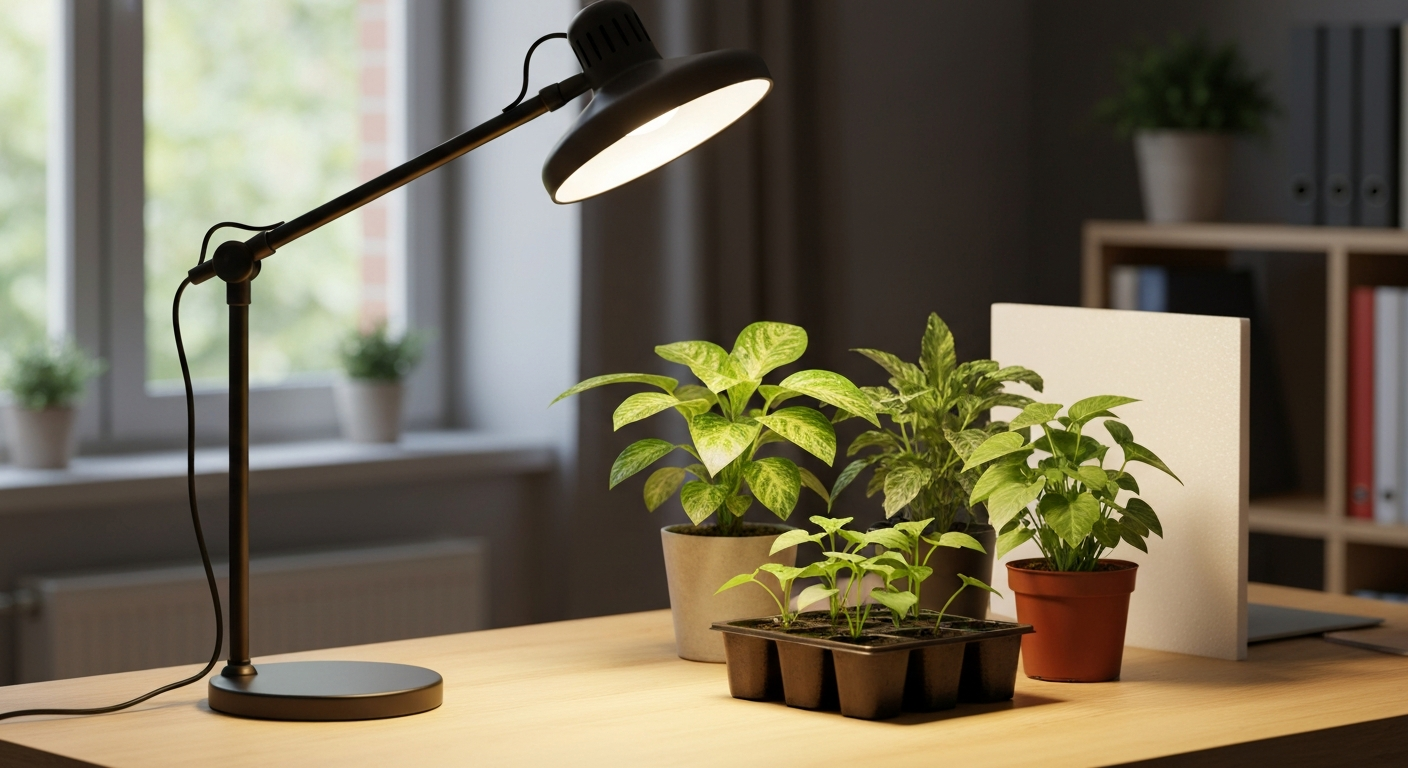
Can You Use a Desk Lamp to Grow Plants? Bulb Choices & Setup Tips
Can you use a desk lamp to grow plants? Clear verdict, bulb choices, setup steps, and when to upgrade.
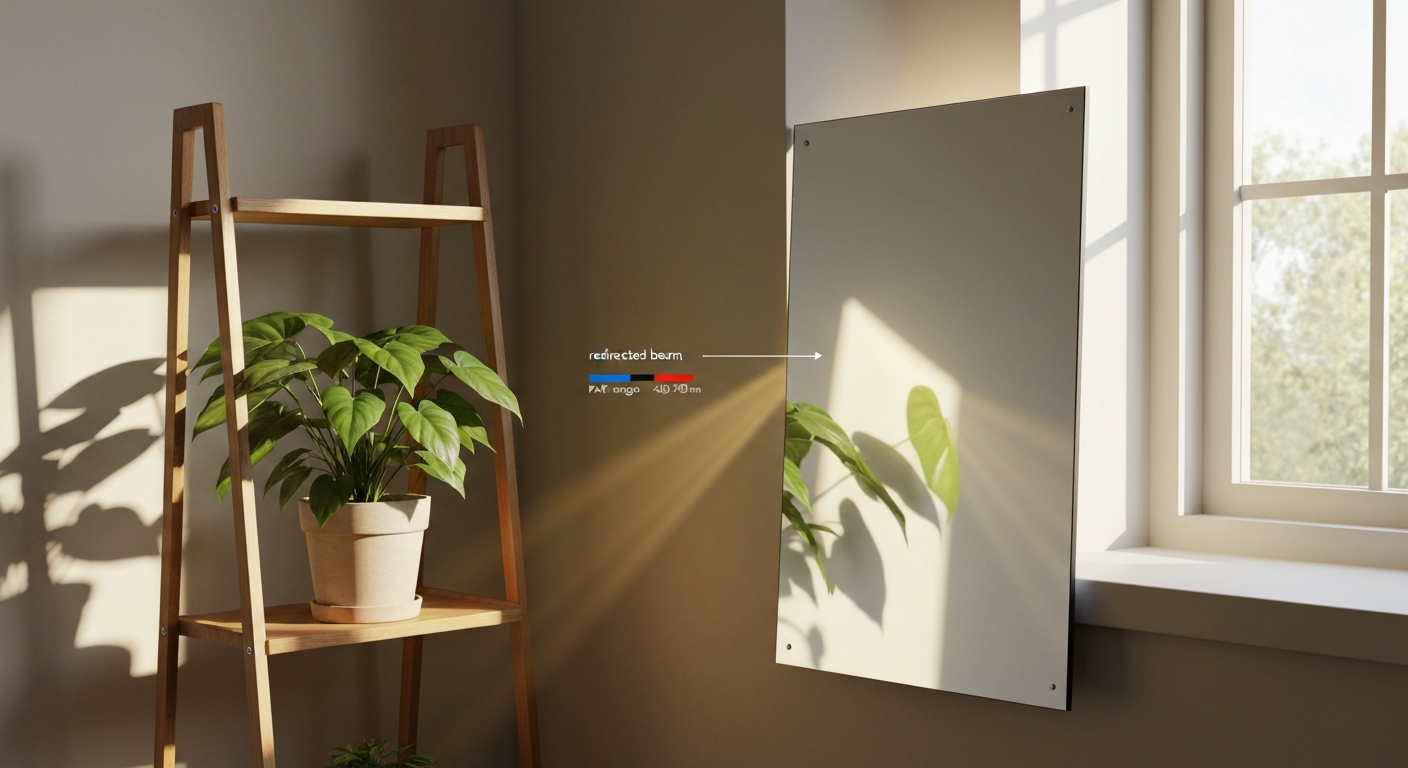
Can You Use Mirrors to Grow Plants? Practical Indoor Guide
Can you use mirrors to grow plants? Learn evidence-based verdict, setup tips, measurements, risks, and better alternives
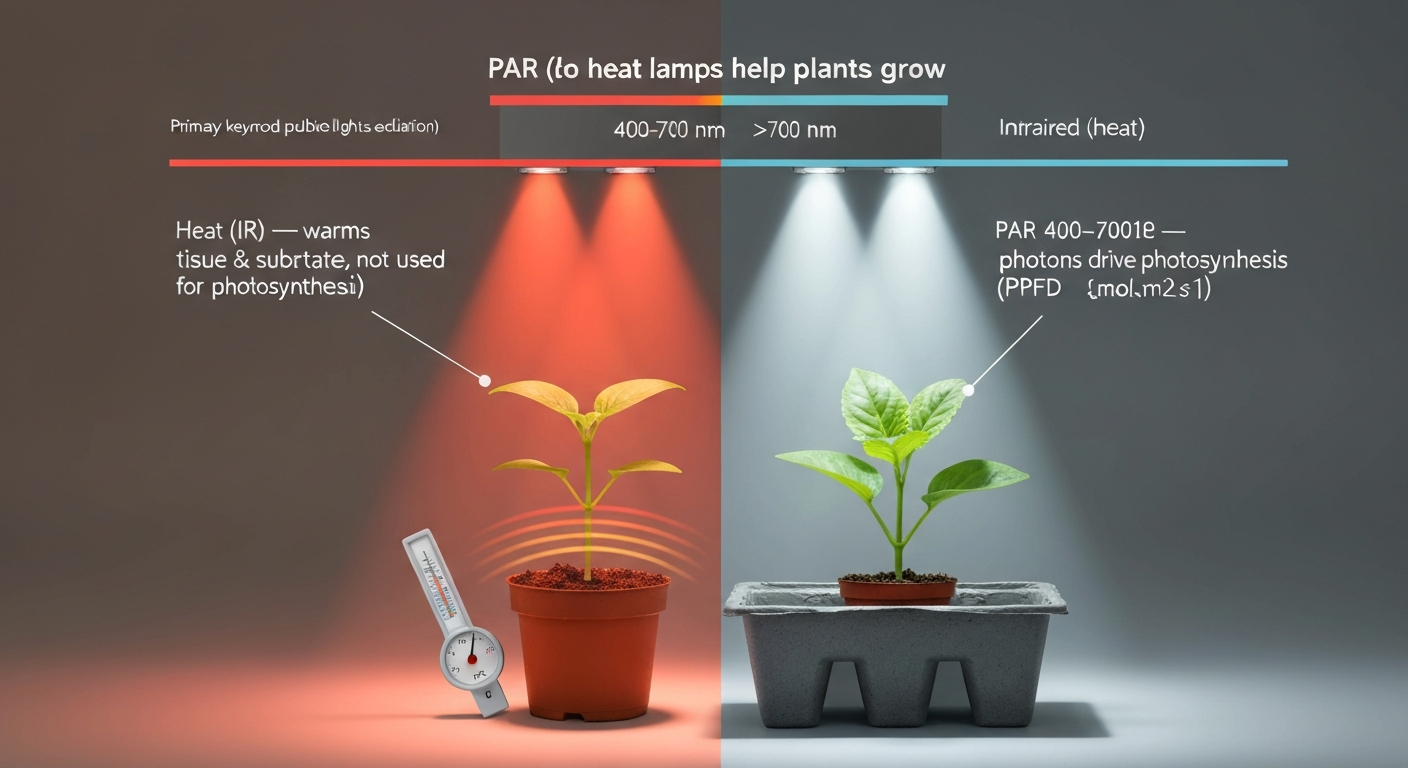
Do Heat Lamps Help Plants Grow? Guide for Gardeners
Do heat lamps help plants grow? Clear verdict, when they help, setup & safety tips, costs and better alternatives.