
Heat lamps can help plants in one specific way: they raise temperature. If your seeds are germinating in a cold basement, your cuttings are sitting on a chilly windowsill, or your tropical houseplants are struggling through a cold snap, a heat lamp can absolutely make a real difference. But if you're hoping a heat lamp will replace or even supplement a grow light by driving photosynthesis, it won't. Heat and light are not the same thing, and plants need photons in a specific wavelength range to actually grow. A heat lamp mostly delivers infrared radiation that plants cannot use for photosynthesis at all.
Do Heat Lamps Help Plants Grow? Guide for Gardeners
Marcus Holloway
13 Jul 2026
Quick verdict: do heat lamps help plants grow?
Yes, but only in a narrow, temperature-related role. Heat lamps help when your growing environment is too cold for germination, rooting, or healthy tropical plant metabolism. They do not help by providing photosynthetically useful light, because the infrared and radiant heat they emit falls almost entirely outside the 400 to 700 nm range that drives photosynthesis. If your plants are light-starved, a heat lamp will not fix that. See can sun lamps grow plants for a detailed comparison of sun lamps, grow lights, and their effectiveness for photosynthesis. If they're cold-stressed, it just might.
How plants use light versus heat
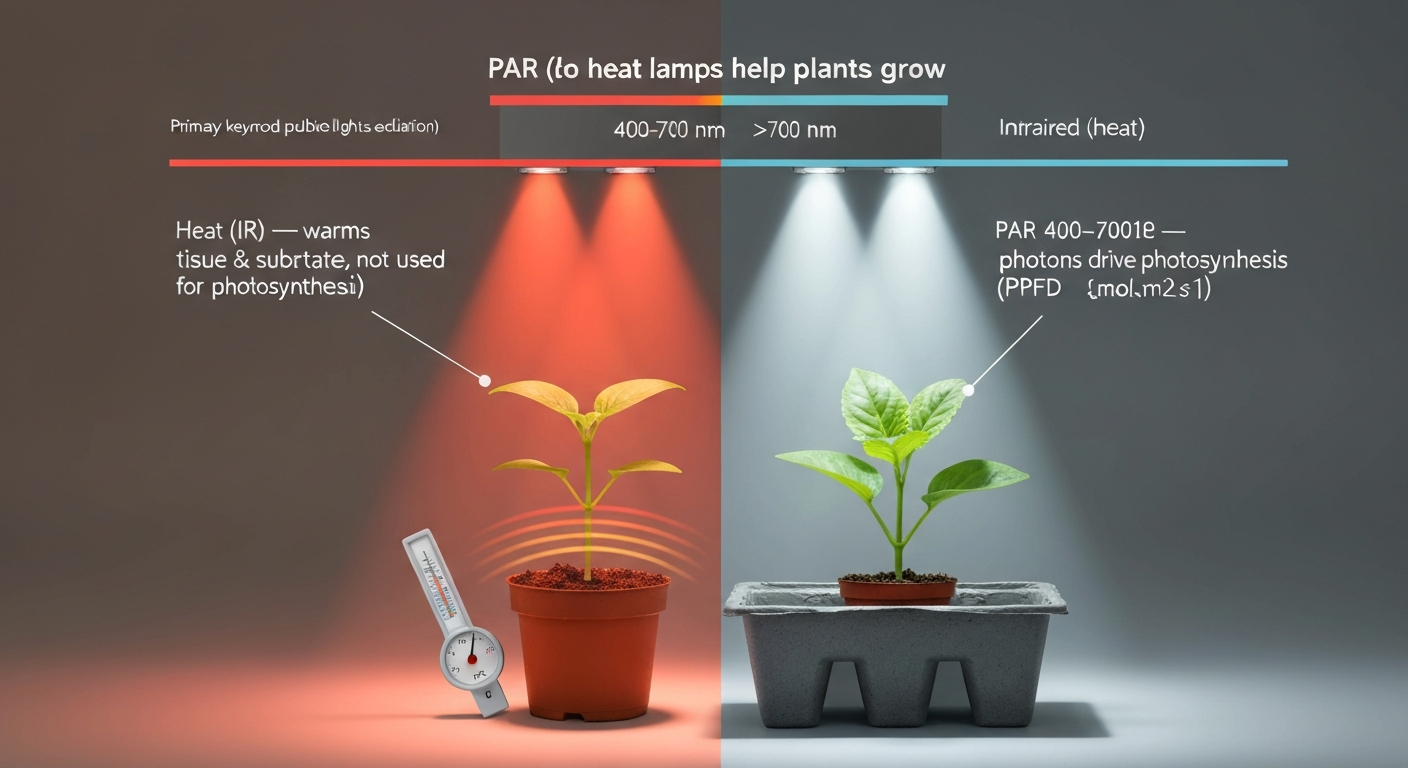
Photosynthesis is a photon-driven process, not a heat-driven one. Chlorophyll and accessory pigments inside leaf cells absorb individual photons and use that energy to fix carbon dioxide into sugars. The photons that matter are those in the photosynthetically active radiation (PAR) band, which runs from 400 to 700 nanometres. Scientists measure how many of those photons reach a plant surface using photosynthetic photon flux density (PPFD), expressed in micromoles per square metre per second (μmol·m⁻²·s⁻¹). Raise the PPFD and, within limits, you raise the rate of photosynthesis. Drop it below what a plant needs, and growth slows regardless of how warm the environment is.
Heat, on the other hand, affects how fast the biochemical reactions of photosynthesis run once the photons have already done their job of capturing energy. Temperature also controls germination speed, root development, enzyme activity, and transpiration. Plants do have temperature preferences, and being too cold genuinely suppresses growth. But warmth without adequate PAR photons does not produce growth. It is like having a warm kitchen with no food. The temperature is fine; there is just nothing to actually build cells with.
Wavelengths above about 700 nm, which is where most of the output from heat lamps sits, contribute negligibly to photosynthetic quantum yield. Research tracing back to McCree's classical action-spectrum work confirmed this boundary, and it is why the PAR definition stops at 700 nm. So when a heat lamp radiates mostly at 800 to 2500 nm (deep infrared), it is warming surfaces and air, not feeding photosynthesis.
Types of heat lamps explained
Not all heat lamps are the same, and understanding their differences matters for choosing the right one for your plants.
Incandescent and reflector infrared bulbs
These are the classic red or clear hard-glass bulbs you see in food-warming stations and animal enclosures. Standard infrared reflector lamps (the R125 and BR125 types commonly made in 250 W to 375 W versions) emit more than 80 to 90 percent of their energy output as heat rather than visible light. They do emit some visible light, so they are not completely dark, but the vast majority of their output is in the near-infrared range well above 700 nm. For plants, this means very little usable PAR and a strong heating effect.
Ceramic heat emitters
Ceramic heat emitters are widely used in reptile and bird husbandry. They screw into a standard socket and get extremely hot, but they emit long-wavelength infrared and produce zero visible light. Manufacturers are explicit about this: they advertise the lack of light output as a feature for nocturnal animals. For plants, that means a ceramic heat emitter provides warmth and absolutely nothing else. Zero PAR, zero photosynthesis support. They are, however, very efficient at raising ambient and surface temperature without disturbing light cycles, which makes them useful in propagation tents where you want heat without extra light during the dark period.
Broad-spectrum incandescent and halogen lamps
A standard incandescent or halogen bulb is sometimes lumped in with heat lamps because it runs hot and delivers warmth. These do emit some PAR photons, particularly in the red portion of the spectrum, but the ratio of heat to useful light is still terrible compared to any purpose-built grow light. I've tried propping up an old 60 W incandescent over seedlings in a pinch. The seedlings got slightly warmer, stretched badly toward the light, and were no better off than before. The light output just isn't engineered for plant growth. If you're asking "can a regular lamp help plants grow", the short answer is no: ordinary household lamps provide far too little PAR compared with purpose-built grow lights.
Heat lamps versus purpose-built grow lights
The fundamental difference is what the lamp was designed to deliver. Purpose-built horticultural lights, whether LED panels, T5 fluorescents, or HPS fixtures, are engineered and specified by their PAR output. Manufacturers publish PPF (total photon output across the PAR band) and PPFD (photon flux at a given distance) precisely because those are the numbers that determine whether your plants photosynthesize. Heat lamps are specified by radiant heat output and surface temperature. These are completely different performance goals.
| Light type | PAR output | Heat output | Primary use case | Useful for photosynthesis? |
|---|---|---|---|---|
| Infrared heat lamp (250 W reflector) | Very low (minimal visible light) | Very high (>80–90% of output as IR heat) | Warming air, surfaces, animals | No |
| Ceramic heat emitter | Zero (no visible light) | High (long-wave IR only) | Ambient and enclosure heating | No |
| Standard incandescent / halogen | Low (some red/yellow PAR) | High (most energy as heat) | General lighting, accidental warming | Negligible |
| T5 fluorescent grow light | Moderate (balanced blue/red PAR) | Low to moderate | Seedlings, cuttings, low-light plants | Yes |
| LED grow light (horticultural) | High (engineered PAR spectrum) | Low (efficient conversion) | All growth stages, high-light crops | Yes, efficiently |
When I switched from a 150 W incandescent clamp lamp to a small LED panel over my seed trays, germination speed stayed about the same (because temperature was already dialed in with a heat mat), but the seedlings went from tall and spindly to compact and dark green within a week. That difference was entirely the PAR upgrade, not temperature. The LED ran cooler, used less electricity, and gave the plants what they actually needed. Heat lamps and grow lights solve different problems.
Which plants and growth stages benefit from added heat
Not every plant needs extra heat. Cold-tolerant crops like lettuce, spinach, and kale can germinate at temperatures down to around 35 to 45°F (2 to 7°C) and grow fine at cool room temperatures. Adding heat to a lettuce tray in a 65°F room solves a problem that doesn't exist. But for other plants and situations, heat is genuinely limiting.
- Warm-season vegetable seedlings: tomatoes, peppers, eggplants, and cucurbits have optimal germination soil temperatures in the 70 to 95°F (21 to 35°C) range. In a cold garage or basement in early spring, soil can easily sit at 55 to 60°F, which dramatically slows or stalls germination.
- Tropical and subtropical houseplants: plants like monstera, pothos, bird of paradise, and most aroids prefer nighttime temperatures above 60°F (15°C). A cold drafty windowsill in winter can push them into stress even if daytime temps seem fine.
- Cuttings in propagation: adventitious root initiation in many ornamental species is faster and more reliable with root-zone temperatures in the 68 to 81°F (20 to 27°C) range. Below this, callus forms slowly and rooting percentage drops.
- Seedlings during cold snaps or in unheated growing spaces: a brief cold event can set seedlings back significantly. A heat lamp providing gentle background warmth acts as insurance.
- High-light crops (tomatoes, peppers, cannabis): these plants need both adequate heat AND high PAR to grow well. Heat alone from a heat lamp will not compensate for inadequate photosynthesis. You need a proper grow light here, with heat management as a secondary concern.
Evidence-based use cases where heat lamps genuinely help
Speeding up seed germination
This is where I've seen the biggest, most measurable payoff from added heat. Pepper seeds, for example, can take three to four weeks to germinate at 65°F but may pop in seven to ten days at 80 to 85°F substrate temperature. See Appendix: Soil temperature conditions for vegetable seed germination (Harrington, cited in Knott’s Handbook / UC propagation materials) for compiled, species‑specific germination temperature tables showing warm‑season crops typically require ~60–95 °F (optimum often 70–95 °F) while cool‑season and small‑seed species germinate at much lower substrate temperatures. A heat lamp suspended above a propagation tray or dome, combined with a soil thermometer, can consistently hit that target when ambient room temperature won't. The lamp isn't feeding photosynthesis here at all. Seeds don't even need light to germinate in most species. It is purely the thermal effect doing the work.
Root-zone warming for cuttings
Bottom heat is an established commercial propagation practice backed by decades of horticultural research, including foundational propagation textbooks like Hartmann and Kester. Warming the root zone (rather than the whole room) concentrates heat where it matters most: at the base of the cutting where adventitious roots form. Washington State University extension guidance on hardwood cuttings, for example, recommends bottom heat at around 60 to 70°F for difficult-to-root species. A heat lamp positioned under or beside a propagation flat can deliver this. A dedicated heat mat is often more precise and energy-efficient for this role, but a heat lamp works in a pinch.
Frost and freeze protection
Radiant infrared heaters are a recognized tool for orchard and greenhouse frost protection. The mechanism is twofold: the radiant energy warms plant tissue directly, and it reduces the rate of radiative heat loss from surfaces on cold clear nights. A heat lamp used inside a small greenhouse, cold frame, or even draped with a frost cloth over a tender container plant can prevent freeze damage during an unexpected cold event. Commercial operations use purpose-built orchard heaters for this, but the physics are the same. This is a legitimate use of heat lamps for plant welfare, even though photosynthesis is not involved.
Warming propagation tents and humidity chambers
A small propagation tent or humidity dome in an unheated room can drop well below useful rooting temperatures overnight. A ceramic heat emitter works particularly well here because it adds warmth without interfering with the light schedule from your actual grow light. You get heat on a thermostat cycle without any extra light pollution disrupting photoperiod-sensitive plants.
Exact setup guidance: placement, distance, and temperature targets
Getting the physical setup right is the difference between effective warming and burning or drying your plants out. I've made both mistakes. Here is what I've settled on.
Temperature targets by use case
| Use case | Target zone | Temperature target | Notes |
|---|---|---|---|
| Seed germination (warm-season crops) | Substrate/soil surface | 70–85°F (21–29°C) | Tomato/pepper optimum 75–85°F; cucurbits 80–95°F |
| Seed germination (cool-season crops) | Substrate/soil surface | 50–68°F (10–20°C) | Lettuce/spinach: no added heat usually needed |
| Cutting propagation (roots) | Root zone / base of cutting | 68–77°F (20–25°C) | Aim for consistent warmth, avoid fluctuation |
| Difficult hardwood cuttings | Root zone | 60–70°F (15–21°C) | Per WSU extension guidance |
| Tropical houseplants | Ambient air | Above 60°F (15°C) at night | Avoid direct lamp exposure to leaves |
| Frost protection | Plant tissue / microclimate | Above 32°F (0°C) | Combine with row cover or frost cloth for efficiency |
| Seedlings post-germination | Ambient air | 65–75°F (18–24°C) | Reduce slightly once true leaves emerge |
Placement and distance
A 250 W infrared heat lamp produces intense radiant heat at close range. Start with the lamp at least 18 to 24 inches (45 to 60 cm) above or away from plant material and measure actual substrate temperature with a soil or infrared thermometer before committing to that position. If the substrate is still too cold after 30 minutes, lower the lamp in small increments. Never set it and forget it without checking temperature first. The goal is to warm the medium to target, not to cook seedlings from above. For side-mounted heat in a propagation tent, position the lamp so it warms the air space rather than shining directly onto leaves or the growing medium surface.
Ceramic heat emitters are more forgiving at close range because they emit no visible light and their surface temperature, while high, delivers heat more diffusely than a focused reflector lamp. Still, keep them at least 12 inches from anything flammable and never leave them unsupported in a makeshift fixture. Use a porcelain socket rated for the wattage. The plastic sockets that come with cheap clamp lamps are not adequate for ceramic emitters running at full wattage.
Run times, scheduling, and control
Running a heat lamp continuously is often unnecessary and wasteful. Plants in germination and propagation stages benefit most from stable temperature, and a thermostat-controlled setup achieves that far more reliably than simply leaving the lamp on all the time.
Thermostatic control
A thermostatic outlet (a plug-in unit with a temperature probe, widely available for around $20 to $40) is the single most useful accessory you can pair with a heat lamp. You set the target temperature, and the outlet cuts power to the lamp when that temperature is reached and restores it when temperature drops. This prevents overheating, reduces electricity use, and keeps your substrate in the optimal range without your constant attention. I use one on every propagation setup I run now. Without it, I've scorched germination trays on warm days when I forgot the lamp was on.
Time clocks versus continuous running
Simple 24-hour mechanical time clocks can work for heat lamps if your ambient temperature has a predictable daily pattern, for example if your growing space warms up on its own during the day and only needs supplemental heat at night. In that case, running the heat lamp from late evening through early morning is sufficient and cuts operating costs significantly. However, for germination trays where consistent substrate temperature matters most, a thermostat is more reliable than a time clock because it responds to actual temperature, not just time of day. Combine both if you want: set the thermostat to the target temperature, then use a time clock to restrict the thermostat's operating window to overnight hours only.
Continuous versus cycled heat
For frost protection of plants in an unheated greenhouse during a cold event, continuous running through the night is appropriate. For a propagation setup inside a conditioned home, thermostat-controlled cycling is usually plenty. For ambient warming of a tropical plant collection in winter, running overnight on a thermostat prevents cold damage without the lamp staying on 24 hours a day. Always monitor humidity as well: heat lamps can dry out propagation media faster than expected, and cuttings in particular are sensitive to moisture loss.
Safety, fire risk, and fixture choices
Heat lamps are not inherently dangerous, but they are significantly more hazardous than LED grow lights because they run very hot. A 250 W infrared reflector lamp generates enough surface heat to ignite paper and dry plant material if it comes into contact with them. I keep a strict minimum clearance of 12 inches from any flammable material, and I only use porcelain or ceramic lamp holders rated for the wattage. Metal clamp fixtures with porcelain sockets (the type used in poultry brooders) are reliable and purpose-built for this. Avoid any fixture with plastic near the socket. Keep cords clear of the heat zone, check that your extension cord is rated for the lamp's wattage, and never cover a running heat lamp with fabric or plastic.
Humidity and heat lamps are an uncomfortable combination. In a propagation tent or humidity dome, a heat lamp can dry out the medium quickly. Check moisture levels at least daily when running supplemental heat, and mist or water more frequently than you would in a cool setup. In humid spaces like a bathroom or enclosed greenhouse with frequent misting, use only fixtures and lamps explicitly rated for damp or wet locations.
Energy efficiency and cost trade-offs
A 250 W infrared heat lamp running eight hours overnight costs roughly 20 cents per night at a $0.10 per kWh rate (0.25 kW x 8 hours = 2 kWh x $0.10). That is manageable for a short germination period of two to three weeks, adding up to around $4 to $6 for the whole seed-starting season. If you are running the lamp continuously 24 hours, that triples to about $60 per month at the same rate, which starts to make a dedicated heat mat (typically 10 to 20 W) look very attractive. For root-zone warming specifically, a purpose-built seedling heat mat is far more energy-efficient than any overhead heat lamp because it targets warmth exactly where the roots are and draws a fraction of the power.
For ambient air warming, a small space heater with a thermostat is usually more efficient than a heat lamp for anything beyond a very small enclosed space, because space heaters circulate warm air while a heat lamp heats by radiation in a more directional way. The heat lamp wins for very targeted spot heating (one tray, one propagation dome) but loses for heating a whole room or large greenhouse zone.
Combining heat lamps with grow lights
The best setups I've run use a grow light for photosynthesis and a heat lamp (or heat mat) for temperature control, treating them as separate tools for separate jobs. If you want a focused discussion on whether and how can you use lamps to grow plants, see the dedicated guide on that question for practical advice and comparisons. For a focused discussion on whether a heat lamp alone can grow cannabis, see Can you use a heat lamp to grow pot. A small LED panel or T5 fixture handles PAR delivery for seedlings or cuttings, and a ceramic heat emitter on a thermostat handles overnight warmth. This combination gives you complete control: you can dial in the light spectrum and duration independently from the temperature, and neither system forces a compromise on the other. For more detail on whether grow lights provide useful warming in addition to light, see do grow lights keep plants warm. For tips on using mirrors to boost light efficiency in small setups, see can you use mirrors to grow plants. If you want more detail on whether grow lights themselves add warmth and how much heat different types put out, see do grow lights produce heat for a focused comparison. It is also safer and more efficient than trying to use a single high-wattage incandescent lamp to do both jobs poorly. For a quick practical note on whether common home lights can substitute for a proper grow light, see can you use a desk lamp to grow plants for guidance on when a desk lamp might (or might not) provide enough PAR for seedlings.
If you are growing light-demanding plants like peppers, tomatoes, or cannabis indoors, a heat lamp is not a substitute for a proper grow light under any circumstances. Those crops need high PPFD, the right spectrum, and sufficient daily light integral (DLI) to produce well. Heat management is a secondary concern once your lighting is sorted. The heat output from high-powered LED grow lights is often enough to warm a small growing tent adequately on its own, making a separate heat lamp unnecessary.
Better alternatives and when to skip the heat lamp entirely
For germination and propagation, a seedling heat mat is almost always the better first choice over a heat lamp. Mats are purpose-built for this task, draw 10 to 20 W, sit under the tray (delivering heat exactly where roots and seeds are), and cost $15 to $30. They pair perfectly with a dome and a thermostatic controller. I only reach for a heat lamp when I need to warm a larger space or an enclosure that a mat can't reach, like a mini-greenhouse shelf or a frost-threatened cold frame.
For ambient room temperature in winter, improving insulation around your growing area (reflective tent walls, a simple frame and plastic enclosure around shelving) does more for temperature stability than running a lamp continuously. Trap the warmth you already have before adding more. For frost protection in an unheated space, combining a heat lamp with row cover or horticultural fleece multiplies effectiveness because the fabric traps the radiant heat close to the plants rather than letting it dissipate into the room.
A note on using heat lamps for cannabis and other high-light crops
A heat lamp cannot grow cannabis or any other high-light crop on its own. Cannabis needs substantial PPFD (commonly 400 to 900+ μmol·m⁻²·s⁻¹ depending on the growth stage), a full PAR spectrum, and carefully controlled photoperiod. A heat lamp contributes none of these. If you are growing cannabis or tomatoes or peppers indoors, a purpose-built LED grow light is essential, and heat management becomes a matter of keeping the grow space from getting too hot under the lights, not too cold. The temperature concern reverses entirely in a well-lit enclosed tent.
FAQ
Do heat lamps help plants grow? (short yes/no verdict)
Yes — with important caveats. Heat lamps can help plant growth indirectly by raising root or ambient temperature (speeding germination, rooting, and frost protection), but they do not substitute for photosynthetically active radiation (PAR). If your goal is to increase photosynthesis or yield, you need PAR‑emitting grow lights (LED, fluorescent, HPS). Use heat lamps only for temperature control where heat — not extra PAR photons — is the purpose.
How do plants use light versus heat? (PAR vs infrared explained)
Photosynthesis is driven by photons in the PAR band (400–700 nm). Plant light quantity is measured as PPF/PPFD (µmol·m⁻²·s⁻¹) and total daily light as DLI. Classical action‑spectrum work shows photons >700 nm (far red/infrared) contribute little to quantum yield for carbon fixation. Heat lamps mainly emit infrared/thermal energy (>700 nm and longer wavelengths), which increases tissue or substrate temperature but does not increase PPFD or directly drive photosynthetic CO₂ fixation. Therefore thermal energy can improve physiological rates that depend on temperature, but cannot replace PAR photons required for growth.
Which plants and growth stages actually benefit from heat lamps?
Useful cases where added heat helps: - Seed germination: warm‑season crops (tomato, pepper, eggplant, many cucurbits) germinate faster and more uniformly at higher substrate temps (often ~21–32 °C / 70–90 °F depending on species). - Cuttings and propagation: many ornamentals and tropical species root better with bottom heat in the ~20–27 °C (68–81 °F) root‑zone range. - Tropical houseplants: raise ambient temps a few °C for species that prefer warm stable conditions. - Frost/freeze protection: radiant heat can protect tissues during short cold events. Cases where heat lamps are unlikely to help: - High‑light crops (lettuce, cannabis, tomatoes in flowering/fruiting) need more PAR; adding IR won’t increase photosynthesis or yield and can increase stress if humidity/ventilation aren’t managed.
Exact setup guidance — distances, temperature targets, run times, thermostats, and monitoring
General recommended practices: - Decide the target: root‑zone temp (e.g., 20–27 °C / 68–81 °F) vs air/canopy temp (a few °C above ambient or to prevent frost). - For root‑zone heating, prefer electric propagation mats or under‑bench heaters; set substrate temp with a thermostat probe in the medium. - For overhead radiant heat (infrared bulbs): keep fixtures far enough to avoid scorching — typical starting distances are 30–60 cm (12–24 in) from foliage for low‑power IR lamps; reduce distance for lower wattages and increase if leaf edges brown. Use an infrared thermometer to check surface temps. - Run times: use a thermostat or timer to maintain target temperatures; continuous bottom heat is common for germination/propagation, while overhead radiant heat is usually intermittent during cold nights or short frost events. - Controls and monitoring: use a dedicated thermostat with probe(s) in the substrate or canopy, an independent thermometer (soil probe and air thermometer), and a hygrometer to watch humidity (warm air holds more moisture and can dry media). - Safety margin: avoid surface media temps above species optima; many seeds are harmed >35 °C (95 °F). Start conservatively and adjust.
Which fixtures and lamp types exist and how do they differ?
Common types: - Incandescent/halogen reflector heat lamps (red glass): emit visible light plus a lot of near‑ and mid‑IR; produce both light and heat but low PAR relative to their electrical input. - Ceramic infrared (no‑light) emitters: long‑wavelength IR, produce heat without visible light — useful for nighttime warming or animal/plant surface warming when light would be disruptive. - Heat pads/mats: deliver direct bottom heat to propagation trays — efficient and controllable for rooting/germination. - Desk/household lamps: generally not rated for horticulture and may lack proper sockets/guards. Compare by spec: horticultural lights specify PPF/PPFD and PPE (µmol·J⁻¹); heat lamps specify radiant heat and temperature performance — choose based on whether you need photons (PAR) or heat.
Safety and fire‑risk precautions plus recommended fixtures and installation tips
Safety essentials: - Use fixtures rated for horticultural or IR use (ceramic emitters in proper porcelain sockets, metal reflectors with guards). - Keep bulbs away from combustible materials; maintain manufacturer‑recommended clearances. - Mount fixtures securely (clamps or fixed mounts), not resting on soil or plastic. - Use GFCI‑protected circuits, heavy‑duty cords, and avoid daisy‑chaining power strips. - Control with thermostats and over‑temperature cutoffs to prevent overheating. - Provide ventilation to avoid local hotspots and reduce humidity/condensation risks. - Install smoke detectors and have a fire extinguisher accessible. - Do not use improvised lamps (unrated desk lamps, bulbs touching media) for long‑term plant heating.
Next Articles
Do Grow Lights Keep Plants Warm? How to Measure Heat
Learn if grow lights truly warm plants, what to measure, and how to troubleshoot cold setups safely.
Can a Regular Lamp Help Plants Grow? What to Know
Find out if a regular lamp can grow plants, what light it provides, and when to switch to a real grow light for results.
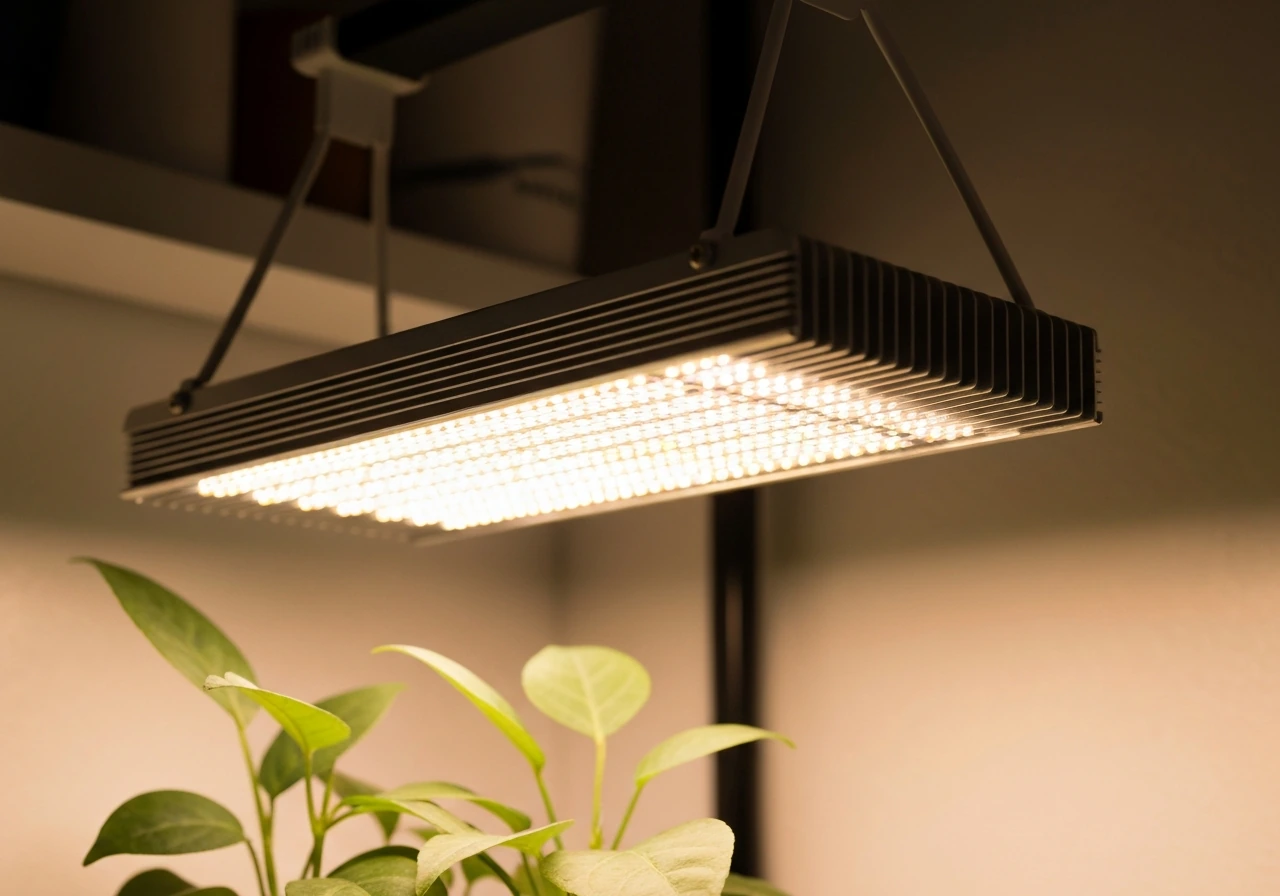
Do Grow Lights Produce Heat? How Hot LEDs Get and Tips
Yes, grow lights emit heat, especially LEDs. Learn how hot they get, safe temps, and how to measure and cool safely.