Yes, you can use mirrors to help grow plants, but only in specific situations and never as a replacement for an actual light source. Mirrors redirect existing photons toward your plants, which can meaningfully boost light levels in dim corners or help spread light from a grow light more evenly. In the right setup, a well-placed mirror can increase the PAR (photosynthetically active radiation) reaching your plants by a measurable amount. But if the underlying light source is too weak, a mirror won't save it. It's a tool for amplifying what you already have, not for conjuring light out of nothing.
Can You Use Mirrors to Grow Plants? Practical Indoor Guide
Marcus Holloway
14 Jul 2026
How light and mirrors actually interact
Plants don't care about light the way our eyes do. They run on photons in a specific wavelength range, roughly 400 to 700 nanometers, called the PAR range (photosynthetically active radiation). Within that band, they're most sensitive to blue light around 430 to 470 nm and red light around 640 to 680 nm, as established by McCree's 1972 photosynthetic action spectrum work. When you measure whether a light source is useful for plants, lux values (which are weighted for human vision) can mislead you. The real number is PPFD, measured in micromoles of photons per square meter per second (µmol/m²/s).
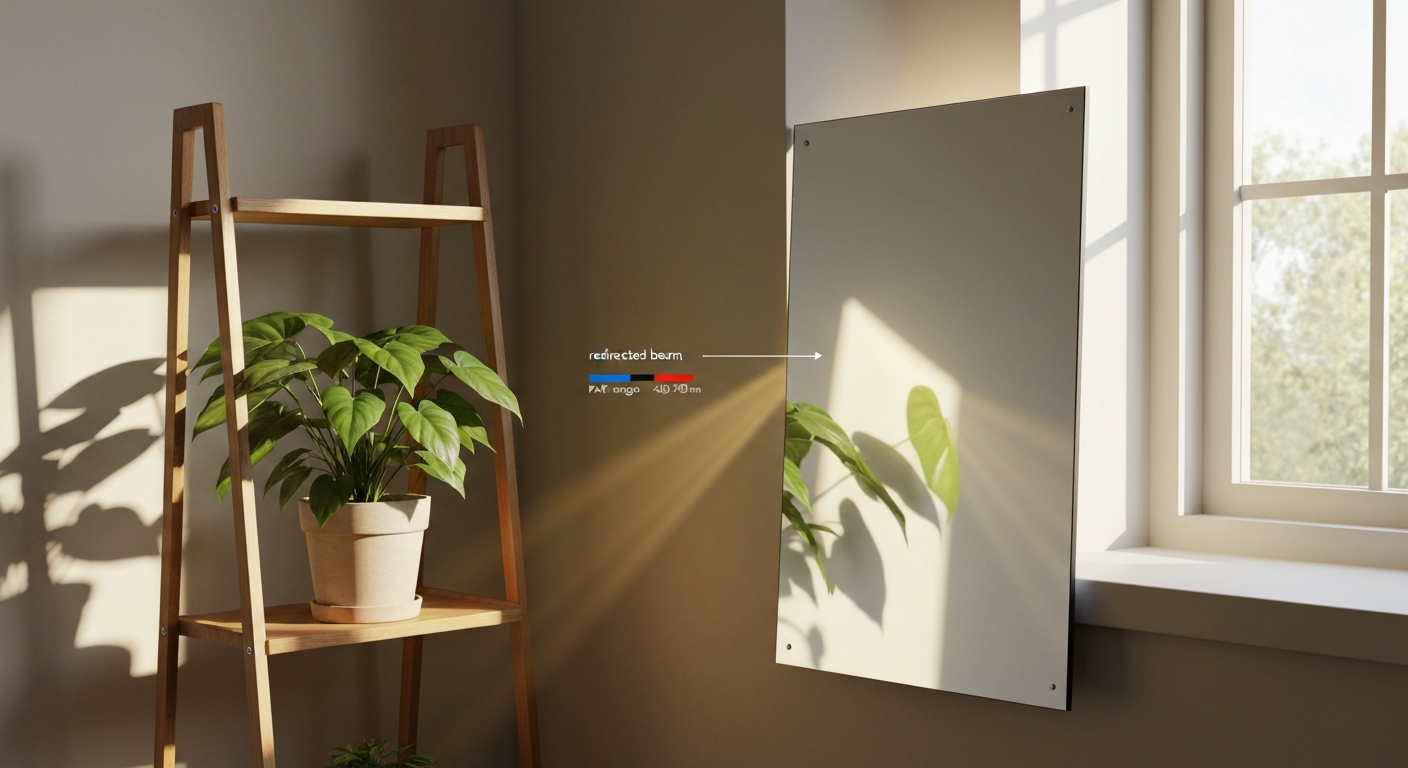
When a photon hits a mirror, it bounces off at the same angle it arrived. Critically, that photon's energy and wavelength don't change. This is called specular elastic reflection. So a mirror reflecting sunlight or grow-light output toward your plants delivers essentially the same spectral mix to them as if the light had come directly from the source. Any small spectral differences are just due to the mirror's coating absorbing slightly more at some wavelengths than others. The mirror itself doesn't filter out the red or blue peaks that plants need most.
What mirrors cannot do is create photons. There's a hard physical law at work here: the conservation of radiance (sometimes called the brightness theorem or étendue conservation in optics). It means a passive reflector can never make a light source appear brighter than the source itself. You're moving photons around, not multiplying them. If your window only delivers 40 µmol/m²/s to a shaded corner of a room, a mirror on the opposite wall can push some of that light back, but it can't turn a dim window into a grow-light-equivalent.
What you can realistically expect: PPFD and lux numbers
The research data from orchard and horticulture trials gives us the clearest real-world benchmark. Studies using reflective ground covers under hail nets (a geometry not totally unlike placing a mirror near plants) measured PAR increases at fruit height of roughly 1.6 to 3.9 times the baseline reflected light, with some of the strongest materials adding around 45 to 55 µmol/m²/s at plant level. That's a meaningful gain if your baseline PPFD is already in a useful range (say, 100 to 200 µmol/m²/s). It's not useful if your baseline is 10 µmol/m²/s from a table lamp across the room.
Specular mirrors (flat glass or aluminized film) are angle-dependent. They deliver a strong beam in one specific direction based on the angle of incidence. This means you can get a notable local increase in PPFD right where the reflected beam lands, but the rest of your plant shelf stays dim. A diffuse white surface spreads reflected light more evenly. This is why professional growers often prefer matte white paint or engineered white reflective film over mirrors for general coverage, even though mirrors can hit higher peak reflectance at ideal angles.
If you want to measure whether your mirror setup is actually helping, use a PAR or quantum sensor, not a phone light-meter app or a basic lux meter. For example, the MQ-500 Full‑spectrum Quantum Sensor, Apogee Instruments (product / guidance) is a professional PAR/quantum meter designed to directly measure PPFD in µmol·m⁻²·s⁻¹ under sunlight and artificial sources MQ-500 Full‑spectrum Quantum Sensor — Apogee Instruments (product / guidance). Apogee and LI-COR both make quantum sensors designed specifically for plant work. A lux meter gives you a human-vision-weighted number that doesn't map reliably to PPFD because the conversion factor changes with the spectrum of the light source. If you're investing in a mirror setup, spending a bit on a PAR reading (some hydroponic shops will loan sensors) gives you real data.
When mirrors genuinely help
There are two scenarios where I've seen mirrors make a real difference. The first is redirecting natural sunlight. If you have a south-facing (or north-facing in the southern hemisphere) window and a plant sitting just out of direct beam, a mirror positioned to bounce that sunlight toward the plant can shift it from struggling to thriving. The beam from a window in direct sun can exceed 500 to 800 µmol/m²/s, so even a partial redirect delivers meaningful photons.
The second is improving light spread around a grow light. If you have a grow light mounted above a shelf, plants at the edges and corners of that shelf receive significantly less PPFD than plants directly below the fixture. Positioning mirrors or reflective panels at the sides of the shelf can bounce some of that edge-falling light back toward the plant canopy, reducing the intensity gradient across the grow area. This is exactly why dedicated grow tents use highly reflective interior walls.
- Redirecting a strong sunlit window beam toward a shaded plant
- Filling in the low-intensity edges and corners under a grow light
- Boosting light on the lower canopy of tall plants where direct light can't reach
- Supplementing during short winter days when every extra photon counts
- Small grow setups in enclosed spaces where a reflective surround is easy to build
When mirrors don't help (and what to do instead)
The most common mistake I see is someone placing a mirror next to a plant in a room lit only by overhead incandescent or warm-white ceiling lights, expecting the mirror to transform the situation. It won't. The ceiling light is already too weak and wrong in spectrum for good plant growth, and all the mirror does is redirect more of that same inadequate light. You're working with a small, low-quality photon budget. Reflecting a fraction of it back doesn't change the fundamental shortfall.
Mirrors also don't help at night or in rooms with no natural light. This sounds obvious, but the logic sometimes gets confused when people think about mirrors being 'like light.' They're not. If there's nothing to reflect, a mirror is just a decorative surface. In a fully interior room with no windows and only a weak desk lamp, the right answer is adding or upgrading the light source, not adding mirrors. A decent LED grow light will outperform any mirror arrangement by an enormous margin.
It's also worth being honest about the geometry limit. Even in ideal conditions, a single flat mirror can only capture and redirect light from the angles it faces. A wall-mounted mirror behind a plant shelf near a window will capture some reflected window light, but it won't double your grow-area PPFD. The physics of radiance conservation means a single passive reflector can never increase average intensity across an area beyond what the original source delivers at that distance.
Do mirrors add heat or warm your plants?
Mirrors can concentrate heat if they're focusing a strong light beam onto a small area. In sunlight, this is a real safety concern. A curved or angled mirror that focuses direct sun onto a single spot can scorch leaves, damage a plastic pot, or in extreme cases create a fire risk on combustible materials nearby. I've seen a curved mirror positioned in direct sun blister paint on a windowsill. The risk isn't huge with a flat mirror, but it's worth checking where the reflected beam lands during peak sun hours before walking away.
Under typical grow lights, the heat contribution from a mirror is minimal. Mirrors reflect the light that reaches them, including the infrared component, and that reflected infrared can add a small amount of radiant warmth if it's directed at the plant. But the thermal effect is nowhere near what a heat lamp produces directly. If you're hoping mirrors will help warm cold-stressed plants, the effect will be too small to matter. For more on whether grow lights themselves add warmth to plants, see do grow lights keep plants warm. For more detail on how much heat different grow lights produce, see our guide do grow lights produce heat. A proper heat lamp or seedling mat is a much better solution for temperature management. If you want to know whether heat lamps are effective for plant growth, see do heat lamps help plants grow (reference id 87d5dce5-9ded-458a-833d-26a781134ce8). For more on whether a heat lamp is suitable for growing cannabis, see our guide: Can you use a heat lamp to grow pot.
The one scenario to watch is a specular mirror pointed at a grow light's beam over a long photoperiod. The concentrated reflection can create a hot spot on leaves directly in the path of the reflected beam. Check for any bleaching, curling, or crispy patches on leaves in the exact zone where the mirror beam falls. If you see those signs, either move the mirror back, tilt it slightly off-axis, or switch to a diffuse white reflector.
Mirrors with common lamps: does it make them effective?
A question that comes up often is whether adding a mirror behind or beside a desk lamp, heat lamp, or full-spectrum sun lamp will finally make it effective for plant growth. For more on whether household lamps can serve as plant lights, see can you use lamps to grow plants. For a focused discussion on whether sun lamps can actually grow plants, see our guide on can sun lamps grow plants. The honest answer: it depends entirely on whether the lamp itself is already in the useful range.
| Lamp type | Typical PPFD at 30 cm | Spectrum quality for plants | Mirror impact | Verdict |
|---|---|---|---|---|
| Standard desk lamp (warm LED or CFL) | 5–25 µmol/m²/s | Poor: lux-optimised, weak red/blue | Small absolute gain; source is still too dim | Not effective even with mirror |
| Full-spectrum / sun lamp (6000–6500K LED) | 20–80 µmol/m²/s (varies widely) | Decent blue coverage; red varies | Mirror can add 10–30% more at plant; modest help | Marginally useful in borderline setups |
| Heat lamp (infrared or red incandescent) | Very low PAR; mostly heat/IR | Almost no usable PAR | Reflects heat more than photons; no growth benefit | Mirror doesn't fix the wrong spectrum |
| Dedicated LED grow light (400–700 nm) | 200–800+ µmol/m²/s typical | Optimised for PAR peaks | Mirror meaningfully boosts edge/corner coverage | Best use case for mirrors |
A desk lamp or regular household bulb is not going to become a grow light just because you put a mirror behind it. The limiting factor isn't the direction the light travels, it's the total photon output and the spectral composition. If you're using a desk lamp as your only grow light and it's not working, a mirror is not the fix. Upgrading to an actual grow light is. For more on whether a regular lamp can actually help plants grow, see the article can a regular lamp help plants grow. That said, if you're using a good full-spectrum lamp and just want to extend its coverage slightly, a reflective surface can squeeze a bit more out of it.
Mirrors vs other reflective materials
Glass mirrors are not actually the best reflective material for plant growing. They have several disadvantages compared to dedicated horticultural reflectors. Flat glass mirrors typically reflect around 80 to 90% of visible light, but they're heavy, fragile, and produce specular (directional) hotspots. Aluminized reflective film (often called Mylar in grower circles) is quoted at 85 to 95% PAR reflectance under ideal conditions, is lightweight, and can line the walls of a grow area easily. Flat white paint is lower peak reflectance (around 75 to 93% depending on formulation) but distributes reflected light far more evenly across a canopy, which usually matters more than peak reflectance numbers.
| Reflector type | Typical PAR reflectance | Reflection pattern | Hotspot risk | Cost and practicality |
|---|---|---|---|---|
| Flat glass mirror | 80–90% | Specular (directional) | Moderate to high | Cheap but heavy and fragile |
| Aluminized Mylar / reflective film | 85–95% | Specular, angle-dependent | Moderate | Cheap, lightweight, easy to cut and mount |
| White reflective film (e.g., Extenday-type) | 75–90% | Diffuse (even spread) | Low | Moderate cost; multi-year life in trials |
| Flat matte white paint | 75–93% | Diffuse | Very low | Very cheap; permanent; hard to adjust |
| Polished aluminium panels | 85–95% | Specular | Moderate to high | More durable than film; moderate cost |
One practical note from the orchard research: contamination matters a lot. Dust, fingerprints, soil splash, or water spots on any reflective surface measurably reduce PAR reflectance over time. A mirror that looked great when you first set it up can lose significant reflective efficiency within a few weeks if it's getting dirty. Wipe down any reflective surface regularly with a clean, lint-free cloth. This applies to Mylar film too, which can crinkle and lose efficiency faster than a glass mirror if handled roughly.
Step-by-step setup: getting the most from mirrors
If you've decided mirrors are appropriate for your setup, here's how to do it properly rather than just propping something up and hoping for the best.
- Choose your mirror size relative to your grow area. A mirror smaller than 30 x 30 cm won't capture enough of the incoming light beam to make a practical difference. For a small shelf (60 x 30 cm), aim for a reflective surface that covers at least half the back wall of the space.
- Pick the right material. For a permanent wall setup, flat white paint is the most practical and produces the most uniform light distribution. For a portable or temporary setup, a large flat glass mirror or Mylar film taped to cardboard works. Avoid wrinkled or dimpled Mylar because it scatters light in unpredictable directions.
- Set the angle. For redirecting window sunlight toward a plant, position the mirror at roughly 45 degrees to the incoming beam and check where the reflected spot lands at the time of day when the sun is at its peak. Adjust until the reflected patch covers the plant canopy rather than the wall or ceiling.
- Check for hotspots. After setting up, feel the surface of leaves in the direct path of the reflected beam after 30 to 60 minutes. If leaves feel notably warmer than surroundings, or if you see any bleaching within a day or two, move the mirror back or tilt it slightly so the beam is less concentrated.
- Measure before and after. Use a PAR meter or quantum sensor if you can access one, even briefly. Take a PPFD reading at the canopy level at the spot you're trying to improve, then take the same reading with the mirror in place. A useful improvement is at least 20 to 30 µmol/m²/s above baseline for low-light plants, or 50+ µmol/m²/s for moderate-light plants.
- Mount securely. A falling mirror is a safety hazard. Use proper wall anchors and mirror clips for glass mirrors, or secure Mylar film with heavy-duty tape or a frame. For shelf setups, prop mirrors against a stable backing rather than leaning them at risk of sliding.
- Keep it clean. Wipe the reflective surface at least once a month with a damp, lint-free cloth. Dust and smudges reduce reflectance significantly. For Mylar film that gets too contaminated or wrinkled, replacement is cheap and straightforward.
- Combine with an appropriate light source. If you're supplementing a grow light, position the reflective surface on the side walls or back wall of the grow area, not directly above the plant where the grow light already provides peak intensity. The goal is filling in the weak spots.
Cost-effectiveness: when is upgrading the light a better idea?
A reasonable flat mirror costs almost nothing if you repurpose one you already own. A piece of Mylar reflective film large enough to line a grow shelf can cost as little as a few dollars. That's hard to argue against as a supplemental tool when you already have a working light source. But if you're buying mirrors specifically hoping to replace or substitute for a proper grow light, the math changes quickly. A basic LED grow light optimised for PAR output will deliver 10 to 50 times more usable photons to your plants than any realistic mirror arrangement using household lighting. If you're spending money and time, an entry-level grow light is almost always the better investment than a mirror-based workaround.
The practical conclusion is this: mirrors work well as a free or cheap supplement when you already have a decent light source, but they are not a path to avoiding a proper grow light in a low-light situation. Use them to optimize what you have. Don't expect them to fix a fundamentally inadequate light setup.
FAQ
Can you use mirrors to grow plants — do mirrors meaningfully improve plant growth for home gardeners and indoor growers?
Short answer: Sometimes — but only as a way to redirect existing light. Mirrors cannot create photons or increase a light source’s intrinsic radiance (conservation of radiance/étendue). In practical room and canopy geometries, mirrors can raise local PPFD (plant‑useful photons) in shaded spots and improve light distribution, but they are not a substitute for insufficient lighting. Expect modest, geometry‑dependent gains rather than multipliers of source brightness.
Why mirrors can't make a lamp or the sun 'brighter' — the physics in plain language
Mirrors perform specular reflection: they redirect incident photons without changing their wavelength or energy (except small wavelength‑dependent loss). Optical principles (étendue/brightness conservation) limit how much passive reflectors can increase the brightness seen by a target. In short: a mirror can steer more of the source’s light onto a plant but cannot produce additional photons or change the source’s spectral power in PAR.
Do mirrors change the light spectrum plants receive (affect PAR or shift wavelengths)?
No intrinsic spectral shift: specular reflection preserves photon wavelength. Any change in PAR composition comes from the mirror material’s wavelength‑dependent reflectance (some coatings reflect red/blue slightly differently) and contamination. A clean quality mirror will generally preserve PAR shape; check material specs if you need specific spectrum fidelity.
What measurable effects should I expect (lux vs PPFD) when adding mirrors?
Mirrors increase incident photon flux in certain directions. Benefits are best measured as additional PPFD (µmol·m⁻²·s⁻¹), not lux, because lux weights human vision, not photosynthesis. In field trials with reflective groundcovers, practical PAR gains were tens of µmol·m⁻²·s⁻¹ in favorable geometry. Exact gains depend on angles, distance, mirror size and cleanliness; use a quantum/PAR meter (Apogee, LI‑COR) to measure changes rather than relying on lux meters.
When are mirrors effective — real‑world scenarios where they help?
Helpful cases: - Redirecting direct sunlight into a specific shaded area (e.g., reflecting window sun onto a houseplant) - Improving light spread from a point grow light to reduce dark corners - Reflecting light under canopies to reach lower leaves (small scale) - Temporarily boosting light for a specific task (seedlings, localized fruit coloring) Mirrors work best when the source, mirror and plant geometry allow reflected rays to reach the canopy — specular reflectors are angle‑dependent and can send substantial light into a narrow target if positioned correctly.
When do mirrors not help or are ineffective?
Ineffective cases: - Rooms with very low total light: mirrors can’t replace a missing light source - Trying to 'amplify' a weak lamp beyond its radiance limit (mirrors can’t make a source brighter) - Expecting uniform, wide‑area increases — specular mirrors create hotspots and uneven illumination - When PAR uniformity across the canopy is critical (use diffuse reflectors instead) - If mirror placement cannot capture and redirect a significant portion of incident light due to geometry.
Next Articles
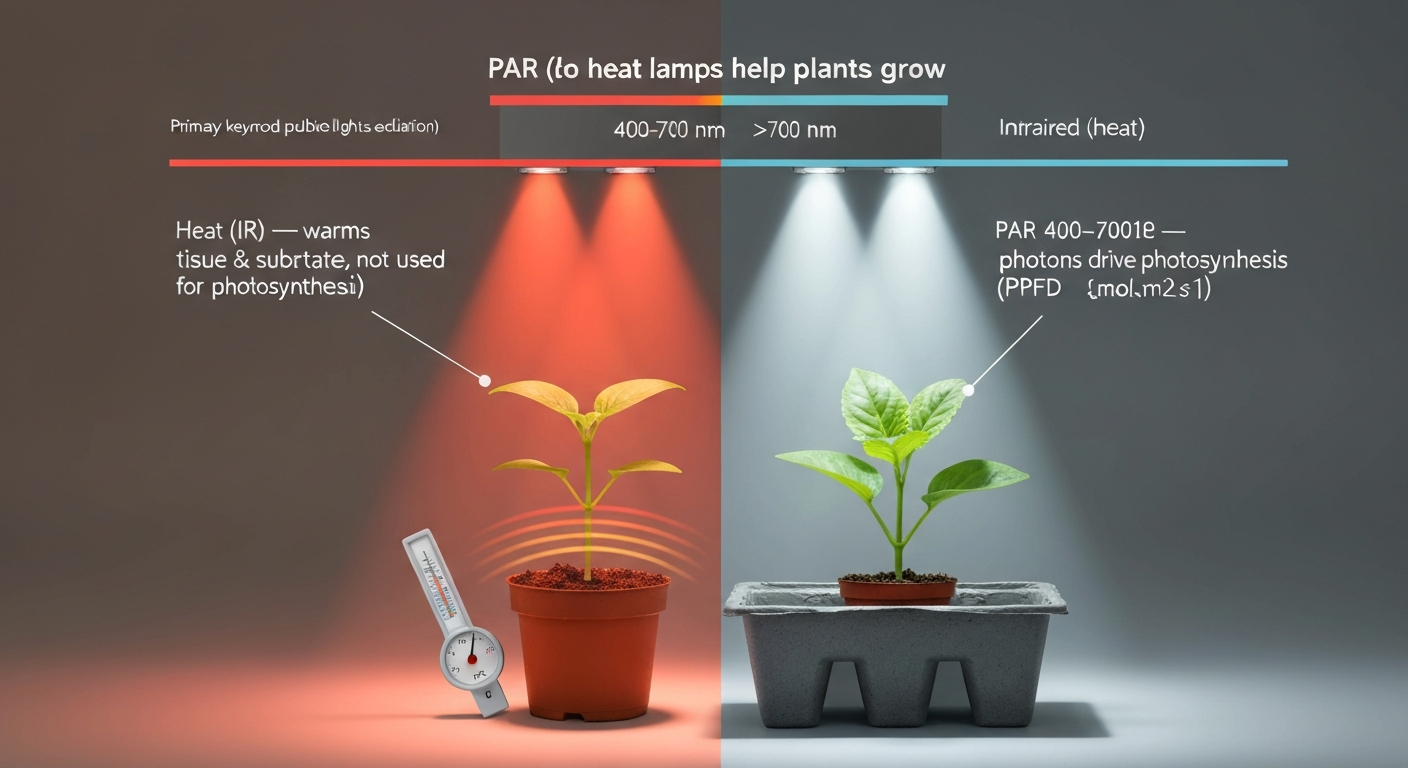
Do Heat Lamps Help Plants Grow? Guide for Gardeners
Do heat lamps help plants grow? Clear verdict, when they help, setup & safety tips, costs and better alternatives.
Do Grow Lights Keep Plants Warm? How to Measure Heat
Learn if grow lights truly warm plants, what to measure, and how to troubleshoot cold setups safely.
Can a Regular Lamp Help Plants Grow? What to Know
Find out if a regular lamp can grow plants, what light it provides, and when to switch to a real grow light for results.