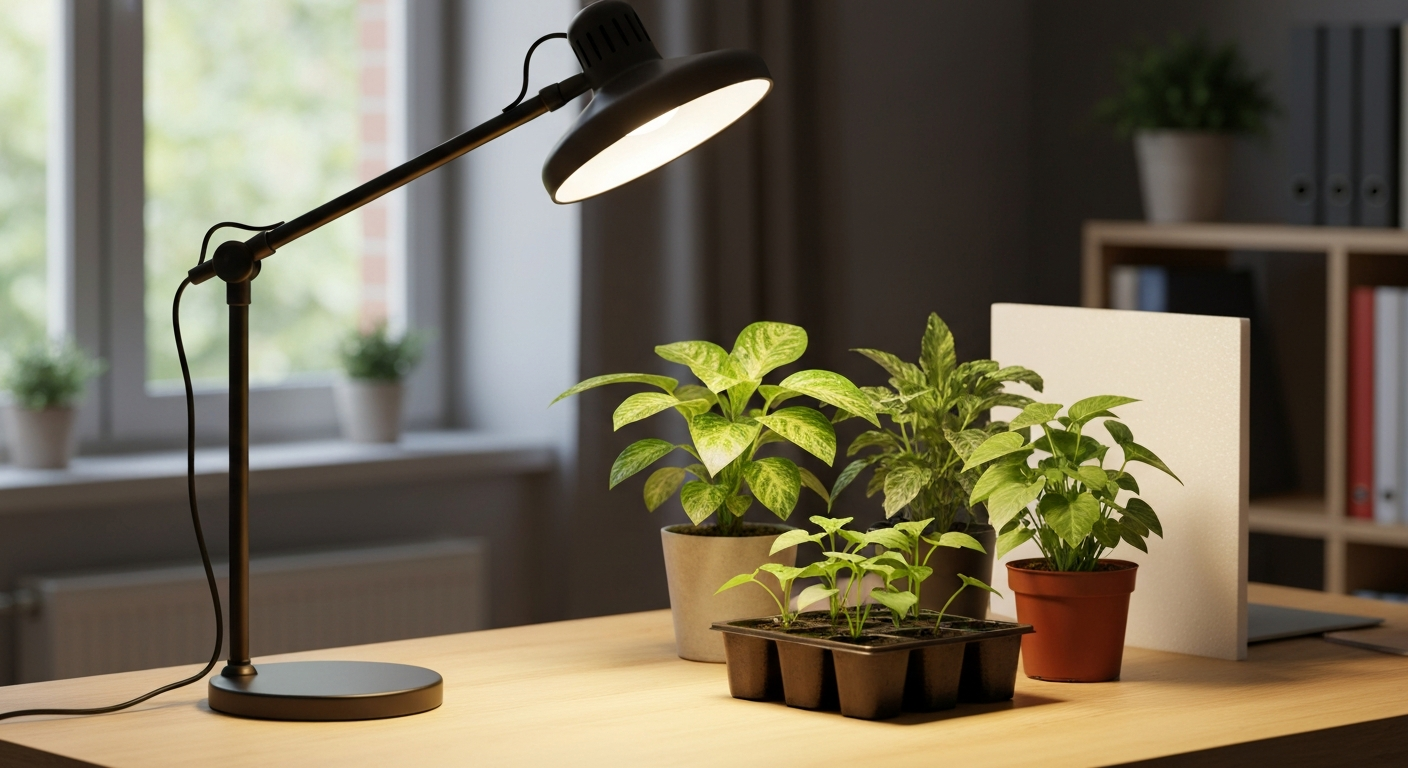
Yes, you can use a desk lamp to grow plants, but with real limits. A desk lamp fitted with the right bulb (a bright LED or CFL, ideally 5000–6500K, run close to the plant for 14–16 hours a day) can successfully support low-light houseplants and seedlings. See can you use lamps to grow plants for a practical guide on which lamp types and setups work for different plant categories. It will not, however, sustain herbs that need full-sun intensity, and it will almost certainly fail fruiting crops like tomatoes. The outcome depends almost entirely on the bulb you choose, how close you put it, and how long you leave it on each day.
Can You Use a Desk Lamp to Grow Plants? Bulb Choices & Setup Tips
Marcus Holloway
22 Jul 2026
What plants actually need from light
Plants care about three things: spectrum (the colors of light), intensity (how many photons actually reach the leaf), and duration (how many hours of light per day). Get all three into a usable range and a plant grows. Miss any one of them badly enough and it stalls or dies.
Spectrum: the colors that drive photosynthesis
Photosynthetically active radiation, or PAR, covers roughly 400–700 nm. Photosynthetically active radiation (PAR) is conventionally defined as electromagnetic radiation between 400–700 nm and is the waveband used to quantify photons for photosynthesis (measured as PPFD in µmol·m⁻²·s⁻¹). Inside that range, plants are most responsive to blue light around 440 nm and red light around 620–670 nm, which is where McCree's classic work on photosynthetic action spectra placed the peaks. That does not mean green light is useless (it penetrates the canopy and still drives photosynthesis), but it explains why horticultural LEDs lean heavily red and blue. Far-red light (700–750 nm) also matters for flowering timing and leaf expansion, even though it sits just outside the traditional PAR definition. For a desk lamp, a daylight-white or cool-white bulb (5000–6500K) covers the blue end reasonably well, but the red end of the spectrum is usually underrepresented compared to a purpose-built grow light.
Intensity: PPFD and the daily light integral
Intensity is measured as PPFD (photosynthetic photon flux density) in micromoles of photons per square meter per second (µmol·m⁻²·s⁻¹). The running total a plant receives in a day is its Daily Light Integral, or DLI, measured in mol·m⁻²·d⁻¹. You can calculate DLI yourself: multiply PPFD by hours of light per day, then multiply by 0. For the standard conversion (DLI = PPFD × hours × 0.0036), see Virginia Tech Extension’s Calculating and Using Daily Light Integral (DLI): An Introductory Guide, Virginia Tech Extension (SPES‑720) blank" rel="noopener noreferrer">Calculating and Using Daily Light Integral (DLI): An Introductory Guide — Virginia Tech Extension (SPES‑720). 0036. So 100 µmol·m⁻²·s⁻¹ for 16 hours gives a DLI of 5.76 mol·m⁻²·d⁻¹. That number is genuinely useful because it tells you whether a light source is actually doing the job for a given plant category.
Duration: photoperiod and day length
Most houseplants tolerate 12–16 hours of light per day without issues. Seedlings are often run at 16–18 hours to compensate for a lower-intensity source. Long-day and short-day plants (like poinsettias or chrysanthemums) are sensitive to photoperiod for flowering, but for the purposes of using a desk lamp to keep something alive or growing vegetatively, 14–16 hours is a safe default. A basic outlet timer costs a few dollars and removes all the guesswork.
| Plant category | Target PPFD (µmol·m⁻²·s⁻¹) | Target DLI (mol·m⁻²·d⁻¹) | Desk lamp realistic? |
|---|---|---|---|
| Low-light houseplants (pothos, snake plant, ZZ) | 10–75 | 1–6 | Yes, easily |
| Seedlings / cuttings | 50–300 | 5–15 | Yes, with correct setup |
| Culinary herbs (basil, cilantro, parsley) | 150–400 | 10–18 | Marginal — borderline for most bulbs |
| Leafy greens (lettuce, spinach) | 150–300 | 12–17 | Marginal — needs a bright bulb very close |
| Fruiting crops (tomato, pepper, cucumber) | 300–700+ | 20–35 | No — desk lamps cannot get there |
Lux vs PPFD: making sense of the numbers
Lux is the unit most cheap light meters and phone apps report, but it is calibrated to human vision, which peaks around green (555 nm). Plants do not use light the way human eyes do, so lux is an imperfect proxy for plant growth. Converting lux to PPFD requires a factor that depends on the lamp's spectrum. For typical white LEDs that factor is roughly 0.012–0.018 µmol·m⁻²·s⁻¹ per lux. So if your phone app reads 5,000 lux under a cool-white LED desk lamp, you are looking at roughly 60–90 µmol·m⁻²·s⁻¹ of PPFD. That gets you into the low-light houseplant and seedling range, but it is nowhere near what basil or lettuce prefers. Under narrow-band red or blue LEDs, the error from lux conversion gets much larger (±15–30% or worse), so lux becomes a poor guide when using colored grow bulbs.
How to actually measure your desk lamp's output
You have three practical options. A research-grade quantum sensor from LI-COR or Apogee gives PPFD directly with roughly ±5% accuracy, but they cost hundreds to thousands of dollars and are overkill for a home setup. Hobbyist handheld quantum meters (Apogee MQ series, for example) run $300–$600 and are genuinely useful if you grow a lot. For most people starting out, the Photone smartphone app (iOS and Android) combined with a piece of white diffuser paper is a practical and inexpensive option. It will not be research-grade accurate, but it gets you into the right order of magnitude for a white LED or CFL source, and it understands source type selection to reduce spectral error. Use it to compare positions and distances relative to each other rather than trusting the absolute number to be exact.
Desk lamp bulb types: what actually works
Not all desk lamp bulbs are equal for plants. Here is an honest assessment of each common type.
| Bulb type | Spectrum for plants | Heat output | Energy efficiency | Can it work? |
|---|---|---|---|---|
| Standard incandescent (A19) | Poor — very red/IR heavy, almost no blue | High | Very low (~10 lm/W) | No — mostly heat, not useful light |
| Halogen | Poor — similar to incandescent, heavy IR | Very high | Low (~15–20 lm/W) | No — fire/burn risk, inefficient |
| CFL (compact fluorescent) | Decent — covers blue-green well, weaker red | Moderate | Moderate (~55–70 lm/W) | Yes for low-light plants and seedlings |
| Standard white LED (5000–6500K) | Good — broad spectrum, decent blue | Low | Good (~80–120+ lm/W) | Yes for houseplants and seedlings |
| 'Full-spectrum' LED (marketed for plants) | Good to very good, often enhanced red/blue | Low | Good | Yes — best desk lamp option |
| Red/blue 'blurple' grow bulb (A19 socket) | Targeted but narrow, low green/far-red | Low | Good | Yes but awkward — check actual PPFD output |
Incandescent and halogen bulbs are the ones to avoid. Both waste most of their energy as heat rather than light, and what light they do produce skews heavily infrared and red with almost no blue. That is a bad spectrum for vegetative growth and the heat close to foliage is a real burn risk. If you are interested in whether heat from a lamp can help plants in other ways, that is a different topic worth exploring separately.
CFLs work reasonably well at close range. A 23–26W CFL (equivalent to a 100W incandescent) run 15 cm from a seedling tray gives a usable PPFD. Their main drawbacks are fragility and the fact that they degrade faster than LEDs. If you already have a CFL desk lamp, it is worth trying before spending money on anything new.
White LEDs in the 5000–6500K range are the current sweet spot for desk lamp growing. They are efficient, run cool, and produce a usable spectrum. A 10–15W LED in a reflector desk lamp run 15–20 cm from low-light plants is a genuinely workable setup. Bulbs marketed as 'full-spectrum' or 'plant grow' bulbs in standard A19 or E26 format are worth considering because they usually include enhanced red output. Just check the actual wattage: a 9W 'grow bulb' in an E26 socket is not producing the same photon output as a 24W CFL, regardless of the marketing language.
One thing worth noting: purpose-built LED horticultural fixtures achieve photosynthetic photon efficacy of roughly 2.3–3.5 µmol per joule. Household LED bulbs are nowhere near that because they are optimized for lumens (human vision), not photons in the plant-useful range. That gap matters when you are trying to hit the PPFD targets herbs and greens need. For a regular houseplant it is fine. For growing basil year-round, you will eventually hit a ceiling with a desk lamp.
Step-by-step setup for growing plants with a desk lamp
- Choose your bulb: For most people, a 12–15W daylight LED (5000–6500K, 1000+ lumens) or a plant-specific LED in an A19/E26 format is the best starting point. If you can find a screw-in grow bulb from a reputable brand (e.g., GE BR30 Grow, Sansi, or similar) with actual wattage listed at 15W+, that is a solid choice.
- Choose your fixture: A gooseneck or adjustable-arm desk lamp gives you the best control over distance. A clamp lamp with a reflector bowl (the type sold for workshop use) is even better because the reflector directs light downward efficiently. Avoid fixtures with enclosed diffusers that trap heat.
- Position the plant: Place the lamp so the bulb is directly above or angled slightly above the foliage. Side-lighting is less efficient than top-lighting for most plants.
- Set the distance: Start at 15–20 cm (6–8 inches) for seedlings and low-light plants, and use an app like Photone to check PPFD. If readings are under 50 µmol·m⁻²·s⁻¹, move closer. If leaves start showing bleaching or curling, back off 5 cm at a time.
- Set a timer: Plug the lamp into a cheap outlet timer. Run 14 hours for low-light houseplants and 16 hours for seedlings. Do not leave the lamp on 24 hours — most plants need a dark period.
- Monitor for heat: Hold your hand at leaf height for 30 seconds. If it feels uncomfortably warm, the bulb is too close or too hot. LEDs at 15 cm are usually fine; halogens and incandescents at 15 cm are not.
- Check progress weekly: Watch for leggy, stretched growth (etiolation), which means the plant is not getting enough light. Move the lamp closer or extend the photoperiod slightly. If leaves are yellowing from the top down rather than from age, that may be light burn — increase distance.
Distance, duration, and placement: practical targets
Light intensity drops sharply with distance. For a small point source like a bulb, doubling the distance cuts intensity to roughly one quarter. In practice, desk lamp bulbs are not perfect point sources and reflectors change the math, but the general principle holds: every centimeter you move the lamp away costs you photons. I have measured cheap A19 LEDs go from 80 µmol·m⁻²·s⁻¹ at 15 cm to under 20 µmol·m⁻²·s⁻¹ at 30 cm. That difference means the gap between 'adequate for a pothos' and 'too dim for anything' is often just 10–15 cm of height.
| Plant type | Recommended distance | Recommended daily duration | PPFD target at leaf |
|---|---|---|---|
| Low-light houseplants (pothos, peace lily, snake plant) | 20–30 cm | 12–14 hours | 10–75 µmol·m⁻²·s⁻¹ |
| Seedlings (early germination to cotyledon stage) | 10–15 cm | 16–18 hours | 50–150 µmol·m⁻²·s⁻¹ |
| Seedlings (true leaf stage, pre-transplant) | 15–20 cm | 16 hours | 100–250 µmol·m⁻²·s⁻¹ |
| Culinary herbs (basil, mint, chives) | 10–15 cm with bright bulb | 14–16 hours | 150–300 µmol·m⁻²·s⁻¹ |
| Succulents and cacti | 15–20 cm | 12–14 hours | 50–150 µmol·m⁻²·s⁻¹ |
If you are supplementing natural light rather than replacing it entirely, the duration and distance targets can relax. A plant sitting in a north-facing window that gets 2–3 hours of indirect daylight might only need 6–8 hours of desk lamp supplementation to hit an adequate daily DLI. In those cases, keep the lamp at the right distance and let the natural light do the heavy lifting during the day.
Reflectors, mirrors, and running multiple lamps
Adding a reflective surface behind or beside your plants can meaningfully increase the light reaching leaves without spending anything extra on electricity. White painted walls, white cardboard, or emergency Mylar blankets all bounce light back toward the plant. In a small enclosed shelf or closet grow space, reflective walls can improve light uniformity noticeably. The gains are real but modest: you are redistributing existing light, not generating new photons, so you might recover 15–30% more usable light on side leaves and lower growth.
Mirrors are a different story. A mirror reflects light at the same angle it arrives (specular reflection), which makes them harder to aim usefully than a matte white surface that scatters light diffusely. Whether mirrors are genuinely useful for plant growing is a topic with some nuance to it. For a simple desk lamp setup, a piece of white foam board is both cheaper and more effective than a mirror in most configurations.
Running two desk lamps aimed at the same plant from slightly different angles is one of the simplest and cheapest upgrades you can make. Two 12W LEDs running 16 hours a day draw under 400Wh combined, and the PPFD at leaf level roughly doubles compared to a single lamp. This is often more practical than chasing a single high-wattage bulb, which may generate heat problems at close distances.
What a desk lamp can and cannot realistically grow
Low-light houseplants: works well
Pothos, snake plants, ZZ plants, peace lilies, philodendrons, and similar low-light species are the ideal desk lamp candidates. Their DLI requirement of roughly 1–6 mol·m⁻²·d⁻¹ is easily achievable with a 10–15W LED run at 20–25 cm for 12–14 hours. You will see healthy growth, good color, and no etiolation. For more detail on the capabilities and limits of lamp-based growing, see the guide Can sun lamps grow plants. This is the desk lamp's sweet spot, and it genuinely works.
Seedlings: works well with careful setup
Starting seeds under a desk lamp is one of the most practical applications. Seedlings in the early stages need a DLI of around 5–15 mol·m⁻²·d⁻¹, which is achievable with a bright LED (15W+) placed 10–15 cm above the tray and run for 16–18 hours. University extension guidance on seedling production under inexpensive shop lights and household LEDs consistently confirms this works. The key is keeping the light close as seedlings emerge to prevent leggy, stretched growth. Raise the lamp gradually as plants get taller. Expect transplant-ready seedlings in a similar timeframe to a south-facing windowsill, though colors and compactness may vary depending on the spectrum of your bulb.
Culinary herbs: borderline, depends on the bulb
Basil, cilantro, and parsley prefer a DLI of 10–18 mol·m⁻²·d⁻¹ and PPFD in the 150–300+ µmol·m⁻²·s⁻¹ range. A single standard desk lamp is right at the edge of delivering that. A bright 15W full-spectrum LED with a reflector bowl, run 15 cm above the plant for 16 hours, can realistically hit 150–200 µmol·m⁻²·s⁻¹ at leaf level. You will get harvestable herbs, but growth will be slower and leaf size smaller than herbs grown under a proper grow light or in a sunny window. Mint and chives are more forgiving; basil and cilantro will show you quickly if the light is not enough by producing small, pale leaves.
Leafy greens: marginal
Lettuce and spinach prefer DLI in the 12–17 range. A single desk lamp will not reliably get there. Two desk lamps with bright LEDs, run close together over a small container, might sustain a small cut-and-come-again lettuce planting. Expect slow growth and smaller leaves compared to window or purpose-built grow light setups. If you want to grow salad greens seriously and consistently, a purpose-built LED panel (even an inexpensive one) is a better tool.
Fruiting crops: not realistic
Tomatoes, peppers, cucumbers, and similar crops need DLI of 20–35 mol·m⁻²·d⁻¹. A desk lamp simply cannot get there. Even a 15W LED run 18 hours a day at 10 cm might produce 80–120 µmol·m⁻²·s⁻¹, which calculates to a DLI of around 5–8, well short of what fruiting crops need. You will end up with a plant that stays alive but never flowers or fruits in any meaningful way. This is where investing in an actual grow light panel pays off.
Safety, heat, and energy use
Modern LEDs at normal desk lamp wattages are safe for plant use. They do not emit significant UV radiation (the type linked to health concerns), they do not produce a tanning effect, and they do not pose a cancer risk from normal use. This is a common concern worth putting directly to rest. A white LED desk lamp is not meaningfully different from standard room lighting in terms of radiation safety.
Heat is more of a concern with older bulb types. Incandescent and halogen bulbs run hot enough to scorch foliage at the distances plants need to be placed for adequate PPFD. LEDs and CFLs are much safer in that regard, though CFLs do generate moderate heat and should not be enclosed without ventilation. If you are ever curious about using dedicated heat lamps for plant growing, the short answer is that heat and grow light are separate functions, and conflating them leads to burned plants. For a focused discussion on whether heat lamps are suitable for growing cannabis, essentially answering 'can you use a heat lamp to grow pot', see that topic for specifics on why heat and light serve different functions and the risks of conflating them. For more detail, see our guide on do heat lamps help plants grow. For more detail on heat output from different types of grow lights and how that affects plants, see the page about do grow lights produce heat.
Energy cost is modest for desk lamp setups. A 12W LED running 16 hours a day uses about 192Wh, which at typical residential electricity rates (around $0.15/kWh in the US) costs under $0.03 per day. Two lamps run the same way cost under $0.06 a day. That is negligible for most households. The bigger cost consideration kicks in only when you move to larger, purpose-built fixtures for serious growing.
When to stop using a desk lamp and upgrade
If your plants are consistently showing etiolation (stretched, pale growth leaning toward the light) despite moving the lamp as close as safely possible, the lamp has hit its ceiling. The same is true if you are trying to grow herbs that stay small and flavorless, or seedlings that become lanky before true leaves fully form. These are signs you have maxed out what a desk lamp can deliver.
The logical next step is a purpose-built LED grow light, even an entry-level one. A simple LED quantum board or panel in the 30–50W range (actual draw, not 'equivalent' marketing wattage) costs $30–$80 and delivers PPFD levels that put a desk lamp to shame. At that point you can realistically grow herbs, leafy greens, and even flowering plants year-round. That is a different product category from a desk lamp, but it is not a big leap in complexity or cost.
For now, if you have a desk lamp with a decent LED bulb and a plant that needs low-light to moderate-light conditions, start using it. Measure the PPFD with an app, get the distance right, set a timer, and see what happens. Most people are surprised by how well it works for the right plants.
FAQ
Can you use a household desk lamp to grow plants effectively — yes or no?
Short answer: Yes, with strong caveats. A desk lamp can support low‑light houseplants and early seedlings if you choose the right bulb, keep it close, and run long photoperiods. It will not reliably replace purpose‑built horticultural fixtures for light‑hungry crops (fruiting vegetables, high‑yield herbs, or dense leafy greens) or for final production stages where high PPFD/DLI is required.
What are the light requirements plants actually need (basic measurable terms)?
Plants use photons in the PAR waveband (400–700 nm). Instantaneous light is measured as PPFD (µmol·m⁻²·s⁻¹). Daily Light Integral (DLI, mol·m⁻²·d⁻¹) = PPFD × hours × 0.0036. Typical DLI targets: seedlings ≈5–15 mol·m⁻²·d⁻¹, low‑light houseplants ≈1–6, culinary herbs/leafy greens ≈10–18, fruiting crops ≈20–35 (use these to decide whether a desk lamp can meet needs).
Which common household bulb types work best and why (LED, CFL, incandescent, halogen, 'full‑spectrum')?
Best to worst for plants: (1) White LEDs with high CRI/CCT and higher lumen watts — can work if close; many A19 household LEDs have low photosynthetic photon efficacy (PPE) but still usable for low‑demand plants. (2) Compact fluorescents (CFLs) — good for seedlings when placed close; inexpensive, cooler than incandescents. (3) 'Full‑spectrum' marketed bulbs — spectrum varies; read manufacturer SPD/PPF if available. (4) Halogen — hotter and inefficient (low µmol·J⁻¹), not recommended. (5) Incandescent — very poor photosynthetic efficacy and wasteful heat; avoid for sustained plant lighting. Purpose‑built horticultural LEDs outperform all household bulbs for PPE and spectrum.
What measurable PPFD or DLI can I expect from a desk lamp at typical distances?
Rough guide (very dependent on bulb and reflector): a single A19 LED/CFL 10–12 W directly over a small area at 10–15 cm may deliver ~20–100 µmol·m⁻²·s⁻¹ (≈0.7–6 DLI over 12 h). At 30–60 cm that may drop to <10–20 µmol·m⁻²·s⁻¹ (insufficient for many herbs). For seedlings and low‑light plants you want at least ~50 µmol·m⁻²·s⁻¹ at canopy for decent DLI with long photoperiods; measure with a quantum meter or convert lux cautiously using spectrum factor (typical white LED factor ~0.013–0.017).
Quick decision rules — when to try a desk lamp and when to upgrade?
Try a desk lamp if: your plants are low‑light species or seedlings, you can place the lamp <30 cm from foliage, and you can run 12–18+ h/day. Upgrade if: you need >150 µmol·m⁻²·s⁻¹ at canopy, want compact/fast growth of herbs/greens, grow fruiting crops, have many plants/large area, or cannot maintain safe distance/heat controls. If plants show stretching, pale leaves, or very slow growth after 2–3 weeks, move to higher‑output fixtures.
Step‑by‑step setup using a desk lamp (bulb selection, fixture, distance, duration)
1) Choose bulb: prefer white LED or 2700–5000K high‑CR I CFL if LED not available; avoid incandescent/halogen. 2) Choose fixture: clamp lamp with adjustable neck and reflector or multiple lamps for even coverage. 3) Distance: start 10–30 cm from canopy for LEDs/CFLs; adjust so leaves are warm but not hot. 4) Photoperiod: seedlings 14–18 h, low‑light houseplants 10–14 h, most herbs/greens 12–16 h. 5) Measure: use a quantum meter (best) or lux meter + conversion factor for your bulb to estimate PPFD. 6) Monitor: watch plant morphology and leaf color; lower/raise or add fixtures to change PPFD.
Next Articles
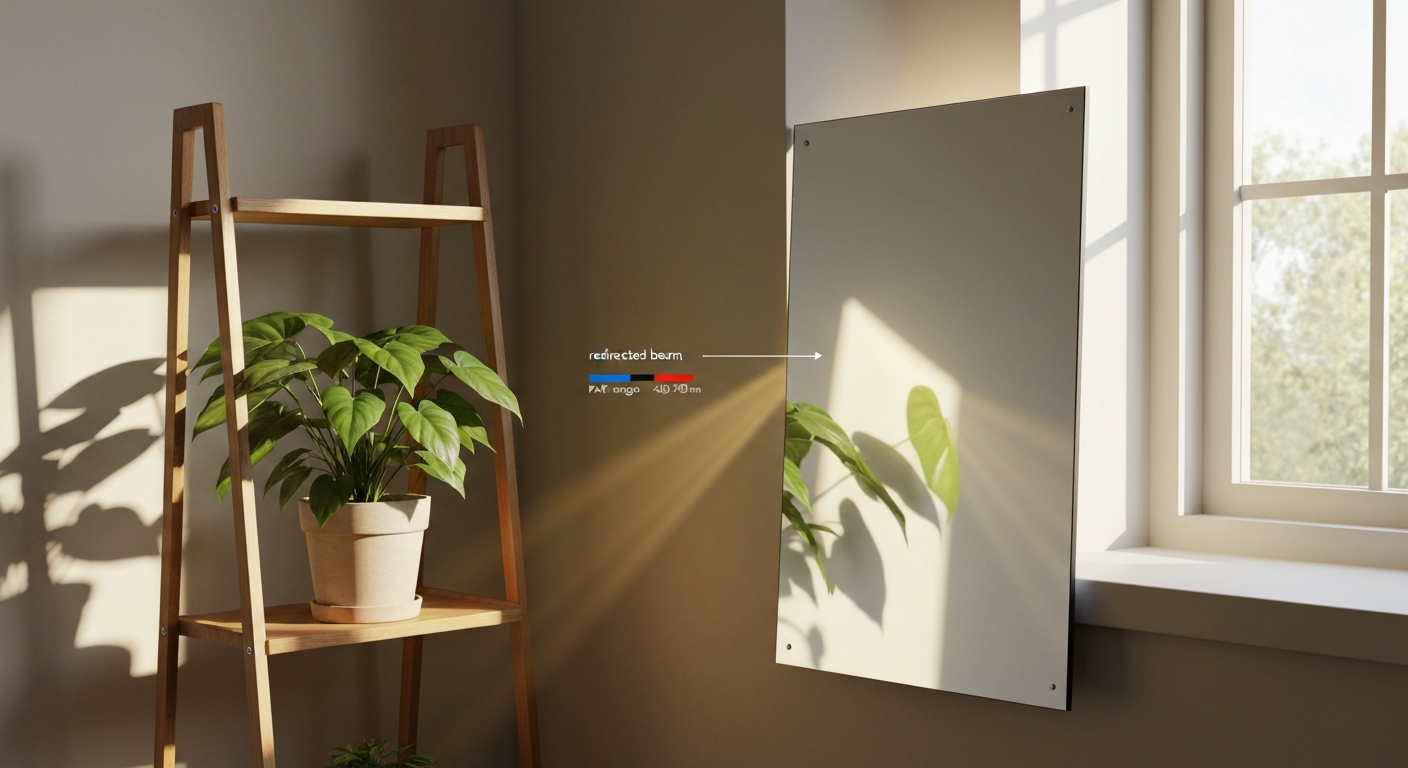
Can You Use Mirrors to Grow Plants? Practical Indoor Guide
Can you use mirrors to grow plants? Learn evidence-based verdict, setup tips, measurements, risks, and better alternives
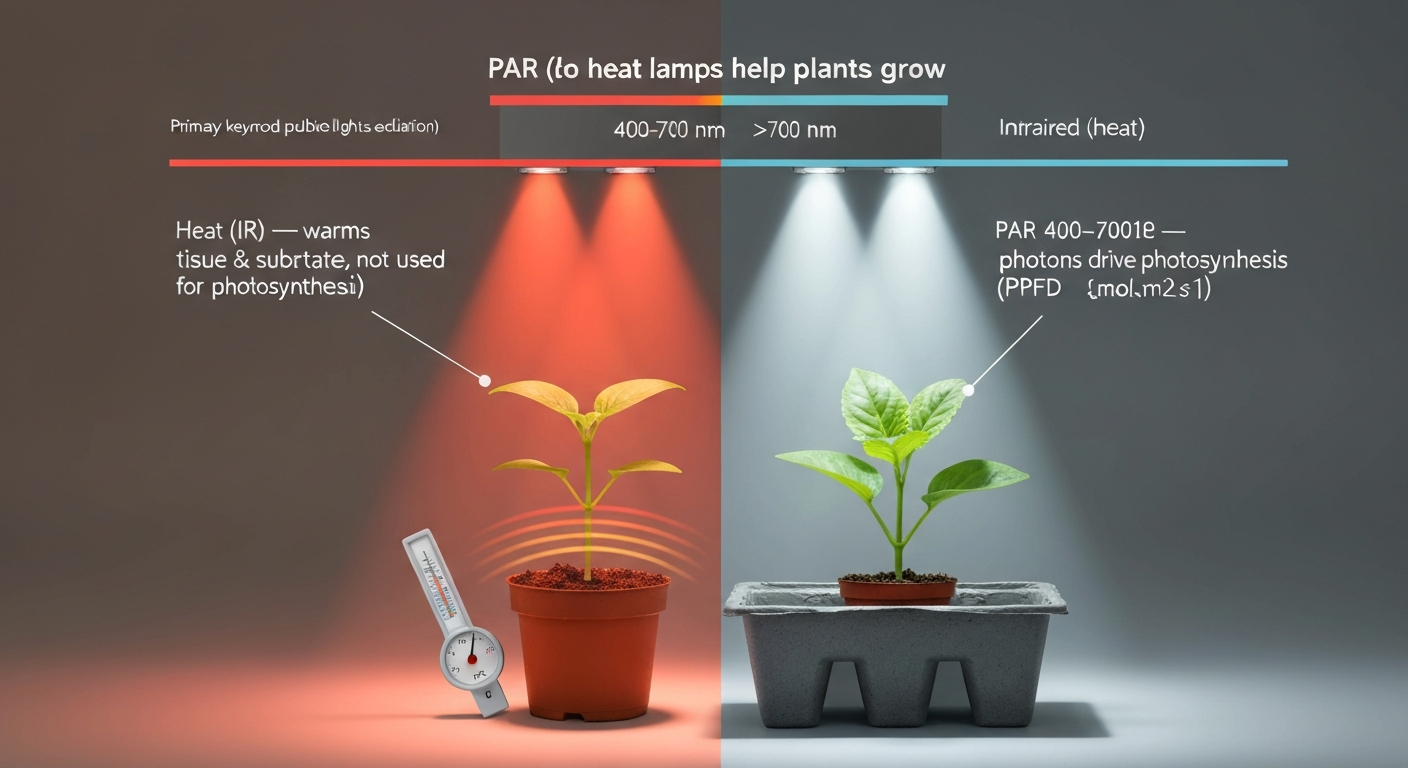
Do Heat Lamps Help Plants Grow? Guide for Gardeners
Do heat lamps help plants grow? Clear verdict, when they help, setup & safety tips, costs and better alternatives.
Do Grow Lights Keep Plants Warm? How to Measure Heat
Learn if grow lights truly warm plants, what to measure, and how to troubleshoot cold setups safely.