Whether you need grow lights in a greenhouse depends almost entirely on your season, your location, and what you're growing. In summer, at most latitudes, a well-positioned greenhouse gets plenty of natural light and you can skip the lights entirely. But in fall through early spring, especially if you're north of about 40° latitude or dealing with a lot of cloudy days, supplemental lighting often makes the difference between plants that thrive and plants that just survive. The honest answer is: check your actual light levels first, then decide. This guide walks you through exactly how to do that.
Do You Need Grow Lights in a Greenhouse? A Guide
Marcus Holloway
6 Jun 2026
When sunlight in a greenhouse is usually enough
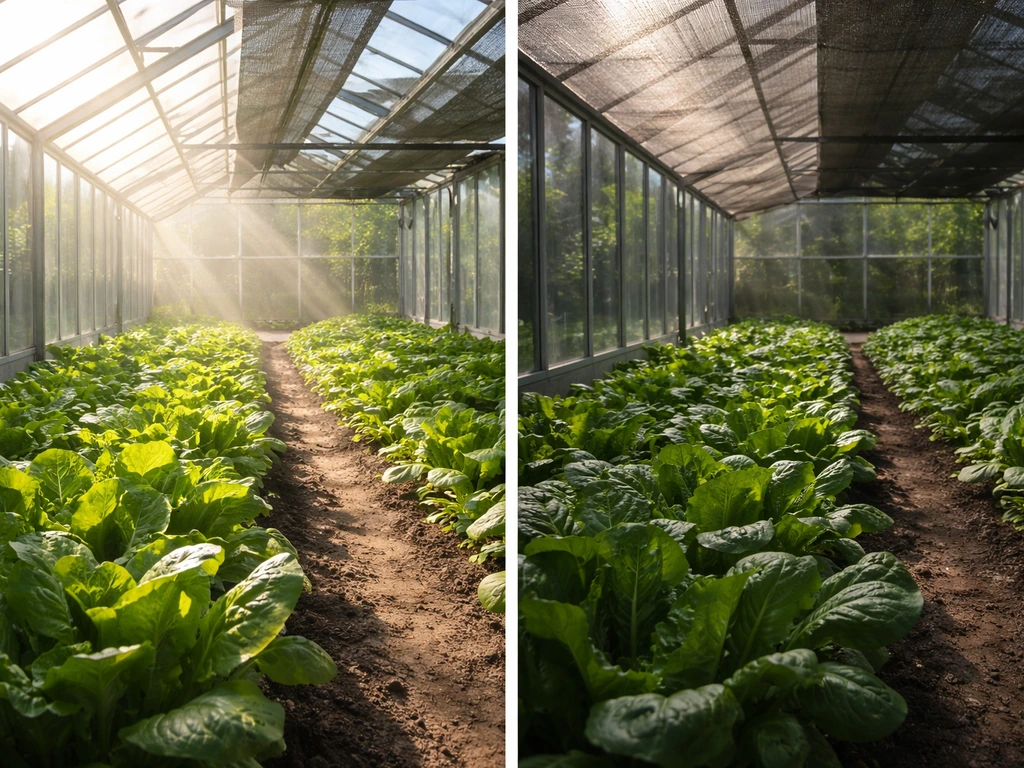
From late spring through late summer, most greenhouses receive more than enough natural light for the majority of crops. If you're growing tomatoes, cucumbers, peppers, or herbs during peak daylight months and your greenhouse faces south (or north if you're in the southern hemisphere) with minimal shading from trees or buildings, you probably don't need supplemental lighting at all. The sun is doing the heavy lifting, and adding grow lights in those conditions is just wasted electricity.
Light transmission is the key variable here. Even a clean glass or twin-wall polycarbonate greenhouse will reduce incoming sunlight by 30 to 50 percent compared to being outside. That sounds like a lot, but during summer months the outside light levels are high enough that even after those losses, your plants are getting what they need. Multiply the outside daily light integral (DLI) for your location by your glazing's transmission factor (typically 0.5 to 0.7 for glass or polycarbonate) and you'll have a rough estimate of what your crops are actually receiving. Michigan State University recommends exactly this approach using published DLI maps as a starting point.
Low-light crops like lettuce, spinach, herbs, and many houseplants have relatively modest light requirements and can often get by on natural greenhouse light for more months of the year than fruiting crops can. If you are growing microgreens, you often need supplemental grow light to hit the light levels they require indoors or during shorter winter days do you need a grow light for microgreens. If you're growing shade-tolerant plants or you're in a mild, relatively sunny climate, the window where supplemental lighting is genuinely necessary may be quite short.
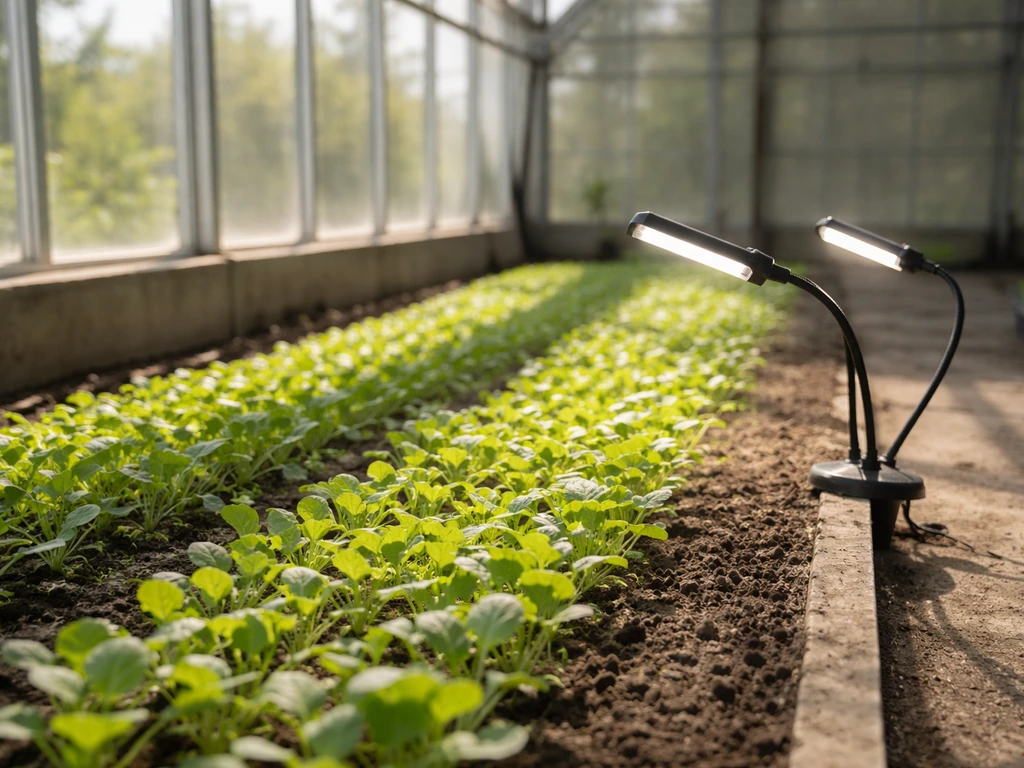
When you DO need supplemental grow lights
The scenarios where supplemental lighting shifts from optional to practically necessary come up more often than most beginners expect. Here are the situations where I'd tell you to plan for grow lights from the start: Microgreens often need supplemental lighting, so it helps to know whether your setup provides enough PPFD or daily light integral grow lights.
- Winter growing at northern latitudes (roughly above 40°N): Short days mean low cumulative light even on clear days, and cloudy winter weather compounds the problem. University of Alaska Fairbanks extension is direct about this: supplemental lighting improves growth during cloudy, low-light conditions and raises total daily light levels when natural daylight hours are short.
- Year-round production of fruiting crops (tomatoes, peppers, cucumbers): These are high-light crops with demanding DLI requirements. OSU notes that clouds diffuse much of the light needed for good crop development in winter, making supplemental lighting systems essentially required for extending the growing period.
- Starting seeds or rooting cuttings in late winter or early spring: Even if your main greenhouse stays adequate for established plants, seedlings and plugs need high-quality light right from germination. MSU extension specifically calls out high-intensity supplemental lighting for plugs and liners in northern climates through early spring.
- A greenhouse that's partially shaded by structures, trees, or a non-ideal orientation: Any structure to the south of your greenhouse (in the northern hemisphere) cuts your effective light window during the exact hours when irradiance is highest.
- A heavily overcast climate year-round: Pacific Northwest, coastal regions, and areas with prolonged cloudy stretches fall into this category regardless of season.
- Photoperiod-sensitive crops needing long days to flower: Some ornamentals and crops require day lengths longer than what winter naturally provides. Even low-intensity lights run for a few extra hours in the evening can trigger the right response, and this is a completely different need than boosting photosynthesis.
It's worth separating two distinct reasons you might use grow lights in a greenhouse. One is photosynthetic supplementation, adding total light energy (DLI) to support faster growth and higher yields. The other is photoperiod manipulation, using low-intensity light to extend the perceived day length and trigger flowering responses in long-day plants. MSU extension explains this distinction clearly: photoperiod lighting works at very low intensities because the plant only needs to detect that light is present, while boosting DLI for actual photosynthesis requires much higher intensity. You might need one, the other, or both, and choosing wrong means either wasting money or not solving your problem.
How to figure out light levels in your greenhouse right now
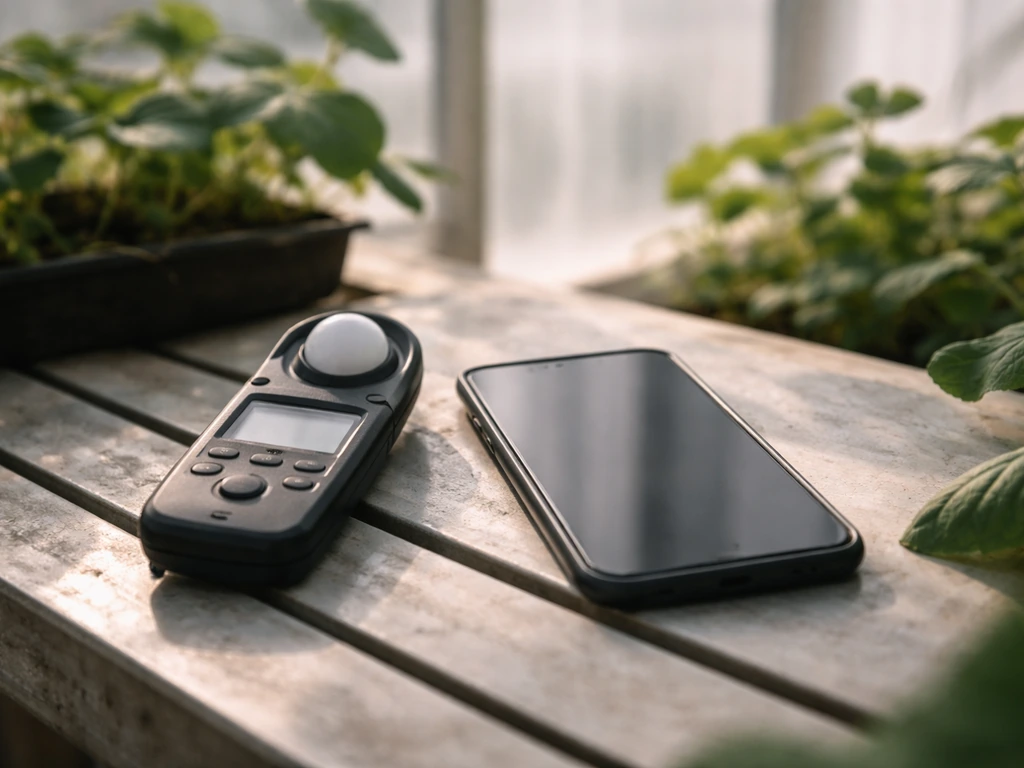
The most reliable way to know whether you actually need supplemental lighting is to measure your Daily Light Integral (DLI), which is the total amount of photosynthetically active light your plants receive over an entire day. DLI is measured in moles of light per square meter per day (mol/m²/day). Purdue University's controlled environment agriculture team describes DLI as the core metric for deciding whether supplemental light is needed for a given crop. You don't need to understand the physics; you just need to know your target DLI for your crop and whether you're hitting it.
Here's a quick three-step approach you can do today:
- Look up a DLI map for your location and month. MSU has free online DLI maps for the continental US that show average outside DLI by month and region. Find your zone and note the outside DLI for your current or target growing month.
- Multiply by your greenhouse's light transmission factor. A clean glass greenhouse typically transmits around 60 to 70 percent of outside light; polycarbonate panels are similar or slightly lower; dirty or aged glazing can drop to 50 percent or less. So if your outside DLI is 20 mol/m²/day and your greenhouse transmits 60 percent, your inside DLI is roughly 12 mol/m²/day.
- Compare to your crop's DLI requirement. Lettuce grows well at 10 to 17 mol/m²/day. Tomatoes want 20 to 30 mol/m²/day. Seedlings and cuttings often target 10 to 15 mol/m²/day. If your calculated inside DLI is below your crop's minimum, you need supplemental light to close the gap.
For a more precise reading, a quantum light meter (PAR meter) measures PPFD (photosynthetic photon flux density) in micromoles per square meter per second. Take readings at plant canopy height at several points throughout the day on a representative day, then convert to DLI. Virginia Tech extension provides a straightforward formula: multiply your average PPFD by the number of daylight hours multiplied by 3,600, then divide by 1,000,000. Even a basic handheld PAR meter (available for $50 to $150) will give you enough data to make a good decision. If you don't want to buy a meter, a basic lux meter on your smartphone is a rough proxy, though it won't give you precise PAR values.
Choosing the right grow light if you need one
Once you've confirmed you need supplemental lighting, the two decisions that matter most are spectrum and intensity. Here's how to think about each without overcomplicating it.
Spectrum: what color light your plants actually need
For most greenhouse supplemental lighting, you want a broad-spectrum LED that covers red and blue wavelengths, usually described as full-spectrum or as a specific Kelvin rating in the 3,000K to 6,500K range. Red light (around 630 to 660nm) drives photosynthesis and flowering efficiently. Blue light (around 400 to 500nm) supports compact, sturdy growth and helps prevent the leggy, stretched look you get with poor light. MSU's floriculture research shows that spectral composition, including far-red light, can influence plant responses beyond just total light energy, but for most home greenhouse growers a quality full-spectrum LED is more than adequate.
If your only goal is photoperiod extension for long-day flowering (not boosting photosynthesis), you can use very inexpensive low-intensity bulbs run for one to two hours in the evening. Even a standard incandescent or low-wattage LED at 10 to 20 micromoles of PPFD is often enough to break the dark period and mimic a long day.
Intensity: how much light you actually need to deliver
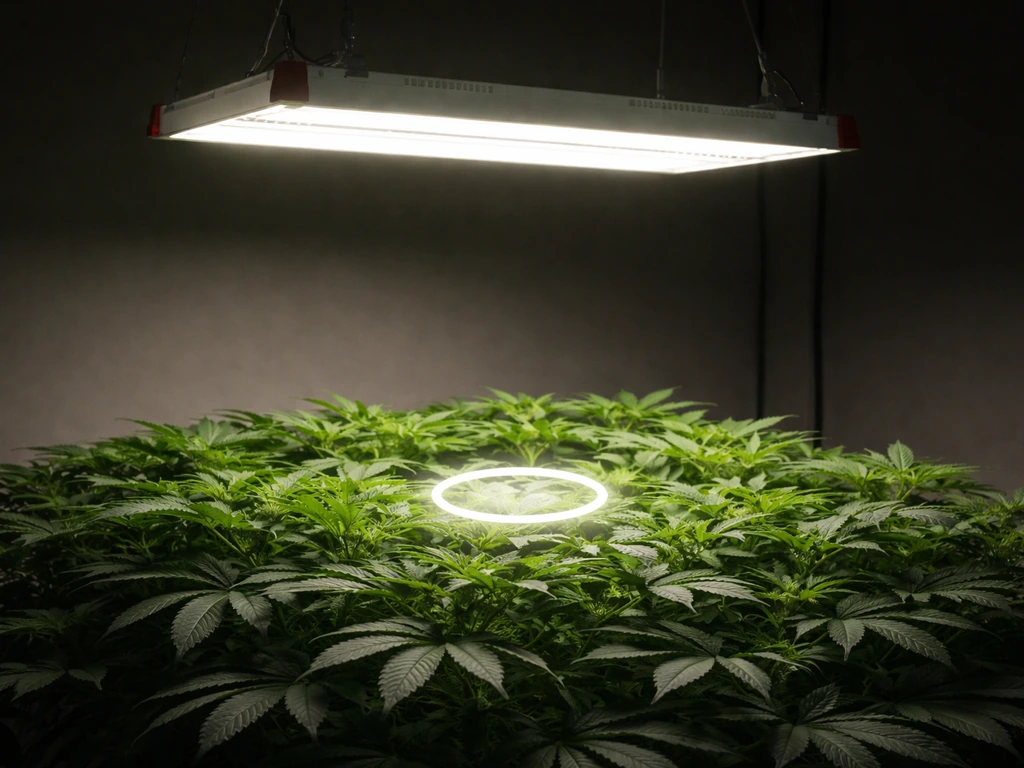
For photosynthetic supplementation, you want to close the gap between your measured inside DLI and your target DLI. Virginia Tech's extension guide walks through exactly how to calculate the PPFD your supplemental lights need to deliver and for how many hours per day to reach your target DLI. As a practical starting point: most supplemental greenhouse setups for vegetables target 150 to 300 PPFD at canopy height from the supplemental fixture alone, since they're working on top of whatever natural light is present.
For a rough sense of scale, MSU extension gives an example of one supplemental lamp needed per 40 square feet of growing area in a commercial setting. Home greenhouse setups will vary, but that's a useful benchmark for initial planning.
| Light Type | Best For | Intensity Needed | Relative Cost |
|---|---|---|---|
| Full-spectrum LED (broad spectrum) | Photosynthetic supplementation, seedlings, fruiting crops | 150–300+ PPFD at canopy | Medium to high upfront, low operating cost |
| Red/blue LED panel | Photosynthetic supplementation on a budget | 150–300+ PPFD at canopy | Low to medium upfront, low operating cost |
| High-pressure sodium (HPS) | High-intensity supplementation, large greenhouses | High (200–400+ PPFD) | High upfront, high heat and energy use |
| Low-intensity incandescent or LED bulb | Photoperiod extension only (not photosynthesis) | 10–20 PPFD is sufficient | Very low |
| T5 fluorescent | Seedlings and low-light crops close to canopy | 50–150 PPFD at close range | Low to medium |
How to position and run lights safely
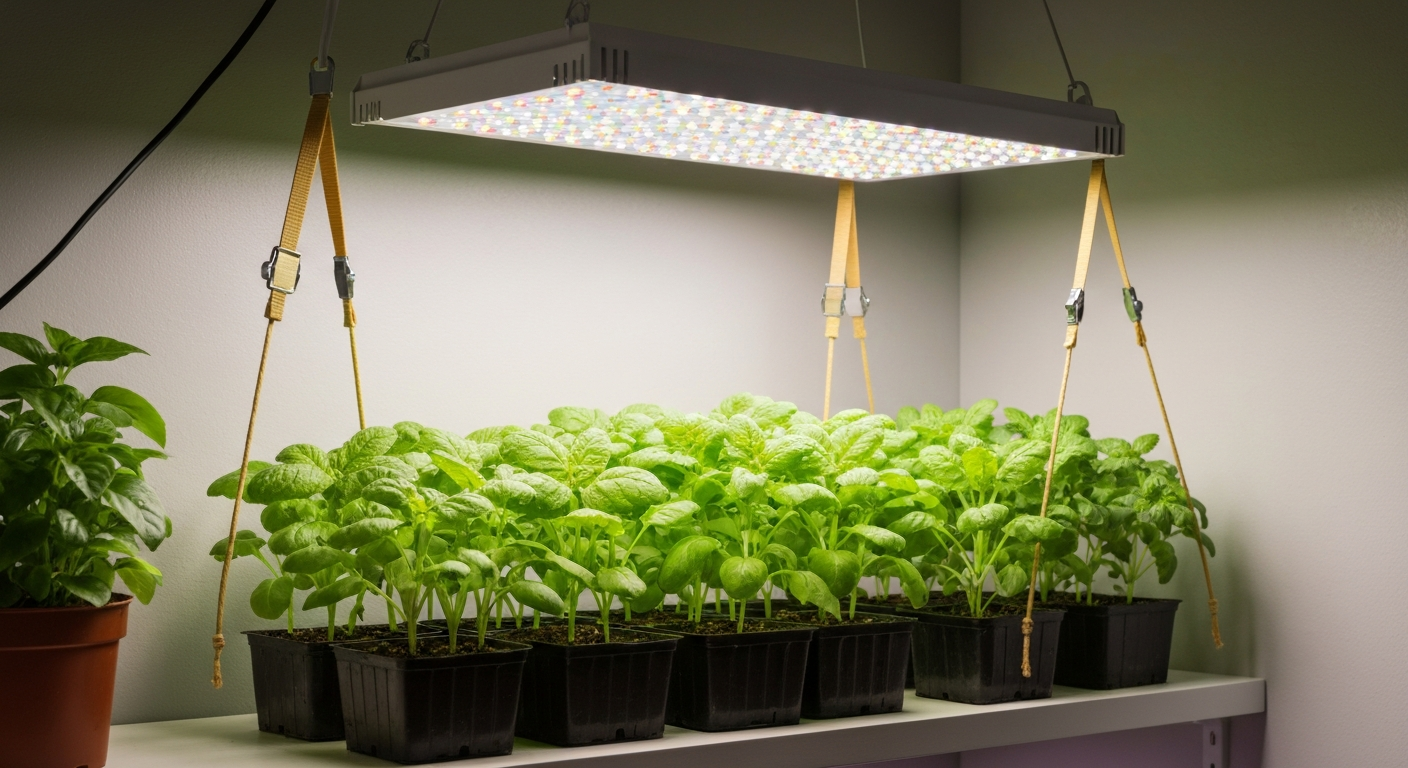
Positioning is where a lot of beginners go wrong. The most common mistake is hanging lights too far above the canopy and wondering why results are disappointing, or hanging them too close and burning leaf tips. For most LED grow lights used for greenhouse supplementation, a starting distance of 12 to 24 inches above the plant canopy is a reasonable baseline, then adjust based on what you observe. MSU extension's supplemental lighting guidance specifically emphasizes positioning lights at canopy level to maximize delivered intensity and uniformity, and avoiding lighting areas where there are no plants (wasted energy).
For running times, use a timer. Manually switching lights on and off is unreliable and defeats the purpose of a consistent photoperiod. For photosynthetic supplementation, the goal is to deliver enough extra light to reach your target DLI. Virginia Tech's DLI guide shows you can calculate the required hours of supplemental light by dividing your DLI gap by the PPFD your fixture delivers (converted to the right units). As a practical rule, most greenhouse supplemental setups run 4 to 6 additional hours per day in winter, typically in the morning before sunrise or evening after sunset to extend the photoperiod.
Purdue's greenhouse environment research reinforces treating the light period and dark period as intentional design variables rather than whatever the sun gives you. Most plants do need a genuine dark period, so running lights 24 hours a day is not better and can actually harm some crops. Sixteen to eighteen hours of combined natural plus supplemental light per day is a common upper limit for most vegetables and herbs.
For electrical safety in a greenhouse environment, use fixtures with an IP rating appropriate for damp or wet locations (IP44 minimum, IP65 preferred). Greenhouses involve humidity, condensation, and sometimes irrigation splash, all of which are incompatible with standard indoor-only fixtures. Use GFCI-protected outlets, keep wiring off the ground and away from irrigation lines, and follow local electrical codes. This is not an area to cut corners.
What results to expect by plant type and season
Realistic expectations matter here, because grow lights are not magic. They compensate for missing light; they don't create ideal growing conditions on their own. Temperature, CO2, watering, and nutrition all still matter. OSU extension notes that the economics of supplemental lighting for greenhouse tomatoes can be marginal, and that supplemental lighting increases yield primarily when other production factors are also optimized.
| Plant Type | Target DLI (mol/m²/day) | When Supplemental Lights Help Most | Expected Benefit |
|---|---|---|---|
| Lettuce, spinach, herbs | 10–17 | Nov–Feb at northern latitudes | Faster growth, better color, reduced bolting risk |
| Tomatoes, peppers, cucumbers | 20–30 | Oct–Mar, cloudy climates year-round | Improved fruit set, higher yield, prevents stretching |
| Seedlings and plugs | 10–15 | Late winter seed starting (Jan–Mar) | Compact, stocky growth instead of leggy seedlings |
| Orchids and tropical houseplants | 8–15 | Fall through spring | Maintained health, continued blooming |
| Long-day ornamentals (e.g., petunias, chrysanthemums) | Photoperiod control (low intensity) | Winter months with short days | Triggers or delays flowering on schedule |
| Microgreens | 10–20 | Any time natural light is limited | Consistent germination and even growth |
In general: low-light crops respond well to even modest supplemental lighting and are the easiest wins. Fruiting crops require significantly higher light levels and the investment in higher-intensity fixtures, but the payoff in winter production can be substantial if you're committed to year-round growing. For seed starting specifically, the difference between good light and poor light is dramatic and visible within two weeks, which makes it one of the clearest cases for investing in supplemental lighting. For seed starting indoors, you often do need grow lights to provide enough usable light for the seedlings to develop properly For seed starting specifically.
Misconceptions and safety concerns worth clearing up
The most common concern I hear from greenhouse beginners is about heat. High-intensity discharge (HPS) lights do generate significant heat and can raise greenhouse temperatures, which matters when you're already trying to manage a warm summer environment. LED grow lights produce far less heat at the fixture (though they still add some thermal load to the space) and are generally a better fit for greenhouse supplemental lighting for this reason. If you're running LEDs, overheating from the lights alone is rarely a problem in a vented greenhouse.
Grow lights will not give you a tan, cause skin cancer, or meaningfully harm your eyes during normal brief exposure in a greenhouse. Plant grow lights are designed to emit wavelengths useful for photosynthesis (primarily red and blue), not the UV wavelengths responsible for tanning and sunburn. Some grow lights do emit a small amount of UV, but the levels in typical horticultural LEDs and fluorescents are negligible for incidental human exposure.
That said, staring directly into any bright light source repeatedly is not a good idea, and certain high-powered HPS or metal halide fixtures warrant basic eye protection during extended maintenance work directly beneath them. Use common sense, but don't let concern about this stop you from setting up a useful growing system.
Another misconception is that grow lights are redundant in a greenhouse because the greenhouse already has a glass roof letting in natural light. That's exactly right for summer, but a greenhouse in January in Minnesota is not getting adequate light through that glass roof for fruiting crops, no matter how clean the glazing is.
If you're wondering can you put grow lights in a greenhouse, the key point is that winter light levels through the glass often are not enough for fruiting crops. The glass helps with heat retention and wind protection; it doesn't compensate for the fundamental fact that winter days are short and the sun is low in the sky.
If you are wondering, do you need grow lights for seedlings, the same DLI and season logic applies, and you can often tell quickly once you measure your light levels at canopy height short and the sun is low in the sky.
Finally, it's worth noting that the need for supplemental lighting in a greenhouse is fundamentally the same question as whether grow lights are necessary in any low-light indoor environment. If you're also growing plants under artificial light indoors, starting seeds under lights, or growing hydroponically, the DLI measurement approach and spectrum guidance here apply just as directly to those situations as to a greenhouse. The same question applies to hydroponic setups too: do you need grow lights for hydroponics based on your target light levels and crop needs growing hydroponically.
FAQ
If my greenhouse is heated, do I still need grow lights in winter?
Yes, heat and light solve different problems. Heating helps temperature so growth can occur, but winter greenhouse light levels through glazing are often still too low for fruiting crops. You can have a warm houseplant-like environment and still get slow, stretchy growth if you are below your crop’s target DLI.
How can I tell whether my problem is low light or something else like fertilizer or water?
Use symptoms plus measurement. If new growth is pale, spacing increases (leggy stems), or flowering slows during short days, low light is likely. Confirm with a DLI or PPFD reading at canopy height on a representative day. If DLI is on target, then adjust nutrients, watering schedule, and temperature instead of adding more lighting.
Should I measure light at the greenhouse floor or at canopy height?
At canopy height. Lights are affected by distance, angles, and shading, so values taken lower in the structure can seriously overestimate what leaves actually receive. Take multiple readings across the crop area because coverage usually varies between rows, benches, and corners.
What’s the fastest way to estimate whether I’m close to the target DLI without buying a PAR meter?
A lux meter or phone app can help you compare changes over time, like before and after clearing shade, cleaning panels, or adjusting light height. However, lux is not the same as PAR, so use it only for rough direction. For a final yes or no, a PAR (quantum) meter at canopy height is the practical step.
Do grow lights need to run every day once I start using them?
Not necessarily. If you are using supplementation to reach a DLI target, you can vary runtime by season and weather, but only if your measurement or calculation account for cloudy versus clear days. The simplest approach is to set a timer based on daylight length and then fine-tune using DLI checks every couple of weeks.
Can I use smart plugs or automated timers instead of a simple timer?
Yes, but automate based on light schedule, not just sunrise and sunset apps. Greenhouses can have different internal light conditions depending on cloudiness, glazing type, and shade. A good pattern is fixed timer for baseline, then adjust after a measured DLI check.
Is it better to add more light intensity for fewer hours, or less intensity for more hours?
Either can work as long as total DLI matches the crop goal. In practice, intensity choices affect uniformity, fixture cost, and heat load. Many greenhouse growers prefer moderate intensity with longer runtime in winter because it is easier to position lights and reduce hotspots that can stress leaves.
How close is too close for LED lights, and what do leaf burn signs look like?
Too close can cause tip burn or leaf edge scorch, and sometimes a bleached or overly dark look in severe cases. Start with a moderate mounting distance, then move in small steps while monitoring for changes within several days. Also ensure even coverage, since one bright zone can burn leaves while other areas still look underlit.
Do greenhouse grow lights need a full-spectrum LED, or is red and blue enough?
For most greenhouse supplementation, red and blue is often sufficient for photosynthesis and normal growth. Full-spectrum (or a balanced white LED within the typical 3,000K to 6,500K range) can make the visual inspection easier and may support broader plant responses. If you only care about meeting DLI, focus more on delivering the right PPFD and coverage than on chasing marketing-heavy spectrum labels.
For photoperiod control, how low intensity is actually enough?
The key is breaking the dark period, not matching the same brightness needed for photosynthesis. That means you can use low-intensity light for one to two hours, but the crop must be sensitive to day length, and coverage must reach the plants' canopy. If the bulbs are too far away or partially blocked, the plant may still perceive the dark period.
Should I worry about UV exposure or eye safety from grow lights?
Incidental exposure from typical horticultural LEDs is usually not a tanning or burn risk for occasional proximity. Still, avoid staring directly at high-brightness fixtures and use basic eye protection when doing long maintenance directly beneath intense HID units or very high-output LEDs.
Do I need to clean or maintain the greenhouse glazing before measuring light?
Yes, and it can be the difference between “need lights” and “no lights.” Film, dust, algae, and even snow residue reduce transmission, which changes your DLI without any fixture changes. Clean glazing before your first DLI measurement, then recheck if you notice seasonal buildup.
If I’m growing microgreens, do I really need grow lights in a greenhouse?
Often yes, because microgreens require higher light levels at the canopy over short periods. Even if your greenhouse works for herbs and greens, microgreens can still fall below their target PPFD or DLI in fall through winter or during frequent cloudy stretches. Measure at canopy height and compare to your microgreens light goal.
How many hours of supplemental lighting should I plan for in winter?
Plan a starting schedule, then validate with DLI. Many setups add roughly 4 to 6 hours during winter, commonly before sunrise or after sunset, but the exact number depends on your measured light levels and your crop’s DLI target. Use your meter reading to avoid under-shooting during long cloudy periods.
What electrical setup is safest for greenhouse grow lights?
Use fixtures rated for damp or wet conditions (IP65 is a good target) and power them through GFCI-protected outlets. Route wiring away from irrigation splash paths, use strain relief, and keep connections elevated where condensation drips are common. If your greenhouse has frequent humidity cycling, prioritize corrosion-resistant components and outdoor-rated cable.
Next Articles
Do You Need Grow Lights to Start Seeds? A Clear Guide
Do you need grow lights to start seeds? Know when window light is enough, setup tips, and signs of too little light.
Why Do Plants Grow Best in Blue Light? Science & Practical Guide
Explore why blue light boosts vegetative growth, ideal blue:red ratios, PPFD, photoperiods, fixtures, and setup tips.
What Artificial Light Will Grow Plants: Best Lights Guide
What artificial light will grow plants: practical guide to LED, CFL, HID spectra, PPFD targets, setup, cost & tips.