LED grow lights, fluorescent tubes, and HID lamps (metal halide and high-pressure sodium) will all grow plants indoors. LEDs are the best default choice for most home gardeners right now: they run cool, last long, and modern full-spectrum panels cover the wavelengths plants actually use. Fluorescent and CFL fixtures are still perfectly capable for seedlings and low-light herbs. Incandescent bulbs, ring lights, and most household lamps produce too little usable light to grow anything reliably, so skip those. What matters most is not the brand or even the wattage, but whether the light delivers enough photons in the right wavelength range, close enough to your plants, for long enough each day.
What Artificial Light Will Grow Plants: Best Lights Guide
Marcus Holloway
26 Jul 2026
Who this guide is for
If you are starting seeds on a windowsill that does not get enough sun, keeping houseplants alive through a grey winter, growing herbs in a kitchen with no natural light, or setting up a small vegetable or cannabis grow for the first time, this guide is written for you. I am not targeting commercial greenhouse operators with a full lighting engineer on staff. I am talking to home gardeners who just want their tomato seedlings to stop going leggy, plant hobbyists who want their tropical aroids to actually thrive indoors, and complete beginners who feel intimidated by all the jargon around grow lights. I have been in all three of those positions, and the goal here is to cut through the noise and give you something you can act on today.
How light actually drives plant growth
Plants use light as fuel. Photosynthesis converts photons, carbon dioxide, and water into sugars the plant uses to build tissue, produce fruit, and flower. Not all photons are equally useful. Scientists define Photosynthetically Active Radiation (PAR) as light between 400 and 700 nanometers (nm), which covers the visible spectrum from violet through red. Your artificial light source needs to deliver meaningful quantities of photons in that range, or your plants will struggle regardless of how bright the lamp looks to your eyes. For a concise primer on what type of light plants need to grow, see what type of light do plants need to grow.
Beyond raw photosynthesis, light also controls plant development through a process called photomorphogenesis. Specific wavelengths trigger specific plant responses: blue light regulates leaf shape and stem thickness, red and far-red light interact with receptors called phytochromes to tell the plant what time of year it is and whether to flower. This is why a lamp that looks white and bright is not necessarily doing the right job for your plants.
Photoperiod, meaning the number of hours of light a plant receives per day, is the third pillar. Many plants use day length as a cue to flower or stay vegetative. Long-day plants (most herbs and greens) thrive with 14 to 18 hours of light. Short-day plants (cannabis in flower, chrysanthemums, some fruiting crops) need uninterrupted dark periods to trigger blooming. Getting photoperiod wrong is one of the most common reasons grow lights seem to fail, so a simple plug-in timer is an essential piece of kit.
Types of artificial grow lights and when to use them
There are four main categories of artificial light used to grow plants. Each has real strengths and genuine limitations, and the right choice depends on your budget, space, and what you are growing.
| Light type | Spectrum quality | Energy efficiency (PPE) | Heat output | Best for | Main drawback |
|---|---|---|---|---|---|
| Full-spectrum LED | Excellent (tunable) | 2–3+ µmol/J | Low | All stages, all crops, tight spaces | Higher upfront cost |
| Fluorescent / CFL | Good (broad) | ~1–1.5 µmol/J | Low to moderate | Seedlings, clones, low-light herbs | Low PPFD output, not for flowering |
| HID: Metal Halide (MH) | Good (blue-heavy) | ~1.2–1.7 µmol/J | High | Vegetative growth, large canopies | Heat, high running costs, ballast needed |
| HID: High-Pressure Sodium (HPS) | Moderate (red-heavy) | ~1.5–1.9 µmol/J | High | Flowering, fruiting, commercial scale | Heat, spectrum gaps, ballast needed |
| Incandescent / halogen | Poor for plants | <0.5 µmol/J | Very high | Nothing practical | Almost no useful PAR output, wastes electricity as heat |
LED grow lights
Modern horticultural LEDs are the clear winner for most home growers in 2026. A quality full-spectrum LED panel now delivers photosynthetic photon efficacy (PPE) of 2 to 3 or more µmol per joule, meaning you get more usable plant light per watt of electricity than any other technology. They run cool enough to hang much closer to your canopy than HID fixtures, they do not require a separate ballast, and they last tens of thousands of hours. The catch is the upfront price, which is still higher than fluorescents or a basic HPS setup. However, the energy savings and longevity usually make up for it within one or two growing seasons.
Fluorescent and CFL lights
T5 fluorescent tubes and compact fluorescent lamps (CFLs) were the go-to for home growers for decades, and they still do a solid job for seedlings, cuttings, and low-light crops like lettuce and herbs. They are cheap, easy to find, and produce very little heat. The limitation is output: a 4-foot T5 fixture simply cannot produce the PPFD needed to flower tomatoes or cannabis. Use them for propagation stages or as side lighting, but do not expect them to carry a full vegetative or flowering grow on their own.
HID lights: metal halide and high-pressure sodium
HID lights dominated indoor growing for 30-plus years. Metal halide produces a blue-heavy spectrum well suited to vegetative growth; high-pressure sodium outputs a red-heavy spectrum better matched to flowering. Many growers historically switched between MH (veg) and HPS (flower) to match plant stage. Both technologies are still capable of growing excellent crops, and a 600W or 1000W HPS can flood a large canopy with serious PPFD. The downsides are real though: HID fixtures run hot, require ventilation and cooling, consume more electricity per unit of plant light than modern LEDs, and need a ballast. For a beginner in a small space, the heat management alone makes them harder to use well.
Incandescent bulbs and household lamps
Standard incandescent and halogen bulbs convert most of their energy to heat, not light, and the light they do produce is heavily weighted toward the red and infrared end of the spectrum with very little blue. Their PPE is typically below 0.5 µmol/J, which means they deliver almost nothing useful to a plant per watt spent. They will not grow plants in any practical sense. If you’re wondering "will any light grow plants", the short answer is no, the lamp must deliver usable PAR photons at sufficient intensity and the right spectrum to actually support growth. Ring lights, desk lamps, and decorative grow bulbs sold in hardware stores generally fall into the same category. A dedicated grow light is a different product entirely.
Light spectrum explained: what each color actually does
Think of the light spectrum as a toolkit. Different wavelengths do different jobs, and a good grow light tries to give plants access to the right tools at the right time. For example, blue light strongly influences leaf and stem development; learn more in why do plants grow best in blue light.
- Blue light (400–500 nm): Drives compact, sturdy growth. Plants exposed to adequate blue develop shorter internodes, thicker leaves with higher photosynthetic capacity, and properly functioning stomata. Research by Hogewoning et al. showed that the ratio of blue to red light significantly affects leaf anatomy and total yield in cucumber. Too little blue and plants stretch; too much blue at the expense of everything else and you lose photosynthetic efficiency.
- Red light (600–700 nm): The most efficient wavelength per photon for driving photosynthesis. Red photons interact with phytochrome receptors, helping control flowering time. Red-dominant light alone causes plants to stretch, which is why a balanced red-to-blue ratio matters.
- Far-red (700–750 nm): Technically outside the traditional PAR range but not useless. Far-red modifies the phytochrome system, can accelerate flowering in some crops, and allows deeper canopy penetration. Too much far-red without red causes excessive stem elongation. Some advanced LED fixtures let you dial in far-red separately, which is useful for flowering stage.
- UV-B (280–315 nm): Perceived by a plant receptor called UVR8. Low doses of UV-B can increase flavonoids and secondary metabolites, useful for boosting terpenes or anthocyanins. Higher doses damage photosynthetic machinery. UV is a targeted tool, not a daily requirement for most crops.
- Green light (500–600 nm): Often dismissed as useless because leaves reflect green back to our eyes, making plants look green. But green photons penetrate deeper into leaves and canopies than red or blue. A 2024 meta-analysis in the Journal of Experimental Botany found green light promotes biomass comparably to red and blue when used as part of a broad spectrum. Full-spectrum white LEDs include green, which is one reason they perform well.
Spectrum notes for cannabis
Cannabis growers often get into spectrum optimization more than vegetable growers. During vegetative growth, a blue-rich spectrum (5000–6500K color temperature if using white LEDs, or a specific blue channel) keeps internodes tight and growth compact. During flowering, shifting toward red and adding far-red encourages bud development and can improve terpene profiles. Some growers add a UV-B supplement in the last few weeks of flower, citing secondary metabolite production, though dose control matters. A programmable full-spectrum LED that lets you adjust channel output by stage is the most practical tool for this, but a solid fixed-spectrum full-spectrum panel will still produce excellent results if the PPFD targets are met.
Understanding the numbers: PAR, PPFD, lumens, lux, and DLI
This is the section people often skip, then regret. You do not need a degree to use these numbers, you just need to know which ones to pay attention to.
PAR (Photosynthetically Active Radiation) is simply the label for light in the 400–700 nm range. It is not a measurement on its own, it is a category. When someone says a light has good PAR coverage, they mean it emits photons across that range.
PPFD (Photosynthetic Photon Flux Density) is the number you actually use to size and position a light. It measures how many photons in the PAR range land on a square meter of canopy every second, expressed as µmol/m²/s. This is the metric on manufacturer PPFD maps and what a quantum sensor measures. If someone says their light delivers 800 µmol/m²/s at 18 inches, that is a PPFD figure.
DLI (Daily Light Integral) is the total PAR dose your plants receive over a full day. You calculate it from PPFD and photoperiod: DLI = PPFD × hours of light × 0.0036. A plant sitting under 400 µmol/m²/s for 16 hours receives a DLI of about 23 mol/m²/day. DLI is useful because it lets you compensate: if your light is a bit dim, run it longer; if your photoperiod is constrained, you may need a brighter light.
Lumens and lux are weighted to human vision, not plant photosynthesis. An orange HPS lamp looks very bright to our eyes in lux terms, but a significant portion of its output is not in the most efficient photosynthetic range. You cannot reliably convert lux to PPFD without knowing the exact spectrum of your light source. This means the lux reading on your phone's light meter app is useful for comparison between identical light sources, but misleading when comparing LEDs to HPS or fluorescents. If you want accurate PPFD, use a quantum sensor (PAR meter).
Practical PPFD and DLI targets by growth stage
Here are the target ranges I use and that align with controlled-environment agriculture (CEA) guidance. For a concise explanation of what light brightness makes plants grow the best, see what light brightness makes plants grow the best. These are starting points, not absolute rules. Plants will tell you if the light is too much or too little, and the troubleshooting section below explains what to look for.
| Growth stage | Target PPFD (µmol/m²/s) | Photoperiod (hours) | Approximate DLI (mol/m²/day) | Notes |
|---|---|---|---|---|
| Seedlings / cuttings | 50–200 | 18 | 3–13 | Start at the low end; young tissue burns easily |
| Leafy greens / herbs (full cycle) | 150–300 | 14–18 | 8–17 | Lettuce, basil, spinach thrive here |
| Vegetative fruiting crops (tomato, pepper, cannabis veg) | 300–600 | 18 (cannabis) / 14–16 (others) | 19–39 | More light = faster growth up to a point |
| Flowering / fruiting (tomato, pepper) | 400–700 | 14–16 | 20–30 | Consistent DLI matters more than peak PPFD |
| Cannabis flowering | 600–900 (home); up to 1200+ with CO₂ enrichment (commercial) | 12 | 26–39 | High PPFD without CO₂ boost can hit a ceiling |
| Low-light houseplants (pothos, snake plant) | 50–150 | 12–16 | 2–9 | These tolerate low DLI well; too much causes bleaching |
For cannabis specifically, commercial operators often target 800–1200 µmol/m²/s during peak flower with CO₂ enrichment to around 1200–1500 ppm. At home without CO₂ supplementation, pushing much above 900 µmol/m²/s gives diminishing returns and increases heat stress risk. Hitting a consistent 600–750 µmol/m²/s with a good spectrum and a clean 12/12 photoperiod will give excellent home results.
How to measure your light (without spending a fortune)
Research-grade quantum sensors from LI-COR (the LI-190R) or Apogee (SQ and MQ series) give the most accurate PPFD readings and are what university researchers and serious commercial growers use. They cost $200–$500 or more. For a home grower, a budget Apogee or a reputable smartphone-compatible PAR meter attachment gets you into the useful range at a fraction of that price. Avoid relying on phone light meter apps that only measure lux: as mentioned, lux does not translate reliably to PPFD without knowing the exact spectrum.
When you do have a PAR meter, measure at multiple points across your canopy, not just directly below the light. Edge readings are almost always lower than center readings. Average those points to get your real working PPFD, then use the DLI formula to confirm you are hitting your target daily dose. This multi-point mapping approach is what CEA researchers at Cornell and commercial growers using Resource Innovation Institute guidance actually do, and it takes about five minutes with a clip-on meter.
Distance, placement, and the inverse-square law
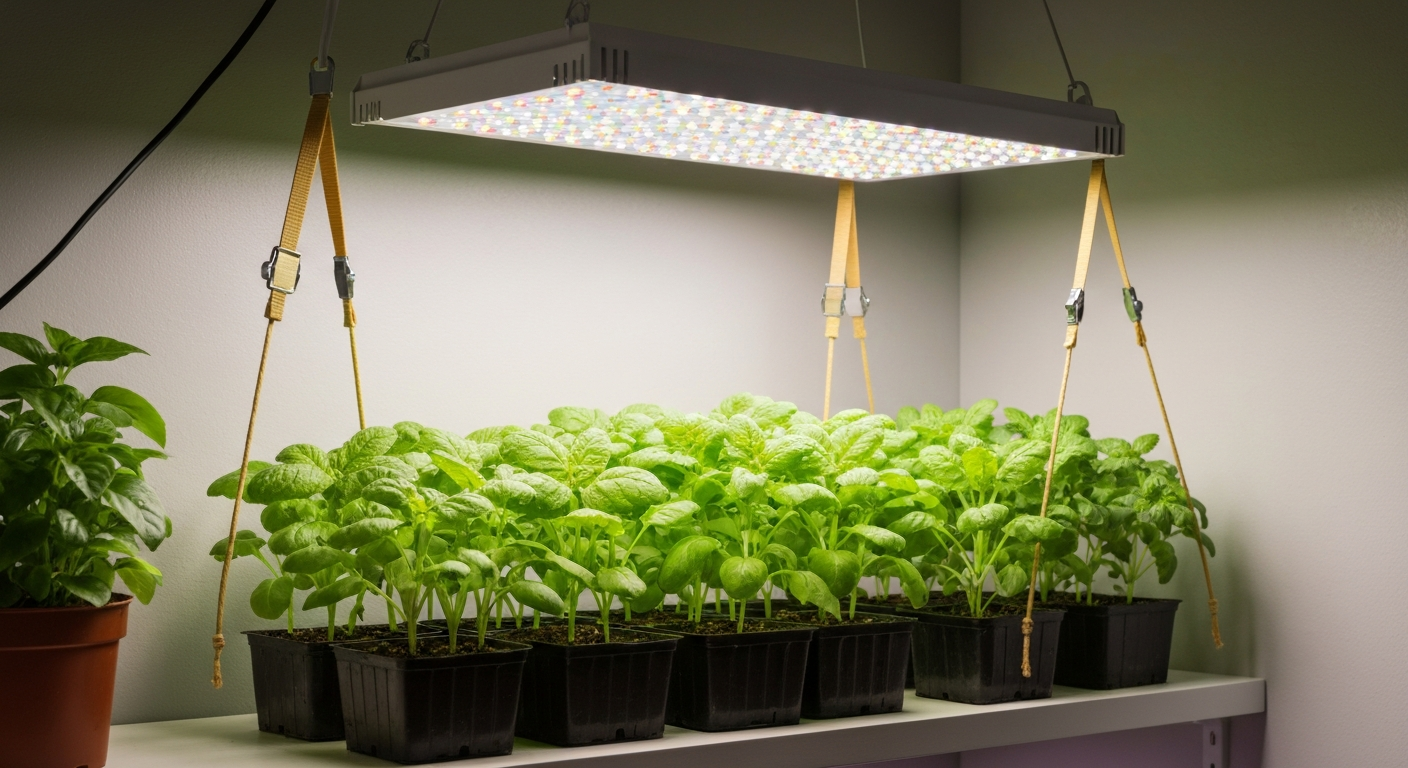
Light intensity drops off sharply as you move a lamp away from the canopy. In theory, doubling the distance quarters the intensity (the inverse-square law). In practice, fixtures with lenses, reflectors, or extended arrays deviate from this, so always check the manufacturer's PPFD map at different heights rather than doing pure math. As a rough guide, most LED grow panels intended for home use work well at 18 to 36 inches (45 to 90 cm) above the canopy, with seedlings kept toward the farther end and mature plants brought closer. HID fixtures need more vertical clearance because of heat: a 600W HPS should typically stay at least 24 inches away to avoid burning, and more ventilation is needed to compensate.
An adjustable hanging system (rope ratchets are cheap and effective) lets you raise the light for seedlings and lower it as plants mature. This single habit makes a bigger difference than most equipment upgrades.
Do grow lights actually work? The honest evidence
Yes, grow lights work, and they work well when the basics are right. If you’re asking “does plant grow light work,” see the section titled “Do grow lights actually work? The honest evidence” for a clear, evidence-based answer. Decades of controlled-environment agriculture research, commercial vertical farms, and countless successful home grows confirm it. I have grown full harvests of tomatoes, peppers, and herbs under LEDs with zero supplemental sunlight, and the results were comparable to outdoor summer harvests.
The failures I have seen, and experienced myself, almost always come down to three things: not enough intensity (PPFD too low for the crop), the light being too far away from the canopy, or the photoperiod being wrong. A dim light positioned 3 feet above a tomato seedling that needed 300 µmol/m²/s is receiving maybe 80 µmol/m²/s. The plant stretches toward the light, looks pale, and barely grows. Move the light to 12 inches, and the same plant takes off. This is not a failure of grow lights as a technology, it is a setup problem.
Grow lights do have genuine limitations. They consume electricity, which costs money and has an environmental footprint. A single 200W LED panel running 16 hours a day uses about 3.2 kWh per day. At average US electricity rates of around $0.16/kWh in 2026, that is roughly $0.51 per day or about $15 per month per panel. For leafy greens and herbs, that math works out well. For fruiting crops that need multiple high-powered panels for months, the economics get tighter. Factor in your electricity cost before scaling up.
Energy and cost: LED vs. fluorescent vs. HID
Measured photosynthetic photon efficacy (PPE), the amount of usable plant light per watt, is the most honest way to compare running costs across lamp types. Based on published data from the Lighting Research Center and horticultural lighting reviews, here is how the technologies compare:
| Technology | Typical PPE (µmol/J) | Relative electricity cost for same PPFD | Heat management cost |
|---|---|---|---|
| Modern horticultural LED | 2.0–3.0+ | Lowest | Minimal |
| T5 fluorescent | 1.0–1.5 | Moderate (low PPFD ceiling) | Low |
| Metal halide HID | 1.2–1.7 | Moderate-high | Significant (fans/AC) |
| High-pressure sodium HID | 1.5–1.9 | Moderate | Significant (fans/AC) |
| CFL | 0.8–1.3 | High per unit of output | Low |
The headline: a modern LED delivers roughly 1.5 to 2 times the plant-usable light per watt compared to HPS, and the gap widens further when you factor in the cooling electricity HID setups require. For new setups, LEDs are almost always the right economic choice over a 2 to 3-year horizon.
Safety and health: addressing the common fears
The most common questions I get from people new to grow lights are about safety, and almost all of them come from misunderstanding what kind of light these fixtures actually emit.
Grow lights will not give you a tan or cause skin cancer under normal use. Tanning and UV-induced skin damage require significant UV-A and UV-B radiation. Most LED grow lights emit little to no UV. Even HID lights, which produce some UV, do not emit enough at typical growing distances to tan skin or cause meaningful UV exposure during brief daily checks. Specialized UV-B supplemental lamps are a different matter and should be used with appropriate eye protection, but these are niche products, not standard grow lights.
Looking directly into a powerful LED grow light is uncomfortable and can temporarily strain your eyes, just as staring at any bright light source would. Some growers wear tinted safety glasses in their grow rooms during extended work sessions, which is sensible. But a few minutes of normal exposure during plant checks carries no meaningful health risk. The grow lights sold for home use are not producing the kind of UV or ionizing radiation associated with cancer. This fear, while understandable, is not supported by evidence.
Electrical safety is the real concern worth taking seriously. Keep electrical connections away from water, use weatherproof cable management in humid grow tents, do not overload outlets, and ensure your hanging hardware can support the fixture's weight. These are basic precautions, not grow-light-specific fears.
Troubleshooting common grow light problems
- Leggy, stretching seedlings: The light is too far away or not bright enough. Reduce distance by 6 to 12 inches and check PPFD. Also confirm you are providing enough blue spectrum, as blue-deficient light causes stretch.
- Leaf bleaching or light burn: The light is too close or the PPFD is too high for the plant's current stage. Raise the fixture and check for yellowing concentrated at the top of the canopy closest to the light. Seedlings are especially vulnerable.
- Slow or no flowering: Check photoperiod first. Short-day plants need true uninterrupted darkness for 12 hours. Even a small light leak from a phone charger LED or a streetlight through a tent seam can interrupt the dark period. Spectrum matters too: red-dominant light and added far-red promote flowering.
- Heat stress (wilting, curled leaves, crispy tips): HID or high-power LEDs too close, insufficient air circulation, or tent temperatures above 30°C. Add an inline fan, raise the light, or switch to a more efficient LED that generates less waste heat.
- Uneven growth across the canopy: The light's PPFD drops off sharply toward the edges. Either use a wider fixture, add side lighting, or rotate plants weekly. Mapping PPFD at the edges versus center will confirm whether this is the issue.
- Plants not using all the light you provide: Plants have a light saturation point. Without CO₂ enrichment, pushing PPFD above 800–1000 µmol/m²/s for most crops gives diminishing photosynthetic returns. More watts beyond that threshold is wasted electricity.
Buying checklist: what to look for at different budgets
Before you buy anything, measure your grow space and decide what you are growing. These two facts determine everything else.
- Know your grow area: Measure length, width, and height. You need to fit the light's footprint to your canopy, not just the tent size.
- Check the PPFD map, not just wattage: Manufacturer PPFD maps at the height you plan to hang tell you what the light actually delivers. A 200W LED delivering 600 µmol/m²/s at 18 inches over a 2×2 ft area is more useful than a 300W LED delivering 400 µmol/m²/s.
- Look for PPE ratings: Modern horticultural LEDs should list photosynthetic photon efficacy. Anything above 2.0 µmol/J is solid. Below 1.5 µmol/J means you are paying a lot for electricity relative to what your plants receive.
- Full-spectrum output: Look for lights covering at least 400–700 nm. Fixtures with adjustable red, blue, and white channels give flexibility. Avoid narrow-spectrum purple/blurple lights that only cover two wavelength peaks.
- Dimming capability: A dimmable fixture lets you dial down intensity for seedlings and ramp up for flowering, giving you one fixture that works across stages.
- Budget tier ($30–$80): A decent T5 fluorescent strip or budget LED panel works fine for seedlings, clones, and herbs. Brands like Barrina and Durolux T5 are reliable in this range.
- Mid-range ($80–$250): This is where LED quality gets serious. Samsung LM301 or LM301H-based panels from brands like Mars Hydro, Spider Farmer, or AC Infinity deliver genuine horticultural-grade PPE and full-spectrum output suitable for vegetative and flowering stages.
- Higher-end ($250–$600+): Adjustable-channel full-spectrum LEDs from Fluence, Gavita (for larger spaces), or top-tier versions from the above brands. Worth it if you are running a serious year-round indoor garden or cannabis grow.
Setting up a simple photoperiod schedule
A mechanical or digital plug-in timer is a $10 to $20 investment that removes the single most common setup mistake. Set it and forget it. For most seedlings and leafy greens, 16 hours on and 8 hours off is a solid starting point. For vegetative fruiting crops, 14 to 18 hours works depending on the species. For short-day flowering crops including cannabis, 12 hours on and 12 hours off is the standard trigger. Put your light on a schedule from day one, even if you plan to check manually sometimes. Inconsistent light cycles stress plants and delay flowering.
When grow lights may not be necessary
Grow lights are tools, not magic. If you have a south-facing window that gets 5 to 6 hours of direct sun in summer, you likely do not need supplemental lighting for herbs, leafy greens, or smaller fruiting plants. A grow light becomes genuinely useful when you are starting seeds 6 to 8 weeks before outdoor planting season (late winter, low sun angle), when your windows face north or east and give you less than 4 hours of useful light daily, when you are growing year-round in a climate with short winter days, or when you want to grow crops like tomatoes, peppers, or cannabis that need more light than most indoor environments provide. The honest answer is that grow lights work best when they are solving a real light deficit, not being added to a setup that does not need them.
FAQ
Which artificial lights will actually grow plants?
LEDs (modern full‑spectrum or tailored red/blue fixtures), fluorescent/CFLs (T5 high‑output or compact fluorescents), and HID lamps (High‑Pressure Sodium, Metal Halide) will all grow plants. Incandescent bulbs are inefficient and produce too little useful photosynthetic light for most practical growing. Choose LEDs for energy efficiency, low heat, spectral control and long life; use fluorescents for low‑budget seedling/propagation setups; consider HID for high‑intensity commercial rooms but account for heat and ventilation needs.
Do grow lights really work, or will any light grow plants?
Yes, grow lights work when they provide photons in the PAR band (400–700 nm) at adequate intensity (PPFD) and duration (photoperiod) for the crop. Not all visible light is equally useful — human‑weighted measures like lux/lumens can mislead. Use lights that deliver measurable PAR/PPFD and plan DLI (Daily Light Integral) targets for each growth stage.
What are PAR, PPF and PPFD and why do they matter?
PAR is the wavelength band plants use for photosynthesis (400–700 nm). PPF (µmol·s⁻¹) is the total photons emitted in that band per second. PPFD (µmol·m⁻²·s⁻¹) is the number of PAR photons hitting a surface per second — the best practical measure of how much photosynthetic light plants receive. Growers use PPFD to calculate DLI and set target light doses for healthy growth.
What are practical PPFD/DLI targets for seedlings, vegetative growth and flowering?
Typical ranges (crop‑dependent): - Seedlings/propagation: PPFD ≈ 50–200 µmol·m⁻²·s⁻¹ (DLI ≈ 5–12 mol·m⁻²·day⁻¹) - Vegetative leafy growth: PPFD ≈ 150–400 µmol·m⁻²·s⁻¹ (DLI ≈ 12–20) - Fruiting/flowering high‑light crops (tomato, pepper, commercial cannabis): PPFD ≈ 400–1000+ µmol·m⁻²·s⁻¹ (DLI ≈ 20–40+ depending on photoperiod and CO₂ enrichment) Use crop‑specific guides to refine targets.
What light spectra work best — do I need red, blue, green, far‑red or UV?
A broad spectrum that includes red (600–700 nm) and blue (400–500 nm) is effective: red photons are highly efficient for photosynthesis and flowering signals; blue photons regulate compact growth, leaf thickness and stomatal opening. Green (500–600 nm) penetrates canopies and can boost whole‑plant photosynthesis when included. Far‑red (700–750 nm) alters phytochrome signals to affect flowering and elongation (use carefully); UV‑B can elicit secondary metabolites but can also cause stress at high doses. For most home growers, full‑spectrum LEDs or a mix of red+blue with some broad white/green is a practical choice.
Can I use a ring light, desk lamp or regular LED panel for plants?
Maybe for very low‑light needs (small seedlings or low‑light houseplants) if the light emits sufficient PAR and you can place it close enough. Most consumer ring lights are designed for human appearance (high CRI visible light) and often lack the intensity (PPFD) plants need beyond early propagation. Measure PPFD or follow manufacturer PAR maps before relying on such lights for serious growth.
Next Articles
Will Any Light Grow Plants? Guide for Indoor Growers
Can any light grow plants? Clear yes/no, science-backed light specs, setup tips, and which household lights work.
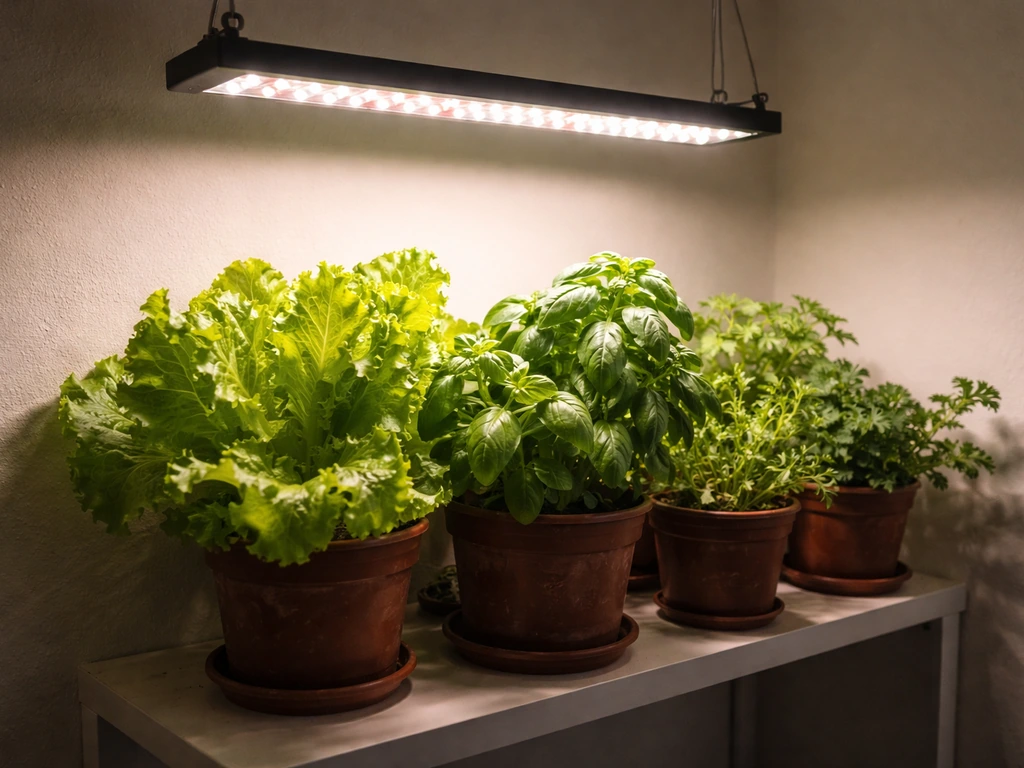
What Type of Light Do Plants Need to Grow Indoors
Pick the right grow light indoors by spectrum, brightness, and placement so plants grow well, bloom, and stay healthy.
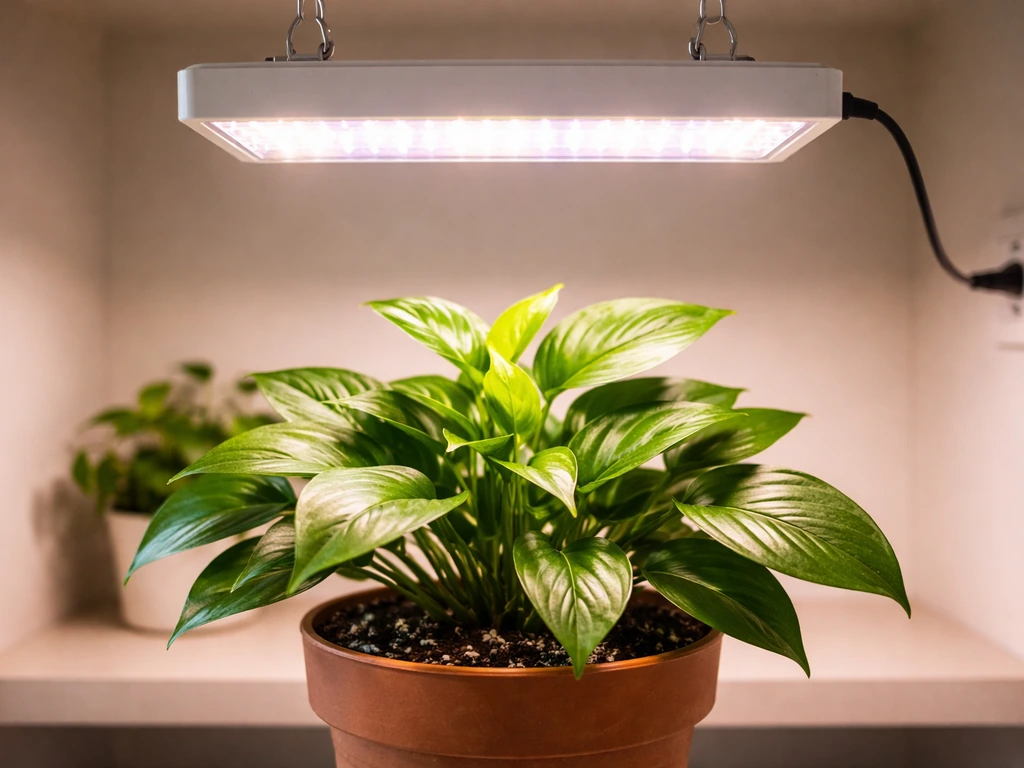
Does Plant Grow Light Work? A Practical Test Guide for Plants
Practical test guide to see if grow lights work, choose the right spectrum and setup, and troubleshoot weak results.