Not every light will grow plants, but more lights than you might expect can at least keep them alive. The real answer depends on three things: whether the light emits wavelengths in the 400–700 nm range that plants can actually use, whether it delivers enough of those photons to push a plant past its survival threshold, and whether you leave it on long enough each day. A dedicated LED grow light ticks all three boxes easily. A desk lamp with a regular incandescent bulb barely ticks one. A ring light or your phone torch? They produce so little usable light at any practical distance that they are not worth counting on for growth, though they probably will not kill a tough houseplant outright.
Will Any Light Grow Plants? Guide for Indoor Growers
Marcus Holloway
24 Jul 2026
What people really mean when they say "any light"
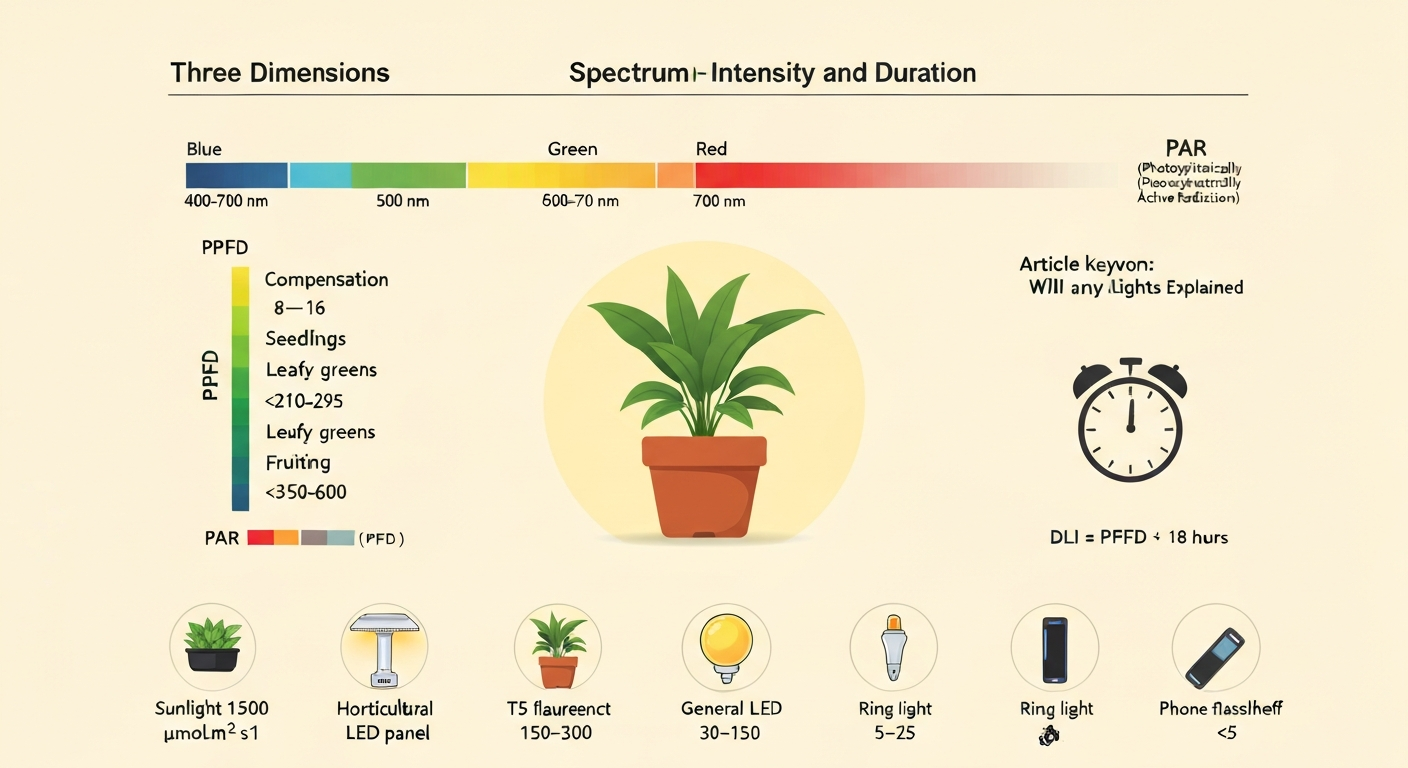
The question comes up because light is light, right? You can see it, the plant is near it, so surely something is happening. The confusion is understandable, but plants and human eyes are measuring light in totally different ways. Your eyes judge brightness using photopic vision, which peaks in the green-yellow range around 555 nm. Plants judge light by counting photons in the 400–700 nm band, weighted by how well each wavelength drives photosynthesis, a measure scientists call Photosynthetically Active Radiation (PAR). A warm incandescent bulb can look very bright to you while delivering almost no useful PAR to a tomato seedling. A cool white LED tube might look less impressive on a shelf but could be pushing out three times the plant-usable photons. So when someone asks whether "any light" works, the real question has three parts: does it emit the right wavelengths, does it emit enough of them, and for how many hours per day?
The three dimensions of useful light: spectrum, intensity, and duration
Spectrum is the range of wavelengths a light source produces. Plants absorb mainly in the blue (400–500 nm) and red (600–700 nm) portions of the PAR band, which is why early grow lights looked purple-pink. For more on blue-light effects and why plants often respond strongly to blue wavelengths, see why do plants grow best in blue light. But research, including a useful meta-analysis on green light, has since confirmed that green photons (roughly 500–570 nm) are not wasted either. A recent meta-analysis (Green light is similarly effective in promoting plant biomass as red/blue light: a meta-analysis, PMC article) reports that green photons (≈500–570 nm) penetrate leaves and canopies and, at some intensities, are as effective as red light at driving photosynthesis and biomass accumulation Green light is similarly effective in promoting plant biomass as red/blue light: a meta-analysis — (PMC article). They penetrate deeper into leaves and canopy layers and can drive photosynthesis effectively. So a full-spectrum white LED that covers the whole 400–700 nm band is a perfectly sensible choice, not just the dramatic purple lights. Intensity is how many of those useful photons arrive at the leaf surface per second, measured as PPFD (Photosynthetic Photon Flux Density) in micromoles per square metre per second (µmol·m⁻²·s⁻¹). Duration is simply how many hours per day the light is on. These three together, not any single one in isolation, determine whether your plant will merely survive, slowly grow, or actually thrive.
How plants actually use light
Every plant leaf has a light compensation point, the PPFD level where photosynthesis produces exactly as much sugar as the leaf burns in respiration. For most common houseplants and crop species under typical indoor temperatures, that compensation point sits roughly between 8 and 16 µmol·m⁻²·s⁻¹. Below that threshold, the plant is burning more energy than it makes. It is running a deficit. It will not die immediately because plants are remarkably good at shade acclimation, but it will not grow either. Meaningful, measurable biomass accumulation only happens when PPFD climbs well above the compensation point. For leafy greens and herbs you are looking at sustained levels in the 150–300 µmol·m⁻²·s⁻¹ range. For more detailed guidance on optimal PPFD and daily light targets by crop, see what light brightness makes plants grow the best. Fruiting crops like tomatoes and peppers want 300–600 µmol·m⁻²·s⁻¹ or more at the canopy. Sunlight on a clear day delivers around 1,500–2,000 µmol·m⁻²·s⁻¹ at its peak.
Photoperiod: the hours-per-day signal that controls flowering
Duration matters beyond just accumulating photons. Many plants use the length of uninterrupted darkness, the photoperiod, as a signal to flower. Short-day plants like chrysanthemums and cannabis need long dark periods to bloom. Long-day plants like lettuce and spinach bolt (flower and go bitter) when nights get too short. Day-neutral plants flower on a schedule driven more by maturity than by light. This means you can sometimes game the system a little: if your light is not very bright, you can leave it on longer to compensate, because the total daily photon dose, the Daily Light Integral (DLI), is what drives vegetative growth. A lower PPFD over 18 hours can match the DLI of a higher PPFD over 12 hours. That trick works well for leafy greens, seedlings, and most vegetative stages, but it will not help you if you are trying to control when a photoperiod-sensitive plant flowers.
PAR, PPFD, lux, and lumens: what the units actually mean
Lumens and lux are photometric units, meaning they measure brightness as the human eye perceives it. Lumens measure the total output of a bulb; lux measures how many of those lumens land on a surface per square metre. These are useful numbers for lighting a room but they are calibrated to human vision, not plant photosynthesis. PAR and PPFD are the plant-science equivalents. PAR describes the band (400–700 nm). PPFD describes the rate at which photons in that band land on a surface, measured in µmol·m⁻²·s⁻¹. You can roughly convert lux to PPFD for white light using a factor of about 0.015–0.020 (so 10,000 lux of white LED is very roughly 150–200 µmol·m⁻²·s⁻¹), but be aware that this conversion factor shifts with spectrum. A warm-white bulb and a cool-white bulb with the same lux reading will produce different PPFD values. For anything beyond casual estimation, a cheap quantum PAR meter (they start around $50 for a basic handheld model) is worth the investment. DLI, the Daily Light Integral, is PPFD integrated across the full photoperiod: DLI (mol·m⁻²·d⁻¹) = PPFD × hours × 3600 ÷ 1,000,000. It is the metric most professional growers actually track.
Dosage targets for real plants: seedlings to fruiting crops
Rather than guessing, use these target ranges as your starting point. They come from Virginia Tech extension DLI guidelines and controlled-environment agriculture literature. The PPFD ranges shown assume a typical 16-hour photoperiod for seedlings and leafy crops, and a 12-hour photoperiod for flowering and fruiting stages.
| Plant Stage / Crop | Target DLI (mol·m⁻²·d⁻¹) | Approx. PPFD at 16 hrs (µmol·m⁻²·s⁻¹) | Approx. PPFD at 12 hrs (µmol·m⁻²·s⁻¹) |
|---|---|---|---|
| Seedlings / cuttings | 5–10 | 85–175 | 115–230 |
| Microgreens | 9–12 | 155–210 | 210–275 |
| Lettuce / leafy greens | 12–17 | 210–295 | 275–390 |
| Leafy herbs (basil, mint) | 10–25 | 175–435 | 230–580 |
| Orchids / low-light houseplants | 4–8 | 70–140 | 90–185 |
| Fruiting crops (tomato, pepper, cucumber) | 20–30 | 350–520 | 460–695 |
| Cannabis vegetative stage | 20–30 | 350–520 | 460–695 |
| Cannabis flowering stage | 30–40+ | 520–695+ | 695–925+ |
A few things jump out from this table. Seedlings need surprisingly little light compared to fruiting crops, which is why a modest CFL or T5 fluorescent can genuinely work for starting seeds. Fruiting crops like tomatoes or peppers need DLI levels that household bulbs simply cannot achieve at normal mounting distances. If your grow light setup cannot hit the minimum PPFD for your chosen crop, you can compensate slightly with a longer photoperiod, but there is a ceiling: most plants should not be lit for more than 18 hours per day, and some need darkness to function normally.
Which household lights can actually work (and which cannot)
I have tested quite a few of these myself, and the results are sometimes surprising. Here is an honest rundown of common light sources you might already have at home.
LED bulbs and strips (general purpose)
Modern white LED bulbs cover the 400–700 nm PAR range reasonably well, and a cluster of them positioned close to plants (15–30 cm) can push 50–150 µmol·m⁻²·s⁻¹, which is enough for seedlings, microgreens, low-light houseplants, and some herbs. The key limitation is that a single A19 LED bulb (typically 800–1100 lumens) does not have enough raw output for leafy crops or anything that fruits. Combining several bulbs, using LED strip lights on a reflective shelf, or stepping up to a purpose-built LED panel makes a real difference. LED strips marketed for plant growing often have enhanced red and blue output and are a cost-effective option for small setups.
Fluorescent tubes and CFLs
T5 and T8 fluorescent tubes are the classic budget grow light and they still earn that reputation. A T5 HO (high-output) fixture positioned 5–15 cm above seedlings or leafy greens delivers 150–300 µmol·m⁻²·s⁻¹, which covers seedlings comfortably and gets lettuce into productive territory. They run cooler than incandescents and can be placed close to plants without burn risk. CFLs work on the same principle: a 23W spiral CFL (rated about 1600 lumens) placed 10–15 cm above a small plant can sustain modest growth. The problem with both is efficiency and scale. They are not efficient at delivering PAR per watt compared to modern LEDs, they degrade faster, and covering a large growing area gets expensive quickly.
Incandescent bulbs
Incandescents are genuinely poor grow lights and this is one area where I will not hedge. They convert only about 5–10% of their electrical energy into visible light; the rest becomes heat. Their spectrum is heavily weighted toward red and near-infrared, which means the PAR output is low relative to how bright they look and how hot they run. Positioning one close enough to a plant to deliver useful PPFD risks heat damage. They are not completely useless as a supplemental source for very low-light-tolerant houseplants, but there is no good reason to use one when LED alternatives cost almost the same and consume far less power.
Ring lights and phone flashlights
A ring light designed for video calls or photography produces real visible light, but it is designed to illuminate a human face, not drive photosynthesis. At 30 cm distance, a typical 10-inch ring light delivers roughly 5–25 µmol·m⁻²·s⁻¹, which puts it right at or below the light compensation point for most plants. That is survival territory at best, and only for shade-tolerant species. Your phone flashlight is even further from useful, typically delivering less than 5 µmol·m⁻²·s⁻¹ at any practical distance. Neither is a viable grow light. If you are curious about the specifics of ring lights, this topic gets a thorough treatment elsewhere on this site.
Dedicated horticultural LED panels
These are purpose-built to maximize PAR output per watt. Modern commercial horticultural LEDs commonly achieve photon efficacies of 1.5–3.0 µmol·J⁻¹, with top fixtures exceeding 2.8 µmol·J⁻¹. Even a modestly priced 100W LED panel designed for growing can deliver 400–700 µmol·m⁻²·s⁻¹ at 30–45 cm, enough to grow tomatoes and peppers productively. They are the most practical and energy-efficient option for anyone serious about growing indoors, and prices have dropped significantly in the last five years.
Light source comparison: strengths, weaknesses, and typical output
| Light Source | PAR Spectrum Coverage | Typical PPFD at 30 cm | Energy Efficiency (PAR per watt) | Heat Output | Best For |
|---|---|---|---|---|---|
| Direct sunlight (outdoors) | Full, 400–700 nm+ | 1,500–2,000 µmol·m⁻²·s⁻¹ | Free / unmatched | High (UV + IR) | Everything, if available |
| Horticultural LED panel | Full or targeted, 400–700 nm | 300–800 µmol·m⁻²·s⁻¹ | Excellent (1.5–3.0 µmol·J⁻¹) | Low | All indoor crops, any stage |
| T5 fluorescent tube | Broad, 400–700 nm | 150–300 µmol·m⁻²·s⁻¹ at 10 cm | Moderate (~0.8–1.1 µmol·J⁻¹) | Low-moderate | Seedlings, leafy greens, herbs |
| General LED bulb / strip | Reasonable, 400–700 nm | 30–150 µmol·m⁻²·s⁻¹ | Moderate (~0.5–1.0 µmol·J⁻¹) | Very low | Low-light plants, seedlings, herbs |
| CFL spiral bulb | Reasonable, 400–700 nm | 50–150 µmol·m⁻²·s⁻¹ at 15 cm | Low-moderate (~0.5–0.8 µmol·J⁻¹) | Low-moderate | Seedlings, small herbs |
| Incandescent bulb | Poor PAR, heavy near-IR | 10–40 µmol·m⁻²·s⁻¹ | Very poor (~0.1–0.2 µmol·J⁻¹) | Very high | Not recommended |
| Ring light (photography) | Reasonable spectrum, low output | 5–25 µmol·m⁻²·s⁻¹ | Poor for plants | Low | Not viable for plant growth |
| Phone flashlight | White LED, very low total output | <5 µmol·m⁻²·s⁻¹ | Negligible | Negligible | Not viable for plant growth |
The takeaway from this table is fairly clear. If you have a dedicated horticultural LED panel, you are well set for almost any indoor growing goal. If you are working with what you already have at home, fluorescent tubes and LED bulbs in clusters can genuinely serve seedlings and leafy greens. Incandescents, ring lights, and phone torches are not practical options for growing anything beyond the most shade-tolerant survivors.
Practical setup: distance, hours, mounting, and timers
Distance is one of the most common mistakes I see with grow lights, and it applies to all light types. Light intensity follows the inverse square law: double the distance and you get roughly one-quarter the PPFD. A grow light that delivers 400 µmol·m⁻²·s⁻¹ at 30 cm might only deliver 100 µmol·m⁻²·s⁻¹ at 60 cm. Start by hanging your light at the manufacturer's recommended height, then use a PAR meter or a lux meter with conversion to check whether you are actually hitting your target. Adjust up or down based on what you measure, not just what you guess.
For photoperiod, most vegetative growth does well at 16–18 hours of light per day. Seedlings can thrive at 16 hours. Flowering crops usually need a 12-hour photoperiod to trigger blooming. A $10 plug-in timer is one of the best investments you can make for a grow setup. Inconsistent light schedules stress plants and can disrupt flowering in sensitive species. Set it and forget it.
Reflective walls or mylar sheeting around your growing area can recover 20–30% of photons that would otherwise be wasted on walls and floor. In a small tent or shelf grow, this makes a meaningful difference to the actual PPFD your plants receive without you spending anything extra on lights. If you are growing on open shelving, even white-painted walls reflect significantly more light than bare wood or dark surfaces.
Troubleshooting: stretching, yellowing, and heat stress
Leggy, stretched seedlings with long gaps between nodes almost always signal insufficient light intensity. The plant is reaching toward any light source it can find. The fix is to move the light closer or upgrade to a higher-output source. Yellowing leaves on a plant under grow lights can mean a few things: the light is too weak (the lower leaves are shaded and dying off), the photoperiod is not long enough for the growth rate you want, or there is a nutrient issue that more light will not fix. Check your PPFD reading and your fertiliser schedule before changing the light.
Heat stress from lights shows up as bleached, papery patches on the leaves closest to the source. It is most common with incandescent bulbs and with LED panels mounted too close. The rule of thumb is to hold your hand at canopy height for 30 seconds: if it feels uncomfortably warm, raise the light. LEDs run much cooler than incandescents, but high-powered panels still produce meaningful heat and should not be pressed against plants. Keep an air gap and ensure some air circulation in your grow space.
Safety, health myths, and realistic expectations
Two questions come up often on forums and they deserve a direct answer. Will a grow light give you a tan? Standard horticultural LEDs and fluorescent grow lights emit almost no UV-A or UV-B radiation. They will not tan your skin. Some specialised UV-supplemented grow lights do emit UV, but these are a niche product and will be clearly labelled. Will grow lights cause cancer? There is no evidence that the visible-light spectrum emitted by standard grow lights poses any cancer risk. The concern likely comes from confusion with UV radiation from tanning beds or certain industrial lighting, which is a completely different category. Regular grow lights are not in that category. As with any electrical equipment, basic safety applies: use rated extension cords, keep water away from connections, ensure fixtures are hung securely, and do not exceed the wattage limits of your socket or circuit.
On realistic expectations: a $30 LED panel will not replace a summer garden for tomatoes, and a fluorescent tube will not help your pepper plants set fruit. But the right light, matched to the right crop and the right setup, genuinely works. I have grown full heads of lettuce, basil, and microgreens under nothing fancier than T5 tubes and a basic LED panel, with consistent results across multiple grows. The science is not complicated once you know what the numbers mean.
Energy use and cost: what you are actually paying
Running a 100W LED grow light for 16 hours a day uses 1.6 kWh per day. At a US average electricity cost of roughly $0.16 per kWh, that is about $0.26 per day or around $7.70 per month. A 250W panel run 12 hours per day comes to $0.48 per day, or about $14.50 per month. These are not scary numbers for a productive indoor garden, but they are worth factoring in before you scale up to multiple large lights. The big efficiency win comes from choosing LEDs over fluorescents or, especially, over HID lights. Modern horticultural LEDs at 2.0–3.0 µmol·J⁻¹ deliver roughly twice the plant-usable photons per watt compared to a double-ended HPS at 1. Nelson & Bugbee (2014) measured many commercial fixtures and reported that the best LEDs and the best double‑ended HPS fixtures then had nearly identical photon efficacies (~1.66–1.70 µmol·J⁻¹) and emphasized that fixture efficacy plus photon delivery (beam pattern, mounting height) determine usable PPFD at the canopy Economic analysis of greenhouse lighting: LEDs vs. high intensity discharge fixtures — Nelson & Bugbee (PLoS ONE, 2014). 6–1.7 µmol·J⁻¹, and they last much longer.
Buying tips: what to look for in a grow light
When shopping for a grow light, ignore marketing claims like "1000W equivalent" or "full spectrum" without supporting data. Look for actual PPFD values at a stated distance, photon efficacy in µmol·J⁻¹ (anything above 1.5 is decent for a budget light; above 2.0 is good; above 2.5 is excellent), and coverage area at a realistic hanging height. Reputable brands publish this data, often as a PPFD map that shows intensity across the coverage footprint. If a manufacturer only lists lumens and wattage, that is a red flag that they are selling to human eyes rather than to plant science.
- Check for published PPFD values at your intended hanging height (30 cm, 45 cm, or 60 cm typically)
- Look for photon efficacy above 1.5 µmol·J⁻¹ for budget options, above 2.0 for a solid mid-range choice
- Choose a coverage area that matches your actual growing footprint, not the maximum claim
- Ensure the fixture has a safety certification (UL, ETL, or CE) for electrical peace of mind
- For seed starting and leafy greens, a T5 HO fluorescent or modest LED panel is sufficient and affordable
- For fruiting crops, budget at least 30–40W of quality LED output per square foot of canopy
- Add a programmable timer, especially if you are growing photoperiod-sensitive plants
The bottom line: matching light to plant and purpose
Any light that emits PAR photons above the plant's compensation point, consistently, for enough hours per day, will grow plants. Most household lights sit right at the borderline: they can keep shade-tolerant plants alive and support the very earliest stages of seedling germination, but they will not deliver the DLI needed for productive growth of leafy crops or the PPFD needed for flowering and fruiting plants. A ring light or phone torch is not a grow light in any meaningful sense. A cluster of LED bulbs or a T5 tube can be, for the right plants in the right situation. A purpose-built horticultural LED panel is the reliable, efficient choice for anyone who wants predictable results. If you are unsure what your specific plants need, understanding what type of light plants need to grow and what brightness level makes them grow best are the logical next places to dig in.
FAQ
Short answer: will any light grow plants?
No — "any light" can keep many plants alive, but not all light will produce useful growth or yields. Plants need photons in the 400–700 nm PAR band at sufficient intensity (PPFD) and accumulated dose (DLI). Very low household light often only prevents death and causes slow, spindly, shade‑type growth; productive growth or flowering/fruiting requires higher, measurable PPFD and an appropriate photoperiod.
What does the phrase "any light" really mean in plant terms?
Colloquially it means “any visible lamp will do.” In plant science it must be translated to parameters: spectrum (which wavelengths; PAR = 400–700 nm), intensity at the leaf surface (PPFD in µmol·m⁻²·s⁻¹), and duration/photoperiod (hours per day and DLI in mol·m⁻²·d⁻¹). Without adequate values for these, the phrase is misleading.
What are the key plant‑facing light parameters I should know?
Three essentials: 1) Spectrum — photons between 400–700 nm (PAR) drive photosynthesis; blue and red influence morphology and photomorphogenesis, green penetrates canopy; 2) Intensity — PPFD (µmol·m⁻²·s⁻¹) is the instantaneous photon flux at the leaf; 3) Duration/DLI — photoperiod (hours) and Daily Light Integral (DLI = PPFD × time integrated, mol·m⁻²·d⁻¹) determine total daily photons. Also note photoperiod signals (night length) affect flowering for many species.
What PPFD and DLI targets are useful (quick reference)?
Common practical ranges (general guidelines): - Seedlings/cuttings: DLI ~5–10 mol·m⁻²·d⁻¹ (low PPFD ~50–150 µmol·m⁻²·s⁻¹ depending on photoperiod) - Microgreens: ~9–12 mol·m⁻²·d⁻¹ - Leafy greens (lettuce, herbs): ~12–17 mol·m⁻²·d⁻¹ - Fruiting greenhouse crops (tomato, cucumber): ~20–30 mol·m⁻²·d⁻¹ Remember crop and variety differences; you can reach a DLI with lower PPFD and longer photoperiod or higher PPFD and shorter photoperiod.
How do I convert lux or lumens to PPFD?
Lux and lumens are weighted for human vision and can’t directly replace PPFD. Rough approximations for white light are often used: PPFD (µmol·m⁻²·s⁻¹) ≈ lux × 0.015–0.020, or about 50–70 lux per 1 µmol·m⁻²·s⁻¹. These are spectrum‑dependent approximations — the only reliable method is to measure with a PAR/quantum meter (PPFD sensor).
Which common light sources are sufficient or poor choices for plant growth?
Summary: - Sunlight: best, full PAR and high PPFD — ideal when available. - Horticultural LEDs: efficient, spectrum selectable, commercially best for indoor production. - Fluorescent (T5) and CFL: usable for low‑to‑moderate PPFD needs (seedlings, houseplants) at close distances. - HPS/CMH: high intensity for greenhouses/warehouses. - Incandescent and most household lamps: poor choice — very low PAR per watt and lots of heat. - Ring lights and phone lights: essentially inadequate for anything beyond preventing death; PPFD too low for real growth.
Next Articles
What Type of Light Do Plants Need to Grow Indoors
Pick the right grow light indoors by spectrum, brightness, and placement so plants grow well, bloom, and stay healthy.
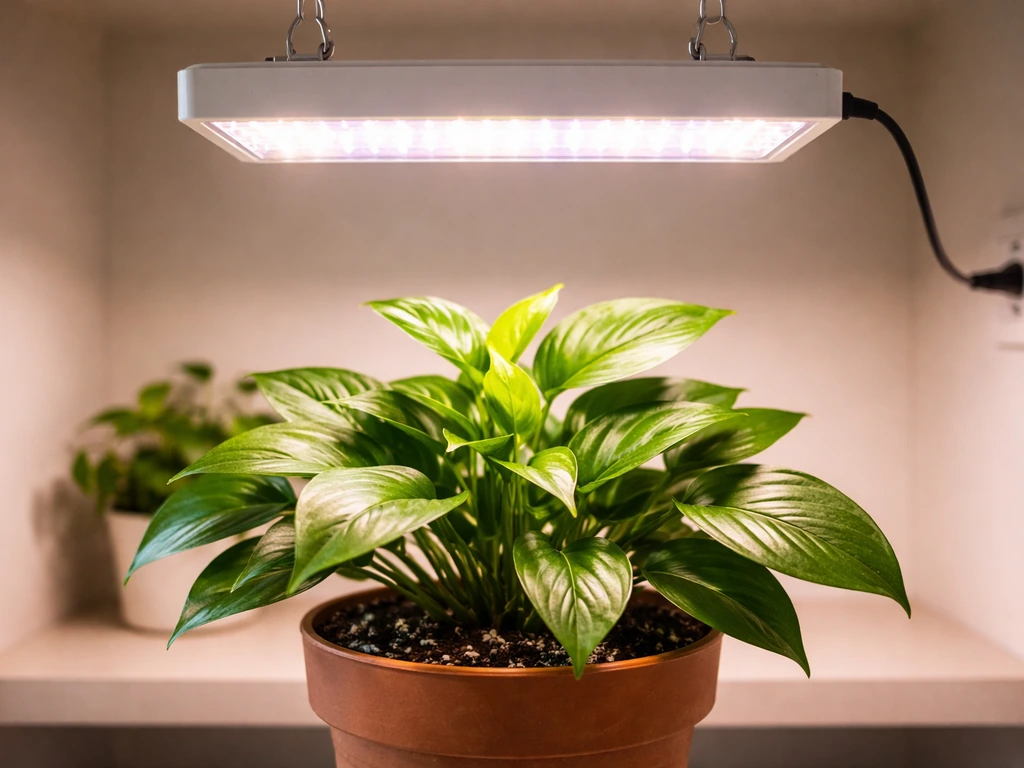
Does Plant Grow Light Work? A Practical Test Guide for Plants
Practical test guide to see if grow lights work, choose the right spectrum and setup, and troubleshoot weak results.
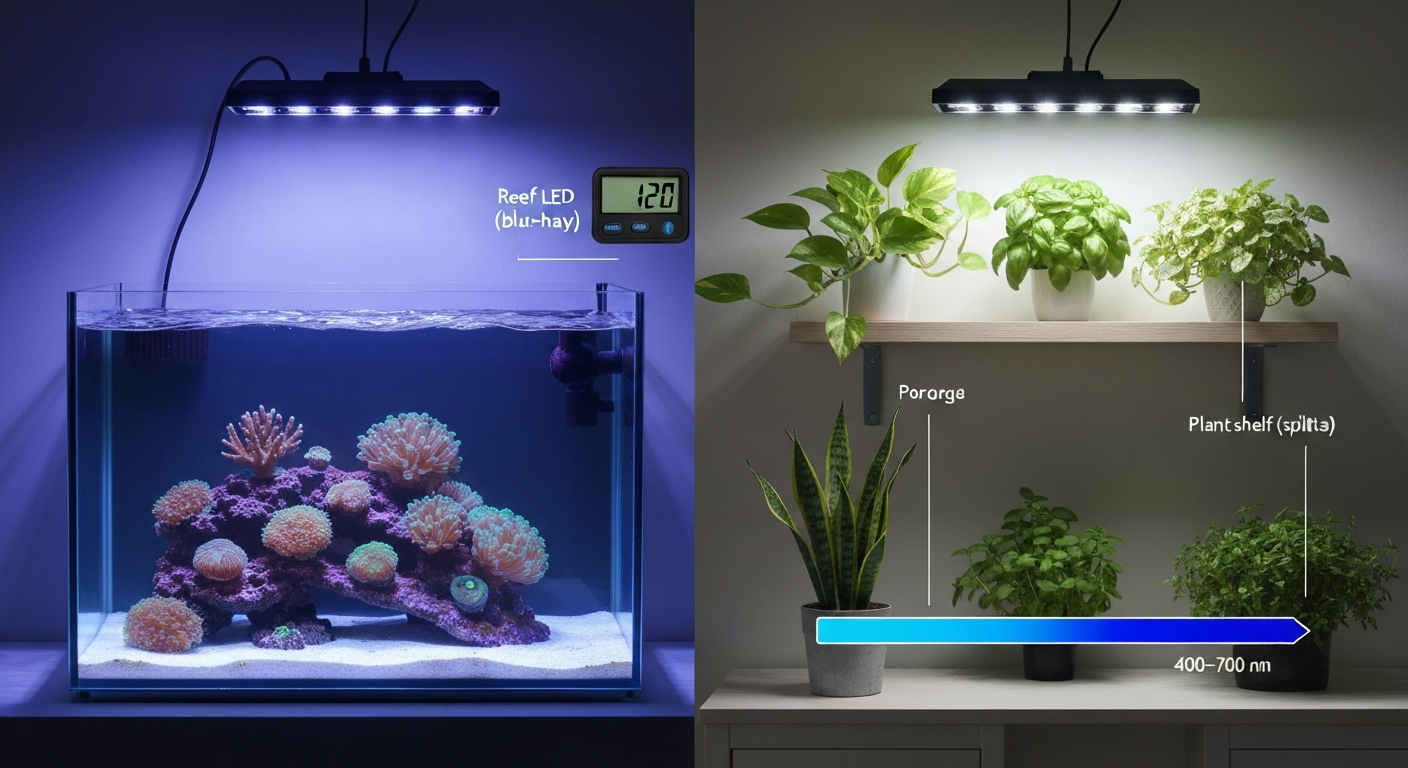
Can Reef Lights Grow Plants? Guide for Hobbyists & Growers
Can reef aquarium LEDs grow plants? Clear, evidence-based yes/no by plant type, PAR targets, retrofit & safety tips.