Reef lights can grow plants, but how well they do it depends entirely on what you're trying to grow. For low-light houseplants like pothos or ferns, a reef LED sitting above a tank will provide enough photons to keep them alive and growing. For freshwater aquatic plants, most modern aquarium LEDs work fine. For marine macroalgae and corals, reef lights are the right tool. But for cannabis, tomatoes, or any high-light terrestrial crop, reef and aquarium fixtures simply don't deliver the PPFD (photon intensity) those plants need, and swapping in a proper grow light will make a measurable difference.
Can Reef Lights Grow Plants? Guide for Hobbyists & Growers
Marcus Holloway
21 Jul 2026
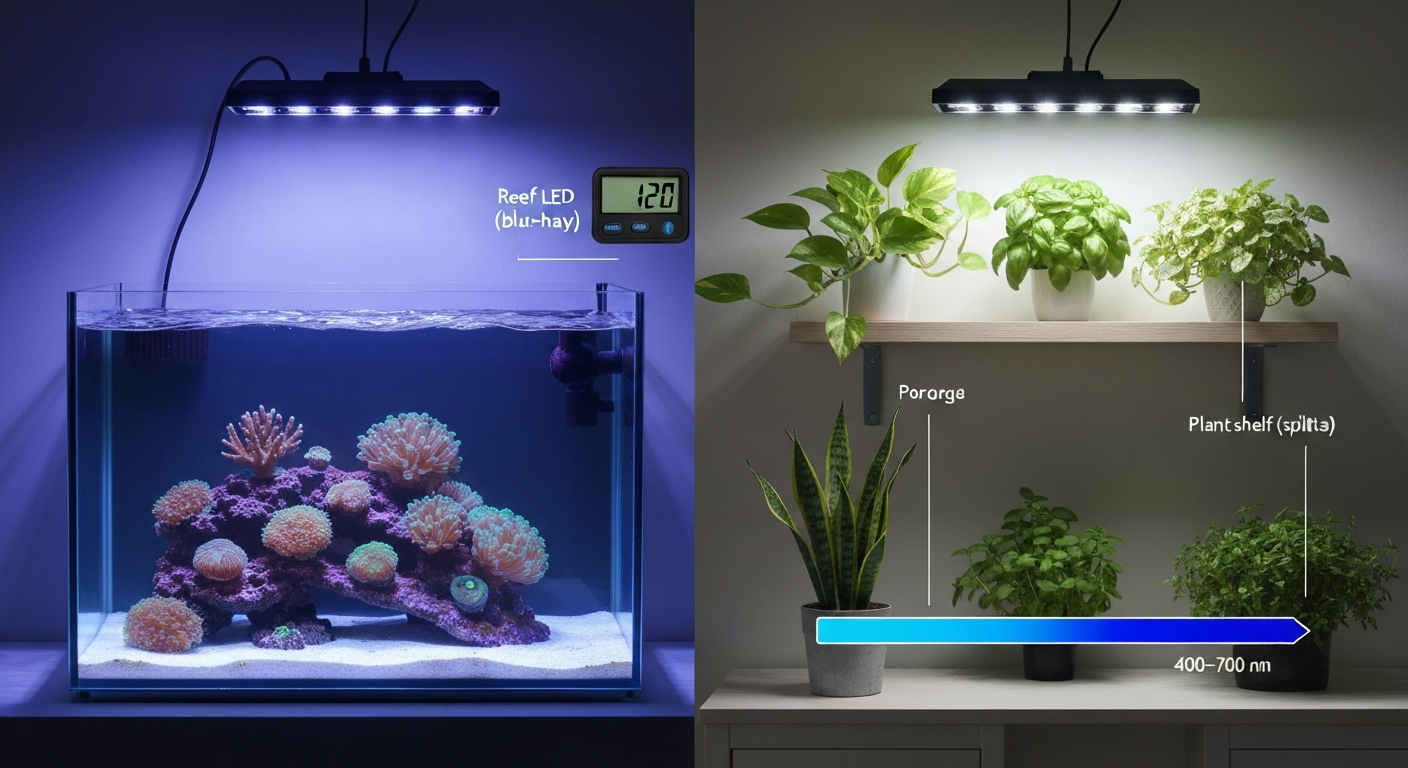
Quick answer: can reef, aquarium, or reptile lights grow plants?
I get this question a lot, usually from aquarium hobbyists who have a spare reef fixture and a windowsill full of plants, or from someone who just set up a vivarium and wonders if the light doing double duty for lizards can also keep plants thriving. Here's the short version by plant type. If you want a quick, practical answer to can you use aquarium lights to grow plants, see this concise guide for clear, evidence-based recommendations.
| Plant type | Will reef/aquarium LEDs work? | Will reptile lights work? | Key limitation |
|---|---|---|---|
| Low-light houseplants (pothos, peace lily, snake plant) | Yes, usually sufficient | Partial (UVB bulbs lack red; compact fluorescents vary) | Spectrum skewed blue; supplement red if plants stretch |
| Medium-light houseplants (herbs, philodendron) | Yes, with good positioning | Generally no | PPFD may be marginal; hang closer or add red strip |
| High-light houseplants / succulents | Marginal; will need supplementing | No | Output too low; upgrade or add grow bars |
| Freshwater aquatic plants (low/med light) | Yes, this is what they're designed for | No | Works well; match PPFD to plant category |
| Freshwater aquatic plants (high light, CO2 injected) | Yes, if fixture is powerful enough | No | Check substrate PPFD; not all aquarium LEDs reach required levels |
| Marine macroalgae (refugium, display) | Yes, reef LEDs are ideal | No | Match species light saturation point; wide range by species |
| Soft corals / LPS corals | Yes, reef LEDs designed for this | No | Keep PPFD 50–250 µmol·m⁻²·s⁻¹; slow acclimation essential |
| SPS corals | Yes, high-end reef LEDs designed for this | No | Need 200–600+ µmol·m⁻²·s⁻¹; temperature and light interact for bleaching risk |
| Cannabis (vegetative) | Barely; very limited results | No | Needs 300–700 µmol·m⁻²·s⁻¹ minimum; reef LEDs rarely hit this over a canopy |
| Cannabis (flowering) | No, not practically | No | Needs 600–1,200 µmol·m⁻²·s⁻¹; purpose-built grow light required |
How plants and corals use light: PAR, PPFD, spectrum, and photoperiod in plain language
Plants and corals both run on photons, but the way we measure those photons matters a lot. PAR stands for Photosynthetically Active Radiation, which is simply the slice of the light spectrum between 400 and 700 nanometres (nm) that drives photosynthesis. Think of it as the 'edible' part of the light buffet for a plant. PPFD, or Photosynthetic Photon Flux Density, is how we measure how many of those photons are hitting a surface every second. It's reported in micromoles of photons per square metre per second (µmol·m⁻²·s⁻¹), and a LI-COR quantum sensor is the gold-standard tool for measuring it. Science of Light Measurement, LI‑COR Environmental explains that PAR is 400–700 nm, PPFD is reported in µmol·m⁻²·s⁻¹, and LI‑COR quantum sensors are the research standard for measuring and calibrating PPFD Science of Light Measurement — LI‑COR Environmental. The key thing to understand is that lux meters, which measure brightness for human eyes, are not reliable for plants because lux is weighted toward how we see light, not how a plant absorbs it. There is no fixed conversion from lux to PPFD because the result changes completely depending on the lamp spectrum.
Spectrum matters beyond just 'how bright.' Research going back to McCree's 1971/1972 action spectrum work shows that plants are most photosynthetically efficient in the red (roughly 600–700 nm) and blue (400–500 nm) bands, with lower efficiency in the green middle. On top of raw photosynthesis, plants use specific photoreceptors called phytochromes (red and far-red sensitive) and cryptochromes (blue sensitive) to control how they grow, when they flower, and whether they stretch toward light. This is why spectrum shapes the plant's form, not just its growth rate. A light source that's heavy in blue but missing red will often cause stretchy, etiolated growth in terrestrial plants. Photoperiod, the number of hours of light per day, is equally important. Many plants use day length to trigger flowering, which is why cannabis growers switch from 18 hours to 12 hours of light to force the plant into flower.
How reef LEDs, aquarium lights, reptile fixtures, and grow lights actually differ
These four types of fixtures look superficially similar, and they all produce light, but they're engineered for fundamentally different jobs. Understanding the differences tells you immediately which one will work for your plants and which won't. If you want a deeper discussion on whether aquarium lights can be used as grow lights, see the article titled 'can aquarium lights be used as grow lights' for detailed comparisons and recommendations.
| Feature | Reef LED (e.g. Radion, Kessil, Orphek) | Freshwater aquarium LED | Reptile fixture (UVB/heat) | Purpose-built grow light (e.g. HLG, Fluence SPYDR) |
|---|---|---|---|---|
| Primary spectrum emphasis | Blue-heavy (actinic 420–470 nm) for coral fluorescence | Broad white + some blue/red for plant and fish colour | UVB (280–315 nm) + visible white or heat (infrared) | Balanced red/blue or full-spectrum white tuned to McCree curve |
| Red channel (630–700 nm) | Often limited or absent in basic models; programmable in high-end units | Moderate; depends on model | Often poor; incandescent/ceramic heat bulbs lack useful PAR | Strong; purpose-built for photosynthesis |
| Far-red (>700 nm) | Rare | Rare | Rare | Included in many modern horticulture LEDs |
| Typical max PPFD over a canopy | 100–400 µmol·m⁻²·s⁻¹ at 30 cm (varies by model) | 30–150 µmol·m⁻²·s⁻¹ at substrate | Low; UV output not in PAR band | 600–1,200+ µmol·m⁻²·s⁻¹ over 1.2×1.2 m |
| Beam angle | Narrow to medium; optimised for aquarium depth | Wide; spread for tank coverage | Wide; ambient room heat and light | Wide; optimised for horizontal canopy coverage |
| Dimming and programming | Yes, full spectrum control in premium models | Basic; some dimmable | No | Yes, full control in quality units |
| Designed for terrestrial plants | No | No | No | Yes |
| Useful for corals/macroalgae | Yes, primary use case | No | No | Not designed for it |
Reptile lights deserve a specific note here. UVB bulbs (used for reptile vitamin D synthesis) output energy in the 280–315 nm range, which is below the PAR band entirely. The visible light from compact fluorescent reptile bulbs or T5 reptile fixtures does contribute some PAR, but the red spectrum is typically weak and the overall PPFD is low. If you're wondering whether reptile lights can grow plants, the short answer is: only marginally, for low-light species, and you'd be better off with even a basic grow strip. The situation is similar to asking whether aquarium lights can serve other purposes, and there's a broader comparison worth thinking through between all these crossover use cases. For a focused discussion on using reptile fixtures for plants, see can reptile lights grow plants.
Measurable light targets to aim for
These PPFD ranges give you concrete targets to work toward. They come from published research, aquarium hobby consensus, and reefkeeping industry guidelines. I use them as practical planning numbers, not hard ceilings, because real-world results always depend on CO2, nutrients, temperature, and acclimation history.
| Plant / coral category | Target PPFD (µmol·m⁻²·s⁻¹) | Typical photoperiod | Notes |
|---|---|---|---|
| Low-light houseplants (pothos, ferns, peace lily) | 10–50 | 12–14 h | Reef LEDs easily achieve this above the tank |
| Medium-light houseplants (herbs, philodendron) | 50–200 | 14–16 h | Possible with reef LED close overhead; check with meter |
| High-light houseplants / succulents | 200+ | 14–16 h | Reef LEDs may struggle; grow light recommended |
| Freshwater aquatic plants, low-light (Java fern, Anubias) | 15–30 at substrate | 8–10 h | Most aquarium LEDs sufficient |
| Freshwater aquatic plants, medium-light | 35–50 at substrate | 8–10 h | Good aquarium LED at correct height |
| Freshwater aquatic plants, high-light (CO2 injected) | 50–80+ at substrate | 8–10 h | Need a quality fixture; verify with PAR meter |
| Cannabis, vegetative (18 h) | 300–700 | 18 h | Aquarium/reef LEDs insufficient for serious growth |
| Cannabis, flowering (12 h) | 600–1,200 | 12 h | Purpose-built grow light required |
| Soft corals | 50–250 | 10–12 h (with ramp) | Reef LED ideal; acclimate slowly from low end |
| LPS corals | 70–250 | 10–12 h (with ramp) | As above; placement by species sensitivity |
| SPS corals | 200–600+ | 10–12 h (with ramp) | High-end reef LED required; temperature management critical |
Water, glass, and depth: how aquarium conditions change the light plants actually receive
One thing people underestimate is how much light is lost before it reaches a plant or coral on the substrate. Water absorbs and scatters light, and the amount of loss depends heavily on wavelength. Red light (around 630–700 nm) is absorbed much more aggressively by water than blue light, which is why deep ocean water looks blue: the reds are gone by the time you're a few metres down. In a typical aquarium that's 30–50 cm deep, you can lose 30–70% of red PPFD depending on water clarity, while blue photons penetrate more efficiently. This matters practically: a freshwater planted aquarium LED that looks bright at the surface may deliver surprisingly low red PPFD at the substrate, which explains why so many planted tank guides tell you to check PAR at substrate level, not at the glass top.
Dirty glass, scratches, and cover glass panels add another layer of loss. A glass lid typically reduces total light transmission by 5–15% even when clean. Algae or mineral deposits on the glass can double that loss. If your substrate PPFD measurements seem lower than expected, check and clean the cover glass first before blaming the fixture. For terrestrial plants sitting outside the tank above a reef light, these water effects don't apply, but the glass top of the light fixture itself can affect spectrum and intensity if it's coated for UV filtering.
Growing terrestrial houseplants under reef or aquarium LEDs
I've grown pothos, tradescantia, and a few herbs on a shelf directly above a running reef tank, and it works surprisingly well for the low-to-medium-light species. The light spilling over the tank edges and the spread from the fixture above is enough to keep most tropical foliage plants happy without any supplemental lighting. The catch is spectrum. Most reef LEDs are blue-heavy by design, tuned to emphasise coral fluorescence rather than balanced plant photosynthesis. Over time, I noticed my herbs growing a little more compact and slightly bluer-green than they do under a purpose-built grow strip, which I suspect is the blue-dominant spectrum pushing toward more compact, vegetative growth. For flowering plants, this is more of an issue: without adequate red light (630–680 nm), phytochrome signalling is incomplete and flowering can be delayed or suppressed.
The simplest fix is to add a cheap warm-white or red LED grow strip alongside the reef fixture. A 3000K or 3500K white LED strip adds the red-wavelength balance that blue-heavy reef LEDs lack. Position it close enough to bump PPFD into the 50–150 µmol·m⁻²·s⁻¹ range for medium-light plants, and run it for 14–16 hours per day. You don't need anything fancy. A basic LED grow bar from any garden centre will do the job for a few trailing plants on a shelf.
- Low-light houseplants (pothos, Sansevieria, peace lily): reef/aquarium LED light spill is usually enough
- Medium-light herbs and foliage plants: place within 30–40 cm of the reef LED or add a warm-white strip
- Watch for stretching (long internodes, leaning toward the brightest point): it means PPFD is too low or red is lacking
- Avoid placing heat-sensitive plants directly over high-wattage reef fixtures with poor heat dissipation
- Don't rely on lux meters for measuring progress: borrow or buy a quantum PAR meter to confirm PPFD
Freshwater aquatic plants: when aquarium LEDs are enough and when they aren't
For freshwater planted aquariums, the news is much better. For practical guidance on choosing and pairing grow lights with aquarium setups, see can i use grow light for aquarium. Low-to-medium-light aquatic plants like Java fern, Anubias, Cryptocoryne, and most mosses need only 15–50 µmol·m⁻²·s⁻¹ at substrate level, and virtually any decent aquarium LED achieves this over a standard 40–80 litre tank. Many reef LEDs, even the blue-heavy ones, deliver enough broad-spectrum light for these species because the spectrum requirements of freshwater plants are more forgiving than corals or high-light terrestrial crops. The real issue arises with high-light, CO2-injected planted aquariums growing demanding species like Rotala, Glossostigma, or aquatic grasses. These want 50–80+ µmol·m⁻²·s⁻¹ at the substrate, which means the fixture needs to push significant PPFD through the water column. A quality freshwater aquarium LED designed for planted tanks will do this; a basic fish-only tank light often won't. Reef LEDs can theoretically hit these numbers, but their blue-weighted spectrum means less red energy reaches the substrate, and red depletion with depth means substrate red PPFD can fall short even when the fixture looks intense.
The practical guidance is: measure at substrate level with a PAR/PPFD meter, target the ranges in the table above, and choose your run time to match. Most planted tank hobbyists run 8–10 hours per day to balance plant growth against algae. If you're using a reef LED over a freshwater planted tank and running it at a spectrum heavy in blue actinic channels, consider dialling up the white/warm channels or adding a supplemental strip for better red coverage.
Marine macroalgae and corals: when reef lights shine (and when they cause problems)
This is the domain reef LEDs are actually built for, so the question flips: here you're asking whether the light is appropriate, not whether it can do the job at all. See can you grow coral with led lighting for detailed guidance on coral lighting needs. For marine macroalgae grown in a refugium or display tank (Chaetomorpha, Caulerpa, Ulva, and others), a quality reef LED works extremely well. Species like Ulva can have photosynthetic saturation points (the PPFD at which photosynthesis maxes out) of roughly 300–600 µmol·m⁻²·s⁻¹ in active growth phases, and some can tolerate over 1,000 µmol·m⁻²·s⁻¹ in bright surface conditions. Most reef LEDs can deliver this kind of intensity for macroalgae at close range.
For corals, intensity targets vary dramatically by category. Soft corals and LPS (large polyp stony) corals are relatively tolerant and can thrive in the 50–250 µmol·m⁻²·s⁻¹ range. SPS (small polyp stony) corals like Acropora are often targeted at 200–600+ µmol·m⁻²·s⁻¹ depending on species, acclimation history, and whether you're keeping the tank warm. The critical risk is coral bleaching. Coral bleaching happens when zooxanthellae (the symbiotic algae inside coral tissue) are expelled, usually under the combined stress of high light and elevated temperature. Research shows photoinhibition of coral zooxanthellae photosynthesis increases at PPFD above roughly 600 µmol·m⁻²·s⁻¹, and the threshold drops significantly when water temperature rises above normal. This means ramping intensity slowly when introducing new corals or upgrading fixtures is essential: a fast jump from 100 to 400 µmol·m⁻²·s⁻¹ can bleach a coral that would have been fine at the higher level if it had been acclimated gradually over 4–6 weeks.
- Use the sunrise/sunset ramping function on programmable reef LEDs: never switch from off to full power instantly
- Introduce new corals at the bottom of the tank and move them up gradually over weeks
- Monitor zooxanthellae colour: pale or white patches are early bleaching indicators
- Keep water temperature stable: light + heat stress together are more damaging than either alone
- Check manufacturer PAR maps for your fixture at the hanging height you're using; don't guess at coral PPFD
Cannabis and other high-light crops: the honest limit of aquarium fixtures
I'll be direct here: for cannabis or any other high-light crop grown seriously, reef and aquarium LEDs are not the right tool. For more detail, see the guide can i use an aquarium light to grow marijuanas. The published research on cannabis light requirements is clear. Vegetative growth benefits from around 300–700 µmol·m⁻²·s⁻¹ and flowering from 600–1,200 µmol·m⁻²·s⁻¹, with some studies pushing to 1,500–2,000 µmol·m⁻²·s⁻¹ in high-CO2 environments. A typical reef LED, even a premium unit like the EcoTech Radion or Kessil A360X, produces a PAR map that might hit 300–400 µmol·m⁻²·s⁻¹ directly beneath the fixture at close range. That's not a canopy average across a 1.2 x 1.2 metre grow space: it's a hotspot at the centre, dropping off toward the edges. Purpose-built grow lights like the Fluence SPYDR 2P or HLG Quantum Boards deliver 900–1,000+ µmol·m⁻²·s⁻¹ as a canopy average across that same footprint. The difference in yield and potency is not subtle.
If you're using a reef or aquarium LED for cannabis and genuinely can't upgrade, you can squeeze a little more performance by hanging the fixture as close as heat allows (usually 15–25 cm above canopy for LED), running the fixture at full power, and using reflective walls to redirect spill light. But be realistic: you'll be growing at the lower end of the vegetative PPFD target at best, and flowering results will be disappointing. The question of using aquarium lights for cannabis comes up often enough that it's worth stating clearly: the spectrum and intensity mismatch makes it impractical for anything beyond an exploratory seedling.
Practical retrofit and upgrade options
If you want to make a reef or aquarium LED work better for terrestrial plants, or supplement an aquarium setup, there are a few practical paths. None of them require expensive equipment or wiring knowledge.
- Add a warm-white LED grow bar or strip (3000K–3500K): this fills in the red spectrum that blue-heavy reef LEDs lack. Clip it to a shelf above the plants or mount it on the tank hood. A 20–40W strip is usually enough for a 60–90 cm plant area.
- Use the spectrum controls on programmable reef LEDs: units like the Radion or Orphek Atlantik iCon allow you to boost the white and red channels independently. If you're growing plants outside the tank, dial up the 660 nm red and white channels and back off the 420 nm actinic.
- Add a supplemental red LED module: discrete 660 nm LED modules are cheap and can be wired into an existing 12V driver or plugged into USB. A few of these pointed at your plant shelf add meaningful red PPFD without replacing the reef fixture.
- Use a separate budget grow light for terrestrial plants: for under $30–50, a basic LED grow panel or T5 grow bar gives better spectrum balance for houseplants than any amount of reef LED tweaking. Keep the reef light for the reef.
- Use dimmers strategically: if your reef LED is programmable, use a slow ramp-up schedule (sunrise/sunset profiles) for both coral and plant health. Abrupt on/off cycling stresses both corals and plants.
What you should not do: Don't try to rewire or modify a sealed reef LED fixture. Don't remove UV-filtering glass from fixtures near living things. Don't use reptile UVB bulbs as a primary grow light source because their PAR output is too low and the UV exposure risk to eyes and skin is real at close range.
Fixture positioning, run times, and how to measure PPFD yourself
Positioning makes an enormous difference. PPFD follows an inverse square relationship with distance, roughly speaking: move a light twice as far away and the intensity at the target drops to about a quarter. Practical distances for reef LEDs used over plants typically range from 20–45 cm above the leaf canopy for medium-PPFD plants. For aquarium use, follow the manufacturer's PAR maps for hanging height, since those are built around delivering target PPFD to the aquarium bottom.
| Use case | Recommended hanging height above canopy/substrate | Photoperiod | Notes |
|---|---|---|---|
| Low-light houseplants under reef LED | 30–50 cm | 12–14 h | Light spill from tank may be sufficient; confirm with meter |
| Medium-light houseplants under reef LED | 20–35 cm | 14–16 h | Supplement with red strip if stretching occurs |
| Freshwater planted aquarium (low/medium light) | Per manufacturer map for tank depth | 8–10 h | Target substrate PPFD, not surface PPFD |
| Freshwater planted aquarium (high light) | Per manufacturer map | 8–10 h | Measure at substrate; CO2 injection usually needed above 50 µmol·m⁻²·s⁻¹ |
| Soft/LPS corals | Per manufacturer map, 30–50 cm typical | 10–12 h with ramp | Use sunrise/sunset ramp; acclimate new corals slowly |
| SPS corals | Per manufacturer map, 20–35 cm typical | 10–12 h with ramp | Monitor PAR and temperature together; bleaching risk above 600 µmol·m⁻²·s⁻¹ |
To measure PPFD yourself, a dedicated quantum sensor (like the Apogee MQ-500 or LI-COR LI-190) is the correct instrument. They run $200–400 but are accurate and reliable. Budget smartphone-based PAR meters and clip-on sensors exist in the $30–80 range and, while less precise, will give you a directionally correct reading. Lux meters are not appropriate, as I mentioned earlier: the lux-to-PPFD conversion factor varies completely with the light source spectrum. A reef LED heavy in blue will give a wildly different PPFD for any given lux reading compared to a warm-white grow strip. Always measure PPFD directly.
Safety notes: UV, heat, electrical, and water risks
Mixing electricity, water, and glass around living things requires basic precautions. Reef LEDs are designed to run over aquariums, which means most quality fixtures have splash-resistant housings, but very few are rated for submersion. Always check the IP (Ingress Protection) rating of your fixture. IP65 means the fixture is dust-tight and protected from water jets; IP67 means it can be immersed briefly. For use over open tanks, IP65 or better is the practical minimum. Running a fixture with no IP rating directly over an open saltwater sump is asking for a corrosion problem at minimum and an electrical fault at worst.
UV exposure from reef LEDs is a real but manageable concern. Many reef LEDs include violet and near-UV channels (380–420 nm) to drive coral fluorescence. Prolonged direct exposure of eyes or skin at close range to these channels is not recommended. Always use UV-blocking glasses when working inside the tank with reef LEDs running. The grow-light question around UV (whether grow lights can tan or harm skin) is a common concern for people starting out with any grow lighting, and the same caution applies here: brief accidental exposure from a reef LED is not a serious hazard, but don't stare into the fixture or work barehanded at close range for extended periods.
- Use GFCI (RCD) protection on all electrical outlets used with aquarium lighting and water equipment
- Check the IP rating of your fixture before mounting it over an open tank or sump
- Don't run power cables through water or over wet surfaces without proper cable management
- Allow ventilation around the driver/heat sink on high-wattage reef LEDs: overheating shortens LED lifespan and can be a fire risk in enclosed canopies
- Wear UV-protective glasses when working close to reef LEDs with violet/actinic channels active
- Never modify sealed fixtures yourself: doing so voids the warranty and potentially creates electrical hazards
- Keep heat-producing drivers away from heat-sensitive plants and animals
Decision checklist: keep the reef light, supplement it, or upgrade?
Run through this checklist to figure out the right path for your situation.
- Are you growing only low-light houseplants (pothos, Sansevieria, ferns) near an existing reef or aquarium setup? Keep the reef light. The spill light is likely sufficient. Measure PPFD to confirm.
- Are you growing medium-light herbs or foliage plants above or beside a reef tank? Keep the reef light and add a warm-white LED grow bar for red balance. Total cost under $30.
- Are you running a freshwater planted aquarium with low-to-medium-light plants? A quality aquarium LED is sufficient. Measure substrate PPFD and choose photoperiod (8–10 h) to manage algae.
- Are you running a high-light CO2 planted tank? Stay with a purpose-built planted aquarium LED that hits 50–80+ µmol·m⁻²·s⁻¹ at substrate. A reef LED can work if it delivers that spectrum and intensity at depth.
- Are you keeping soft corals or LPS in a reef tank? Your reef LED is the right tool. Follow manufacturer PAR maps, ramp slowly, and watch temperature.
- Are you keeping SPS corals? You need a high-end reef LED (Radion, Orphek Atlantik, Kessil A360X or equivalent). Budget aquarium LEDs won't hit the PPFD or spectrum targets reliably.
- Are you trying to grow cannabis or other high-light crops? Buy a purpose-built grow light. A quantum board or full-spectrum LED grow panel in the 200–600W range will outperform any aquarium or reef LED significantly and deliver measurably better results.
- Are you using a reptile UVB fixture for plants? Replace it with even a basic LED grow bar. Reptile UVB bulbs provide negligible PAR for plant growth.
Quick troubleshooting: what slow growth, stretching, bleaching, and algae actually mean
When something goes wrong under a reef or aquarium light, the symptoms usually point directly at the cause. Here's how to read them.
| Symptom | Most likely cause | Fix |
|---|---|---|
| Terrestrial plants stretching toward light (long internodes) | PPFD too low or red spectrum lacking | Lower fixture height, add red/warm-white strip, or increase photoperiod |
| Terrestrial plants look healthy but won't flower | Red/far-red spectrum too low; blue-dominant light delaying phytochrome signal | Add warm-white or 660 nm red supplement; ensure correct photoperiod for species |
| Freshwater aquatic plants growing slowly with pale leaves | PPFD too low at substrate or nutrient deficiency | Measure substrate PPFD; increase intensity or raise photoperiod to 9–10 h; check fertiliser |
| Algae bloom in freshwater planted tank | Photoperiod too long, nutrients unbalanced, or PPFD too high for plant density | Reduce photoperiod to 7–8 h; add more fast-growing plants; check nutrient dosing |
| Coral colour fading (pale without bleaching) | Light intensity too low or spectrum shifted away from blue actinic | Raise PPFD gradually; check blue channel output; clean glass |
| Coral bleaching (white patches) | Light too intense, temperature too high, or both together | Immediately lower intensity; check water temperature; allow recovery before increasing again |
| SPS corals not colouring up (drab brownish) | PPFD too low for species; insufficient actinic spectrum | Increase intensity gradually; boost blue channel; confirm fixture is hitting target PPFD |
| Cannabis seedlings leggy and pale under aquarium LED | PPFD far below 300 µmol·m⁻²·s⁻¹; wrong spectrum | Switch to purpose-built grow light; aquarium LED is not suitable for this use case |
The common thread in most of these problems is that someone is either guessing at PPFD or using the wrong fixture for the job. A $50 PAR meter and a clear-eyed look at what fixture you're using will solve most of these issues before they become costly. Reef lights are genuinely impressive pieces of engineering for their intended job. They're just not grow lights, and grow lights aren't reef lights. When you match the tool to the task, both the plants and the corals do better.
FAQ
Short answer: can reef (aquarium) LED lights grow plants or cannabis?
It depends on the plant type and the fixture. Reef LEDs are optimized for underwater corals and macroalgae (blue‑heavy spectrum and actinic peaks) and often provide modest total PAR at hanging heights used for terrestrial plants. They can support low‑light freshwater plants and some macroalgae or corals when used as intended, but they usually cannot deliver the high PPFDs or full red/blue balanced spectrum that high‑light terrestrial crops (including commercial cannabis) require for optimal growth and yield.
Which plant types are likely to do well under reef LEDs, which will struggle, and which need proper grow lights?
Yes (likely to work): low‑light terrestrial houseplants (Pothos, Sansevieria, ZZ), low‑to‑medium freshwater aquarium plants, many soft corals and low‑to‑medium light macroalgae when the light is above the water. Maybe/conditional: medium‑light freshwater plants and some resilient macroalgae if PAR at plant level and spectrum are acceptable. No (likely insufficient): high‑light aquarium plants, demanding freshwater foreground plants, most SPS corals without dedicated reef fixtures, and high‑yield cannabis/other high‑light crops—these need purpose‑built horticultural LEDs to reach typical target PPFDs.
What are the measurable light targets I should use (PAR/PPFD and DLI) for different plant/coral groups?
Use PPFD (µmol·m⁻²·s⁻¹) measured at canopy/leaf/substrate level and consider daily light integral (DLI) = PPFD × photoperiod. Rough targets: Terrestrial plants: low 10–50 µmol·m⁻²·s⁻¹, medium 50–200 µmol·m⁻²·s⁻¹, high ≥200 µmol·m⁻²·s⁻¹ (many houseplants do fine at low–medium). Cannabis/commercial flowering often targets 600–1,200 µmol·m⁻²·s⁻¹ at canopy for high yields. Freshwater planted aquaria (hobbyist ranges): low ~15–30, medium ~35–50, high ~50–80+ µmol·m⁻²·s⁻¹ at substrate. Macroalgae: species variable; some Ulva/kelp tolerate 100s–1,000s; check species E_k. Corals: soft corals/LPS ~50–250, many SPS ~200–600+ depending on species and acclimation. Measure with a quantum (PPFD) sensor—lux is unreliable without spectrum.
Why are reef LEDs spectrally different from horticultural LEDs and why does that matter?
Reef LEDs emphasize blue and actinic wavelengths (≈400–520 nm) to drive coral fluorescence and visual color and to penetrate water; horticultural LEDs include strong red (600–700 nm) plus blue to match plant photosynthetic response (McCree action spectrum). Plants use red and blue efficiently for photosynthesis and photomorphogenesis (phytochromes, cryptochromes). Reef SPDs can still provide usable photons in the 400–500 nm and some 600–700 nm overlap, but usually lack the balanced red needed for maximum plant photosynthesis and desired form (compactness, flowering cues).
How does light attenuation by water affect using aquarium lights for plants above the tank or macroalgae in the tank?
Water absorbs and scatters photons—blue penetrates best, red attenuates faster. For corals and macroalgae inside the tank, reef LEDs are optimized to deliver effective PPFD underwater at intended mounting heights and beam angles. For terrestrial plants above the aquarium, the water column doesn't matter, but reef fixture beam patterns and reflectors are designed for tanks and may not deliver even canopy coverage. If you put turf/terrestrial plants above an aquarium light intended for in‑tank use, measure PPFD at the plant level rather than assuming output equals manufacturer claims.
When will a reef LED 'work' for a terrestrial houseplant or planted aquarium without modification?
It will work if: (1) the plant is a low‑to‑medium light species; (2) measured PPFD at the leaf/substrate meets the low/medium target for that species; and (3) spectrum is acceptable for the grower’s goals (foliage color, compactness). Many houseplants (10–100 µmol·m⁻²·s⁻¹ needs) and low/medium freshwater plants fall into this category. Use a PPFD meter to confirm.
Next Articles
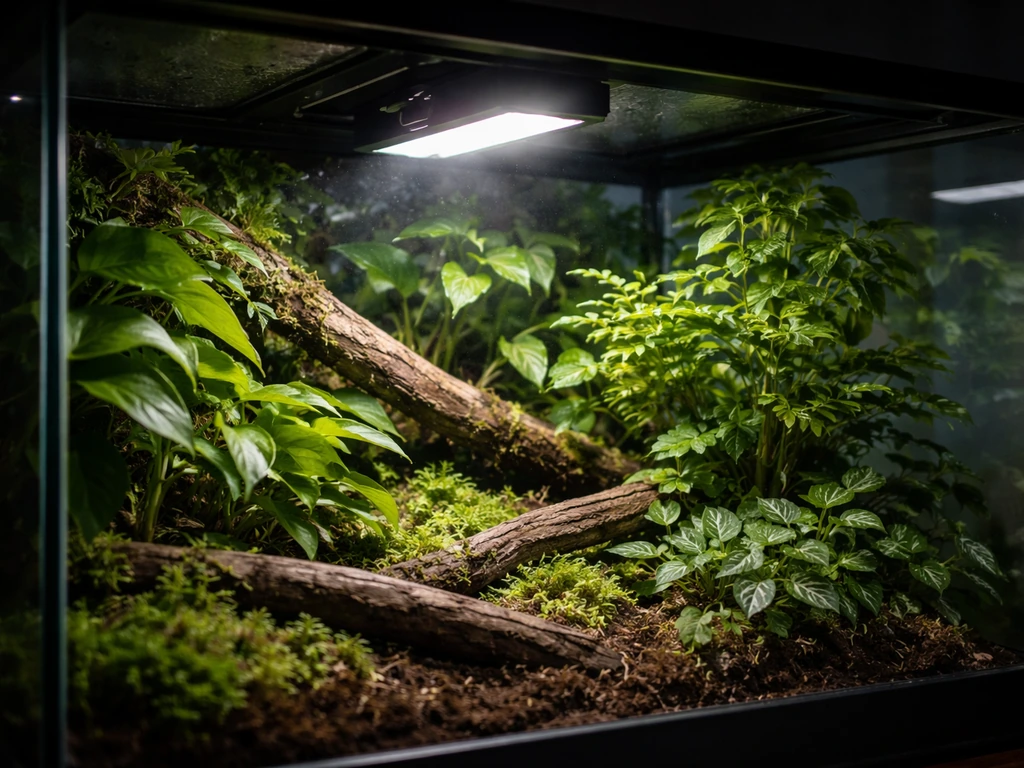
Can You Use Grow Lights for Reptiles Safely?
Yes, you can use some grow lights for reptiles safely with correct spectrum, distance, intensity, and timers.
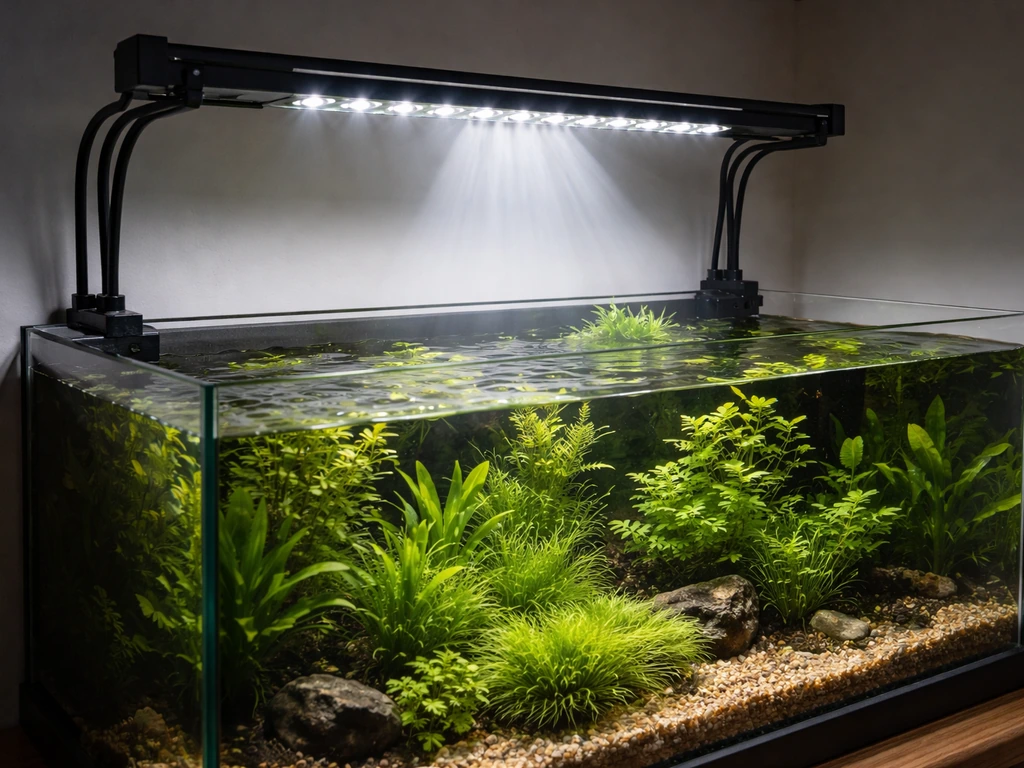
Can I Use a Grow Light for an Aquarium? LED Guide
Yes, you can use an LED grow light for an aquarium if spectrum, intensity, and waterproof mounting are right.
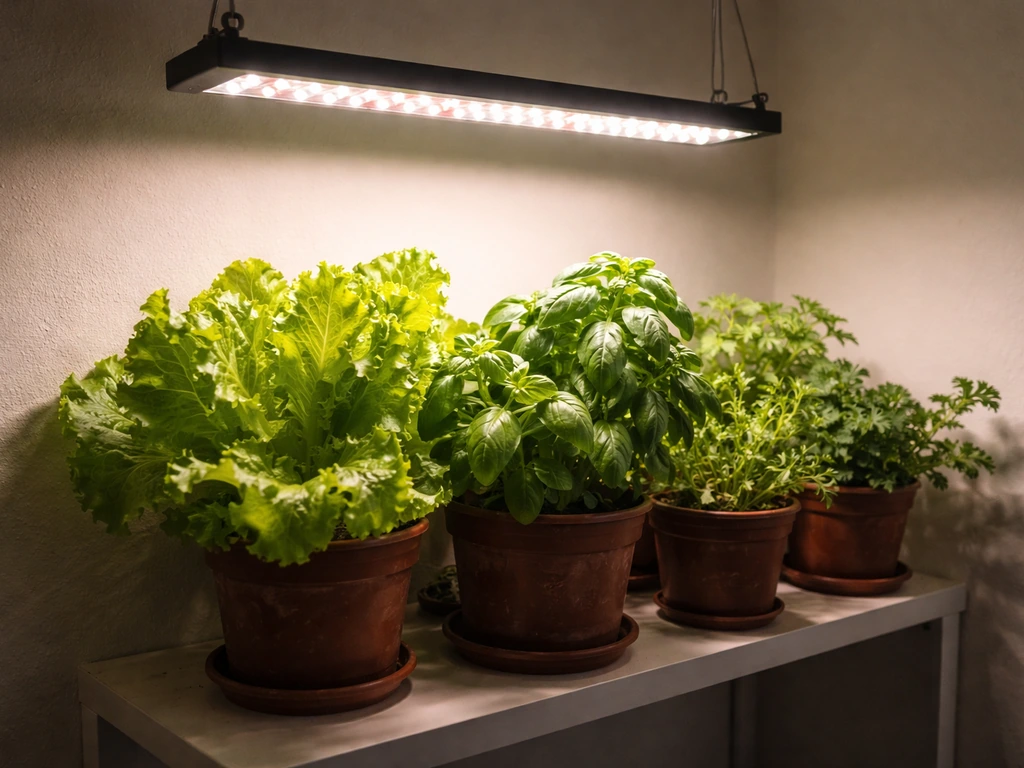
What Type of Light Do Plants Need to Grow Indoors
Pick the right grow light indoors by spectrum, brightness, and placement so plants grow well, bloom, and stay healthy.