Plants don't necessarily grow best in blue light alone, but blue light (roughly 400–500 nm) is essential to healthy, compact, photosynthetically capable plants. It drives chlorophyll absorption, triggers key photoreceptors that shape leaf structure and stomatal behavior, and prevents the abnormal, leggy growth you get from red-only setups. In practice, the best results come from a spectrum that includes a meaningful blue fraction, typically 5–20% of total light output, combined with red and ideally white or far-red wavelengths. Blue light is not a magic growth booster on its own, but without enough of it, your plants will tell you pretty quickly.
Why Do Plants Grow Best in Blue Light? Science & Practical Guide
Marcus Holloway
9 Aug 2026
How light quality actually shapes plant growth
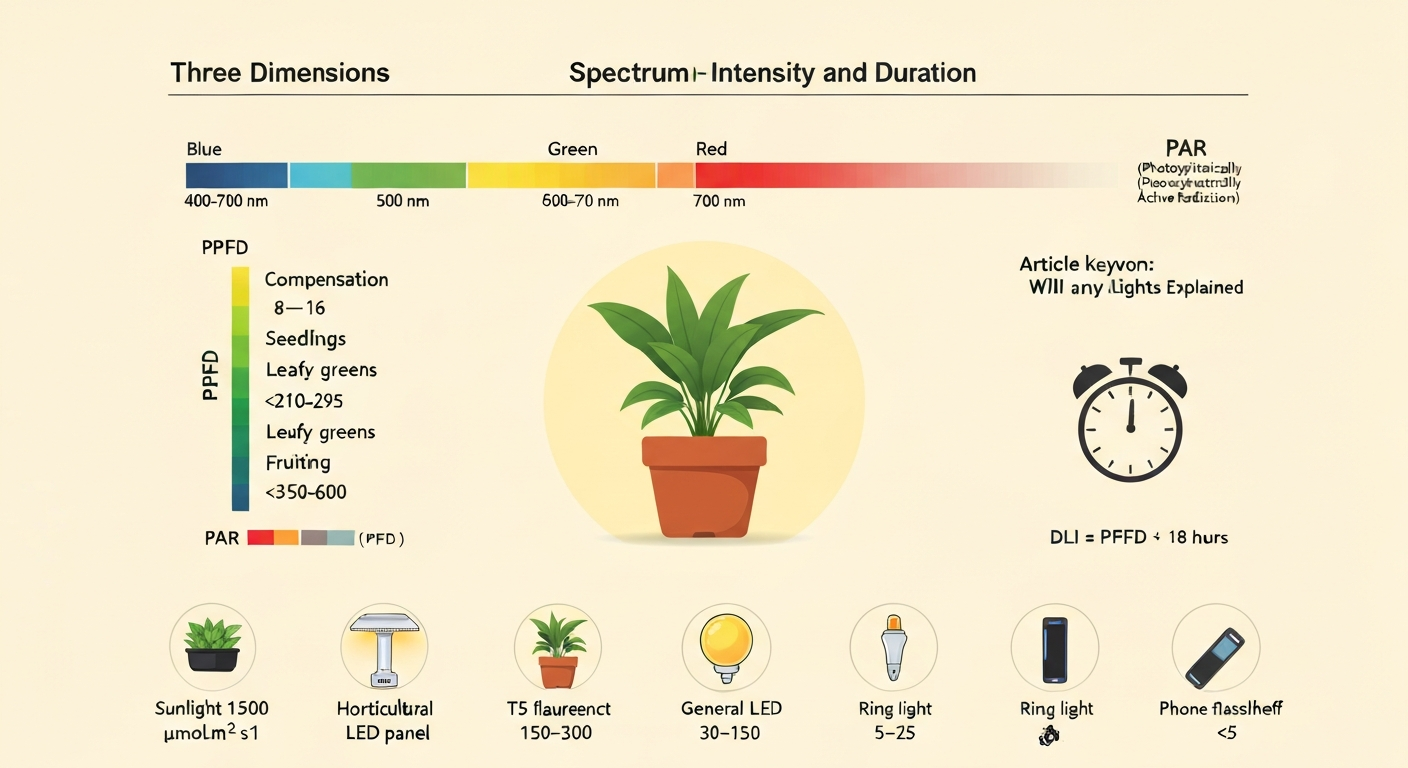
Before getting into why blue light matters, it helps to understand how plant scientists talk about light. The relevant range is PAR, or photosynthetically active radiation, defined as wavelengths from 400 to 700 nm. That covers violet, blue, green, yellow, orange, and red. Not all of those wavelengths do the same job, and not all deliver photons with equal photosynthetic efficiency.
The key measurement you'll see on grow light specs is PPFD, or photosynthetic photon flux density. For guidance on what light brightness makes plants grow the best, see an overview of recommended PPFD and DLI targets. It tells you how many photons in the PAR range are hitting a surface per second, expressed in micromoles per square meter per second (µmol·m⁻²·s⁻¹). Think of it like rainfall intensity: PAR is the size of the rainstorm, PPFD is how hard it's actually raining on your plant canopy right now. A related number is DLI (daily light integral), which is the total photon dose your plant receives over a full day. Leafy greens like lettuce typically need a DLI of around 12–17 mol·m⁻²·d⁻¹, while fruiting crops like tomatoes and cucumbers need 20–30 mol·m⁻²·d⁻¹.
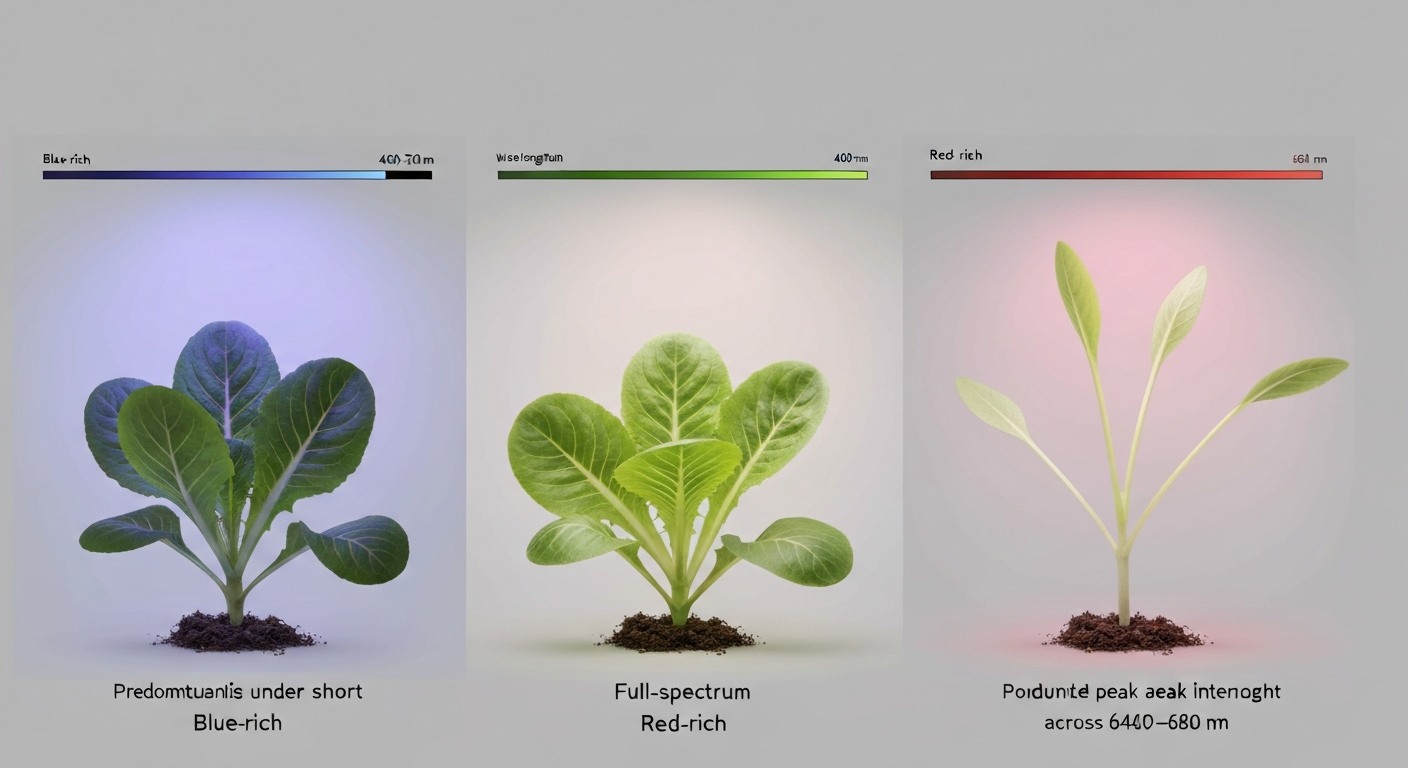
Within the PAR range, different wavelengths do different things. McCree's foundational work in the early 1970s mapped the photosynthetic action spectrum across wavelengths and confirmed strong peaks in both the red (~640–680 nm) and blue (~400–500 nm) regions. That's the scientific backbone behind why most grow light recommendations focus on red and blue, and why those two-color 'blurple' LED panels became so common.
Why blue light matters: chlorophyll absorption and photosynthetic efficiency
Chlorophyll is the pigment that actually captures light energy and converts it into chemical energy through photosynthesis. There are two main types in most plants: chlorophyll a and chlorophyll b. Chlorophyll a absorbs most strongly near 430 nm and 662 nm; chlorophyll b peaks near 453 nm and 642 nm. Both of those blue peaks fall squarely in the 400–500 nm range, which is why blue light has always been understood as a photosynthetically useful wavelength.
There's an important nuance here, though. Per photon delivered at the same PPFD, red wavelengths tend to produce about 20–30% higher quantum yield for CO2 fixation than blue wavelengths. In simple terms: red photons are slightly more efficient at driving the photosynthesis reaction itself. So if the only goal were raw carbon fixation, you'd lean toward red. But photosynthetic efficiency is only part of the story, which is exactly where blue light's other roles become critical.
Blue light and plant photoreceptors: the signals that change everything
Plants don't just passively absorb light for energy. They actively sense it and respond to it, and blue light has its own dedicated receptor systems that chlorophyll has nothing to do with. There are three main families of blue-light photoreceptors, all flavin-based proteins that absorb in the 320–500 nm range: cryptochromes, phototropins, and the Zeitlupe family.
Cryptochromes regulate things like hypocotyl elongation (how tall and stretched a seedling grows), leaf expansion, and the circadian clock. If you've ever grown seedlings under red-only light and watched them get absurdly tall and pale, that's partly because cryptochromes weren't being activated. They suppress the kind of rapid stem elongation that plants normally use to escape shade.
Phototropins (phot1 and phot2) are responsible for more immediate responses: phototropism (bending toward light), chloroplast movement within cells, and, crucially, stomatal opening. Research on Arabidopsis mutants lacking phot1 and phot2 confirmed that normal blue-light-driven stomatal opening simply doesn't happen without these receptors. They trigger a signaling cascade that activates guard-cell H+-ATPase, which pumps protons out of guard cells, causing them to swell and open the stomatal pore. More open stomata means more CO2 getting in and more water vapor getting out, directly increasing gas exchange and photosynthetic capacity.
What blue light actually does to your plant's body
The photoreceptor signaling I just described leads to real, measurable physical changes in plant structure. It's not subtle. Here's what changes when plants receive adequate blue light versus very little:
- Leaf thickness: Plants grown with higher blue fractions develop thicker leaves with altered palisade cell structure and higher pigment concentration per unit of leaf area. This is measured as leaf mass per area (LMA), and it's a reliable indicator of photosynthetic capacity.
- Compactness: Stem internodes stay shorter, giving you that stocky, well-proportioned plant rather than a stretched, floppy one. Blue light suppresses the shade-avoidance elongation response.
- Stomatal density and opening: Blue light increases stomatal conductance, which raises the leaf's gas exchange capacity. This is good for photosynthesis but also increases transpiration, so you may need to water slightly more under high-blue setups.
- Pigmentation: Blue light promotes the accumulation of anthocyanins, carotenoids, and other secondary pigments through photoreceptor pathways. That's part of why plants under full-spectrum or blue-enriched light often look more vivid and healthy than plants under red-only light.
- Secondary metabolite production: Flavonoids and other stress-response compounds are upregulated by blue light, which can be valuable in crops grown for quality rather than just bulk yield.
Controlled dose-response experiments with cucumber showed these effects clearly. Small increases in blue fraction (say, 7–30% of total PPFD) raised LMA and maximum photosynthetic rate (Amax), while extreme monochromatic blue light produced very compact, thick-leaved plants with reduced leaf expansion. The takeaway: there's a sweet spot, and it's not 100% blue.
Blue vs. red vs. full-spectrum: real differences in growth, yield, and flowering
This is where the practical picture comes together. Most controlled studies comparing single-wavelength and mixed-spectrum LED treatments reach similar conclusions: neither blue-only nor red-only light produces the best all-around results. What matters is having both, and the ratio matters depending on what stage of growth you're targeting.
| Light type | Photosynthetic efficiency | Morphology outcome | Stomatal opening | Best for |
|---|---|---|---|---|
| Blue-only (400–500 nm) | Moderate (lower quantum yield per photon) | Very compact, thick leaves, limited expansion | Strong activation | Not recommended alone; useful as a component |
| Red-only (600–700 nm) | High (best quantum yield per photon) | Abnormal: etiolated, thin leaves, poor stomata | Minimal activation | Not recommended alone; causes developmental problems |
| Blue + red (blurple LEDs) | Good | Compact, adequate; can lack balance at low blue % | Good if blue % is sufficient (5%+) | Seedlings, vegetative growth, budget setups |
| Full-spectrum / white LEDs | Excellent | Natural, balanced morphology | Good | General use, all growth stages, most plant types |
| Full-spectrum + tunable red boost | Excellent | Normal to slightly loose depending on blue fraction | Good | Flowering and fruiting phase to maximize yield |
Red-only light is the worst offender for abnormal growth. Plants grown under red-only LEDs commonly develop elongated internodes, thin pale leaves, and poor stomatal development because the blue-light photoreceptors simply aren't being activated. Adding even a small blue fraction (around 5% of total PPFD) largely corrects this. Most commercial and experimental spectral recipes aim for somewhere in the 5–20% blue range, balancing photomorphogenic effects with the higher per-photon efficiency of red wavelengths.
Full-spectrum white LEDs handle this naturally, since their broad spectrum includes sufficient blue alongside green, yellow, and red. That's one reason many modern horticultural LED fixtures use high-quality white LEDs rather than pure red-blue combinations, the white output looks better, covers all photoreceptor needs, and often performs as well or better in plant trials. If you're wondering whether other types of artificial lights can grow plants effectively, the spectrum question is central to that answer, and it comes back to whether the source delivers enough blue and red PAR at the right intensities. For a concise take on whether any light can grow plants, see will any light grow plants. For a practical guide comparing different artificial light types and advice on what artificial light will grow plants, see our dedicated page on that topic. If you’re specifically wondering whether a ring light can grow plants, see the guide can a ring light grow plants for spectrum and intensity considerations. For a practical overview of how different grow light types perform, see our guide does plant grow light work.
When to turn up the blue: seedlings, vegetative growth, and stopping stretch
The vegetative phase is where blue light really earns its place. During seedling development and early vegetative growth, you want compact internodes, thick sturdy leaves, good root development, and strong pigmentation. Blue light's activation of cryptochromes suppresses excessive elongation, so your seedlings stay stocky instead of reaching desperately toward the light. I've personally made the mistake of starting seeds under a warm-spectrum lamp with very little blue output, and the difference compared to a balanced LED is striking within the first two weeks.
For leafy greens like lettuce and spinach, where the entire harvest is vegetative tissue, a higher blue fraction is appropriate throughout the whole crop cycle. These plants benefit from the thicker, more pigmented leaves and compact form that blue light promotes. PPFD targets for leafy greens are typically around 150–300 µmol·m⁻²·s⁻¹ to hit the 12–17 mol·m⁻²·d⁻¹ DLI range they need, and a spectrum with 10–20% blue works well here.
Herbs follow a similar logic. Basil, cilantro, and other culinary herbs grown primarily for foliage quality benefit from good blue fractions to develop intense flavor compounds and pigmentation. Target DLI for herbs is typically 15–25 mol·m⁻²·d⁻¹.
For cannabis specifically, the vegetative stage at the canopy level typically uses PPFD in the range of 400–800 µmol·m⁻²·s⁻¹. A meaningful blue component during veg helps control internode spacing and produces the kind of bushy, multi-branched structure that supports better yields in flowering later. For growers interested in spectrum-specific guidance for cannabis, the research on blue fraction and yield tells an interesting story. See our detailed guide on what light spectrum does weed need to grow for spectrum-specific recommendations and experimental results.
When to reduce blue: flowering, fruiting, and maximizing what you're actually growing for
Here's the trade-off that surprises a lot of new growers: when your plant transitions to flowering or fruiting, the balance shifts. Because red photons deliver higher quantum yield per photon for CO2 fixation, boosting the red fraction during reproductive stages tends to increase total canopy photosynthesis and, with it, yield. Many experienced growers and commercial operations shift their spectrum during flowering by increasing red and far-red output relative to blue. Using light to improve commercial value (Frontiers review / PMC, 2018) reviews practical tradeoffs: higher blue fractions promote compact vegetative growth, improved leaf pigmentation, and stress tolerance, whereas lower blue with increased red (and added far‑red/white) often raises canopy photosynthesis and reproductive/flowering yield, and growers commonly shift spectrum between vegetative and flowering stages.
For cannabis, controlled studies have specifically found that decreasing the blue photon fraction during flowering increases yield. Canopy PPFD during flowering is commonly run at 600–1000 µmol·m⁻²·s⁻¹ in experiments, and the yield response generally continues increasing with intensity up to genotype-specific limits. The implication is that during flowering, photon quantity and the efficiency of red photons matter more than the morphogenic effects of blue.
Fruiting greenhouse crops like tomatoes and cucumbers similarly benefit from higher red fractions in the canopy during fruit development. The DLI target rises too, typically 20–30 mol·m⁻²·d⁻¹, and maximizing photon use efficiency becomes more important than the compactness and thick-leaf benefits blue provides. You still want some blue to maintain stomatal function and normal leaf physiology, but a 5–10% blue fraction is often enough at this stage, rather than the 15–20% you might use during vegetative growth.
Flowering ornamentals are a slightly different case. Some benefit from reduced blue to encourage longer internodes and more natural flower development, while others need photoperiod manipulation (day length control) more than spectrum adjustment. The key insight is that spectrum recipes are not one-size-fits-all across growth stages, which is exactly why modern tunable LED fixtures that let you adjust output exist.
Practical spectrum ratios and PPFD targets at a glance
| Plant type | Growth stage | Recommended blue fraction | PPFD target (µmol·m⁻²·s⁻¹) | DLI target (mol·m⁻²·d⁻¹) |
|---|---|---|---|---|
| Leafy greens (lettuce, spinach) | Full cycle | 10–20% | 150–300 | 12–17 |
| Herbs (basil, cilantro) | Full cycle | 10–20% | 200–350 | 15–25 |
| Fruiting crops (tomato, cucumber) | Vegetative | 10–20% | 300–500 | 18–25 |
| Fruiting crops (tomato, cucumber) | Flowering/fruiting | 5–10% | 400–600 | 20–30 |
| Cannabis | Vegetative | 10–20% | 400–800 | 20–30 |
| Cannabis | Flowering | 5–10% | 600–1000 | 35–50 |
| Seedlings (all types) | Germination to first true leaves | 15–25% | 75–150 | 8–12 |
These numbers are practical starting points, not absolute rules. Every cultivar responds slightly differently, and your growing environment (temperature, humidity, CO2 levels, VPD) interacts with how plants use light. Start within these ranges, observe your plants for signs of light stress (bleaching, curling, abnormal coloration) or light deficiency (etiolation, pale leaves, slow growth), and adjust from there. For a concise guide on what type of light do plants need to grow, see our practical overview on light types and recommended spectra.
Common mistakes worth avoiding
A few errors come up again and again when people start using grow lights, and several of them relate directly to spectrum misunderstandings:
- Using red-only or very low-blue lights for seedlings. This produces etiolated, structurally weak seedlings that never fully recover. Always include a meaningful blue component from day one.
- Assuming more blue is always better. Very high blue fractions or blue-only setups can actually limit leaf expansion and reduce overall biomass accumulation compared to a balanced spectrum. Stay in the 5–20% range.
- Keeping the same spectrum from seed to harvest. Plants in different stages genuinely benefit from different ratios. If your light is tunable, use that capability.
- Ignoring PPFD and guessing at distance. The spectrum ratio means nothing if the total photon dose is wrong. A PAR meter (or a PAR measurement app as a rough guide) will tell you whether your plants are getting the intensity they need at the canopy level.
- Confusing household lights with grow lights. Regular LED bulbs and ring lights don't deliver sufficient PAR at typical use distances, even if they look bright. The spectrum and intensity requirements for photosynthesis are meaningfully different from what's needed for human vision. This is a common question, and the short answer is that most household lights fall well short of what plants actually need.
Setting up your blue light fraction correctly
If you have a full-spectrum LED grow light (which is what most people should be using), you don't need to obsess over blue fraction in isolation. A quality white-spectrum horticultural LED already has a built-in blue component designed for plant use. Where the spectrum conversation becomes actionable is when you're choosing between fixtures or using a tunable light that lets you adjust red and blue output independently.
For distance: most LED grow lights should be positioned 12–24 inches above the canopy for seedlings and young vegetative plants, adjusting up or down based on the light's intensity and what your PPFD readings show. Lights hung too close with high blue output can cause photoinhibition or bleaching. Too far, and you lose the intensity needed for normal photomorphogenesis. Check your specific fixture's manufacturer guidelines as a starting point, then verify with a meter.
For photoperiod: most vegetative crops do well on 16–18 hours of light per day under artificial light. Flowering crops that are photoperiod-sensitive (like cannabis) are typically triggered into flowering by a 12/12 light-dark cycle. The spectrum you use matters, but so does getting the photoperiod right. No amount of blue light optimization helps if your light schedule is off.
One last thing worth saying clearly: grow lights, including those with substantial blue output, are not a health hazard under normal use conditions. The blue light from horticultural LEDs is not ionizing radiation, cannot cause cancer, and won't give you a tan. Sensible precautions like not staring directly at high-intensity LEDs apply to all bright light sources, but the idea that indoor grow lights are dangerous to human health is a misconception worth putting to rest.
FAQ
Why do plants grow best in blue light?
Blue light (≈400–500 nm) is strongly absorbed by chlorophyll and sensed by blue photoreceptors (cryptochromes, phototropins, Zeitlupe family). Absorption supplies energy for photosynthesis, while photoreceptors trigger morphology and stomatal responses—producing thicker, more compact leaves, higher stomatal conductance and altered pigment production. Blue photons are therefore essential for normal photomorphogenesis and efficient gas exchange even though, per photon, red light often produces slightly higher CO2 fixation efficiency.
Is blue light the most efficient wavelength for photosynthesis?
Not exactly. Action‑spectrum studies (e.g., McCree) show red (≈640–670 nm) typically has a higher quantum yield per photon than blue. However, blue light drives critical developmental and stomatal processes that red alone cannot; mixing blue with red or using full‑spectrum light gives better overall growth and morphology than red‑only light.
How much blue light do plants need? (percentages and recipes)
Most crops do well with a modest blue fraction. Common experimental/production recipes use ~5–20% blue (as % of PPFD) for general growth. Leafy greens and vegetative phases often benefit from 10–30% blue for compact, high‑quality leaves; reproductive/flowering phases typically reduce blue to ~5–15% and raise red (and sometimes far‑red) to maximize yield. Species and stage matter—very low (<5%) or red‑only spectra can cause abnormal morphology.
What PPFD and DLI targets should home growers aim for?
Typical indoor targets by crop type: leafy greens (lettuce, baby greens): DLI ~12–17 mol·m⁻²·d⁻¹ (≈150–300 µmol·m⁻²·s⁻¹ PPFD depending on photoperiod). Herbs: DLI ~15–25 mol·m⁻²·d⁻¹. Fruiting crops (tomato, cucumber): DLI ~20–30 mol·m⁻²·d⁻¹. For cannabis and high‑light ornamentals, experimental PPFDs often run 400–1000 µmol·m⁻²·s⁻¹; home growers usually use lower values—start conservative and raise light only if you can supply nutrients, CO2 and cooling.
What photoperiods work with blue‑light emphasis?
Photoperiod depends on species and stage. Vegetative growth: common 16–18 h light (or continuous for some greens); flowering induction: follow species‑specific cues (short‑day or long‑day plants). Blue fraction can be higher in the vegetative stage to promote compactness and leaf development, then reduced in flowering to favor reproductive growth. Total daily light (DLI) is as important as spectrum—adjust photoperiod and PPFD together to hit your DLI target.
Which artificial lights are suitable for supplying blue light?
Best choices: purpose‑built LED grow lights and full‑spectrum white LEDs with adequate blue content. Modern horticultural LEDs allow spectrum tuning (blue+red or white full‑spectrum). Less suitable: ordinary household incandescent or warm LEDs (low blue content and inefficient for PAR), ring lights designed for humans (often low PPFD and poor spectrum). Fluorescent T5/T8 or compact fluorescents can work for low‑light herbs/seedlings but are less efficient and shorter‑lived than LEDs.
Next Articles
What Artificial Light Will Grow Plants: Best Lights Guide
What artificial light will grow plants: practical guide to LED, CFL, HID spectra, PPFD targets, setup, cost & tips.
Will Any Light Grow Plants? Guide for Indoor Growers
Can any light grow plants? Clear yes/no, science-backed light specs, setup tips, and which household lights work.
What Type of Light Do Plants Need to Grow Indoors
Pick the right grow light indoors by spectrum, brightness, and placement so plants grow well, bloom, and stay healthy.