Philips Hue lights can keep low-light houseplants alive and looking healthy, but they cannot reliably grow herbs, seedlings, or fruiting plants the way a purpose-built grow light can. The lumen output is too low, the spectrum is not optimized for photosynthesis, and the photon delivery per watt is a fraction of what dedicated horticultural LEDs provide. For a pothos on a dim shelf or a peace lily in a windowless room, Hue is genuinely useful. For basil you want to harvest, tomato seedlings, or anything that needs to flower, you will hit a wall fast.
Can Philips Hue Grow Plants? Practical Guide & Verdict
Marcus Holloway
6 Aug 2026
Quick verdict: can Philips Hue grow plants?
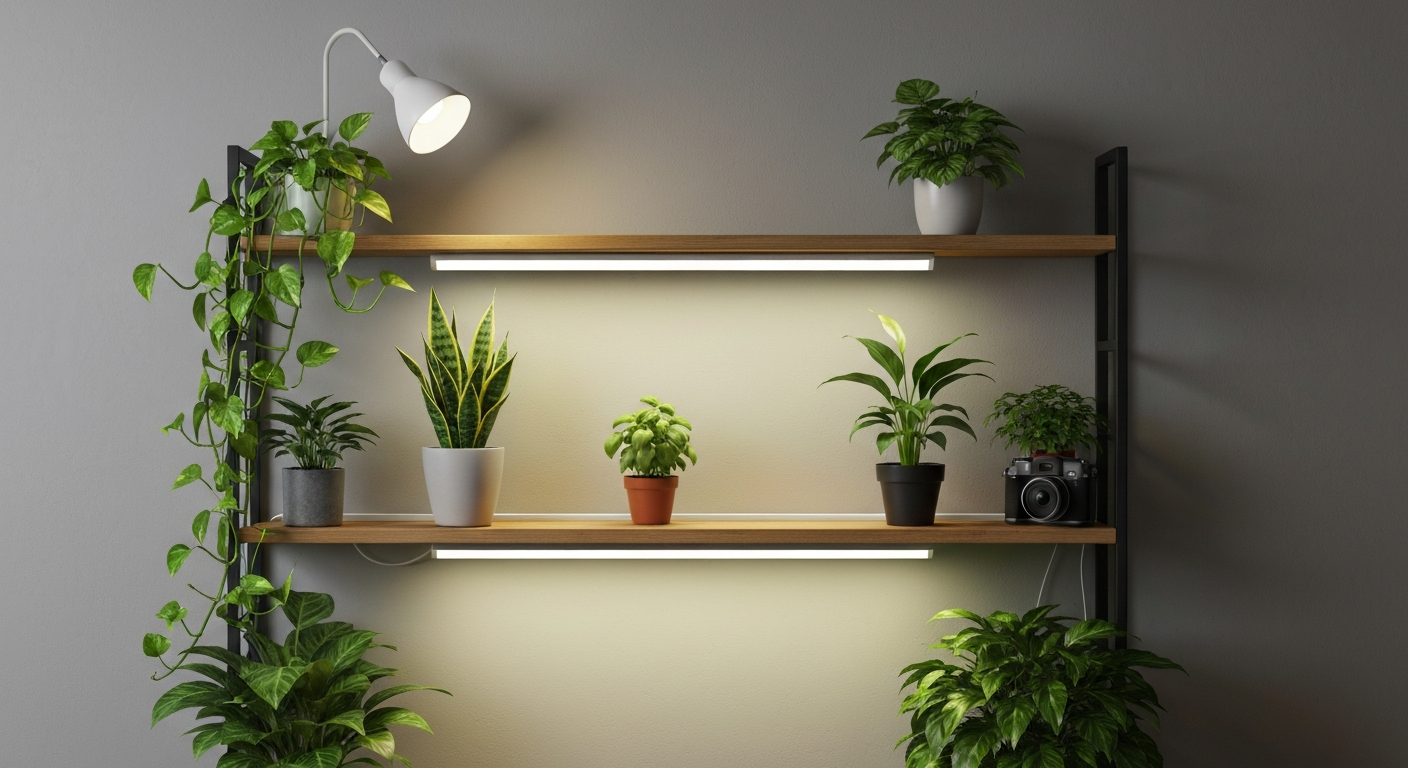
The honest answer is: sometimes, for some plants. Philips Hue bulbs, Lightstrips, and Play bars are consumer-grade RGB and white smart lights. They were designed for mood, ambiance, and home automation, not horticulture. That said, light is light, and plants do not care about brand names. What matters is whether the light source delivers enough photons in the right wavelengths, at the canopy, for long enough each day. By those standards, Hue passes for shade-tolerant foliage plants and fails for anything more demanding. For more on whether ordinary house lights can support plant growth, see do house lights help plants grow.
- Low-light houseplants (pothos, snake plant, ZZ plant, peace lily): Hue can maintain and modestly support growth
- Propagation trays and seedling care under close placement: possible with multiple units, but marginal
- Herbs (basil, mint, cilantro): likely to survive but growth will be slow and leggy without supplemental light
- Fruiting and flowering crops (tomatoes, peppers, cannabis): Hue alone is not sufficient
What 'grow' actually means: survival, vegetative growth, and fruiting
Before we dig into the hardware specs, it helps to be clear about what you are asking the light to do. There is a big difference between keeping a plant alive and actively growing it. A pothos in a dark corner will survive on almost nothing; it just will not put out new leaves very fast. Vegetative growth, where a plant is actively building stems and leaves, requires meaningfully more light. Flowering and fruiting demands even more, plus the right spectrum cues in many species. When people ask whether Hue can grow plants, they are usually asking about at least one of these three very different goals, and the answer changes depending on which one you have in mind.
Horticulture researchers use a metric called DLI, daily light integral, to capture this. DLI is the total number of photons delivered to a square meter over an entire day, expressed in mol per square meter per day. Leafy greens and most herbs typically target somewhere between 12 and 20 mol/m2/day. Fruiting vegetables often need 15 to 30. Shade-tolerant foliage plants can do fine in the low single digits. Knowing your target DLI tells you whether a light source is even in the game.
How plants actually use light: spectrum, PAR, and why lumens mislead you
Plants absorb light through chlorophyll and other pigments, and those pigments are picky. Research going back to K.J. McCree's foundational 1971 work shows that photosynthetic efficiency peaks around 440 nm (blue) and again around 620 to 670 nm (red), with a dip through the green range. This does not mean green light is wasted. It actually penetrates deeper into leaf tissue and contributes to whole-canopy photosynthesis, just less efficiently per photon. The practical takeaway is that blue and red wavelengths drive the most photosynthesis, and a light source weighted toward warm yellow and white (like most household LEDs) is not the most efficient tool for the job.
The measurement unit that actually matters here is PPFD, photosynthetic photon flux density. It counts the number of photons in the 400 to 700 nm range hitting one square meter every second, expressed in micromoles per square meter per second. Lux and lumens, which is what Philips lists on their packaging, measure perceived brightness to the human eye. Human eyes are most sensitive to yellow-green light around 555 nm, so a lamp engineered for human vision will score high in lumens while delivering relatively fewer photons in the blue and red bands that plants actually want. You can get a rough PPFD estimate from lux by dividing by roughly 54 for sunlight or 60 to 80 for white LEDs, but the error margin is 15 to 25 percent depending on the exact spectrum, which is why serious growers measure with a quantum sensor rather than guessing from the box.
What Hue specs actually tell us (and what they don't)
Philips publishes lumen ratings for Hue products, not PPF or PPFD values. Here is what the main products are rated at:
| Product | Rated Lumens | Approximate Wattage | Estimated PPFD at 30 cm (white mode, rough) |
|---|---|---|---|
| Hue White & Color A19 bulb | ~800 lm | ~9–10.5 W | ~15–25 µmol/m²/s |
| Hue White & Color A21 bulb | ~1,600 lm | ~16 W | ~25–40 µmol/m²/s |
| Hue Lightstrip Plus (2 m) | ~1,600 lm | ~12–20 W | ~10–20 µmol/m²/s (spread over length) |
| Hue Play bar (single unit) | ~530 lm | ~6–7 W | ~8–15 µmol/m²/s |
The PPFD estimates in that table are rough conversions using a white-LED factor of about 65 lux per micromole, and they assume the sensor is directly below the bulb at close range. Real PPFD will vary with the color mode you have selected, the exact angle of the fixture, and how many units you stack together. Treat them as ballpark figures, not guarantees. A typical low-light houseplant can get by on 15 to 50 µmol/m2/s. Most herbs want 100 to 200. Seedlings generally need 100 to 300 or more. The numbers above should make it obvious where Hue lives on that scale.
The five Hue products most relevant to plant growing
Hue White and Color Ambiance A19 and A21 bulbs
These are the workhorse of the Hue lineup. The A19 at 800 lumens is the standard 60W-equivalent bulb. Philips Hue White and Color Ambiance A19, product/spec listing (device.report aggregation) lists the A19 at about 800 lumens and shows typical maximum electrical consumption in the ~9–10.5 W range Philips Hue White and Color Ambiance A19 — product/spec listing (device.report aggregation). The A21 at 1,600 lumens is the brighter option and the more useful one for plants if you are going the bulb route. Mount them in a standard clamp fixture or adjustable track, point them straight down at your plant shelf, and get them as close as your fixture allows without heating the foliage (usually 20 to 30 cm is safe with LED). The A21 gives you nearly twice the photons for a modest price premium and is worth the upgrade if you are using these for plant lighting.
Hue Lightstrip Plus
The 2-meter Lightstrip Plus is rated at about 1,600 lumens across its entire length, which sounds decent until you realize that light is spread over two meters rather than concentrated in one spot. Per linear foot of strip, the light output is modest. Where strips shine is coverage. Running a strip along the underside of a shelf gives you even, low-intensity light across a tray of plants, which is excellent for low-light foliage but not intense enough for seedlings or herbs that want real photon density. They are also very convenient for automated day/night cycles through the Hue app.
Hue Play light bars
At roughly 530 lumens per unit, a single Play bar is the weakest option on this list. They are designed for TV backlighting and accent tasks, not area lighting. That said, if you have three or four of them mounted close together over a small tray, you can build up reasonable coverage for low-light plants. The key word is multiple units. One Play bar over a plant does very little.
Hue Bloom
The Bloom is an uplight accent lamp, meaning it is designed to throw light upward and outward, not down onto a plant canopy. For plant use you would need to flip it or redirect it, and even then its output (around 500 to 600 lumens) is in the same modest range as the Play bar. It is the least practical Hue product for plant lighting, though it could work as a side-light supplement for a shelf plant if positioned correctly.
Hue's spectral capabilities: color modes, blue and red settings, and the real limits
Philips Hue White and Color Ambiance products use an additive RGB LED architecture combined with a phosphor-converted white emitter. The white mode works the way most white LEDs do: a narrow blue pump peak around 450 nm excites a phosphor that emits a broader green-yellow band, producing what looks like white light to our eyes. The color modes use the red, green, and blue channels directly. This is relevant for plants because you can, in theory, tune the Hue app to dial up blue or red light.
In practice, setting your Hue bulb to a pure red or blue scene does shift the spectrum toward those photosynthetically useful wavelengths. Scenes with more blue (cooler whites, daylight-type settings, or a directly blue color) increase the proportion of photons in the 400 to 500 nm range. Scenes weighted toward red (warm amber, red color mode) shift toward 620 to 680 nm. The limitation is that shifting to a narrow color mode reduces total light output significantly, because you are only using one or two of the RGB channels. A Hue bulb running in pure red mode is both redder and dimmer than the same bulb at full white. For plants, the trade-off usually favors using full white output (or the warmest white with some color boost) rather than sacrificing brightness for purity of spectrum. The phosphor-converted white output also lacks the deep red and far-red wavelengths (700 to 750 nm) that dedicated horticultural LEDs include to drive the Emerson enhancement effect and signal photoperiod to flowering plants.
The bottom line on spectrum: Hue is better than a pure yellow incandescent and broadly comparable to other white LED sources in terms of useful plant spectrum. It is not in the same category as a purpose-built grow light with calibrated red/blue or full-spectrum horticultural chips. If you are curious how Hue compares to other household light sources, the same spectral limitations apply to regular LED bulbs, office fluorescents, and incandescent bulbs in different ways.
What Hue actually delivers at canopy height: PAR and PPFD reality
I want to be direct here because this is where a lot of online discussions get vague. Without measuring with a quantum sensor, exact PPFD numbers from Hue at canopy height are estimates. What we can say confidently is this: at 30 cm, a single Hue A19 white-mode bulb delivers somewhere in the 15 to 25 µmol/m2/s range. The A21 does better, around 25 to 40. A two-meter Lightstrip suspended a few centimeters above a tray delivers 10 to 20 µmol/m2/s across the strip's footprint. These are reasonable estimates using the standard lux-to-PPFD conversion for white LEDs, with the caveat that without a calibrated quantum sensor you are accepting meaningful uncertainty.
Compare those numbers to what plants actually need. A pothos or snake plant in good shape needs roughly 15 to 50 µmol/m2/s. A Hue A19 in white mode at 30 cm hits the bottom end of that range. The A21 gets you into the middle. For herbs and leafy greens targeting 100 to 200 µmol/m2/s at the canopy, you would need six or more A19 bulbs tightly clustered, or a mix of strips and bulbs. At that point the economics and aesthetics stop making sense compared to a $40 dedicated grow panel.
To put the efficiency gap in concrete terms: dedicated horticultural LED fixtures built on chips like the Samsung LM301 series deliver roughly 2.5 to 3.1 micromoles of PAR photons per joule of electricity. A Hue White and Color bulb running in white mode delivers perhaps 0.5 to 0.8 micromoles per joule at most, because its design optimizes for human-vision lumens rather than plant-useful photons. That is a 3x to 6x efficiency gap. You are not just getting less light, you are getting less of the right light per watt of electricity consumed.
Device-specific setup and best practices
Using Hue bulbs (A19 and A21)
Mount bulbs directly above the plant canopy in a clamp light, track fixture, or desk lamp. Aim for 20 to 30 cm between the bulb and the top of the plant. LED heat is minimal so you will not burn foliage at those distances, but check by placing your hand at canopy height for 30 seconds. If it feels warm, move the lamp up slightly. Run them at maximum brightness (100%) in a cool white or daylight scene (roughly 5000 to 6500K) to maximize blue and total PAR output. Use the Hue app to set a daily schedule of 12 to 16 hours for most houseplants. Multiple bulbs on a shared fixture or shelf rail multiply your effective PPFD, so two A21s side by side roughly double what one delivers.
Using Hue Lightstrip Plus
Strips work best as under-shelf lighting for trays of low-light plants. Stick the strip to the underside of a shelf 15 to 25 cm above the tray. Run at 100% brightness. The light spreads evenly but is low intensity, so this setup is best for foliage maintenance rather than active growth. Avoid running extensions beyond the recommended length (Philips specifies 10 meters maximum) because per-meter brightness drops with longer runs. Two strips in parallel on adjacent shelves, both pointed down at a single tray, can meaningfully boost PPFD if you have the space to rig that.
Using Hue Play bars
Play bars are most useful in banks. Mount three to four of them side by side on a horizontal bar or shelf underside, all pointing straight down at your plant tray. Each unit at 530 lumens is weak alone, but four units together give you something closer to a two-meter Lightstrip in total output with better light concentration. Keep them 15 to 20 cm from the canopy. Like the bulbs, set them to maximum brightness in a cool white or daylight scene.
Scheduling and photoperiod automation
This is honestly where Hue earns its place in a plant setup. The automation tools in the Hue app and its compatibility with platforms like Amazon Alexa, Google Home, and Apple HomeKit make it extremely easy to set consistent, reliable day/night cycles. Set a 14 to 16 hour on period for most foliage plants, 12 hours for plants sensitive to photoperiod. Consistency matters more than people realize: plants get stressed when light schedules are irregular. A Hue routine that turns the light on at 7 AM and off at 9 PM costs you nothing beyond the initial setup and does exactly what a timer outlet would, except it is also adjustable by season if you want to simulate changing day length.
Combining multiple units for more coverage
The single most practical way to improve PPFD with Hue is to use more units. Stacking two A21 bulbs in pendant fixtures 25 cm above a 30 by 30 cm tray roughly doubles the PPFD compared to one. Adding a Lightstrip around the perimeter of the same tray boosts coverage at the edges. This approach gets expensive quickly (Hue hardware is not cheap), and at some point you cross into territory where a purpose-built grow light at a similar or lower cost would do the job better. But if you already own several Hue fixtures and want to put them to work for plants, layering sources is the way to do it.
Which plants are realistic, and which aren't
Based on typical PPFD output and the DLI targets from horticulture research, here is an honest breakdown of what Hue can and cannot realistically support:
| Plant type | DLI target (mol/m²/day) | Hue verdict | Notes |
|---|---|---|---|
| Pothos, ZZ plant, snake plant | 1–5 | Works well | Hue A19 or Lightstrip handles this range easily |
| Peace lily, cast iron plant | 2–6 | Works well | Low-light foliage; Hue is sufficient for maintenance and slow growth |
| Herbs (basil, mint, parsley) | 12–20 | Marginal to insufficient | Multiple A21 bulbs close up may sustain, but growth will be slow |
| Leafy greens (lettuce, spinach) | 12–20 | Marginal | Possible with multiple units and long photoperiod; dedicated light preferred |
| Seedlings | 15–25+ | Insufficient (alone) | Leggy, weak growth almost certain without supplemental light |
| Fruiting crops (tomatoes, peppers) | 20–30+ | Insufficient | Hue cannot reach needed DLI or spectrum; use dedicated grow lights |
How Hue compares to other household light sources
Hue sits in an interesting middle ground relative to other common household light sources. Regular LED bulbs without smart features are similar in spectral output and sometimes brighter per dollar. For more on whether common household lamps can support plant growth, see our guide on do regular light bulbs help plants grow. Incandescent bulbs produce a lot of red and infrared but very few blue photons and waste most of their energy as heat, making them genuinely poor grow lights. For more on how incandescent light affects plant growth, see does incandescent light help plants grow. Black lights (UVA LEDs or fluorescents) produce wavelengths mostly below 400 nm, which are outside the PAR range entirely and do essentially nothing for photosynthesis. Office fluorescents are actually decent for low-light plants because they emit broad-spectrum light across a wide area efficiently, though they lack the scheduling smarts that Hue brings. If you’re wondering whether office lights can help plants grow, see our guide: do office lights help plants grow. Where Hue has a genuine edge over all of these is in its automation and color programmability. That counts for something, but it does not close the PPFD gap compared to dedicated grow lights. If you’re wondering whether black lights help plants grow, see our brief explanation on do black lights help plants grow, the wavelengths they emit fall outside the PAR range and do not support photosynthesis.
Energy, cost, and heat trade-offs
Philips Hue hardware is expensive upfront. A single A21 White and Color bulb costs several times what a basic LED grow bulb costs. If you already own Hue lights and want to use them for plants, the incremental cost is just electricity, and at 10 to 16 watts per bulb, that is negligible over a month. If you are buying Hue specifically to grow plants, the math rarely works out. A purpose-built LED grow panel in the $30 to $80 range will deliver 3 to 6 times the PAR per watt, cover a larger canopy, and come with a dedicated hanging system. Heat is not a meaningful concern with any Hue product at normal growing distances. Unlike incandescent or HID grow lights, you will not burn foliage or dry out soil faster with these LEDs.
When Hue is fine and when to buy a real grow light: a simple decision guide
Use Hue if: you already own the hardware, your plants are low-light foliage species, you want automated scheduling without a separate timer, and you are supplementing some natural light rather than replacing it entirely. The combination of modest PAR and reliable automation makes Hue a reasonable choice for a decorative shelf of pothos or ferns near a window.
Buy a dedicated grow light if: you are starting seeds, growing herbs you plan to harvest, working with fruiting plants, or your plant space gets zero natural light. In those situations, Hue's PPFD ceiling and per-watt photon inefficiency will produce disappointing results no matter how well you position the fixtures. A budget full-spectrum LED grow light with an output of 200 to 400 µmol/m2/s at canopy height will outperform any Hue configuration at a lower hardware cost.
- Identify your plant's DLI requirement. Shade plants: under 6 mol/m2/day. Herbs and greens: 12–20. Fruiting crops: 20+.
- Estimate your available natural light. If your window gives you 3+ hours of direct sun, Hue may be enough to supplement for low-light plants.
- Count your Hue hardware. More units mean more PPFD. One bulb over a plant is rarely enough for anything beyond survival.
- Run a 14–16 hour photoperiod using the Hue app scheduler. Consistency matters as much as intensity for most houseplants.
- If plants become leggy, pale, or stop growing after 4–6 weeks, that is your signal that the light intensity is too low. Add more Hue units or switch to a grow light.
FAQ
Short answer: can Philips Hue (bulbs, Lightstrips, Play bars) be used to grow plants effectively?
Yes — but only for low‑demand houseplants, propagation/maintenance of already established foliage plants, or as a supplemental/ambient light. Hue products are consumer RGB + phosphor‑white LEDs designed for human viewing, not high photon output or horticultural spectral tailoring. They can keep shade‑tolerant plants alive and help cuttings root, but they generally cannot economically deliver the PPFD/DLI required for vigorous seedlings, leafy greens, flowering or fruiting crops. For those you'll normally need purpose‑built grow lights.
Why Hue is limited for horticulture (technical summary)
Three practical limits: 1) Spectrum: Hue uses RGB emitters + phosphor‑converted white; spectrum includes useful blue and some red but lacks the targeted deep‑red/horticultural red peaks and far‑red control used in grow fixtures. 2) Photon efficiency: consumer Hue bulbs deliver far fewer µmol per joule than horticultural LEDs, so for the same wattage horticultural fixtures give many more photosynthetic photons. 3) Output/intensity: Hue A19, Lightstrip and Play have modest lumen/ watt specs (A19 ≈800 lm/~9–10 W, Lightstrip 2 m ≈1600 lm/~12–20 W, Play ≈530 lm), which usually produce low PPFD at canopy distance unless placed very close and in high numbers.
What spectrum matters for plants and how do Hue spectra compare?
Plants photosynthesize from ~400–700 nm (PAR) with peaks around blue (~440–470 nm) and red (~620–670 nm). Green light still contributes to whole‑leaf and lower‑canopy assimilation. Hue’s spectrum (blue pump + phosphor white, plus RGB modes) includes blue and red energy but lacks the concentrated deep/red and far‑red energy and precise spectral ratios that horticultural fixtures provide. Hue can deliver usable PAR but not optimal spectrum control for flowering/fruiting or high‑efficiency photon delivery.
How to convert lumen/lux to PPFD and why you should measure instead of estimate
PPFD (µmol·m⁻²·s⁻¹) measures photons that drive photosynthesis; lux/lumens measure perceived brightness for humans and vary with spectrum. Typical white LEDs give roughly ~60 lux per µmol·m⁻²·s⁻¹ as a rough rule, but this depends on SPD and can be ±15–25% or more. For reliable results use a quantum/PAR sensor to measure PPFD at canopy height. If you must estimate from lux, treat the result as approximate and conservatively lower expectations.
What PPFD / DLI do different plants need (practical targets)?
Approximate horticultural targets: - Shade‑tolerant foliage (pothos, snake plant, zz plant): 20–100 µmol·m⁻²·s⁻¹ (DLI ~1–6 mol·m⁻²·day⁻¹). - Moderate light houseplants (philodendron, monstera, most common indoor herbs): 100–250 µmol·m⁻²·s⁻¹ (DLI ~6–15). - Seedlings/young vegetative: 150–400 µmol·m⁻²·s⁻¹. - Leafy greens/herbs for production: aim for DLI ≈12–20 mol·m⁻²·day⁻¹ (e.g., 200–350 µmol·m⁻²·s⁻¹ for 12–16 h). - Flowering/fruiting crops: often 15–30 mol·m⁻²·day⁻¹ and higher PPFDs — usually beyond what Hue can economically provide.
Device‑specific guidance: which Hue products and color modes are most useful for plants?
Best options (in descending order): - Hue Lightstrip (2 m) at max brightness and positioned close over a small canopy: highest lumen output per device. - Multiple Hue Play bars grouped together (face down) to concentrate light. - Hue White & Color A19 bulbs (use the brighter A21/1600 lm variants if available). Color modes: use full‑spectrum white (tunable white at 4000–6500 K) or combine white + saturated red/blue color scenes to boost PAR in the photosynthetically active bands. Avoid relying on decorative pastels; use the brightest white or custom scenes with increased blue and red components.
Next Articles
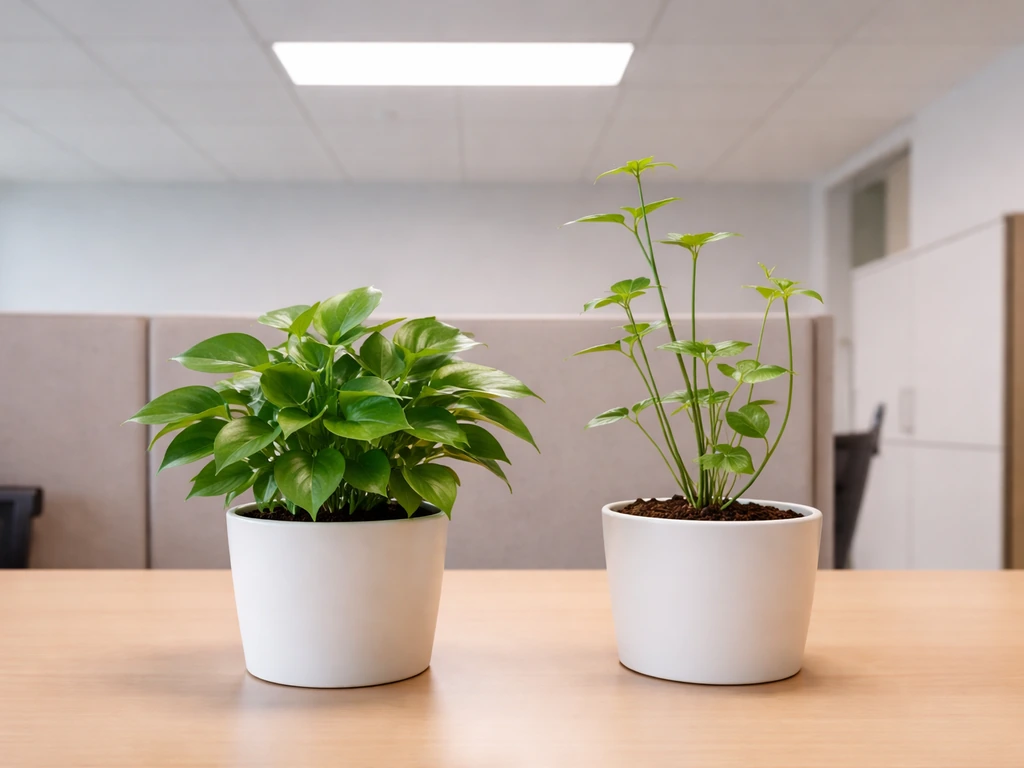
Do Office Lights Help Plants Grow? What Works and What Doesn’t
Yes for some foliage, no for most flowering plants. Learn light needs, office fixtures limits, and fixes for healthy gro
Does Incandescent Light Help Plants Grow? What to Know
Incandescent bulbs rarely help plants grow well due to weak light for photosynthesis and high heat; use LEDs or CFLs ins
Do House Lights Help Plants Grow? What Works and What Doesn’t
See if house bulbs help plants grow, when they fall short, and how to set proper spectrum, intensity, and timer grow lig