Yes, CFL bulbs can be used as grow lights, and they actually work pretty well for the right jobs. I've started hundreds of seedlings under CFLs, kept herbs alive through winter on a kitchen shelf, and grown lettuce in a small cabinet using nothing but screw-in spiral bulbs. Where they fall short is trying to push large fruiting plants like tomatoes or peppers through a full flowering cycle. For those, you'll want more firepower. But for seedlings, cuttings, herbs, leafy greens, and low-light houseplants, a few well-placed CFLs will absolutely do the job.
Can CFL Bulbs Be Used as Grow Lights? Practical Guide
Marcus Holloway
7 Aug 2026
Quick verdict: yes, with real limits
CFLs produce light in the photosynthetically active range (400 to 700 nm), they're cheap to buy, they run on a standard screw-in socket, and they put out far less heat than incandescent bulbs. That makes them genuinely useful for low-to-medium light plants in small spaces. University extension programs at Kansas State and Iowa State specifically list CFLs alongside T5 fluorescents as acceptable options for home seed starting. Where they don't work is at scale: a single 26W CFL simply cannot deliver the photon density a fruiting crop needs across even a square foot of canopy. If you're growing tomatoes to harvest, look at T5HO tubes, dedicated LED panels, or shop lights instead.
How CFLs affect plant growth: spectrum and intensity
Plants don't care about brightness the way human eyes do. They care about two things: the color (wavelength) of light hitting their leaves, and the total number of photons arriving per second. These are separate problems, and CFLs handle one better than the other.
Spectrum: CFLs cover the basics
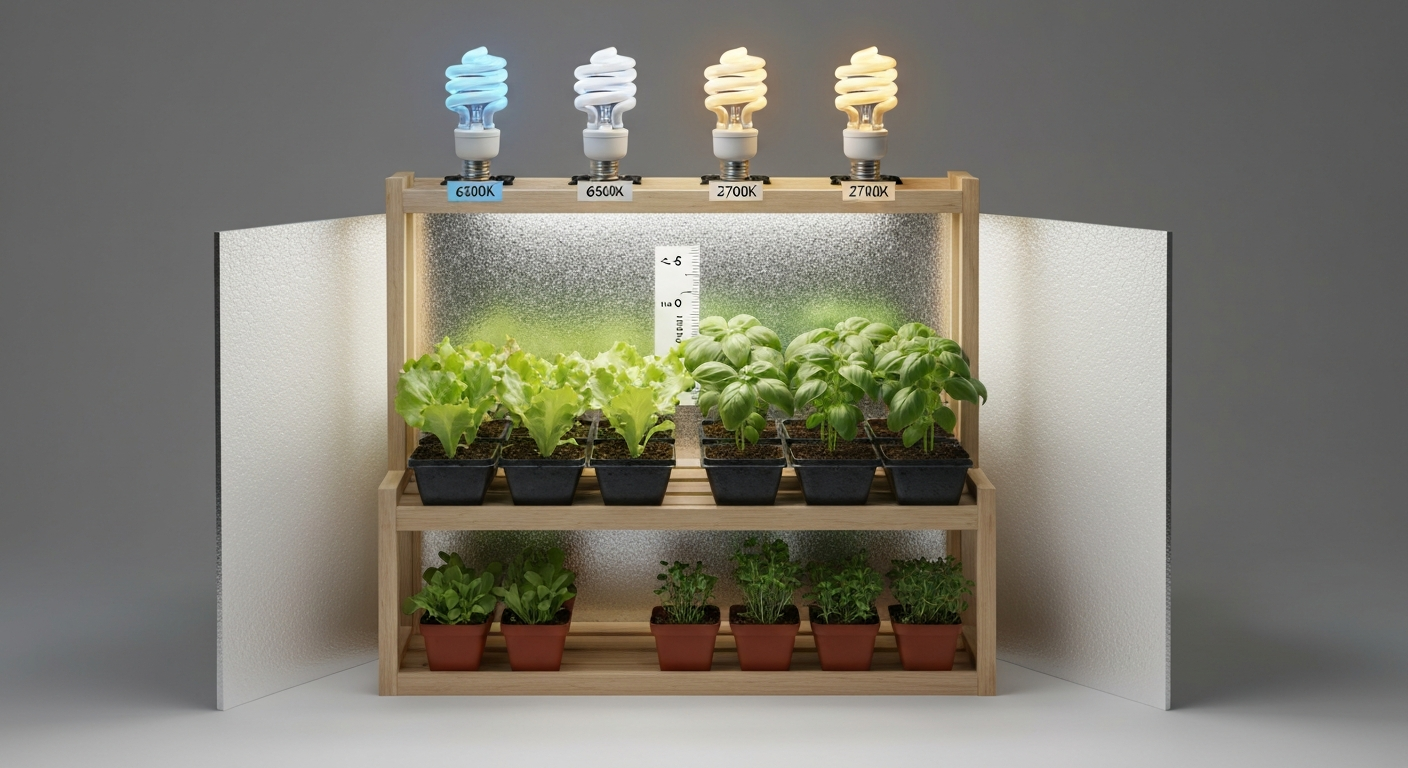
CFLs emit a broad spectrum that includes useful blue wavelengths (around 400 to 500 nm) and red wavelengths (around 600 to 700 nm), which are the two ranges chlorophyll absorbs most efficiently. The exact balance depends on the color temperature of the bulb. A 6500K CFL leans blue-heavy, which is great for compact, leafy vegetative growth. A 2700K CFL leans toward the red and warm end, which better supports flowering. Manufacturer spectral power distribution charts for common CFL brands confirm this difference visually. Neither is a perfect match for sunlight, but both are good enough for the plants I've mentioned.
Intensity: this is where CFLs struggle
Intensity is measured in PPFD (photosynthetic photon flux density), expressed in micromoles of photons per square meter per second (µmol·m⁻²·s⁻¹). For measuring PPFD, consider a calibrated quantum sensor, the LI‑COR LI‑190R Quantum Sensor product page specifies PAR (400–700 nm) readings in µmol·m⁻²·s⁻¹ and a ±5% NIST‑traceable calibration for greenhouse/growth‑chamber measurements. A single 26W CFL held 4 to 6 inches from a plant might deliver somewhere around 150 to 300 µmol·m⁻²·s⁻¹ directly underneath it, but that number drops off fast as you move to the edges. Seedlings need roughly 100 to 200 µmol·m⁻²·s⁻¹. Herbs and leafy greens can thrive at 200 to 400. Fruiting crops want 400 to 600 or more, sustained across the whole canopy. Covering a 2 sq ft area at fruiting intensity with CFLs requires stacking several bulbs, which quickly becomes inefficient compared to a purpose-built fixture.
CFLs also have a PAR efficacy (the ratio of useful photons to electrical watts consumed) that trails modern LEDs significantly. Published comparative tables show fluorescent and CFL-class fixtures typically falling below 1.6 µmol·J⁻¹, while quality horticultural LEDs now regularly exceed 2.5 µmol·J⁻¹. That gap matters when you're paying an electricity bill every month. One practical workaround is to convert lumens to an approximate PPFD using conversion factors published by instrument makers like Apogee Instruments, but keep in mind those factors vary by lamp spectrum, so treat any lux-to-PPFD conversion as a rough guide rather than a hard number.
What to realistically expect from CFLs (measurable performance)
Luminous efficacy for CFLs runs roughly 35 to 60 lumens per watt (lamp plus ballast). That's lower than T5 linear fluorescents and well below modern LED grow lights. In practical terms, a 26W CFL produces around 1,600 to 1,700 lumens total. After factoring in the CFL's spectral conversion (using fluorescent lamp conversion factors from Apogee's tables, roughly 70 to 80 lux per µmol·m⁻²·s⁻¹), that translates to a usable PPFD of perhaps 200 to 300 µmol·m⁻²·s⁻¹ directly below the bulb at 3 to 4 inches. By the time you're 12 inches away, that number drops to under 75. Keeping your bulbs close, and using multiple bulbs, is non-negotiable with CFLs.
Daily Light Integral (DLI) is a more useful planning number than instantaneous PPFD. Purdue Extension's Measuring Daily Light Integral (DLI) – Purdue Extension HO‑238‑B‑W provides crop-specific DLI ranges and practical measurement and placement guidance for greenhouse and indoor crops. DLI is the total photon dose a plant receives over a full day. Purdue Extension's crop-specific DLI tables show that lettuce needs roughly 12 to 17 mol·m⁻²·day⁻¹, herbs like basil want 15 to 20, and most fruiting vegetables want 25 to 35. A small bank of CFLs running 16 hours a day in a tight reflective space can realistically hit 10 to 15 mol·m⁻²·day⁻¹ for a small footprint, which covers lettuce and many herbs. Hitting 25+ mol for fruiting crops is extremely difficult with CFLs without running an impractical number of bulbs.
Which CFL bulbs to actually buy
Not every CFL sitting on a hardware store shelf is a good choice for plants. Here's what I look for when picking bulbs for a grow setup.
| Parameter | Seedlings / Cuttings | Vegetative / Herbs | Flowering (if using CFLs at all) |
|---|---|---|---|
| Color temperature (CCT) | 6500K | 6500K or mix 6500K + 2700K | 2700K dominant |
| True wattage (actual draw) | 13–26W per bulb | 23–42W per bulb | 42–65W per bulb |
| Lumens per bulb (target) | 800–1,600 lm | 1,600–2,800 lm | 2,800–4,200 lm |
| Number of bulbs per sq ft | 1–2 | 2–3 | 3–5 (not recommended at scale) |
| Spiral vs globe shape | Spiral (bare tube) | Spiral (bare tube) | Spiral (bare tube) |
In general, buy the highest actual wattage you can find in the color temperature you need. Those 'equivalent' wattage labels on the box are for human lighting comparisons and mean nothing for plant growth. A bulb labeled '100W equivalent' might actually draw only 23 real watts. Look for the actual wattage, not the incandescent equivalent. Spiral (bare tube) shapes expose more phosphor surface than globe-shaped CFLs and distribute light better in all directions, which matters when you're mounting them sideways in a DIY reflector.
Placement, distance, fixtures, and reflectors
Distance is probably the single most important thing to get right with CFLs. Light intensity follows an inverse-square relationship: double the distance and you lose roughly three-quarters of your PPFD. Kansas State Extension recommends keeping fluorescent and CFL fixtures within a few inches to about 15 cm (6 inches) of seedlings for adequate light delivery. I typically aim for 3 to 6 inches for seedlings and 6 to 12 inches for more established plants. If a plant starts stretching toward the light or growing with long, weak internodes (called etiolation), that's the tell-tale sign it isn't getting enough intensity, and you need to move the bulb closer or add another one.
Fixtures matter more than people expect. A bare CFL screwed into an open socket wastes a large percentage of its light output to the sides and above. A simple clip-on aluminum reflector hood, or a homemade reflective tent made from white foam board or Mylar, can realistically double the useful light hitting your plants. For a small herb shelf or seed tray, I screw multiple CFLs into a multi-socket power strip fixture and line the inside of the shelf with white foam board. It's cheap and surprisingly effective. Make sure any socket or fixture is rated for the wattage of the bulbs you're using, and allow air circulation around the ballast end of the bulb since that's where heat concentrates.
- Keep seedlings 3 to 6 inches (7 to 15 cm) below the bulb
- Keep established herbs and leafy greens 4 to 10 inches (10 to 25 cm) below the bulb
- Line enclosures with white paint, white foam board, or Mylar to redirect lost light back to plants
- Use a multi-socket fixture or clamp-on adapter to run several bulbs over one tray
- Raise the fixture as plants grow, always maintaining that 4 to 10 inch sweet spot
- Orient spiral CFLs so the longest axis of the tube runs parallel to the plant canopy when possible
How long to run CFLs: photoperiods by growth stage
Photoperiod is just the number of light hours per day. Because CFLs deliver lower photon density than dedicated grow lights, you need to compensate somewhat by running them longer. Here's how I approach each stage.
| Growth Stage | Recommended Daily Light Hours | Notes |
|---|---|---|
| Seed germination | 0 (dark) | Most seeds germinate in darkness; no light needed until sprout emerges |
| Seedling (first true leaves) | 14–18 hours on, 6–10 hours off | 6500K bulbs, keep very close, 16 hours is a good default |
| Vegetative / herbs / leafy greens | 14–18 hours on, 6–10 hours off | Mix 6500K and 2700K or use 6500K; 16 hours works well for most |
| Flowering induction (long-day plants) | 18 hours on, 6 hours off | Encourages continuous flowering in plants like basil |
| Flowering induction (short-day plants) | 12 hours on, 12 hours off | Triggers bloom in plants like chrysanthemum or some cannabis strains |
| Low-light houseplant supplementation | 10–14 hours on | Supplementing dim winter window light; less critical to be exact |
A simple plug-in mechanical outlet timer costs around $10 and is one of the best investments you can make for any grow setup. Consistent photoperiods matter more than most people realize, and getting up to switch lights on or off manually is a habit that breaks within a week. Set the timer and forget it.
Practical setups: exact configurations for common use cases
Seed starting tray (10 x 20 inch standard flat)
This is where CFLs shine and where I still use them myself. For a single standard 10x20 seed tray (about 1.4 sq ft), two to three 26W 6500K CFL spirals in a reflective hood mounted 3 to 4 inches above the tray is plenty. Run them 16 hours on, 8 hours off. This setup costs under $30 in hardware and produces seedlings that are compact, green, and healthy. As soon as seedlings are transplanted to larger containers and enter active vegetative growth, I either stack more bulbs or switch to a T5HO fixture.
Small herb shelf (1 to 2 sq ft)
For a dedicated herb shelf with basil, parsley, cilantro, and mint, I use four 23W CFLs: two 6500K and two 2700K in a mix. Mount them in a row with a reflective backing 6 to 8 inches above the plant tops. Run 16 hours on. This produces decent herb growth, though basil in particular wants more light and will grow faster under a T5HO or a small LED panel if you can swing the budget.
Small lettuce or leafy green bed (1 to 2 sq ft)
For a compact lettuce setup in a cabinet or shelf enclosure, use four to six 26W 6500K CFLs, line the enclosure with white foam board or Mylar, and run them 16 hours on. Keep bulb tips 5 to 8 inches from the top of the canopy. Expect loose-leaf varieties to perform better than iceberg-type heads, since loose-leaf lettuce tolerates lower DLI. Harvest outer leaves continuously and the plants will stay productive for weeks.
What CFLs are genuinely good for (and what they're not)
I want to be honest here because I've seen people waste money buying dozens of CFLs trying to grow peppers to harvest, only to get leggy plants and almost no fruit. The table below is based on real-world results and the published PPFD and DLI data we have.
| Use Case | CFL Verdict | Why |
|---|---|---|
| Seed starting / cuttings | Excellent | Low PPFD demand; CFLs hit target easily at close range |
| Low-light houseplant supplementation | Excellent | Plants like pothos, peace lily, and snake plants only need 50–150 µmol·m⁻²·s⁻¹ |
| Herbs (basil, mint, parsley) | Good | Manageable light demand; works with 4+ bulbs and a reflective enclosure |
| Loose-leaf lettuce / spinach | Good | Low-to-mid DLI requirement fits what CFLs can deliver |
| Microgreens | Good | Short growth cycle means efficiency matters less |
| Compact flowering plants (African violet, begonia) | Acceptable | Works with 2700K CFLs; expect slower growth than under T5HO or LED |
| Large fruiting crops (tomatoes, peppers, cucumbers) | Poor | Cannot deliver the sustained 400–600+ µmol·m⁻²·s⁻¹ needed at scale |
| Multi-plant production grows | Poor | Too many bulbs required; operating cost exceeds LED alternatives quickly |
| High-yield cannabis flowering | Not recommended | Energy inefficiency and low canopy penetration severely limit yields |
For the cases where CFLs fall short, shop lights with T8 LED tubes or dedicated LED grow panels are better choices. They're also worth considering if you're asking whether regular lights or daylight bulbs could fill the role instead; the honest answer is that daylight-spectrum CFLs (6500K) come closest among common household bulbs, but a purpose-built grow LED will always outperform them in both spectrum and efficiency. If you're wondering whether "can regular lights be used to grow plants," daylight-spectrum CFLs are the closest common household option, though purpose-built grow LEDs will still outperform them in spectrum and efficiency. Short answer: can daylight bulbs be used as grow lights, yes, 6500K 'daylight' bulbs work reasonably well for seedlings and leafy greens, but dedicated grow LEDs or high-output fluorescents are better for flowering and fruiting crops. If you're wondering whether a ring light can be used as a grow light, see our guide on can a ring light be used as a grow light. For guidance on the reverse, using grow lights as ordinary room lighting, see can you use grow lights as regular lights.
CFLs vs other common options
| Light Type | PAR Efficacy (µmol·J⁻¹, approx.) | Best Use | Relative Cost (upfront) | Heat Output |
|---|---|---|---|---|
| CFL (screw-in) | 0.8–1.3 | Seedlings, herbs, small greens | Very low ($3–$10/bulb) | Low-moderate |
| T5HO linear fluorescent | 1.2–1.6 | Seedlings, clones, leafy greens | Low-moderate ($30–$80/fixture) | Low-moderate |
| Shop light (T8 LED tube) | 1.5–2.0 | Seedlings, leafy greens, herbs | Low ($20–$60/fixture) | Low |
| Horticultural LED panel | 2.0–3.0+ | All growth stages, fruiting crops | Moderate-high ($60–$300+) | Low |
| Incandescent / regular bulb | 0.1–0.3 (very little PAR) | Not suitable for plant growth | Very low | Very high |
| Ring light | ~0.5–0.9 (varies by model) | Marginal; not designed for plants | Low-moderate | Low |
Modern horticultural LEDs consistently come out on top in life-cycle analyses. When you normalize energy and operating costs to equal photon output over the lamp's lifetime, LEDs produce far lower energy use and lower environmental impact than CFLs. If you're setting up something permanent or growing through multiple seasons, the upfront cost of an LED panel pays itself back quickly in electricity savings. CFLs make the most sense as a low-commitment starter option or for very small, low-demand applications.
Safety, heat, mercury, and CFL maintenance
CFLs run warmer than LEDs but much cooler than incandescent bulbs or HID lamps. The main heat is concentrated at the ballast end (the base), not the tube itself. Keep the base area ventilated and don't enclose it in a tight space without airflow. Never touch a running CFL: the glass can still be warm enough to cause discomfort, and the phosphor coating shouldn't be handled.
CFLs contain a small amount of mercury, around 1 to 5 milligrams per bulb depending on the manufacturer. This is much less than older fluorescent tubes, but it still means you need to handle breakage carefully. The EPA recommends ventilating the room immediately if a CFL breaks, carefully collecting fragments without vacuuming (which spreads mercury vapor), and disposing of broken or spent CFLs through a household hazardous waste program or a participating retailer rather than the regular trash. Most hardware stores offer CFL recycling drop-offs.
On UV exposure: some CFL models, particularly single-envelope (bare spiral) types, emit measurable UVA and UVB at very close distances, under about 30 cm. Photobiology research has noted this can affect photosensitive individuals at that range. For plants this isn't a concern, and in a normal grow setup where you're not staring into the bulbs for extended periods, it's not a practical risk. If you're concerned, double-envelope CFLs (those with an outer glass cover) emit considerably less UV.
Rated life for most CFLs is 6,000 to 15,000 hours, but in grow setups where bulbs cycle on and off daily, frequent switching shortens lifespan faster than continuous operation. I typically replace grow CFLs after 12 to 18 months of regular use even if they haven't visibly failed, because lumen output degrades noticeably over time. A bulb that looks fine to your eye may be delivering 20 to 30 percent less light than when it was new.
Troubleshooting common CFL grow problems
- Leggy, stretched seedlings: bulbs are too far away. Move them to within 3 to 5 inches of the plant tops immediately.
- Pale or yellowing leaves despite correct watering: likely light starvation. Add more bulbs or reduce distance.
- Leaf curling or bleaching directly under the bulb: rare with CFLs but possible if bulb is pressed against foliage. Maintain at least 2 to 3 inches of air gap.
- Plants not flowering despite correct photoperiod: check that 'dark period' is genuinely dark. Even a small light leak from a timer indicator can disrupt short-day plant flowering.
- Bulb flickering or slow to start: ballast aging or cold temperatures (CFLs perform poorly below about 10°C / 50°F). Replace the bulb or warm the grow space.
- High electricity bill relative to output: this is a sign you've outgrown CFL-scale growing. Upgrade to an LED panel and you'll reduce power draw while increasing PPFD significantly.
The bottom line on using CFLs as grow lights
CFLs are a legitimate, practical starting point for small-scale indoor growing. For a broader discussion on whether any light can be a grow light, see our guide titled “Can any light be a grow light.”. They're cheap, widely available, easy to work with, and produce enough light in the right spectrum for seedlings, herbs, leafy greens, and low-light houseplants. The key is getting them close to your plants, using a reflective enclosure, running them 14 to 18 hours a day, and choosing the right color temperature for your growth stage. Where they genuinely fail is in covering large areas or pushing fruiting crops to high yields. If you hit those limits, upgrading to LED grow panels or high-output fluorescent fixtures is the logical next step, and you'll immediately notice the difference in both plant performance and your electricity usage. If you’re wondering whether an OTT light can serve as a grow light, see can an OTT light be used as a grow light for guidance on spectrum, intensity, and mounting considerations. If you're wondering whether a regular light bulb will work as a grow light, see our focused guide on will a regular light bulb work as a grow light for a quick comparison and recommendations.
FAQ
Can compact fluorescent (CFL) bulbs be used as grow lights for indoor plants?
Yes — with caveats. CFLs can successfully provide useful light for seedlings, clones, small pots, herbs and low‑light houseplants as either supplemental light or sole source for short periods. They are not ideal for large areas or high‑light flowering/fruiting crops because their photon output and efficiency are limited compared with purpose‑built horticultural LEDs or high‑output fluorescents.
How do CFLs affect plant growth (spectrum vs intensity)?
Spectrum: Many white CFLs (2700K, 4100K, 6500K) emit broad visible spectra that include blue and red wavelengths needed for photosynthesis; higher CCT (5000–6500K) has more blue light, which favors compact vegetative growth. Intensity: CFLs produce relatively low photosynthetic photon flux per bulb (low PPFD) and poor area uniformity, so they must be placed close to plants and/or many bulbs must be used for adequate light levels.
What is a clear, evidence‑based verdict: should I use CFLs or not?
Decision points: Use CFLs if you are growing seedlings, small leafy greens, herbs, houseplants, or doing low‑intensity supplemental/night‑interrupt light and you want a low‑cost, low‑complexity option. Upgrade to LEDs or high‑output fixtures if you need high PPFD, good uniformity, lower long‑term energy use, or are producing large flowering/fruiting crops.
What wattage (or incandescent equivalent) and color temperature should I choose for common uses?
Recommendations: For small trays/seedlings: one or more 23–26 W CFLs (≈100 W incandescent equivalent) per small seed tray (10×20 cm) or 40–60 W total per square foot if used as sole source. For small vegetative pots/herbs: 40–60 W CFLs (or multiple 23–26 W bulbs) per square foot. Use 5000–6500 K (‘‘daylight’’) CFLs for seedlings/vegetative growth; 2700–3000 K (‘‘warm white’’) or mixed warm+cool for flowering/finish if you must use CFLs. Exact bulb counts depend on distance and fixture layout.
How close should I place CFLs to plants?
Place CFLs very close because of low intensity: seedlings and transplants: 2–6 in (5–15 cm) above foliage; larger vegetative plants: 6–12 in (15–30 cm) depending on bulb wattage/heat and light spread. Move bulbs up if leaves show heat stress, bleaching, or curling; move down if plants stretch/elongate.
What photoperiods work with CFLs for different growth stages?
Seedlings/propagation: 14–18 h light per day (many growers use 16–18 h). Vegetative growth: 14–18 h. Flowering/fruiting (photoperiodics): switch to crop‑specific hours (e.g., 12 h for short‑day flowering plants like many cannabis strains). For let‑alone daylight‑neutral crops, maintain the DLI/PPFD target rather than strictly changing hours. Continuous low‑intensity lighting may work for some leafy crops but check species needs.
Next Articles
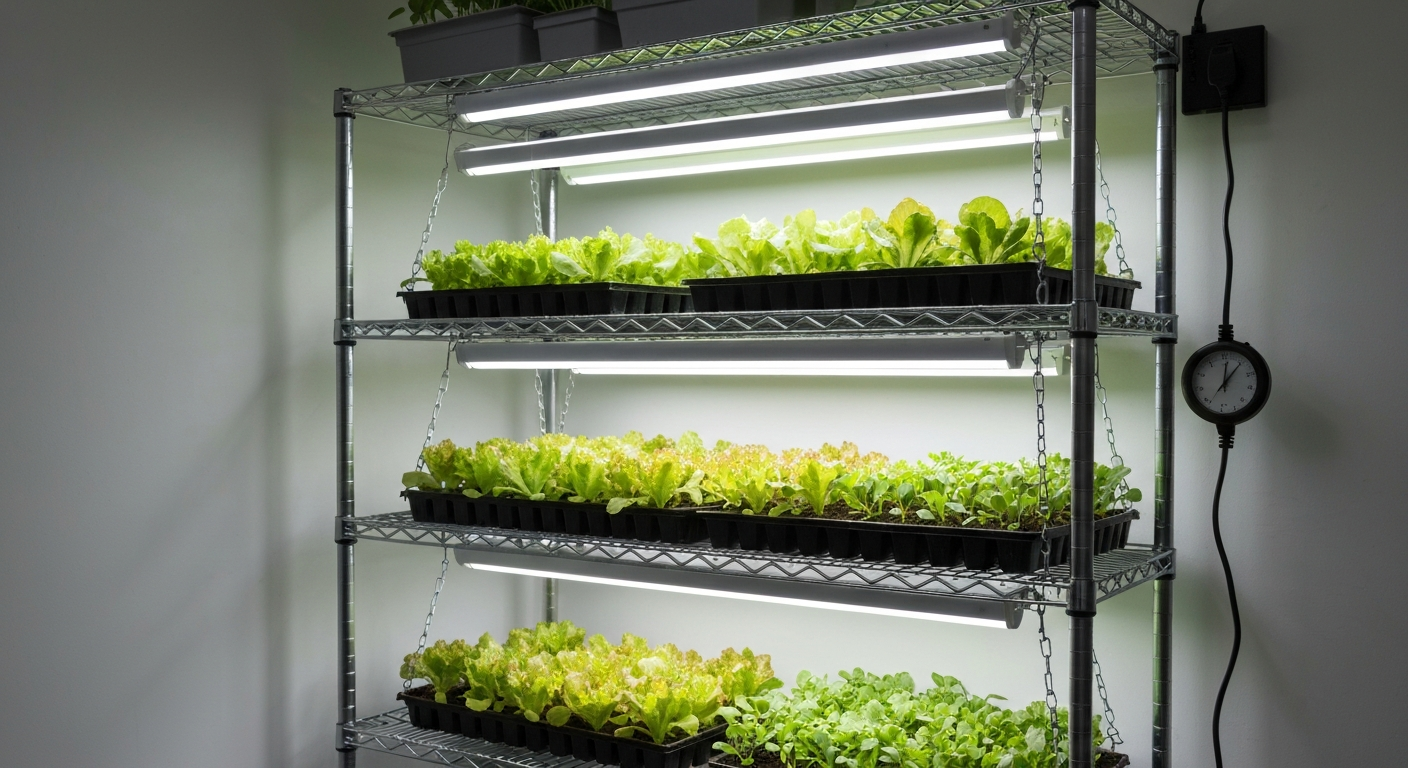
Can Shop Lights Be Used as Grow Lights? Best Types & Setup Tips
Can shop lights work as grow lights? Practical verdict, best types, setup tips, and buying checklist.
Can a Ring Light Be Used as a Grow Light? Practical Verdict
Can a ring light work as a grow light? Practical verdict, setup tips, limits, and better alternatives for houseplants.
Will a Regular Light Bulb Work as a Grow Light?
Can a regular bulb grow plants? Compare incandescent, CFL, halogen and LED for seedlings, indoor plants, setup, safety.