Yes, some shop lights can work as grow lights, but not all of them, and not without some real limitations. The types that actually pull their weight are cool-white or full-spectrum LED shop lights (4000K to 6500K, the brighter the better) and fluorescent T5 or T8 fixtures. Used correctly, meaning hung close to your plants and run for long enough hours each day, these can handle seedlings, leafy greens, herbs, and other low-to-medium light crops reasonably well. They will not replace a purpose-built horticultural fixture for flowering plants or fruiting crops, but for a lot of common indoor gardening tasks, they are a genuinely practical and affordable option.
Can Shop Lights Be Used as Grow Lights? Best Types & Setup Tips
Marcus Holloway
20 Jul 2026
Quick verdict: can shop lights be used as grow lights?
The honest answer is: it depends on the light type, the crop, and how you set it up. I have started hundreds of tomato and pepper seedlings under a pair of 4-foot LED shop lights from a hardware store, and they worked just fine. But I have also watched basil get leggy and pale under an older fluorescent fixture that simply was not bright enough or close enough to the canopy. The difference comes down to three things: spectrum (does the light emit wavelengths plants can use?), intensity (is there enough photon output per square foot?), and duration (are you running it long enough to make up for lower intensity?). Get those three right with a decent shop light and you are in good shape for a wide range of plants.
Where shop lights fall short is with fruiting and flowering crops, or any situation where you need high light intensity across a larger area. Tomatoes in flower, cucumbers pushing fruit, autoflowering cannabis, and most tropical fruiting plants need a Daily Light Integral (DLI) of 20 to 30 mol per square meter per day. Most shop lights, even good LED ones, simply cannot deliver that without running an impractical number of fixtures in very close proximity. For those crops, a purpose-built horticultural LED bar or panel is a better investment.
How plant-light performance is actually measured
Before you pick any light, it helps to understand why lumens (the number on most shop-light boxes) mean almost nothing for plants. Lumens measure brightness as a human eye perceives it, weighted heavily toward green and yellow, which are exactly the wavelengths plants use least efficiently. Plants care about a different range entirely: photosynthetically active radiation, or PAR, which spans 400 to 700 nanometers (essentially violet through red).
The useful measurement is PPFD: photosynthetic photon flux density, expressed in micromoles of photons per square meter per second (µmol/m²/s). Think of it as the flow rate of plant-usable photons arriving at the leaf surface. A seedling tray needs roughly 75 to 150 µmol/m²/s. Lettuce in active growth wants 150 to 250 µmol/m²/s. Fruiting crops can push 400 to 600 µmol/m²/s or more. PPFD is what you actually need to measure or estimate for your setup.
DLI, or Daily Light Integral, combines PPFD with time. The formula is straightforward: DLI = PPFD × hours per day × 0. Virginia Tech Extension provides the same conversion and crop DLI targets in their guide Calculating and Using Daily Light Integral (DLI), Virginia Tech Extension (SPES‑720) blank" rel="noopener noreferrer">Calculating and Using Daily Light Integral (DLI) — Virginia Tech Extension (SPES‑720). 0036. So a light delivering 100 µmol/m²/s for 16 hours gives a DLI of about 5.8 mol/m²/day, which is adequate for seedlings (target range 5 to 10) but well short of what basil wants (15 to 25) or fruiting vegetables need (20 to 30). Virginia Tech Extension publishes these crop DLI targets and they are a useful benchmark for planning any indoor light setup. The takeaway: a lower-intensity shop light can sometimes compensate by running longer, up to a point.
Efficacy, measured in µmol per joule (µmol/J), tells you how efficiently a fixture converts electricity into plant-usable photons. Purpose-built horticultural LEDs typically land between 2.0 and 3.0 µmol/J. Many consumer shop lights sit below 1.0 to 1.7 µmol/J. That gap matters when you are comparing electricity bills and light output over months of growing.
LED shop lights: when they work and what to look for
Modern LED shop lights are by far the best shop-light option for plant growing, and honestly some of them are surprisingly capable. The ones worth considering are fixtures rated at 40 watts or more per 4-foot bar, with a color temperature between 4000K and 6500K. A cooler color temperature (closer to 6500K) means more blue photon content, which research confirms promotes compact, thick growth and strong chlorophyll development. A warmer 4000K leans more toward the red end, which tends to support slightly faster biomass accumulation in leafy crops.
The problem with most consumer LED shop lights (brands like Barrina, Sunco, or Feit are popular examples) is that their product pages report lumens, CCT, and wattage but almost never publish PPF output or PPFD maps. You are essentially buying blind unless you measure in situ with a PAR meter or find an independent community test. Some review sites and grower forums have done this work, and the consistent finding is that a single 40-watt LED shop bar hung 6 to 12 inches above a seedling tray can deliver around 80 to 150 µmol/m²/s directly below the center, dropping off sharply toward the edges. Independent community measurements across review sites and forums (examples include LEDGrowLightsReviews) report single 40-watt LED shop bars hung 6–12 inches above a seedling tray often produce about 80–150 µmol/m²/s at the center. For a single flat of seedlings, that is workable. For a 3-by-4-foot grow area, you will need at least three or four bars side by side to get even coverage.
When shopping, prioritize: high lumen output per watt (look for fixtures above 100 lumens/watt as a proxy), a CRI of 80 or higher (broader spectrum coverage), 5000K to 6500K for seedlings and vegetative growth, and linkable designs so you can chain multiple bars together. Avoid fixtures with no published wattage or with suspiciously low wattage claims relative to their lumen numbers.
Fluorescent shop lights (T5 and T8): still useful, with caveats
Before LED shop lights got affordable and bright, T5 and T8 fluorescent fixtures were the go-to for seed starting, and they still hold up well in that role. A 4-foot T5HO (high output) fixture with two or four tubes is genuinely capable for seedlings and vegetative herbs when hung 2 to 6 inches above the canopy. T5HO tubes push significantly more light than standard T8s, and the short distance to the canopy is non-negotiable: intensity drops off fast with fluorescents.
Standard T8 fluorescent shop fixtures (the classic 2-tube, 4-foot shop light from every hardware store) are the most common entry point. UNH Cooperative Extension specifically mentions these as acceptable for seedlings when kept within about 30 centimeters (roughly 12 inches) of the plants and run for 16 to 22 hours per day to compensate for their modest PPFD output. That long runtime is the trade-off: you are making up for lower intensity with more time.
One practical advantage of T5 fixtures is that you can find them used or very cheaply new, and replacement tubes are widely available. The downsides are higher energy use per lumen compared to LEDs, more heat output, and the fact that tubes degrade over time, losing output before they actually burn out. Plan to replace T5/T8 tubes annually if you are growing year-round.
CFLs and daylight bulbs: useful for small-scale work, but limited
Compact fluorescent bulbs (CFLs) and standard screw-in daylight LED bulbs (usually 5000K to 6500K) can work for very small setups: a single herb pot on a countertop, a propagation dome with a couple of seedlings, or a supplemental boost for a windowsill plant. For a focused discussion on whether CFL bulbs can serve as grow lights, see can cfl bulbs be used as grow lights. They emit a reasonable spectrum, especially the 6500K versions, and the blue-heavy output suits leafy plants and seedlings.
The hard limit is intensity. A 60-watt-equivalent daylight LED bulb (about 9 actual watts) might deliver 100 µmol/m²/s at 4 to 6 inches away, but the coverage area is tiny, maybe 6 by 6 inches directly below the bulb. Multiple bulbs in a reflective enclosure can scale this up somewhat, and growers have used clusters of CFLs this way for years. But for anything beyond a single small plant, this approach becomes awkward and inefficient compared to a bar-style shop light.
"Daylight" labeled bulbs in regular household fixtures are worth distinguishing from "full spectrum" grow-specific bulbs. The term daylight simply refers to color temperature (usually 5000K to 6500K) and does not guarantee enhanced red output or any particular grow-light spectrum. They can work, but manage expectations: they are a low-cost workaround, not a proper grow light.
Shop-light types that will not work for plants
Some light types are genuinely not worth trying for plant growing, either because their spectrum is wrong, their efficiency is terrible, or they generate too much heat. Here is what to skip:
- Incandescent bulbs: Very heavy in far-red and infrared output, minimal blue, and extremely inefficient. Almost all energy becomes heat rather than usable light. Plants under incandescents tend to stretch badly and overheat.
- Halogen bulbs: Similar spectrum problems to incandescent, with even more heat output. Fire and burn risk if hung close enough to matter for plant PPFD.
- Ring lights: These are designed to produce flattering, even illumination for human faces on camera. They emit white or slightly warm light but at low PPFD and minimal coverage area. They do not provide enough intensity or the right spectral balance for consistent plant growth.
- OTT lights and craft/task lights: These are balanced for human color perception (high CRI for accurate color rendering), not for photosynthesis. Intensity is low and they cover a small area. They will not drive meaningful plant growth.
- Decorative LED strips and novelty grow bulbs: Cheap pink/purple LED strips sold as "grow lights" often have very low actual wattage and inconsistent spectra. Measure before trusting any claims on these.
The common thread among all of these is that they either waste energy as heat, emit the wrong wavelengths, or simply do not produce enough photon output per watt to reach useful PPFD at any practical mounting distance. If you are curious about whether a regular household bulb or ring light could ever substitute, the short answer is: for a cactus on a windowsill with natural light as the primary source, maybe. If you’re wondering whether a regular light bulb will work as a grow light, the short answer is generally no, they can only supplement natural light or support very small, low-light plants will a regular light bulb work as a grow light. As a sole light source for growing plants, no. If you also wonder whether grow lights can double as everyday room lighting, see can you use grow lights as regular lights for a short guide on the practical trade-offs and typical use cases.
Shop lights vs. purpose-built grow lights: how they really compare
This is the comparison most people actually want to understand before spending money. The honest picture is that shop lights win on upfront cost and availability, while purpose-built grow lights win on efficiency, spectrum control, and performance ceiling. Here is how they stack up across the factors that matter most:
| Factor | LED Shop Light | T5/T8 Fluorescent Shop Light | Purpose-Built Horticultural LED |
|---|---|---|---|
| Upfront cost | $15–$50 per 4-ft bar | $20–$60 per 2-tube fixture | $60–$300+ depending on wattage |
| Efficacy (µmol/J) | Typically 0.8–1.7 µmol/J | Typically 0.5–1.0 µmol/J | Typically 2.0–3.0 µmol/J |
| Spectrum control | Fixed CCT (4000K–6500K), no adjustment | Fixed white spectrum, some grow-specific tubes available | Full or targeted spectrum, often red/blue/far-red tunable |
| PPFD at 12 inches | ~80–150 µmol/m²/s (single bar) | ~60–120 µmol/m²/s (2-tube T8) | ~200–800+ µmol/m²/s depending on fixture |
| Coverage area | Narrow strip, need multiples for area coverage | Narrow strip, need multiples | Designed for specific footprint, mapped uniformity |
| Published PPF/PPFD data | Rarely, lumens only | Rarely | Yes, with PPFD maps and µmol/J |
| Heat output | Low | Moderate | Low to moderate |
| Lifespan | 30,000–50,000 hrs (LED) | 15,000–20,000 hrs (tubes need replacing) | 50,000+ hrs for quality brands |
| Best use case | Seedlings, herbs, leafy greens | Seed starting, cuttings | Any crop from seedling to fruiting |
The operating cost difference is real but often misunderstood. A single 40-watt LED shop bar running 12 hours a day uses about 0.48 kWh per day, which at the U.S. average of roughly 18.8 cents per kWh (as of early 2026) comes to about $2.71 per month. A 200-watt horticultural fixture on the same schedule costs around $13.54 per month, but it is covering a much larger footprint and delivering far more photons per joule. To cover that same footprint with shop lights, you might need four to six bars, bringing costs much closer together while still delivering lower efficacy. Run the numbers for your specific setup before assuming shop lights are always cheaper to operate.
My personal recommendation: if you are starting seeds, growing herbs, or maintaining houseplants through winter, a few LED shop bars are a smart, low-commitment entry point. If you are serious about growing fruiting vegetables, leafy greens at scale, or anything that needs high DLI year-round, put the money into a purpose-built fixture. The efficiency gap is large enough that it pays back over a season.
Practical setup guide: distance, runtime, mounting, and coverage
Getting the setup right matters as much as choosing the right fixture. Here is what I have found actually works, based on trial and error with both shop lights and dedicated grow lights.
Hanging distance
Start LED shop lights at 4 to 8 inches above seedlings and 6 to 12 inches above established vegetative plants. Intensity drops dramatically with distance (roughly following an inverse-square relationship), so every inch you move the light away costs you real PPFD. T5HO tubes can go as close as 2 to 4 inches above seedlings without heat damage. If plants are stretching toward the light (etiolation), move the fixture closer. If leaf edges are showing bleaching or curling in otherwise healthy plants, raise it slightly.
Runtime and photoperiod
Use a timer. This is not optional. For seedlings under shop lights, 16 to 18 hours per day is the standard recommendation to compensate for lower PPFD and hit target DLI values. Lettuce and herbs can run 14 to 16 hours. Do not try to run lights 24 hours to compensate for low intensity: plants need a dark period for respiration and hormonal cycling, and continuous light causes leaf damage in many species. A simple plug-in mechanical timer costs about $8 and pays for itself immediately.
Mounting and reflectors
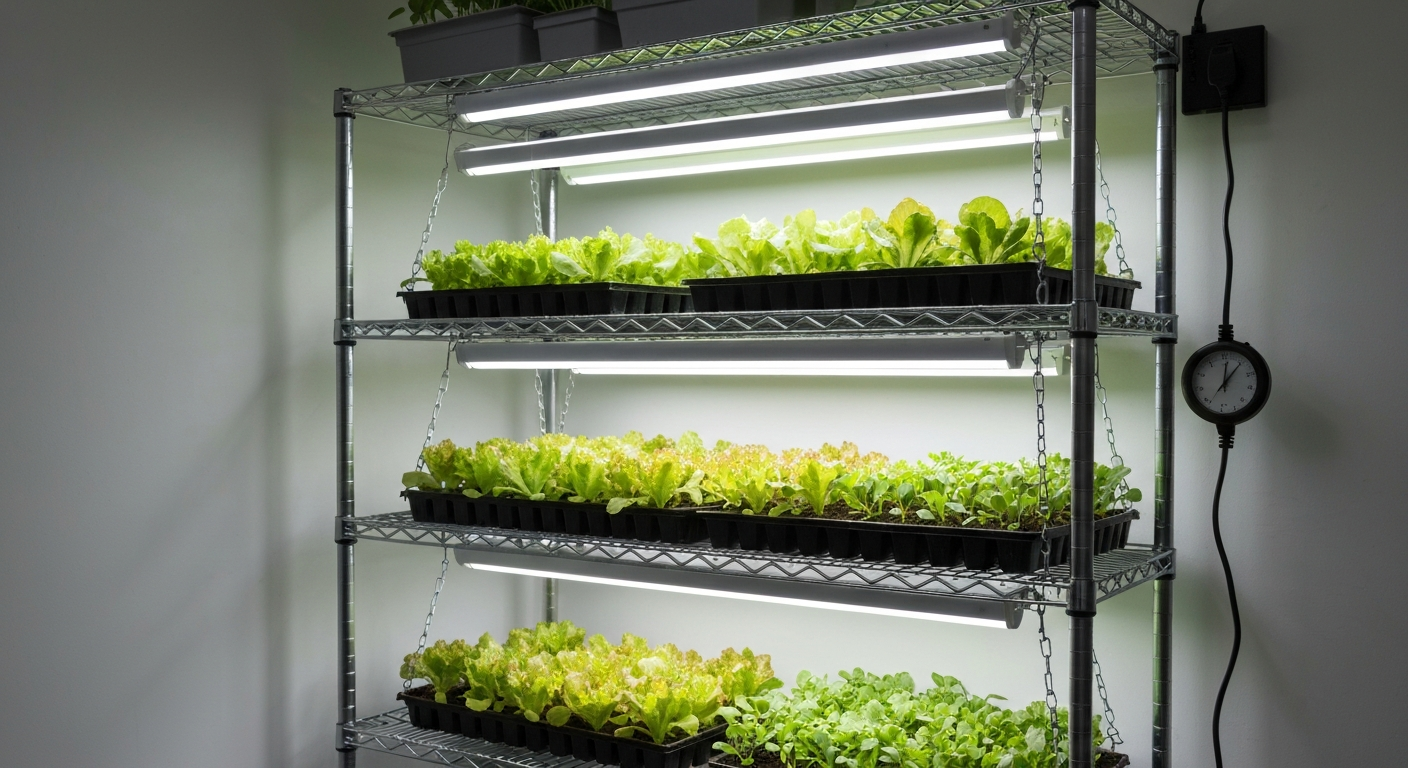
Shop lights are designed to hang from chains or be surface-mounted, and adjustable chains are ideal for growing because you can raise the fixture as plants get taller. For seed starting, attach the chains to a wire shelf unit so you can increment height in 2-inch steps. Wrapping the sides of your growing area with white foam board, white poly sheeting, or even aluminum foil (matte side out) can reflect a meaningful amount of light back onto the canopy and improve edge coverage. In a simple reflective enclosure, I have seen canopy PPFD improve 15 to 25 percent compared to open-air placement with the same fixture.
Spacing multiple fixtures for even coverage
A single 4-foot shop bar lights a strip roughly 4 feet long and 6 to 12 inches wide at useful intensity. For a standard 1020 seedling tray (10 by 20 inches), two bars side by side provide reasonably even coverage. For a 2-by-4-foot growing table, plan on three to four bars. Overlap the coverage zones slightly rather than spacing bars far apart, because the intensity dip between fixtures causes uneven growth. If you notice plants in the center of the array growing faster or taller than those near the edges, your fixtures are spaced too far apart or the edges need reflective material.
Plant stage and light needs at a glance
| Plant Stage / Crop | Target DLI (mol/m²/day) | Target PPFD (µmol/m²/s) | Suggested Runtime with Shop Light |
|---|---|---|---|
| Seedlings / cuttings | 5–10 | 75–150 | 16–18 hours |
| Leafy greens (lettuce, spinach) | 12–17 | 150–250 | 14–16 hours |
| Herbs (basil, cilantro) | 15–25 | 200–300 | 14–18 hours |
| Fruiting veg (tomato, cucumber) | 20–30 | 300–500+ | Shop lights not recommended as sole source |
Troubleshooting common shop-light grow problems
- Leggy, stretched seedlings: The light is too far away or the runtime is too short. Lower the fixture and extend the photoperiod to 16 to 18 hours. If you are already at maximum proximity, add another bar.
- Pale or yellow new growth: Usually a sign of insufficient light intensity or spectrum. Check distance, consider upgrading to a brighter fixture or adding a bar.
- Slow growth in herbs or greens: Calculate your actual DLI using the formula (PPFD × hours × 0.0036). If you are well below the crop target, you need more fixtures, closer placement, or a purpose-built light.
- Uneven growth across the tray: Some plants getting more light than others. Rearrange plants periodically, improve reflective surroundings, or add fixtures to fill gaps.
- High electricity use with modest results: If you are running four or more shop bars to cover a moderate area, the cost and performance case for switching to a dedicated horticultural fixture becomes compelling.
The bottom line is that shop lights are a legitimate tool for a specific range of indoor growing tasks. Used within their real capabilities, they are practical, affordable, and accessible for anyone starting out. Push them beyond those limits, and you will hit a wall that no amount of extra runtime can fully overcome. Know what your plants need, measure or estimate your PPFD honestly, and choose the right tool for the job. Can regular lights be used to grow plants? This guide explains when common shop and household lights work, their limits, and how to set them up effectively. If you specifically want to know whether an OTT light can be used as a grow light, see our guide on can an OTT light be used as a grow light for specifics on spectrum, intensity, and recommended setup. For more on what types of lights can function effectively for plants, see can any light be a grow light.
FAQ
Can shop lights be used as grow lights?
Yes—many shop lights (LED strips/tubes, T5/T8 fluorescents, and compact fluorescent bulbs) can be used successfully for seedlings and vegetative growth if chosen and deployed correctly. They are usually less efficient and less spectrally optimized than purpose‑built horticultural fixtures, so performance depends on type, mounting distance, number of fixtures, runtime and the crop’s light needs.
Which shop‑light types work best for plants?
Best options: modern LED shop‑light bars/tubes (high lumen output, full‑spectrum or daylight CCT) and T5 fluorescent fixtures (high output with good PAR for short distances). CFLs/daylight bulbs can work for small setups or single seedlings. Avoid low‑quality, low‑wattage consumer fixtures if you need higher PPFD or flowering/fruiting crops.
How do shop lights compare with purpose‑built grow lights?
Purpose‑built horticultural LEDs usually have higher photosynthetic photon efficacy (PPE, ~2.0–3.0 µmol·J⁻¹) and published PPF/PPFD/SPD data and better spectrum mixes for plant responses. Consumer shop lights often publish lumens/CCT (human metrics), have lower PPE (~<1–1.7 µmol·J⁻¹), and rarely provide PPFD maps—so expect lower photon output per watt and less predictability.
What technical metrics should I use to judge a fixture?
Primary plant metrics: PAR (400–700 nm) expressed as PPF (µmol·s⁻¹) and PPFD (µmol·m⁻²·s⁻¹); use Daily Light Integral (DLI, mol·m⁻²·d⁻¹) to match crop targets. Lumens/lux are human‑weighted and can mislead unless SPD is known. Also check efficacy (µmol·J⁻¹ or µmol·W⁻¹), spectral power distribution (SPD), and uniformity.
What PPFD/DLI targets should I aim for?
Seedlings/cuttings: ~75–150 µmol·m⁻²·s⁻¹ (with long photoperiods to reach DLI 5–10 mol·m⁻²·d⁻¹). Leafy greens: DLI ~12–25 mol·m⁻²·d⁻¹. Fruiting vegetables (tomato, cucumber): DLI ~20–30 mol·m⁻²·d⁻¹. Convert PPFD to DLI: DLI = PPFD × hours × 0.0036.
How should I set up shop lights (distance, runtime, mounting)?
Distance: keep fluorescent/T5/CFLs very close (~6–12 in / 15–30 cm) and LED shop bars close (~6–18 in) depending on output—raise if bleaching occurs. Runtime: common photoperiods are 14–18 h for veg, 16–22 h for seedlings; use DLI conversion to ensure targets. Mounting: use adjustable hangers/ratchet straps; use reflective surfaces or white walls to improve uniformity. Measure PPFD across canopy if possible.
Next Articles
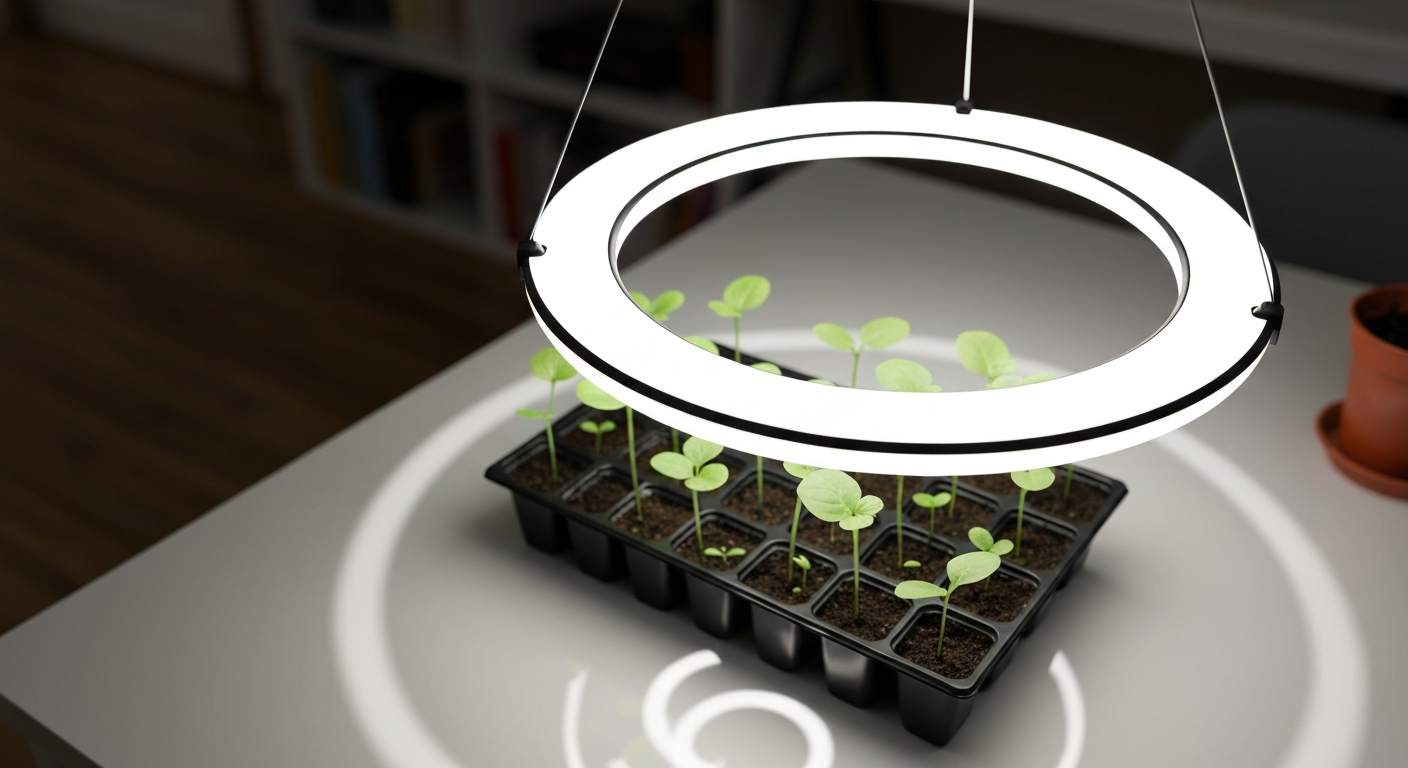
Can a Ring Light Be Used as a Grow Light? Practical Verdict
Can a ring light work as a grow light? Practical verdict, setup tips, limits, and better alternatives for houseplants.
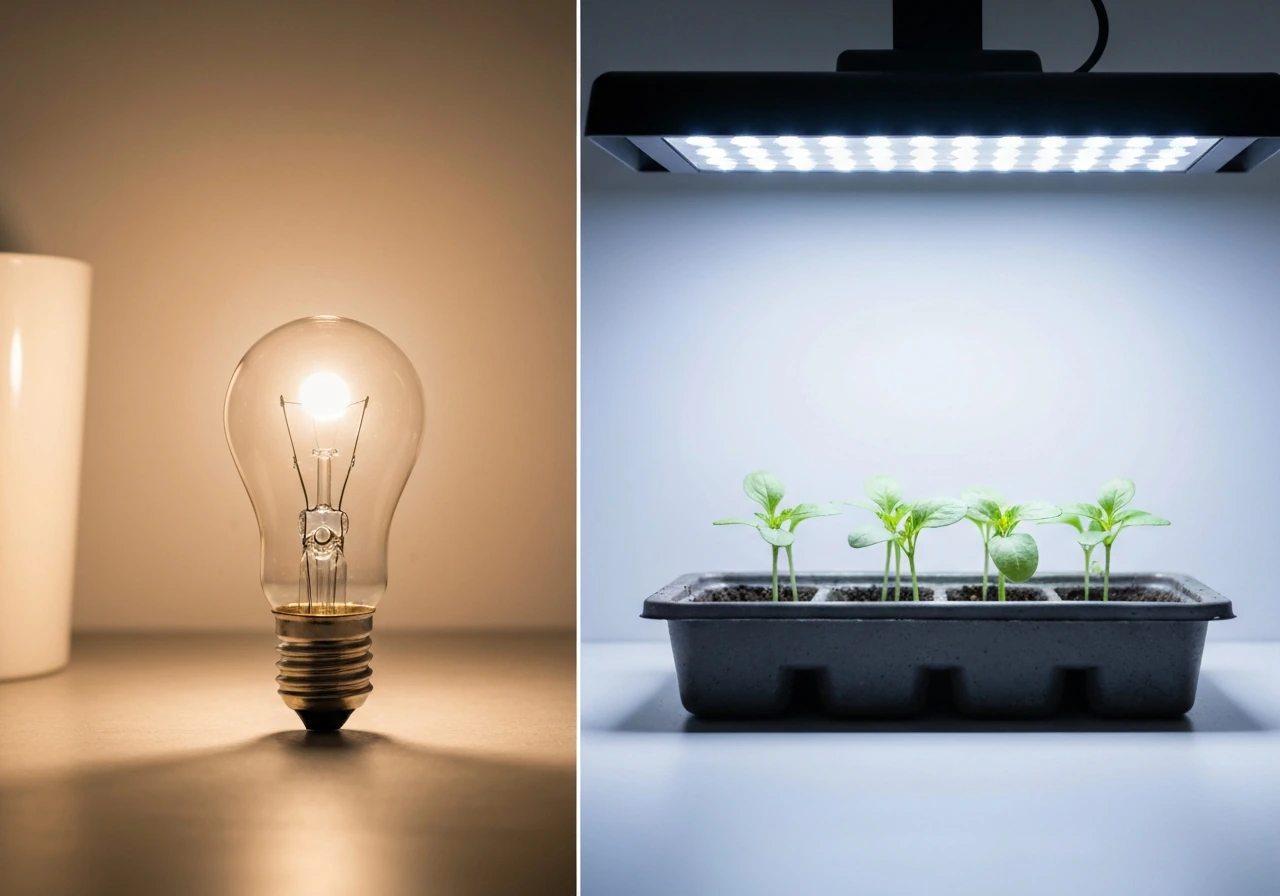
Will a Regular Light Bulb Work as a Grow Light?
Can a regular bulb grow plants? Compare incandescent, CFL, halogen and LED for seedlings, indoor plants, setup, safety.
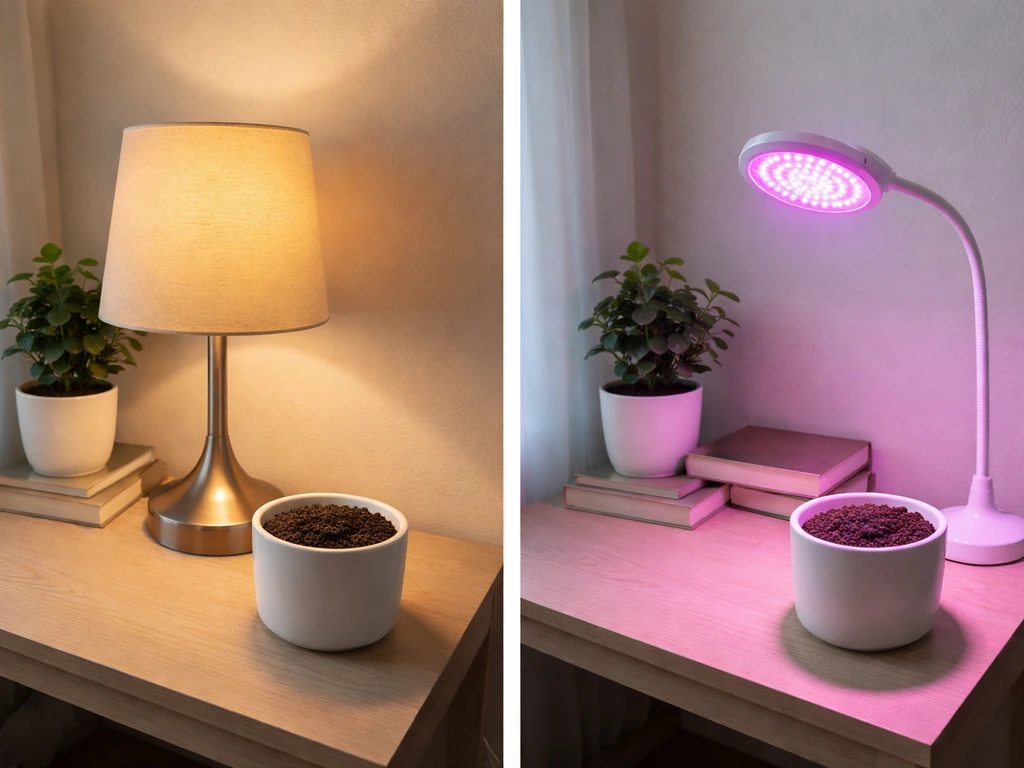
Can You Use Grow Lights as Regular Lights? (Yes, But)
Learn if grow lights work as regular lamps, key spectrum and PPFD vs lumens, and how to set distance safely for plants.