A ring light can work as a grow light in a narrow set of situations, but for most plants it falls short. If you have low-light houseplants, freshly-rooted cuttings, or tiny seedlings that need just a little boost, a decent photography ring light placed close enough can technically deliver enough photons to keep them going or push early growth. But the moment you want to grow vegetables, push a plant through flowering, or support a whole shelf of seedlings, a ring light almost certainly won't deliver the intensity your plants need. Here's exactly how to figure out which side of that line your situation sits on.
Can a Ring Light Be Used as a Grow Light? Practical Verdict
Marcus Holloway
12 Jul 2026
Grow-light basics every home gardener should know
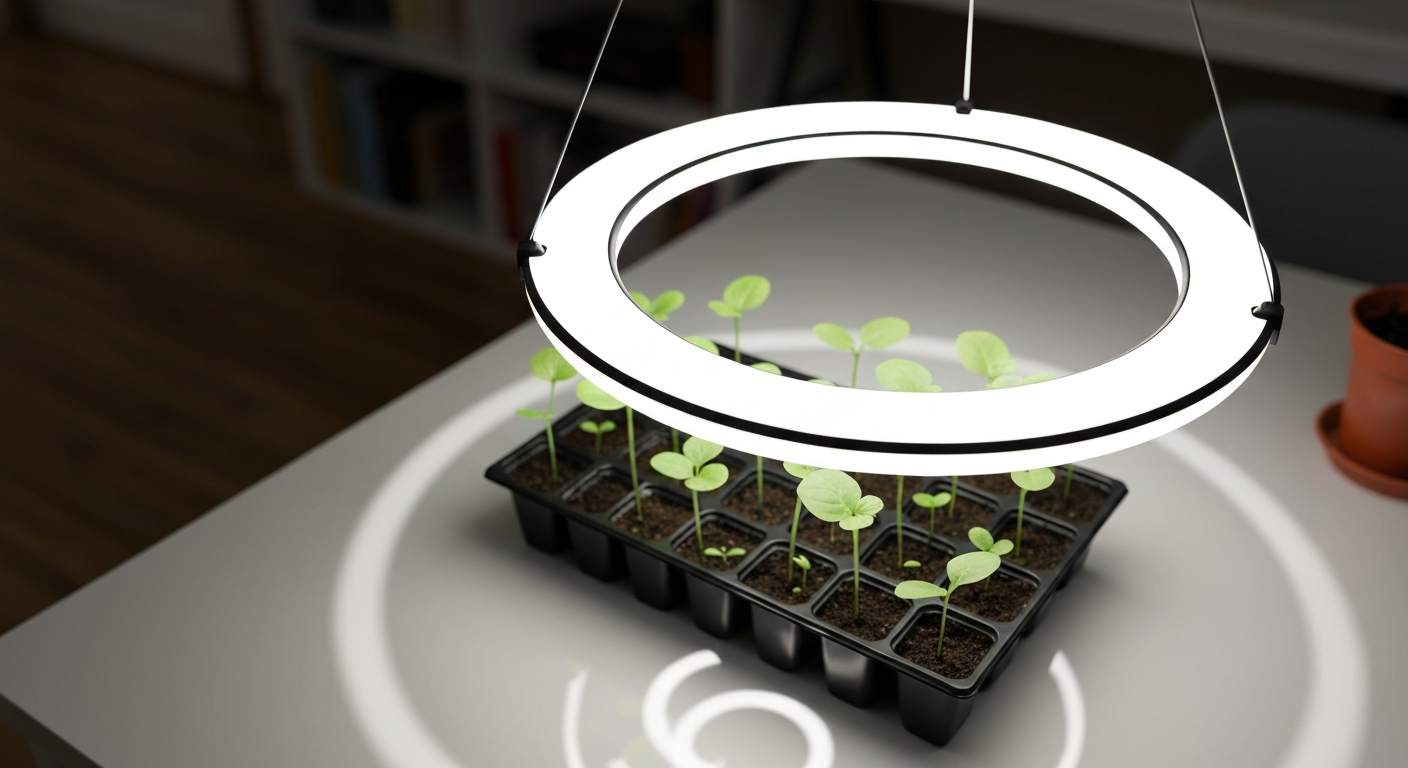
Before you point any light at a plant and expect results, you need to understand four things: spectrum, intensity, daily light integral, and photoperiod. These aren't just technical buzzwords. They explain why a ring light sometimes works and sometimes doesn't, and they'll help you read any grow-light claim critically.
Spectrum: which colors actually feed photosynthesis
Plants use light across roughly 400 to 700 nanometers, which is the photosynthetically active radiation (PAR) window. Within that range, blue light (around 400 to 500 nm) and red light (around 600 to 700 nm) are particularly effective on a per-photon basis, which is why you'll see purpose-built grow lights heavy in those wavelengths. That said, green light (around 500 to 600 nm) isn't wasted. Research, including a meta-analysis published in the Journal of Experimental Botany, has shown that green photons penetrate deeper into plant canopies and can contribute meaningfully to whole-plant photosynthesis. For practical home use, a broad-spectrum white LED that includes both blue and red energy tends to work better for general houseplant or seedling growing than narrow-band red/blue strips. Spectrum also drives more than just photosynthesis. Blue light affects compact growth and stomatal behavior, while red light supports flowering and fruiting cues. See The Role of Blue and Red Light in the Orchestration of Secondary Metabolites, Nutrient Transport and Plant Quality (MDPI Plants review) for a comprehensive review of blue vs. red light effects on secondary metabolites, nutrient transport, stomatal behavior and flowering responses.
Intensity: PPFD is the number that matters
Light intensity for plants is measured in PPFD (photosynthetic photon flux density), expressed as micromoles of photons per square meter per second (µmol·m⁻²·s⁻¹). This is completely different from lux or lumens, which measure brightness as human eyes perceive it. A light can look blindingly bright to you and still be weak for photosynthesis. Lux meters and phone apps measure lux, not PPFD, so if you use them to estimate plant light, you need to apply a conversion factor. For white LEDs, that's roughly 0.013 to 0.018 µmol·m⁻²·s⁻¹ per lux, but be aware this can still be off by 10 to 20 percent depending on the exact spectrum of your bulb.
Daily light integral (DLI): accumulating enough photons over the day
PPFD tells you the rate of photon delivery at one moment. DLI tells you the total photon dose a plant receives over a full day, measured in moles per square meter per day (mol·m⁻²·day⁻¹). It's calculated with a straightforward formula: DLI = PPFD × hours of light × 0.0036. So if your ring light delivers 80 µmol·m⁻²·s⁻¹ at the leaf surface and you run it for 14 hours, the DLI is 80 × 14 × 0.0036 = 4.0 mol·m⁻²·day⁻¹. Many low-light houseplants can survive on a DLI of 3 to 5. Lettuce wants 12 to 17. Fruiting crops want 20 to 30. That formula is your planning tool.
Photoperiod: how many hours counts
Photoperiod is simply how many hours of light a plant gets per day. It affects both the DLI your plant accumulates and the flowering response in photoperiod-sensitive species. Most foliage plants and seedlings do fine with 12 to 16 hours of artificial light per day. Running a light for longer can partially compensate for low PPFD, but there's a ceiling. Most plants need a dark period, and running lights for 20 to 24 hours can stress plants even if photon levels are low. A timer is one of the most valuable tools you can add to any light setup.
Measurable performance targets by plant stage
Different growth stages have meaningfully different light demands. Here's a practical reference table based on extension-recommended ranges. These are canopy-level targets, meaning the PPFD measured right at the top of the plant, not at the fixture.
| Plant Stage / Crop | Target PPFD (µmol·m⁻²·s⁻¹) | Target DLI (mol·m⁻²·day⁻¹) | Typical Photoperiod |
|---|---|---|---|
| Seedlings and cuttings (very young) | Under 100 | 5–10 | 14–16 hours |
| Microgreens | 100–200 | 9–12 | 12–16 hours |
| Low-light houseplants | 50–150 | 3–8 | 12–14 hours |
| Foliage / vegetative growth | 100–500 | 12–17 | 14–16 hours |
| Flowering and fruiting crops | 400–1,200 | 20–30 | 12–16 hours |
These ranges come from University of Maine Cooperative Extension and Virginia Tech Extension guidance. If your light can't hit the PPFD floor for a given stage, you either run it longer (if the plant's dark-period needs allow) or accept that growth will be slow. For flowering crops especially, the gap between what a ring light typically delivers and what the plant actually needs is large.
How to measure or estimate light at home
The most accurate tool is a quantum PAR meter, which reads PPFD directly. Budget options start around $30 to $50 (Apogee and LI-COR make professional versions, but hobbyist-grade meters like the Solarameter or Photon Systems Instruments units are more accessible). If a quantum meter is out of budget, a lux meter is your next option. They're available for under $20, and smartphone apps like Photone or Lux Light Meter Pro use your phone camera to approximate lux. Apply the white-LED conversion factor of roughly 0.013 to 0.018 µmol per lux to get an estimate of PPFD. So if your app reads 5,000 lux, your PPFD is roughly 65 to 90 µmol·m⁻²·s⁻¹. A couple of cautions: this conversion only works reliably for white LEDs. It fails badly for narrow-band red/blue sources. And phone camera sensors can underread in certain light conditions, so treat those estimates as ballparks, not engineering figures. Still, even a rough PPFD estimate is far more useful than guessing.
What ring lights typically deliver
Photography ring lights are designed to produce flattering, even illumination for the human eye, not to drive photosynthesis. Most consumer models (think Neewer, Amaran, Elgato) list wattage, lux at a meter, color temperature (CCT), and CRI on their product pages. What they almost never publish is PPFD, µmol·s⁻¹, or a spectral power distribution (SPD) graph. That omission matters because you can't accurately calculate photon delivery to your plants from a lux spec alone without knowing the spectral shape.
From what I've measured and from consistent hobbyist reports, here's what a typical 10-to-18-inch photography ring light at realistic distances actually looks like for plants:
- Spectrum: broad white light biased toward the 5,500 to 6,500K range, which does include useful blue and some red energy, but is not optimized for photosynthesis
- Intensity at 30 cm (12 inches): roughly 100 to 300 µmol·m⁻²·s⁻¹ on a good unit at close range; many cheaper models deliver less
- Intensity at 60 cm (24 inches): drops sharply, often to 30 to 80 µmol·m⁻²·s⁻¹, following the inverse square law
- Beam pattern: ring-shaped with a brighter annular ring and a dimmer center, meaning coverage is uneven across a plant tray
- Coverage area: adequate for one or two small plants directly in the center; inadequate for a tray or shelf
- Heat: ring lights run relatively cool compared to incandescent or HPS fixtures, but close placement (under 20 cm) on smaller models can still cause leaf tip dryness
The intensity numbers above assume a reasonably bright mid-range ring light (roughly 45 to 60 watts). A small USB-powered 6-inch ring light likely delivers less than 50 µmol·m⁻²·s⁻¹ even up close. On the upper end, a large 18-inch studio ring light drawing 65 to 80 watts might push 300 to 400 µmol·m⁻²·s⁻¹ at 20 cm, which is actually useful for seedlings. The point is: the range is wide, and without measuring, you're guessing.
When a ring light can actually work
There are real use cases where a ring light is a perfectly reasonable plant light, and I don't want to dismiss them. The key is matching the light's output to a plant's actual needs.
- Very young seedlings in the first 7 to 14 days: At this stage, PPFD targets are below 100 µmol·m⁻²·s⁻¹, and even a modest ring light placed 25 to 35 cm above the tray can hit that mark
- Propagation and rooting cuttings: Cuttings under propagation domes are typically stress-sensitive and don't want intense light yet; a ring light at low intensity can be ideal
- Low-light houseplants like pothos, peace lily, snake plant, or ZZ plant: These plants naturally adapt to dim conditions and have a DLI need of roughly 3 to 8 mol·m⁻²·day⁻¹, which a ring light running 12 to 14 hours can reach
- Supplemental lighting in a bright room: If your plants already get several hours of window light, a ring light running 4 to 6 hours can push the DLI up meaningfully without needing to do all the heavy lifting
- Desktop or single-plant display: One plant centered under an 18-inch ring light at 25 to 40 cm gets reasonably even coverage and adequate intensity for foliage maintenance
When a ring light is likely insufficient
Here's where most people run into trouble. The ring light looked bright, they set it up over their herb garden or tomato seedlings, and three weeks later the plants are pale, leggy, and struggling. That's a light-intensity problem, and a ring light is almost always the wrong tool in these situations:
- Vegetative growth of light-hungry plants: Basil, peppers, tomatoes, and most herbs want 200 to 400 µmol·m⁻²·s⁻¹ or more; most ring lights can't reliably deliver that beyond 25 to 30 cm
- Flowering and fruiting crops: These need DLI values of 20 to 30 mol·m⁻²·day⁻¹ and PPFD of 400 to 1,200 µmol·m⁻²·s⁻¹ at the canopy, which is simply out of range for any consumer photography ring light
- Trays of seedlings: The ring-shaped beam pattern creates a hot-spot ring and a dim center; plants at the edges of a standard 10 x 20-inch tray will be starved even if center plants are adequately lit
- Large canopy coverage: Ring lights are designed for a single subject, not for lighting a shelf or bench evenly
- Efficiency: Ring lights not designed for horticulture won't publish photon efficacy in µmol·J⁻¹; purpose-built horticultural LED panels commonly achieve 1.5 to 3.0 µmol·J⁻¹, meaning you get far more plant-useful light per watt with a proper grow fixture
Practical setup: how to use a ring light for plants step by step
If your situation fits the use cases above and you want to try it, here's how to set it up properly.
- Measure your light first: Before placing any plant, use a lux meter or smartphone app to map the lux at different distances directly below the ring. Measure at the center and at the edges. Apply the white-LED conversion (multiply lux by 0.015 as a middle estimate) to get approximate PPFD values.
- Find the right distance: Target at least 80 to 100 µmol·m⁻²·s⁻¹ at the leaf surface for seedlings, or 50 µmol·m⁻²·s⁻¹ for very low-light houseplants. On most mid-range ring lights, this will be 20 to 40 cm from the center of the ring.
- Set your run time using the DLI formula: Decide on a DLI target (5 mol·m⁻²·day⁻¹ for low-light plants, 8 to 10 for seedlings). Then: hours needed = DLI target ÷ (PPFD × 0.0036). Example: 8 ÷ (100 × 0.0036) = 22 hours, which is too long. That means your PPFD is too low and you need to move the light closer or accept a lower DLI.
- Use a timer: Set the light on a plug-in or smart-outlet timer. For seedlings use 14 to 16 hours on and 8 to 10 hours off. For houseplants, 12 to 14 hours on is a reasonable starting point.
- Position plants in the center, not the edges: The beam is brighter in a ring pattern. Place your most light-hungry plants directly under the center-to-ring zone and rotate pots every few days for more even exposure.
- For multiple plants or a wider tray: Consider two ring lights side by side, or accept that a ring light will underperform and plan an upgrade. Overlapping two rings at the right height can improve coverage.
- Mount securely: Ring lights come with floor stands, desk clamps, or tripods. Make sure the mount allows you to lower the light close enough to be effective. Many tripod-mounted rings can't get below 60 cm on a countertop, which may be too far for low-intensity models.
- Check plants weekly: Look for leggy stems (light too far or too weak), leaf tip burn or bleaching (light too close or too intense), or yellowing lower leaves (insufficient overall light). Adjust distance and run time based on what you see.
Safety and comfort: eyes, heat, and electrical basics
Ring lights run at low enough power that they're generally not a significant burn or fire hazard, but there are a few things worth taking seriously.
- Eye exposure: Don't look directly at any ring light at close range for extended periods. White LEDs concentrated in a ring can be uncomfortable or cause temporary afterimages. If the light is positioned in a workspace you occupy for hours, angle it away from your direct line of sight or use a diffuser.
- Heat at close distance: At distances under 15 to 20 cm, smaller ring lights can raise leaf surface temperature enough to cause tip dryness or stress. Keep at least 20 cm between the lamp and leaf surface and check with the back of your hand before placing plants.
- Electrical safety: Don't leave lights running unattended in a setting with moisture (misting trays, propagation setups with wet lids) unless the fixture is rated for damp locations. Photography ring lights are not rated for humid environments.
- Timers: A mechanical plug-in timer is cheap (under $10) and removes the risk of forgetting to turn lights on or off. This matters both for plant health and for keeping your electricity use predictable.
- Ventilation: Ring lights rarely generate enough heat to require active ventilation, but in a small enclosed cabinet or grow tent, any light adds to ambient temperature. Ensure there's airflow if you're running several lights in a confined space.
Ring lights vs. common alternatives: how do they compare?
One of the most common questions I see from new indoor growers is whether the light they already own, whether that's a ring light, a desk lamp, or a shop fixture, will do the job. If you're wondering whether a regular light bulb will work as a grow light, see guidance on that question for a quick comparison and practical recommendations will a regular light bulb work as a grow light. The answer depends heavily on which type of light it is. Here's an honest side-by-side. See the guide “Can regular lights be used to grow plants” for a focused look at when everyday fixtures will or won't meet plant needs.
| Light Type | Typical PPFD at 30 cm | Spectrum Quality for Plants | Coverage | Efficiency (µmol/J approx.) | Best Plant Use Case |
|---|---|---|---|---|---|
| Photography ring light | 100–300 µmol (large models) | Moderate (broad white) | Narrow, uneven ring pattern | Not rated; likely <1.5 | Low-light houseplants, seedlings, cuttings |
| Incandescent bulb | Very low (<50 µmol) | Poor (heavy red/IR, little blue) | Point source, very narrow | <0.5 | Not recommended for plants |
| Daylight CFL (6500K) | 80–200 µmol at 10–15 cm | Decent (broad, blue-heavy) | Moderate, works well in clusters | ~0.8–1.2 | Seedlings, foliage plants at close range |
| T8/T5 shop light (cool white) | 150–350 µmol at 10–20 cm | Good (full broad spectrum) | Wide, even across a shelf | ~1.0–1.5 | Seedlings, foliage, microgreens |
| Ott/task light (full spectrum) | 50–150 µmol at close range | Decent (mimics daylight) | Spot/task, narrow | ~0.8–1.2 | Single low-light plants, desk use |
| Horticultural LED panel | 400–1,000+ µmol (adjustable) | Excellent (tuned for PAR) | Wide, even footprint | 1.5–3.0+ | All stages including flowering and fruiting |
The broader question of whether any light can be a grow light comes down to whether it can deliver adequate PPFD in the PAR range at your plants' canopy level. Incandescent bulbs fail almost entirely on both spectrum and intensity. Daylight CFLs and shop lights can genuinely work for seedlings and foliage plants, especially in clusters. For a practical comparison and recommendations on that topic, see can cfl bulbs be used as grow lights which covers CFL performance, spectrum, and when they are a good option for seedlings and foliage plants. If you're asking 'can daylight bulbs be used as grow lights', the short answer is yes for seedlings and foliage plants, daylight CFLs or shop lights can work, but measure or estimate PPFD to confirm they meet your plants' needs. For more detail on whether shop lights can be used as grow lights, see whether shop lights can be used as grow lights. And dedicated horticultural LEDs are the most efficient and reliable option when you need serious output. The ring light sits somewhere in the middle: better than incandescent, less reliable and less efficient than a T5 or LED panel.
Can your grow light double as regular room lighting?
This question cuts both ways. People ask whether a ring light can grow plants, but also whether a grow light can light a room. If you’re wondering whether you can use grow lights as regular lights, short answer: some broad‑spectrum white horticultural LEDs can double as everyday room lighting while still supporting foliage plants using grow lights as regular room lighting. Ring lights are already designed for room use, so that's a non-issue. The harder tradeoff comes when you're using a dedicated horticultural LED: those are often biased toward red and blue, which creates a purple-pink glow that most people find unpleasant for living spaces. Broad-spectrum white horticultural LEDs are a better choice if you want one fixture to serve double duty. They tend to have good CRI (color rendering index) values above 80, which means they show colors accurately enough for a workspace or living room. The downside is that in optimizing for aesthetics and CRI, they may sacrifice some photon efficacy compared to purpose-built grow fixtures. For most home growers, a broad-spectrum white LED is a reasonable compromise: it looks fine as room lighting and still does a solid job for foliage plants and seedlings.
Buying checklist: what to look for in a plant-friendly light
Whether you're evaluating a ring light you already own or shopping for something new, here are the specs that actually tell you whether a light will work for plants. Comprehensive technical reviews, such as the Horticultural Lighting Report (Lighting Research Center, RPI), technical review comparing fixture efficacy, DLI and PPFD concepts, compare fixture photon efficacy, PPFD footprints and DLI guidance to help choose between LED modules, T5 fluorescents, HPS and other options Horticultural Lighting Report (Lighting Research Center, RPI) — technical review comparing fixture efficacy, DLI and PPFD concepts. If a product page doesn't list these, treat that as a yellow flag.
- PPFD at the intended mounting distance: Look for µmol·m⁻²·s⁻¹ at one or more distances (30 cm, 60 cm). A PPFD map is even better. If only lux is listed, apply the white-LED conversion (×0.013 to 0.018) as a rough estimate.
- Photon efficacy (µmol·J⁻¹): Purpose-built horticulture LEDs should ideally hit 1.5 µmol·J⁻¹ or higher. This tells you how efficiently the fixture converts watts to plant-useful light.
- Spectrum coverage: A broad-spectrum white LED covering 400 to 700 nm is versatile for most home use. Red-heavy or red/blue-only spectra are better for specialized flowering setups but look unpleasant as room lights.
- Coverage footprint: Check the size of the canopy area the manufacturer claims at a given PPFD. A light that delivers 400 µmol·m⁻²·s⁻¹ but only over a 20 × 20 cm area is very different from one that covers 60 × 60 cm at the same intensity.
- CCT (color temperature) and CRI: For general foliage and seedlings, 4,000 to 6,500K with a CRI of 80 or above is a good range. Lower CCT (2,700 to 3,000K) is more red-heavy and better for flowering.
- Heat and housing: LEDs should have passive or active heat management. Check that the driver and housing are rated for the environment you'll use them in.
- Dimmability and timer compatibility: These are quality-of-life features but genuinely useful for adjusting intensity by plant stage and automating photoperiod.
When to upgrade: what to buy instead of a ring light
If you've measured your ring light and found it can't hit the PPFD your plants need, or if your use case involves more than one or two small plants, here's a practical guide to what to buy instead based on your situation.
| Use Case | Recommended Fixture Type | Why It Works Better |
|---|---|---|
| One shelf of seedlings or microgreens | T5 or T8 fluorescent shop light, or an LED strip bar in 4,000–6,500K | Wide, even coverage across a standard tray; easily suspended at the right height |
| Single foliage plant or low-light desktop plant | LED desk lamp with 5,000–6,500K and >800 lumens, or a small LED panel | More PPFD per watt than a ring light; smaller footprint |
| Multiple foliage plants or herb garden indoors | LED quantum board or spider-style panel (50–100W) | Broad even footprint, published PPFD maps, high efficacy |
| Flowering or fruiting crops (tomatoes, peppers, strawberries) | Horticulture-grade LED panel (150W+) with full spectrum or adjustable spectrum | The only fixture type reliably hitting 400–1,200 µmol·m⁻²·s⁻¹ over a meaningful canopy area |
| Propagation station | T5 HO 24-inch bar or small LED strip kept 5–10 cm above domes | Low intensity is appropriate here; inexpensive and widely available |
| Supplemental light for window plants | Any decent broad-spectrum LED run 4–6 hours: even a ring light works here | Window provides baseline DLI; supplement just needs to top it up |
Quick recap and decision guide
If you're standing in front of your ring light right now and trying to decide what to do, here's the short version. Measure the lux under your light at the height you plan to use it, multiply by 0.015 to get a rough PPFD, then use DLI = PPFD × hours × 0.0036 to see if you can realistically hit the DLI target for your plant at a reasonable photoperiod. If the math works out and you're growing low-light houseplants, seedlings, or cuttings, go ahead and use it. Set a timer, keep the light close enough, and check your plants weekly. If the math doesn't work, you now know exactly why, and the table above tells you what to buy instead. The ring light isn't a bad tool; it's just a tool designed for something else. Used in the right context, it can save a struggling houseplant or nurse seedlings through their first weeks. Used in the wrong context, it'll just run up your electricity bill while your basil quietly gives up.
FAQ
Can a ring light be used as a grow light?
Short answer: sometimes — but only for low‑demand uses. A ring light can provide usable photosynthetic photons for seedlings, cuttings and low‑light houseplants if it delivers adequate PAR at canopy level and is placed close enough. It is usually inadequate for sustained vegetative growth or flowering/fruiting because most consumer ring lights lack the intensity (PPFD), measured spectrum and photon efficacy horticultural crops require.
What are the core requirements for a light to be effective for plants?
Plants need photons in the PAR range (≈400–700 nm). Key measurable variables are PPFD (µmol·m⁻²·s⁻¹ = instantaneous photon flux density), DLI (mol·m⁻²·day⁻¹ = cumulative daily photons), and photoperiod (hours light per day). Spectrum matters too: blue (≈400–500 nm) and red (≈600–700 nm) are most photosynthetically efficient and shape morphology/flowering, while green contributes within canopies.
What PPFD and DLI targets should I aim for?
Rough targets: seedlings/cuttings ~50–100 µmol·m⁻²·s⁻¹ (DLI 5–10 mol·m⁻²·day⁻¹ depending on hours); leafy houseplants and many ornamentals 100–300 µmol·m⁻²·s⁻¹ (DLI 8–20 mol·m⁻²·day⁻¹); flowering/fruiting crops often need 400+ µmol·m⁻²·s⁻¹ and DLIs of 15–30+ mol·m⁻²·day⁻¹. Use DLI = PPFD × hours × 0.0036 to convert between them.
How do ring lights typically perform on spectrum and intensity?
Most consumer ring lights are white LEDs listed by wattage, lumen or lux and CCT/CRI, not by PPFD or SPD. They often emphasize visual color rendering rather than optimized plant spectra. As a result, their PAR output (µmol·m⁻²·s⁻¹) at realistic distances is frequently low, and photon efficacy (µmol·J⁻¹) is usually not competitive with horticultural fixtures.
Can I estimate whether a ring light will work without specialized meters?
You can make a rough estimate: if the product lists lux at a given distance, convert using an approximate factor for white LEDs (~0.013–0.018 µmol·m⁻²·s⁻¹ per lux) to estimate PPFD — but this can be off by 10–30% and fails for narrow‑band lights. A PAR (quantum) meter or spectrometer is the reliable way to know. If PPFD at canopy is below target ranges above, the ring light is probably inadequate.
Practical setup guidance if I want to try a ring light for plants
1) Measure PPFD at canopy with a PAR meter if possible. 2) Place the ring light close to leaves (10–30 cm) to increase PPFD, but avoid hot spots or touching foliage. 3) Use the DLI formula to set run time (e.g., PPFD 50 µmol·m⁻²·s⁻¹ for 12 hours gives DLI ≈2.16 mol·m⁻²·day⁻¹). 4) For seedlings, run 12–16 hours; for mature foliage, 14–18 hours or as species requires. 5) Monitor plants for stretch (too little blue), bleaching (too intense/close), or slow growth.
Next Articles
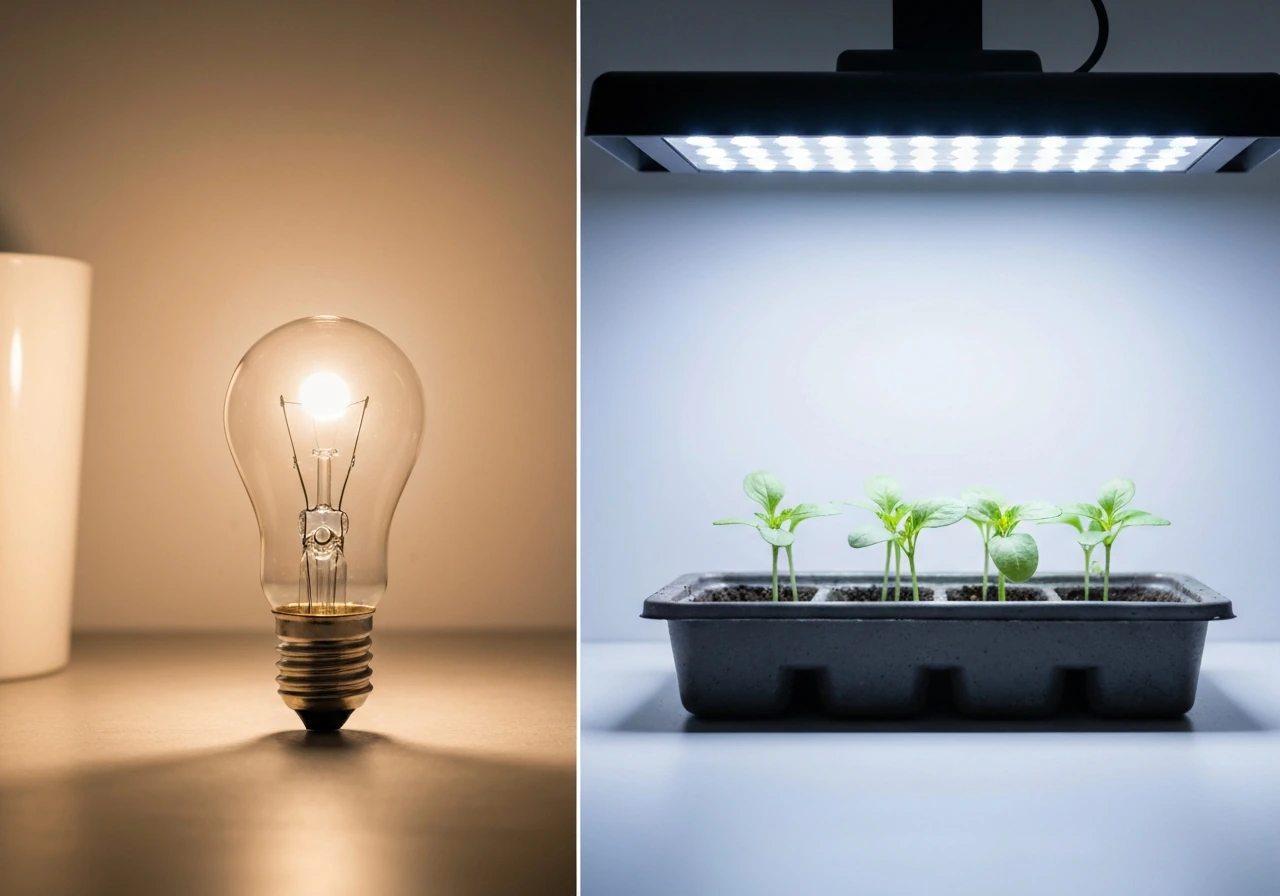
Will a Regular Light Bulb Work as a Grow Light?
Can a regular bulb grow plants? Compare incandescent, CFL, halogen and LED for seedlings, indoor plants, setup, safety.
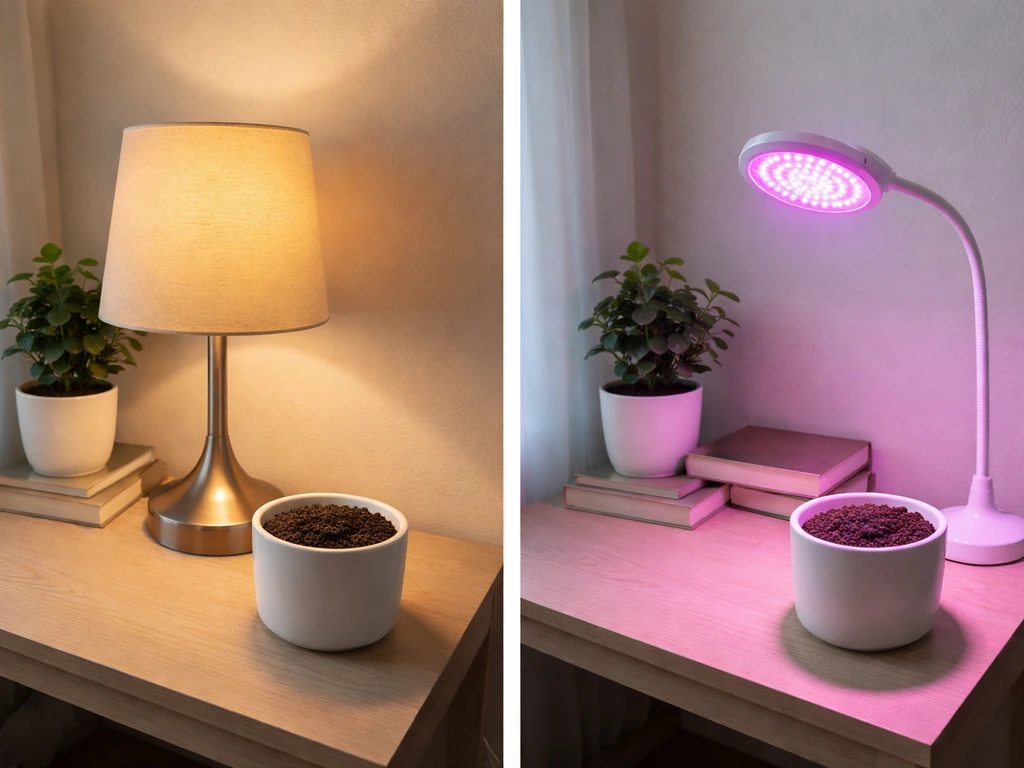
Can You Use Grow Lights as Regular Lights? (Yes, But)
Learn if grow lights work as regular lamps, key spectrum and PPFD vs lumens, and how to set distance safely for plants.
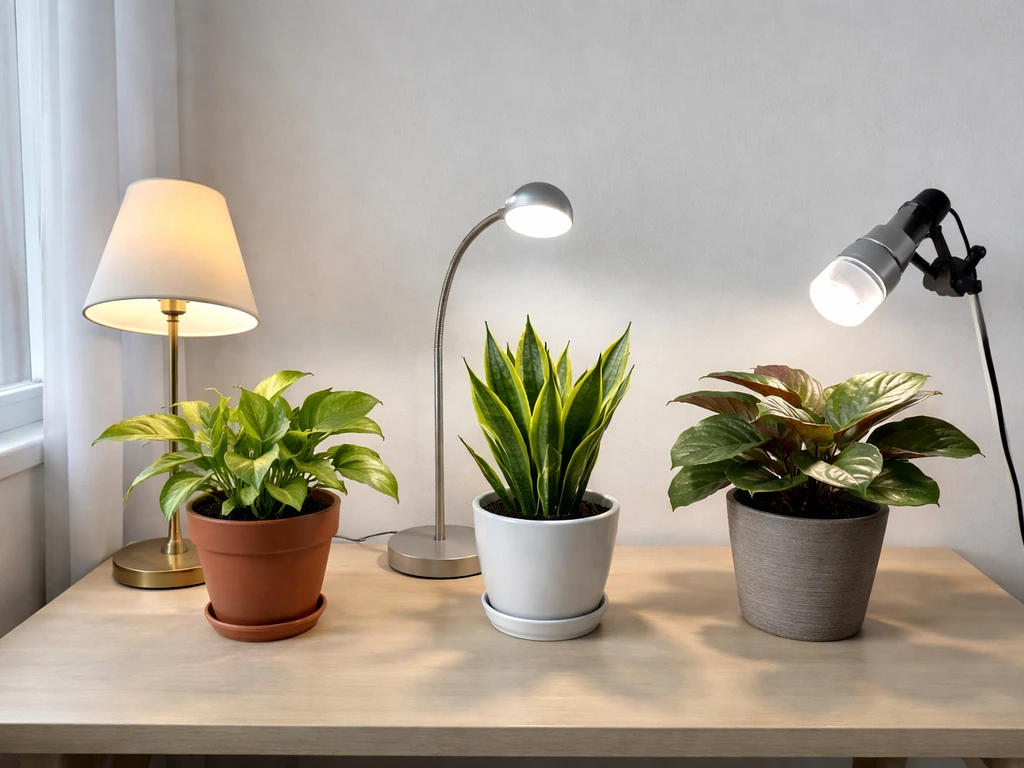
Can Any Light Be a Grow Light? What Works Indoors
See which household lights can grow plants indoors, what fails, and how to set spectrum, distance, and run time safely.