Yes, you can put grow lights under plants, but it works reliably only in specific situations and with the right setup. The most common use case is a tiered shelving system where one shelf's light panel hangs below the plants on the shelf above it. Done correctly, under-plant lighting can deliver enough photosynthetically active radiation (PAR) to support healthy growth. With the right PAR levels and spacing, growers can grow pros under canopy lights in the same way they would with well-designed overhead illumination. Done carelessly, you end up with leggy, uneven plants that stretch sideways toward any other light source they can find.
Can You Put Grow Lights Under Plants? Yes With These Steps
Marcus Holloway
24 Jun 2026
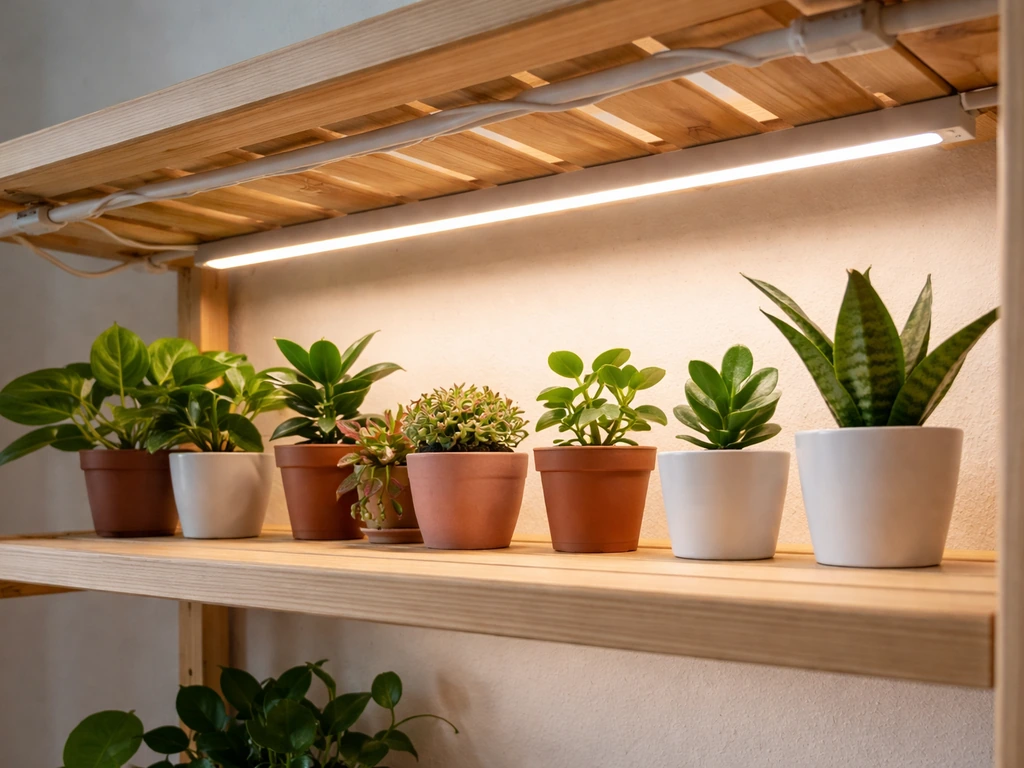
Yes, but only in specific situations
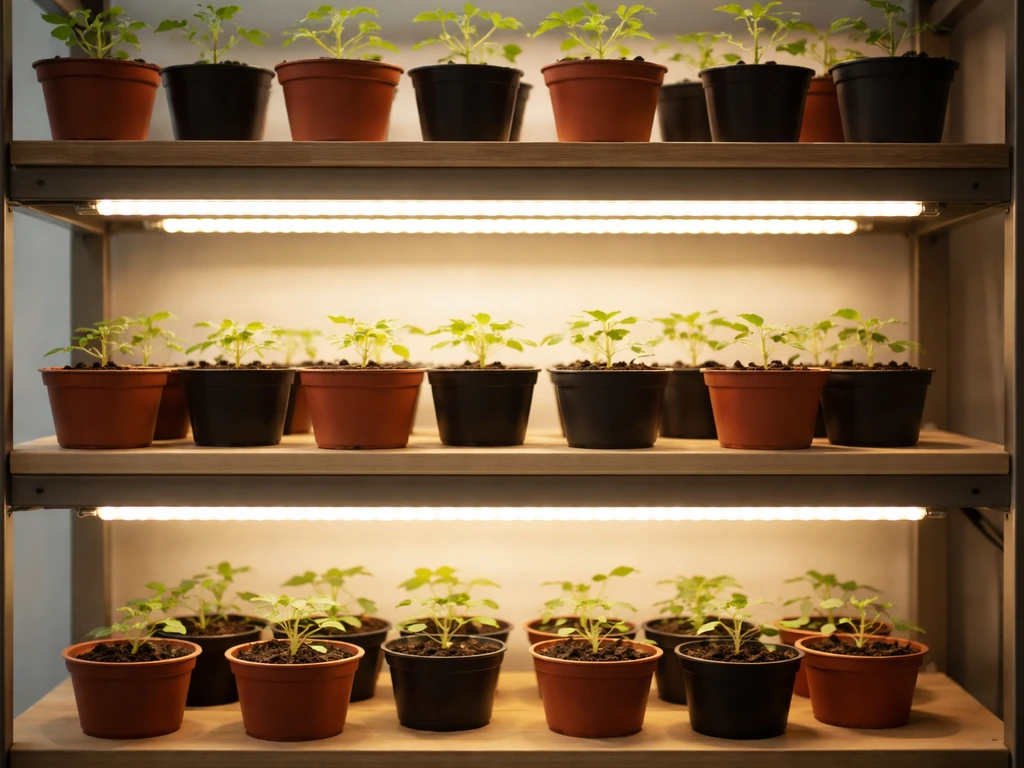
Under-plant lighting makes the most sense in a few practical scenarios: multi-tier grow shelves where overhead fixtures on one shelf also serve as under-lighting for the shelf above, grow tents with raised mesh platforms, propagation trays where you want supplemental light from below, and specialty setups like grow tables with translucent tops. Outside of these cases, placing your only light source below the canopy is generally a bad idea and will cause problems.
The reason comes down to how plants handle light direction. Phototropism, the process by which plants grow toward light, means that a plant receiving light exclusively from below will eventually reorient itself in ways you probably don't want. Research on head lettuce has shown that bottom lighting can alter leaf morphology, change leaf angles, and reduce overall leaf count compared to standard overhead lighting. For most home gardeners, that translates to plants that look off, with leaves angling or curling in unusual directions and canopy structure that's harder to manage.
Where under-lighting genuinely earns its place is as a supplement, not a sole source. If your plants already have overhead light and you're adding a fixture below to fill in the lower canopy or to serve plants on a shelf just above, you're working with the plant's biology rather than against it. Seedlings and cuttings are especially forgiving here, since they haven't yet developed complex canopy geometry that makes directional light tricky. Do grow lights help cuttings root, and under-shelf setups can play a supportive role if you provide enough light intensity and keep the fixture close.
How under-plant light placement changes plant growth
Leaves are optimized to absorb light on their upper surface. The palisade mesophyll cells, the main photosynthesis workhorses, are densely packed near the top of the leaf. Light coming from below hits the spongy lower surface first, which is less efficient at capturing energy. That doesn't mean zero photosynthesis happens, it absolutely does, but the geometry is less ideal. Leaf angle relative to the incoming light direction matters a lot for how much energy actually gets captured.
Canopy structure adds another layer of complexity. In a dense planting, the bottom leaves partially block light from reaching the upper leaves when the source is below, which is essentially the opposite of the normal shading problem. This is why under-lighting works better for low-canopy plants (lettuce, herbs, seedling trays) than for tall, bushy plants with multiple leaf layers stacked above each other.
The practical takeaway: if you're lighting seedlings from below on a shelf, or supplementing the bottom of a cannabis or tomato canopy that already has strong overhead coverage, you're fine. If you're trying to grow basil using only a light panel sitting on the floor shining upward, expect your plants to be confused and unhappy within a few weeks.
Best grow light types for underneath setups
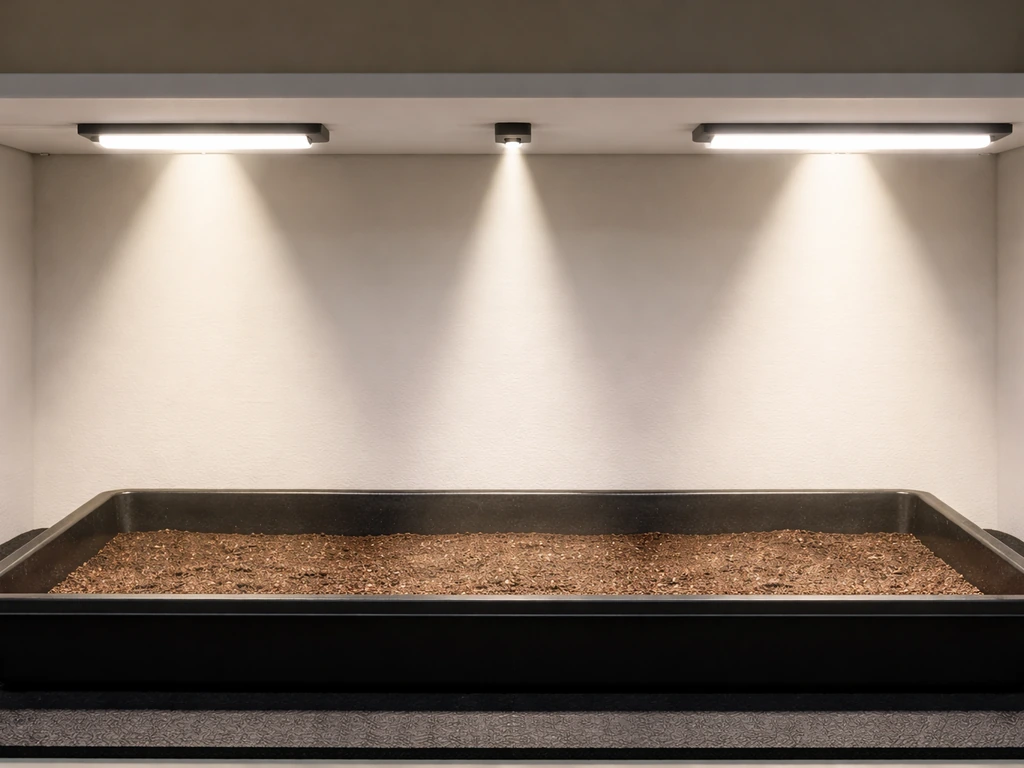
Not every fixture works well when mounted below plants. You want something thin enough to fit under a shelf, with a wide enough beam angle to cover the tray or pot area above it, and ideally with low heat output so you're not baking roots or soil from below.
| Light Type | Beam Angle | Heat Output | Best For Under-Plant Use | Notes |
|---|---|---|---|---|
| LED bar/strip lights | 120–150° | Very low | Excellent | Thin profile, wide coverage, easy to mount under shelves |
| LED panel (quantum board) | 120° | Low | Good | Flat, efficient, works well for wider trays; watch mounting depth |
| T5/T8 fluorescent tubes | ~120° | Low-moderate | Good | Proven for seedlings; less efficient than LED but affordable |
| Compact fluorescent (CFL) | Varies | Moderate | Fair | Awkward shape for uniform coverage; better for single plants |
| HID (HPS/MH) | Varies | Very high | Poor | Too much heat too close to roots and soil; not recommended below plants |
| Spotlight/narrow-beam LED | 15–45° | Low | Poor | Creates hot spots and severe corner under-delivery |
LED bar lights and quantum board panels are the clear winners here. Their wide beam angles (typically 120 degrees or more) spread light more evenly across a shelf footprint, which is exactly what you need when the light has to cover the entire base of a tray from just a few inches away. Narrow-beam spotlights are a bad choice: the beam angle determines your coverage footprint, and a tight beam delivers intense light in one small spot while the edges of your tray get almost nothing.
Spectrum matters too. Red and blue wavelengths drive most photosynthesis, and a full-spectrum LED with strong red and blue output will serve under-plant lighting well whether you're germinating seeds, propagating cuttings, or growing leafy greens. Red and blue wavelengths drive most photosynthesis, so if you're asking do you use grow lights during germination, this is the part of the spectrum you want to pay attention to. You don't need anything exotic here; a standard broad-spectrum LED panel in the 3000–6500K range or a dedicated horticultural red/blue LED works fine.
How to set intensity and distance (PPFD basics without the headache)
PPFD stands for photosynthetic photon flux density, and it's just a measurement of how much usable light is hitting a surface per second. Think of it as the light intensity your plant actually experiences. The recommended sweet spot for most actively growing plants is blank" rel="noopener noreferrer">400 to 800 µmol/m²/s. For seedlings and clones, you can start lower, around 100 to 300 µmol/m²/s, since young plants can be stressed by too much intensity before they've developed enough chlorophyll to handle it. As a result, can grow lights burn seedlings if you start them too bright or keep the fixture too close, so use the low end of the PPFD range first.
Distance controls intensity more than anything else. Light follows an inverse square relationship: double the distance and you roughly quarter the intensity. For under-shelf setups, keeping your fixture 6 to 12 inches from the plants above it is the standard starting point, which aligns with extension service recommendations for seedling lighting. If your shelf spacing is tight, a lower-wattage fixture or a dimmer will help you avoid overdriving the plants from too close.
Uniformity is the sneaky challenge with under-plant lighting. A single centrally placed fixture will always deliver more light directly below its center and significantly less at the corners and edges. To check this, do a simple PPFD map: measure intensity at several points across your tray (center, midpoints of each side, and corners) with all other lights off. If your corners are reading less than 50% of your center value, you have a uniformity problem. Fixes include adding reflective material (white foam board, mylar film) around the sides of the shelf opening to bounce light back toward the edges, using multiple smaller fixtures instead of one large one, or choosing a fixture with secondary optics designed for wide-angle coverage.
Setup steps for a safe under-plant lighting system
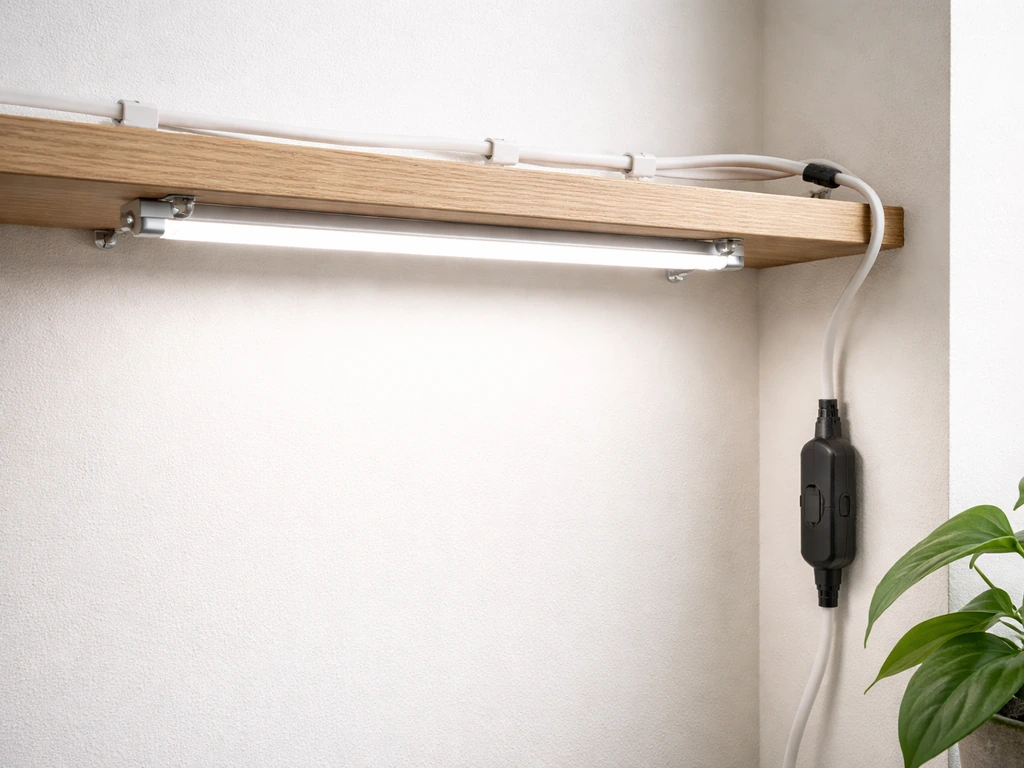
- Choose a thin LED bar or panel with a beam angle of 120 degrees or wider. Check that it carries a UL 8800 listing or equivalent safety certification, especially if it will be near moisture from watering.
- Mount the fixture to the underside of the shelf above using the included brackets, zip ties, or a purpose-built shelf light clip. Make sure it's secured so it can't fall onto plants or into water.
- Set the initial distance at 8 to 10 inches between the fixture and the top of your plants or tray surface. Adjust from there based on plant response.
- Add reflective material (white foam board, reflective film, or white-painted surfaces) to the sides and back of the shelf bay. This significantly improves edge uniformity without adding any power draw.
- Plug the fixture into a mechanical or smart timer. Set it for 14 to 16 hours of light per day for seedlings and leafy greens, or 16 hours if you're trying to maximize growth rate. Sun-loving plants may need up to 18 hours if the fixture is your only light source.
- Do a PPFD spot-check with a light meter or a phone-based PAR meter app (these are approximate but useful for relative comparisons). Aim for at least 200 to 400 µmol/m²/s for seedlings and 400 to 600 µmol/m²/s for established leafy plants.
- Check for heat buildup after the first 30 minutes of operation. Hold your hand at plant level for 10 seconds. If it feels uncomfortably warm, either raise the fixture or reduce wattage using a dimmer.
Typical results and troubleshooting
When an under-shelf setup is dialed in correctly, you should see compact, even growth with good color. Seedlings won't stretch, leaves will be a healthy green (not pale or yellowish), and new growth will emerge steadily. Proper lighting can help seedlings grow normally, but the results depend on intensity, distance, and coverage uniformity will seedlings grow under led lights. Expect results that are comparable to a decent overhead setup, with the main trade-off being slightly less canopy efficiency because light is coming from a non-ideal direction.
Most problems in under-plant lighting come down to three root causes: not enough light, uneven light, or too much heat. Here's how to read the symptoms:
| Symptom | Likely Cause | Fix |
|---|---|---|
| Leggy, tall, stretching plants | Insufficient PPFD at leaf level | Lower fixture closer to plants; increase photoperiod to 16–18 hrs; check for light leaks pulling plants sideways |
| Uneven growth (one side bigger) | Uneven PPFD distribution across tray | Add reflective side panels; reposition fixture to center; consider adding a second bar fixture |
| Pale or yellowish leaves | Light intensity too low or spectrum mismatch | Increase PPFD; verify fixture has adequate red/blue output; move fixture closer |
| Leaves curling downward or upward | Heat stress or too much intensity | Raise fixture or dim it; verify no heat buildup at plant level |
| Slow or no germination | PPFD too low or photoperiod too short | Increase runtime to 16 hrs; confirm seeds have adequate moisture; light alone won't germinate if temps or moisture are off |
| Burnt or bleached leaf tips nearest the fixture | Fixture too close or wattage too high for the distance | Raise fixture 2–3 inches; consider dimming if fixture supports it |
If you're growing seedlings specifically and seeing leggy growth, it's almost always a light intensity or duration problem. If you're wondering whether you should i put grow lights on seeds, start by ensuring you have enough intensity and keep the light positioned at the right distance. Seedlings left too long in a seed flat with inadequate light will stretch dramatically trying to find more. The fix is almost always getting the fixture closer or running it longer, not switching fixture types. This same principle applies whether your light is above or below the plants.
Safety checks and misconceptions worth clearing up
Under-plant lighting doesn't introduce any exotic new risks compared to standard overhead setups, but the placement does change a few practical considerations worth checking off.
- Moisture and electrical safety: Under-shelf fixtures are closer to soil, trays, and drainage water than overhead lights. Always use a fixture with a UL 8800 listing (the current US/Canada safety standard for horticultural lighting), which specifically evaluates wet-environment ratings and photobiological hazards. Don't use general-purpose indoor fixtures in this role.
- Heat below the roots: Some fixtures get warm enough to raise soil temperature from below. For most leafy greens and seedlings, slightly warm soil is actually fine, but extended exposure to heat above 75–80°F at root level will stress plants. Check with your hand after 30 minutes of operation.
- Eye and skin exposure: Since under-shelf lights are often at standing or seated eye level, you're more likely to look directly into them than you would with an overhead fixture. Most horticultural LEDs aren't dangerous for brief incidental exposure, but avoid staring directly at any grow light, especially blue-heavy or UV-enhanced models. UL 8800 certification requires evaluation of photobiological effects on humans, so listed products are assessed for these risks.
- Fire risk from wiring under shelves: Route cables along the shelf structure rather than letting them hang freely near plants or water. Use cable clips or zip ties, and don't daisy-chain multiple fixtures through undersized extension cords. A dedicated surge-protected power strip rated for the total wattage of your setup is the right move.
- Will under-lighting give you a tan or cause cancer? No. Standard horticultural LEDs don't produce meaningful UV output. Even UV-enhanced grow lights used in commercial horticulture emit UV at levels that require sustained, direct, close-range exposure to cause any skin effect. Occasional exposure while tending your plants carries essentially zero risk.
- Will it look weird or bother housemates? Under-shelf grow lights, especially blue-heavy ones, can be visually intense in a room at night. Enclosing the shelf bay with a simple curtain or growing in a dedicated space solves this without any plant trade-off.
One last thing worth noting: if your primary goal is germinating seeds or rooting cuttings, the direction of your light source matters less than getting the intensity and duration right. Do grow lights help seeds germinate? Yes, and the key is providing enough light intensity and the right schedule for your seed tray germinating seeds. Germination happens before true leaves form, so phototropism isn't a factor yet. A well-placed under-shelf LED that hits your seed tray with consistent 200+ µmol/m²/s for 16 hours a day will outperform a badly positioned overhead light every time. Focus on the numbers first, then worry about geometry.
FAQ
How do I know if under-plant lighting is too weak or too strong for my seedlings or leafy greens?
Use PPFD targets as your guide. For actively growing plants, start in the 400 to 800 µmol/m²/s range, for seedlings and clones start around 100 to 300. If your plants are stretching, the usual cause is insufficient PPFD or too long a shelf distance. If they look bleached, scorched, or stop growing, you likely have excessive PPFD or the fixture is too close, reduce intensity or increase distance.
Can I use under-shelf grow lights as the only light source for full production, like basil or tomatoes?
It can work, but it is harder to do well than supplementation because you must achieve both adequate PPFD and strong coverage uniformity across the whole canopy. If you only place one fixture near the center, corners often end up below your ideal range. In practice, most people get better results using under-lighting to fill the lower canopy while overhead provides the main driving light.
What spacing and fixture distance should I use under a shelf to avoid uneven growth?
The standard starting point is keeping the fixture about 6 to 12 inches below the plants above it, then tuning based on PPFD readings. Unevenness is usually worse when shelf spacing is tight and beam spread is narrow, so choose a wide-angle LED and verify edge and corner PPFD with a quick PPFD map before committing to a full crop.
Do I need to worry about heat when I mount grow lights under plants?
Yes, but the type of fixture matters. High-heat fixtures can warm the underside of pots or trays, which can stress roots and dry the medium faster. If you cannot use LEDs, add ventilation and measure surface temperature under the shelf. With LEDs, heat is usually manageable, but still ensure airflow and avoid sealing the fixture in a way that traps heat.
Will under-lighting cause plants to grow sideways or curl leaves more than overhead lighting?
It can, especially if the plants receive light primarily from below. Phototropism encourages reorientation toward the strongest light direction. If you notice leaning, unusual leaf angles, or canopy drift over time, switch to a mixed lighting strategy (overhead plus under-lighting) or increase overhead contribution so the plant is not chasing a single direction.
Is it safe to place grow lights under every plant, including tall or bushy ones?
Not usually. Tall, multi-layer canopies create a reverse shading problem when the light is below, because lower leaves block light that would have reached higher layers. Under-lighting tends to be most effective for low-canopy crops, propagation trays, and plants where the target leaves sit closer to the underside light.
What’s the best way to check coverage uniformity without buying extra gear?
If you have a PPFD meter, measure at the center, midpoints of each edge, and each corner with other lights off. If corner readings are under about 50% of the center, uniformity is poor and you will likely see uneven growth. If you do not have a meter, you can still do a practical check by using identical pots across the tray and observing corner performance over 1 to 2 weeks, but you will have less precision.
Should I run under-shelf lights on the same schedule as overhead lights?
For seedlings and rooting, consistency matters more than matching overhead exactly. Many growers use a 14 to 18 hour photoperiod for propagation and then adjust as plants develop. If you supplement under a working overhead system, start with a shorter or dimmer under-light schedule first, then increase only if lower-canopy growth is lagging.
Can under-plant lighting replace a proper reflective setup in a grow shelf?
Often not. Even with wide-angle LEDs, some light is lost to the surrounding shelf surfaces. Adding reflective material to the sides of the shelf opening (for example, light-colored panels or reflective film designed for horticulture) can bounce stray photons back toward the edges and corners, improving uniformity without adding more power.
What fixture type should I avoid for under-shelf mounting?
Avoid narrow-beam spotlights and deeply focused fixtures. Beam angle controls how wide the coverage footprint is, so a tight beam creates hot spots under the center and leaves edges underlit. Bar-style LED or quantum-board style panels are typically easier to get even coverage from a short distance.
If I’m starting from seeds, does under-lighting still matter after germination?
Under-lighting can help seeds germinate because the photosynthetic response is mainly about getting enough usable light, and phototropism is less of a factor before true leaves form. After germination, if you keep using the same setup, you may need to adjust intensity upward and ensure coverage uniformity, otherwise seedlings can become unevenly green and more likely to stretch.
Next Articles
Grow Pros Under Canopy Lights: Setup, Spacing, and Fixes
Guide to set up canopy lights: placement, spacing, height, spectrum, timers, and fixes for weak, stretched, or bleached
What Artificial Light Will Grow Plants: Best Lights Guide
What artificial light will grow plants: practical guide to LED, CFL, HID spectra, PPFD targets, setup, cost & tips.
Will Any Light Grow Plants? Guide for Indoor Growers
Can any light grow plants? Clear yes/no, science-backed light specs, setup tips, and which household lights work.