Yes, you can use aquarium lights to grow plants, but the results depend almost entirely on which type of aquarium light you have and what you're trying to grow. A quality planted-tank LED (like a Fluval Plant 3.0 or a Kessil A360X) can genuinely sustain low- to medium-light houseplants and aquatic plants. A basic blue actinic reef strip or a reptile heat fixture? Not so much. The honest answer is: some aquarium lights work surprisingly well, others are nearly useless for plants, and knowing the difference saves you a lot of frustration.
Can You Use Aquarium Lights to Grow Plants? Practical Guide
Marcus Holloway
8 Aug 2026
Quick verdict: can you use aquarium lights to grow plants?
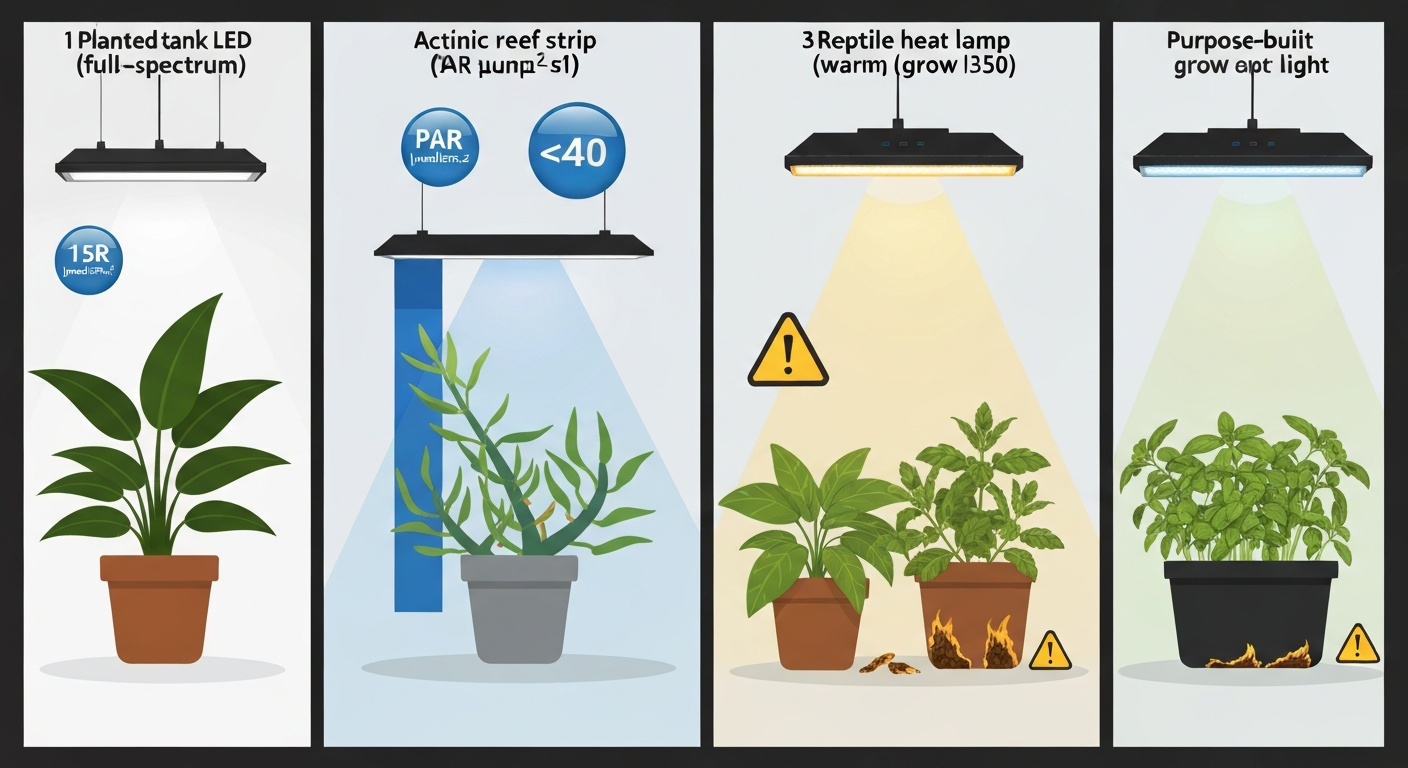
Most freshwater planted-tank LEDs and T5 fluorescent fixtures can support low- to medium-light terrestrial plants with a reasonable setup. High-quality reef LEDs with tunable full-spectrum channels can push into medium-light territory for soil plants and work well for aquatic plants. Actinic-only (blue/violet-heavy) reef strips and reptile heat lamps fall short because they lack the balanced red spectrum plants need to photosynthesize efficiently. High-light crops like tomatoes, peppers, or cannabis will almost always outgrow what aquarium fixtures can deliver unless you stack several of them very close to the canopy. So the verdict is conditional: yes for low-light plants, possibly for medium-light plants, rarely for high-light crops. For more details, read our guide can aquarium lights be used as grow lights which dives deeper into spectral choices, PPFD targets, and setup tips.
Types of aquarium lights and how they compare to grow lights
Not all aquarium lights are built the same, and their usefulness for plant growth varies widely. Here's how the main categories stack up against purpose-built grow lights.
| Fixture Type | Typical Spectrum | Useful for Plants? | Intensity (PAR) | Key Limitation |
|---|---|---|---|---|
| Planted-tank LED (e.g., Fluval Plant 3.0, Chihiros WRGB) | Full-spectrum WRGB + red/violet channels | Yes, low–medium light plants | Moderate (~100–250 µmol·m⁻²·s⁻¹ at 12") | Falls short for high-light crops |
| T5/T8 fluorescent (aquarium) | Cool white or plant-growth spectrum | Yes, low–medium light | Low–moderate | Lower PAR than LEDs; tubes age quickly |
| Reef LED (e.g., Kessil A360X Tuna Sun) | Tunable blue + white + selectable channels | Yes, with full-spectrum setting | Moderate–high near surface | Blue-heavy by default; must tune toward red |
| Actinic/blue reef strip (420–460 nm dominant) | Narrow blue/violet only | Very limited | Low for plant use | Lacks red (~660 nm); favors algae |
| Reptile heat/UVA lamp | Mostly infrared and broad white/warm | Minimal | Very low PAR | Wrong spectrum; heat risk |
| Purpose-built grow light (LED) | Optimized red + blue, often full spectrum | Excellent | High (250–600+ µmol·m⁻²·s⁻¹) | N/A — this is the benchmark |
The planted-tank LED category is the sweet spot if you're repurposing aquarium gear. These fixtures are engineered to support aquatic plant growth, so their spectral output overlaps meaningfully with what terrestrial plants need. Reef LEDs can work well too, but you need to dial up the red and white channels, not just run the default blue-heavy reef mode. T5 fluorescents are a decent budget option but lose output faster than LEDs. Actinic strips and reptile fixtures are essentially non-starters for growing anything you actually want to thrive.
Light spectrum basics and why wavelength matters
Plants don't just need 'light.' They need specific wavelengths that their chlorophyll can actually absorb and convert into energy. Back in 1972, K.J. McCree measured the photosynthetic efficiency of 22 crop species across the spectrum and found two main peaks: one around 440 nm (blue) and another centered around 620–660 nm (orange-red). McCree (1972) measured the spectral quantum yield for 22 crop species and found peaks near ~440 nm and ~620–660 nm, forming the basis for PAR (400–700 nm) weighting blank" rel="noopener noreferrer">K. J. McCree — The action spectrum, absorptance and quantum yield of photosynthesis in crop plants (Agricultural Meteorology, 1972) measured the spectral quantum yield for 22 crop species and found peaks near ~440 nm (blue) and ~620–660 nm (orange–red), establishing the basis for PAR weighting for plant-useful photons.. That research established the 400–700 nm range as PAR, or Photosynthetically Active Radiation, the standard measure of plant-useful light.
Blue light (400–500 nm) drives compact, sturdy growth and regulates stomata. Red light (600–700 nm) is the powerhouse for photosynthesis, flowering, and fruiting. Green light (500–600 nm) was long dismissed as useless, but more recent research (Frontiers in Plant Science, 2021) shows it penetrates deeper into the leaf canopy and contributes meaningfully to overall photosynthesis. A broad, white-spectrum LED with good blue and red content performs comparably to narrow-band red/blue grow lights for most plants.
Where aquarium actinic lights go wrong for plants is simple: they're loaded with 420–460 nm blue and violet, which excites coral fluorescent proteins beautifully but provides almost none of the red photons plants depend on for growth and flowering. Running an actinic reef strip over your herbs is like trying to charge your phone with a cable that only fits halfway in. The blue contribution isn't zero, but without red, growth will be stunted, stretched, or stalled.
Light intensity and photoperiod: the numbers you actually need
Spectrum is only half the story. Intensity matters just as much, and this is where most aquarium lights hit their ceiling. The standard measurement for plant-useful light intensity is PPFD (Photosynthetic Photon Flux Density), measured in micromoles per square meter per second (µmol·m⁻²·s⁻¹). According to University of Minnesota Extension guidance, here's how indoor plants break down by light requirement:
| Light Category | PPFD at Canopy (µmol·m⁻²·s⁻¹) | Typical Plants | Aquarium Light Viable? |
|---|---|---|---|
| Low light | 50–150 | Pothos, snake plants, ferns, peace lily | Yes, most planted-tank LEDs qualify |
| Medium light | 150–250 | Herbs (basil, mint), philodendron, most aroids | Yes, with quality planted LED at close range |
| High light | 250–450 | Succulents, seedlings, most vegetables | Marginal — needs multiple fixtures or very close mounting |
| Very high light (fruiting crops) | 450–800+ | Tomatoes, peppers, cannabis | No — aquarium lights rarely reach or sustain this |
Photoperiod matters too. Most houseplants and herbs do well with 12–16 hours of light per day. Seedlings typically want 14–16 hours. Iowa State University Extension uses the Daily Light Integral (DLI) formula to tie intensity and duration together: DLI (mol·m⁻²·day⁻¹) = PPFD × hours × 0.0036. If your planted-tank LED delivers 150 µmol·m⁻²·s⁻¹ at canopy level and you run it for 14 hours, your DLI is about 7.6 mol·m⁻²·day⁻¹, which is a solid target for medium-light herbs. Low-light houseplants need DLI values of roughly 2–5, while high-light crops want 20–40 or more. That gap is hard to close with aquarium gear alone.
How to actually measure what your light is doing
Here's something I learned the hard way: a lux meter from your phone app is not a reliable way to measure plant-useful light. Lux measures human-perceived brightness, weighted toward green wavelengths where our eyes are most sensitive. A lamp that looks brilliant to your eye might be delivering very little in the red band that plants actually need. To get real PPFD readings, you need a quantum sensor or PAR meter. Apogee's MQ-series meters are the hobbyist standard and are explicitly built around McCree's photosynthetic weighting.
That said, if you only have a lux meter, you can make a rough conversion using spectral conversion factors. For a standard daylight or cool-white LED (roughly 4000–6500K), the conversion is approximately 0.014–0.018 µmol·m⁻²·s⁻¹ per lux. So if your lux meter reads 10,000 lux under a planted-tank LED, that's roughly 140–180 µmol·m⁻²·s⁻¹, which puts you in the medium-light range. But the error can be 30–75% or more if the light has a non-white spectrum, like an actinic or red-heavy fixture. For those, lux conversion is essentially meaningless.
- Best option: Apogee MQ-210 or MQ-500 PAR meter (roughly $200–$400 new, but rentable or available secondhand)
- Budget option: Lux meter app (acceptable for white-spectrum LEDs only, use with the conversion factors above)
- Avoid: guessing by eye or relying solely on manufacturer lumen ratings
- Measure at canopy level, not at the fixture — PAR drops fast with distance
- Take readings at multiple spots across the growing area, not just directly below the light
Setting up aquarium LEDs for soil plants: the practical side
If you're mounting an aquarium LED above a shelf or grow area (rather than inside a tank), a few setup details make a big difference. Most aquarium fixtures are designed to sit on tank rims or hang a few inches above water, so you'll need to get creative with mounting. A simple adjustable hanging kit, a tension rod system, or a DIY PVC stand all work. The main thing is being able to raise or lower the fixture as plants grow.
Distance matters enormously because PAR follows an inverse-square relationship: double the distance, roughly quarter the intensity. A Fluval Plant 3.0 that reads 113 µmol·m⁻²·s⁻¹ at 12 inches might drop to 30–40 at 24 inches. For low-light plants, 12–18 inches is a reasonable starting point. For medium-light plants, you'll likely need to get down to 8–12 inches. Watch the plants as much as the numbers: leaf curl, bleaching, or brown tips mean too close; stretched, pale, leaning stems mean too far.
- Mount the fixture so you can adjust height easily — a pulley system or adjustable hanging cable works well
- Start at 12–14 inches above the canopy and use a PAR meter or lux meter to check actual intensity
- Add a reflective surface (white foam board, Mylar, or flat white paint on surrounding walls) to reduce light waste at the edges
- Connect the fixture to a mechanical or digital timer — consistency in photoperiod matters as much as intensity
- If the fixture has adjustable channels (like a Kessil A360X or Fluval Plant 3.0), tune the spectrum toward the plant/daylight preset rather than the blue reef mode
- Keep the driver and any electronics away from soil moisture splashes — aquarium fixtures are splash-resistant, not soil-spray resistant
Using aquarium lights for planted tanks: what works and what doesn't
For actual aquatic planted tanks, the picture is more straightforward. Purpose-built planted-tank LEDs like the Fluval Plant 3.0, Chihiros WRGB, and NICREW ClassicLED Plus are genuinely good at what they do. Best Aquarium LED Light for Planted Tanks, Aquarium‑Guides (comparative PAR/discussion) provides product‑by‑product PAR grids for fixtures like Fluval Plant, Chihiros WRGB, and NICREW, showing typical PPFD at distances such as 3", 6", 12", and 18" to illustrate coverage and falloff Best Aquarium LED Light for Planted Tanks — Aquarium‑Guides (comparative PAR/discussion). They're tuned for aquatic plants like Anubias, Java fern, Cryptocoryne, and stem plants, and they deliver PPFD values that match the needs of most popular aquatic species at standard tank depths.
The main limitation is depth. PAR drops significantly as you go deeper into a water column, so plants at the substrate level in a tall tank (24 inches or more) may be getting only a fraction of the surface reading. For deep tanks, you may need to boost intensity or add a second fixture. Also, aquarium LEDs designed for fish-only setups (not planted tanks) are often optimized to make fish colors pop rather than support photosynthesis. Running a fish-display LED over a planted tank is like cooking with a heat lamp: it looks active but doesn't do the job.
Repurposing reef and reptile lights for plants
Reef LEDs occupy an interesting middle ground. Premium units like the Kessil A360X Tuna Sun use tunable multi-chip arrays and optional spectral controllers that let you add red, amber, and violet channels. When you dial in a balanced spectrum with meaningful red output, these fixtures can genuinely support aquatic plants and many terrestrial low- to medium-light species. For more detail on reef LEDs and their ability to support terrestrial and aquatic plants, see our guide called can reef lights grow plants. The Tuna Blue variant is less useful by default because it leans heavily into blue and UV for coral fluorescence. If you have a reef LED with selectable channels, experiment with the warmest, most plant-friendly preset before writing it off.
Reptile lights are a different story. Reptile basking lamps produce mostly infrared and broad-spectrum warm light, but their PAR output is very low because they're not designed to drive photosynthesis. More importantly, reptile UVB tubes (like those from Zoo Med or Arcadia) emit UV radiation in the 280–320 nm UVB range, which is outside the PAR window and can damage plant tissue with prolonged exposure. There's also a human safety issue: ICNIRP guidelines set strict UV exposure limits for skin and eyes, and UVB reptile lamps at close range exceed those limits faster than most people expect. Don't repurpose reptile UVB fixtures for plant growing, and definitely don't use them in an occupied room without eye and skin protection.
For those curious about using reptile lights more broadly, or whether reef lights can support coral growth specifically, those topics have their own dedicated discussions elsewhere on this site that go deeper into the specifics. For details on using reef LEDs specifically for corals, see our guide on can you grow coral with led lighting. For a dedicated discussion on whether and how to use grow lights with reptile enclosures, see can you use grow lights for reptiles. See our guide Can I use grow light for aquarium? for a focused discussion on using reptile and reef lights for aquarium-specific setups.
What results to realistically expect by plant type
This is where I want to be honest rather than optimistic. Your results will depend on which specific aquarium fixture you're using, how close it is, and what you're growing. Here's a realistic breakdown:
| Plant Type | Light Need (PPFD) | Aquarium LED Result | Notes |
|---|---|---|---|
| Low-light houseplants (pothos, snake plant, fern) | 50–150 µmol·m⁻²·s⁻¹ | Good — most planted-tank LEDs qualify at 12–18" | Set timer for 12–14 hrs; stable consistent growth expected |
| Medium-light herbs (basil, mint, parsley) | 150–250 µmol·m⁻²·s⁻¹ | Decent — quality planted-tank LED at 8–12" distance | May grow slower than under a purpose-built grow light |
| Seedlings (most vegetables) | 150–250 µmol·m⁻²·s⁻¹ + 14–16 hrs | Possible — needs close mounting and long photoperiod | Watch for leggy growth if PPFD drops below 100 |
| Aquatic plants (Anubias, Crypts, stem plants) | 20–150 µmol·m⁻²·s⁻¹ at depth | Very good — planted-tank LEDs are made for this | Match intensity to plant species; avoid excess for algae control |
| High-light crops (tomatoes, peppers) | 400–600 µmol·m⁻²·s⁻¹ | Poor — almost no aquarium light delivers this sustained | Multiple stacked fixtures might get there; not practical |
| Cannabis (high-light crop) | 400–800 µmol·m⁻²·s⁻¹ | Insufficient with standard aquarium fixtures | A purpose-built grow light is strongly recommended here |
The most common mistake I see is people assuming that because an aquarium light looks bright, it's delivering enough PAR. Brightness to human eyes and photosynthetically useful photon flux are genuinely different things. A reef light that looks blindingly blue might be delivering 200 µmol·m⁻²·s⁻¹ of blue photons but almost nothing in the red band, giving you maybe half the effective photosynthetic input a PAR reading would suggest.
Safety, electrical considerations, and waterproofing
Aquarium lights are designed to operate around water, which gives them a head start over standard LED strips or desk lamps. Most quality aquarium fixtures carry IP65 ratings (dust-tight and resistant to water jets) or higher. IP67 means the fixture can handle temporary submersion to about 1 meter; IP68 means continuous immersion is rated. These ratings cover physical water ingress, but they don't tell the whole story about electrical safety.
IP ratings and UL wet-location listings (governed by UL 1598 in the US) are not the same thing. A UL wet-listed luminaire has undergone additional electrical and thermal testing beyond what an IP score covers. If you're using an aquarium LED in an unconventional setup (say, above a soil grow with irrigation or in a garage), confirm the fixture is UL wet-location listed, not just IP-rated. The National Electrical Code (NEC 2023) also requires GFCI protection for lighting in wet or damp locations, including horticultural lighting in certain situations. Run your aquarium lights on a GFCI outlet regardless of whether your jurisdiction has caught up with the latest NEC cycle. It's a simple, cheap protection that covers both your equipment and you.
- Always use GFCI-protected outlets for any light near water or in a grow space with irrigation
- Check for UL wet-location listing, not just IP rating, if the environment is consistently wet
- Keep drivers and power supplies elevated and away from splash zones — many aquarium LEDs have separate drivers that are not waterproof
- Don't block ventilation slots on the fixture housing — aquarium LEDs generate heat at the driver and heatsink
- Avoid daisy-chaining multiple fixtures on an undersized circuit — check wattage against circuit capacity
- Use waterproof timer outlets or smart plugs rated for the fixture's wattage
Common problems and how to fix them
Spectrum mismatch
If your plants are pale, purple-tinted, or growing slowly despite adequate hours, the spectrum is likely the culprit. Blue-heavy actinic or reef spectra don't provide enough red for balanced photosynthesis. Fix: switch to a full-spectrum or planted-tank mode if your fixture allows it, or supplement with a cheap red LED strip in the 620–660 nm range.
Low intensity and leggy growth
Stretched, pale, or leaning stems (etiolation) mean your plants are not getting enough PAR. Either the fixture is too far away or it's simply not powerful enough. Try reducing the hanging distance first. If you're already at 8 inches and plants are still stretching, the fixture doesn't have enough output for what you're growing. Consider adding a second light or switching to a purpose-built grow light for those specific plants.
Algae problems in planted tanks
Algae thrives when you give it too much light without enough plant competition or CO2. If you're getting green water, hair algae, or black beard algae in a planted tank, the most common causes are too-long photoperiods and nutrient imbalances. Start by reducing your photoperiod to 8 hours and doing a 3-day blackout if the problem is severe. Then increase plant density and consider CO2 supplementation before raising light intensity again.
Heat stress
Aquarium LEDs positioned very close to terrestrial plants (especially at 4–6 inches) can generate enough radiant heat to damage leaves, particularly soft herbs. Touch the top of the canopy: if it feels warm after 10 minutes under the light, raise the fixture. For aquatic plants, monitor water temperature during the first few days with a new light. Older T5 fluorescent fixtures over tanks can raise water temperature 2–5°F depending on fixture proximity and airflow.
When to stick with your aquarium light and when to upgrade
Here's the decision guide I wish someone had given me earlier. Use your aquarium light if you're growing low- to medium-light houseplants or aquatic plants, if you already own a quality planted-tank LED and want to see how it performs for soil plants, or if you're starting seeds that will move outdoors. The cost of a second fixture or a PAR meter is often less than the cost of replacing dead plants from an inadequate setup, so measure before you commit to a layout.
Buy a purpose-built grow light if you're trying to grow herbs or vegetables as a primary food source indoors year-round, if your plant collection is expanding past a shelf or two, if you want to grow high-light crops like tomatoes, peppers, or cannabis, or if you've already run your aquarium light at full intensity and close distance and your plants are still showing deficiency symptoms. Purpose-built grow lights are not exotic or expensive anymore. A solid T5 HO fixture or a budget LED panel designed for growing will outperform even a premium aquarium LED for terrestrial plants in most cases.
Actionable setup checklist
- Identify your fixture type: planted-tank LED, reef LED, T5 fluorescent, actinic, or reptile — this determines your starting potential
- Set the spectrum to a full-spectrum or plant/daylight preset if adjustable; avoid pure blue or actinic modes for growing
- Measure PPFD at canopy level using a PAR meter, or estimate with a lux meter using the 0.014–0.018 conversion factor for white LEDs
- Target 50–150 µmol·m⁻²·s⁻¹ for low-light plants, 150–250 for medium-light, and 250+ for high-light species
- Set a timer for 12–14 hours per day for houseplants and herbs; 14–16 hours for seedlings
- Calculate DLI using: PPFD × hours × 0.0036 — aim for 4–8 mol·m⁻²·day⁻¹ for most houseplants and herbs
- Mount with adjustable hanging hardware so you can raise or lower the fixture as needed
- Start at 12 inches for most plants and adjust based on plant response over the first 1–2 weeks
- Add reflective surfaces around the growing area to improve light distribution and reduce edge losses
- Connect to a GFCI outlet and use a reliable timer — consistency beats intensity for most plant types
- Check plants weekly: leggy growth means more intensity or less distance; browning or leaf curl means too close or too hot
- For planted tanks, keep photoperiod at 8–10 hours to balance plant growth and algae suppression
Quick myth-busting: grow light safety and health concerns
A lot of people hesitate to use any kind of grow light because they've heard vague warnings about UV radiation, cancer risk, or getting a tan. Here's the straightforward reality. Most aquarium LEDs and planted-tank fixtures emit no meaningful UV radiation. They operate entirely within the visible spectrum (400–700 nm) and pose no more UV risk than a standard LED desk lamp. You won't get a tan, and there's no credible link between standard visible-spectrum LED plant lights and cancer risk.
The fixtures where you do need to be careful are reptile UVB lamps and certain reef-specific UV channels, which can emit UVA and UVB radiation. ICNIRP guidelines set occupational exposure limits specifically for these UV bands, and reptile UVB tubes at close range (12–18 inches) can approach or exceed those limits with prolonged, repeated exposure. The rule of thumb: if a lamp is advertised for UVB output and uses that as a selling point, don't stare at it, don't use it unshielded in occupied rooms for hours at a time, and never use it as a grow light for plants in a space where people spend extended time. For standard planted-tank LEDs and full-spectrum grow lights, none of these concerns apply.
Final recommendations
If you already own a planted-tank LED, try it. Set it to a full-spectrum or plant mode, hang it 10–14 inches above your plants, put it on a 14-hour timer, and give it two weeks. Low-light houseplants and most herbs will respond well. If you're starting from zero and your primary goal is growing plants rather than fish, skip the aquarium section and go straight to a purpose-built grow light. The price difference is smaller than it used to be, and you'll get consistently better results for medium- and high-light species.
The best outcome from this whole question is that it usually leads people to think more carefully about what their plants actually need in terms of spectrum, intensity, and duration, which are the three levers that matter most regardless of what fixture you're using. Once you understand those, the source of the light matters a lot less than whether it's hitting the right numbers at the right distance.
FAQ
Short answer: can you use aquarium lights to grow plants (terrestrial and aquatic)?
Yes — with caveats. Many aquarium LEDs and fluorescent fixtures will support low‑ and medium‑light aquatic and terrestrial plants if they provide adequate photosynthetic photons (PAR, 400–700 nm) and are positioned close enough. However, typical aquarium fixtures often lack the sustained PPFD/DLI needed for high‑light crops (e.g., fruiting vegetables, high‑yield cannabis) unless you use purpose‑built planted‑tank models or mount multiple fixtures very close to the canopy.
Which aquarium light types are suitable or unsuitable for growing plants?
Suitable: planted‑tank / full‑spectrum aquarium LEDs (multi‑channel WRGB/Plant series, Kessil A360X freshwater mode) and high‑output T5 plant fluorescents — these are designed with PAR in mind and can support many aquatic and terrestrial plants. Often usable: general white aquarium LEDs (higher CCT/daylight variants) can grow low→medium‑light plants. Unsuitable or risky: reef/actinic‑only fixtures (heavy blue/UV emphasis) and reptile UV/heat lamps are not ideal alone — reef actinic spectra miss red photons needed for robust terrestrial growth; reptile UV lamps produce UV that can be harmful to humans and are not optimized for photosynthesis.
What spectrum matters for plant growth and what should I look for?
Plants use photons across 400–700 nm (PAR), with strong effectiveness near blue (~440 nm) and red (~620–660 nm) peaks (McCree curve). A balanced full‑spectrum white LED (with good blue + red content) or a plant‑focused spectral mix performs best for overall growth, morphology and flowering. Pure actinic/blue fixtures can drive photosynthesis but often produce leggy or stunted growth without added red.
How much light (PPFD / DLI) do indoor plants need and how do aquarium lights compare?
Use PPFD (µmol·m⁻2·s⁻1) at canopy level and DLI (mol·m⁻2·day⁻1). Typical bands: Low ≈ 50–150 µmol·m⁻2·s⁻1, Medium ≈ 150–250 µmol·m⁻2·s⁻1, High ≈ 250–450 µmol·m⁻2·s⁻1. DLI = PPFD × hours × 0.0036. Many consumer aquarium fixtures will deliver low→medium PPFD at practical hanging distances; they often fall short of high‑light targets unless placed very close or augmented.
How should I mount aquarium lights for terrestrial plants (distance and photoperiod)?
Mount close but safe: start at 6–12 inches (15–30 cm) for higher‑output aquarium LEDs and measure actual PPFD (see next FAQ). For lower‑output bars, 3–6 inches may be needed. Photoperiod: common daily schedules are 12–16 hours for foliage plants and herbs; seedlings often 16–18 hours. Avoid excessive continuous light; use a timer and target a DLI appropriate to the plant type.
How do I measure and verify light levels (what tools and conversions matter)?
Use a quantum sensor or PPFD meter (µmol·m⁻2·s⁻1) for accurate plant‑useful photon measurements. If you only have a lux meter, be cautious: lux→PPFD conversion depends on the fixture SPD and can vary widely. Manufacturers or independent PAR grids/measurements for the specific fixture are helpful. Measure at canopy level and across the footprint to find hot and low spots and average PPFD if possible.
Next Articles
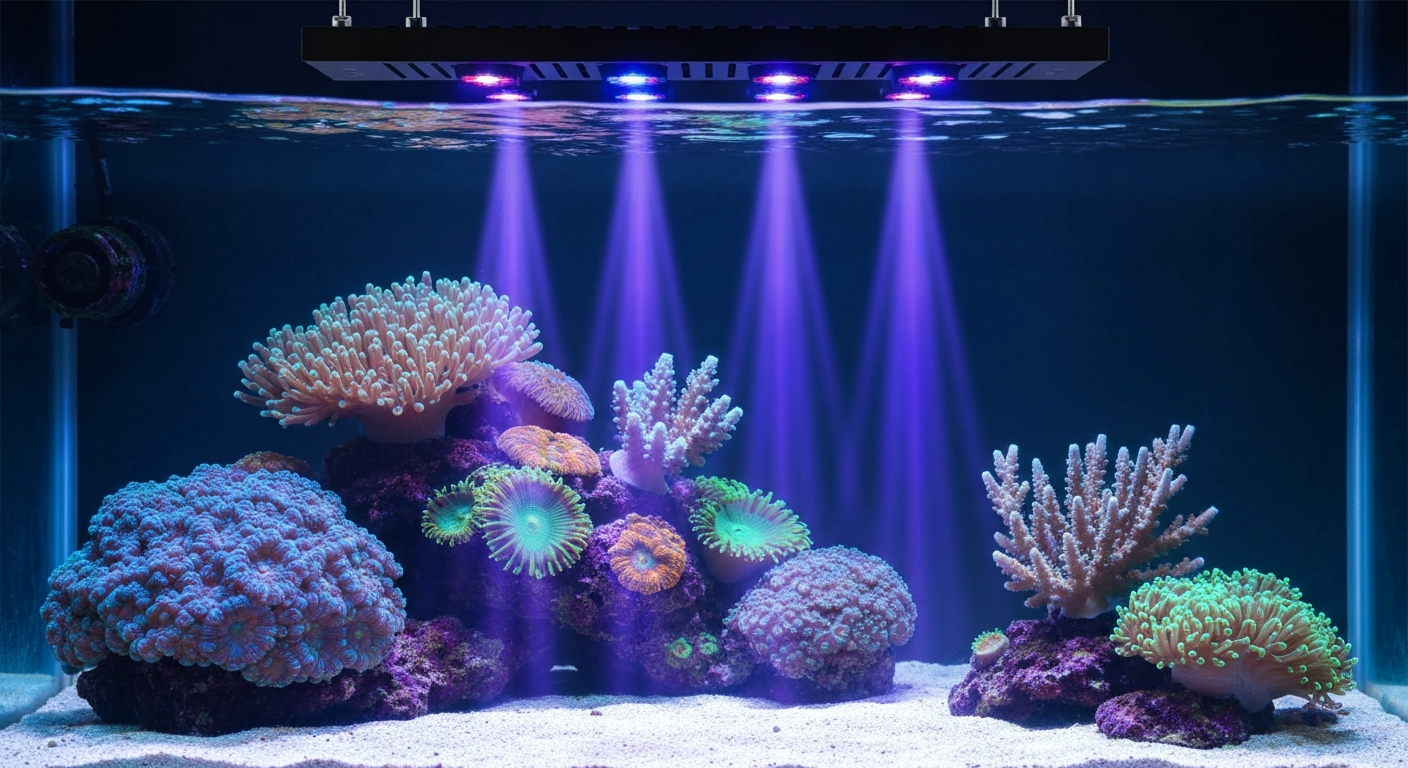
Can You Grow Coral with LED Lighting? Reef Guide & Ranges
Can you grow coral with LED lighting? Clear verdict, PAR/PUR targets, fixture picks, setup, acclimation & trouble‑shoots
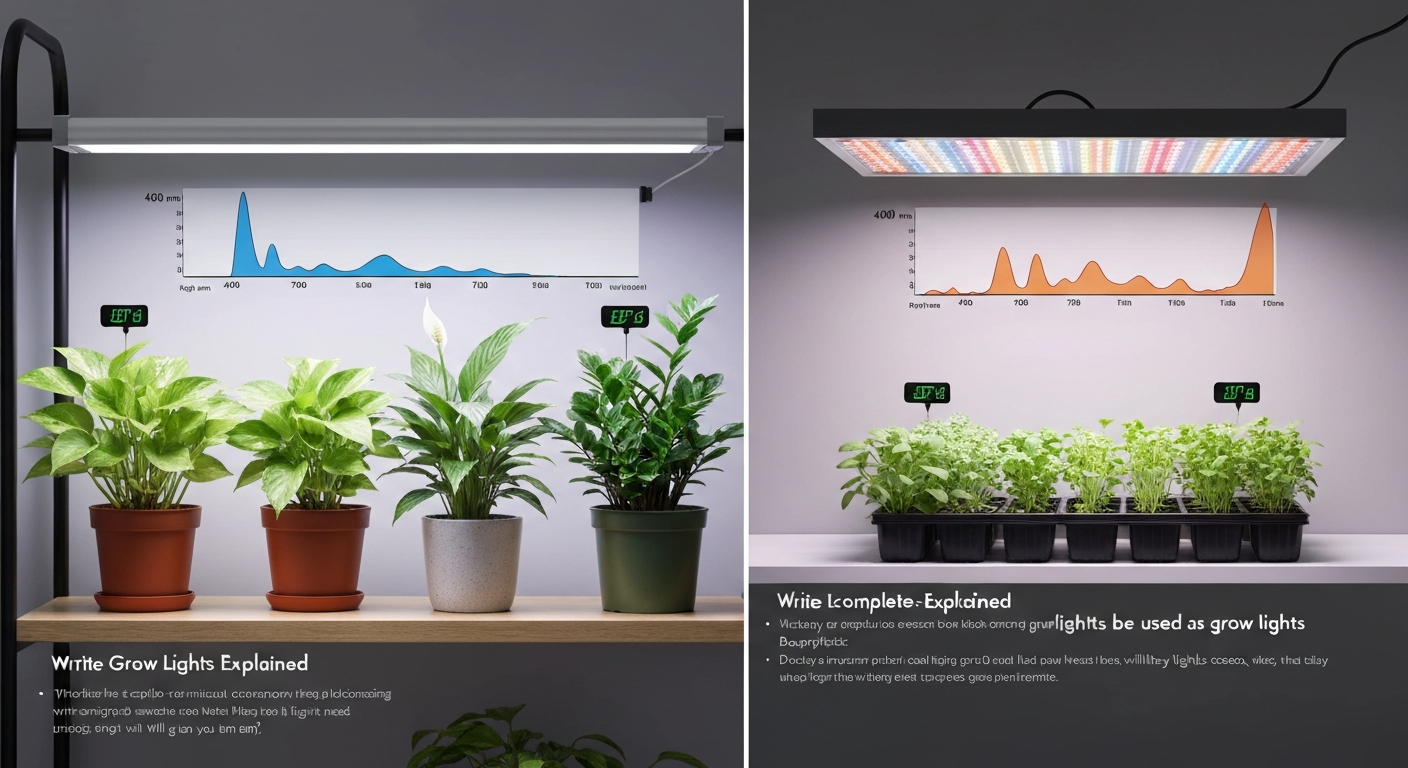
Can Aquarium Lights Be Used as Grow Lights? Verdict & Tips
Can aquarium lights double as grow lights? Get a clear verdict, practical thresholds, setup tips, and when to upgrade.
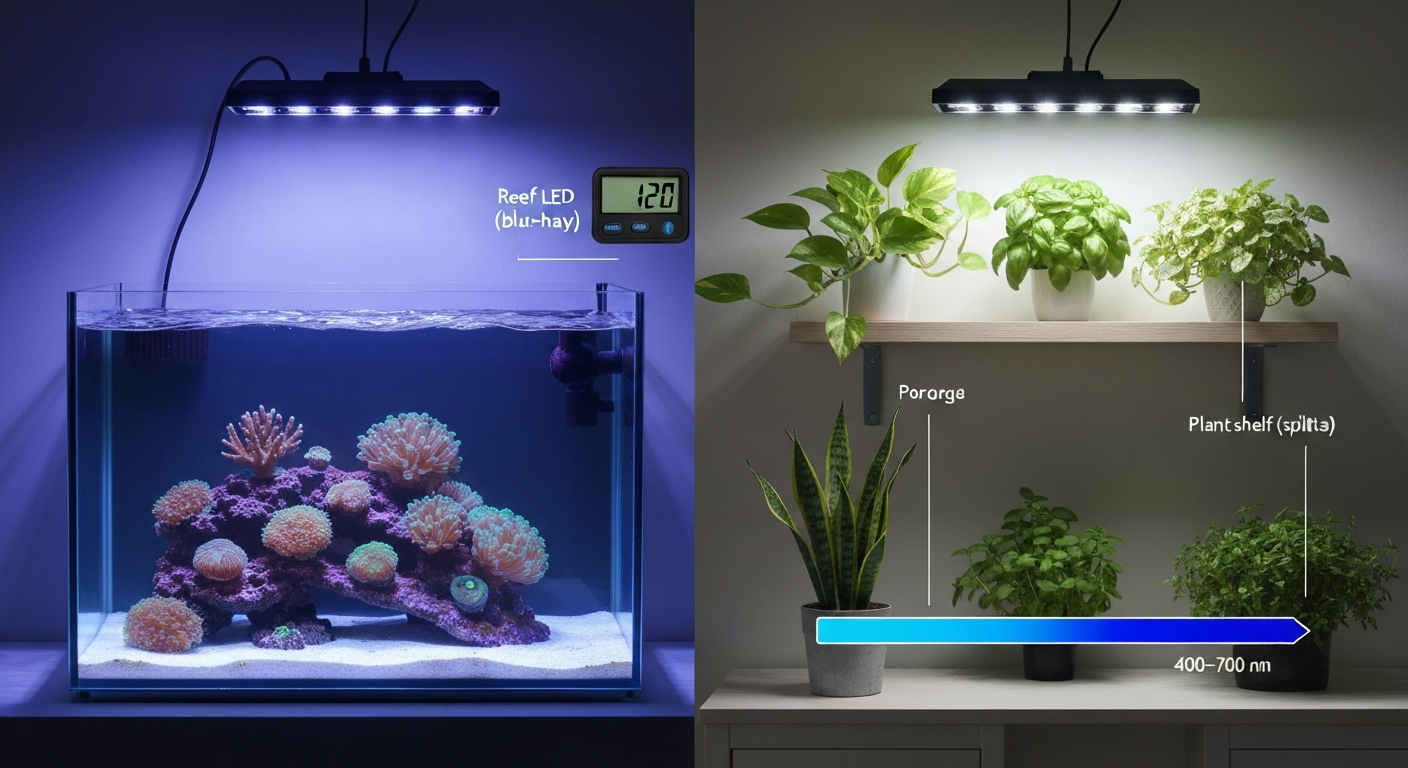
Can Reef Lights Grow Plants? Guide for Hobbyists & Growers
Can reef aquarium LEDs grow plants? Clear, evidence-based yes/no by plant type, PAR targets, retrofit & safety tips.