
Yes, you can absolutely grow coral with LED lighting, and plenty of reef keepers, including commercial coral farms, have ditched metal halides and T5 fluorescents in favor of LEDs without losing growth or color. The catch is that not just any LED will do. The spectrum, intensity, and programmability of the fixture matter enormously. A dedicated reef LED from a reputable manufacturer tuned to deliver strong blue and violet output at the right PAR levels will work. A standard plant grow light pulled from your gardening shelf almost certainly will not, at least not for anything beyond the most forgiving soft corals.
Can You Grow Coral with LED Lighting? Reef Guide & Ranges
Marcus Holloway
4 Aug 2026
How coral photosynthesis actually works
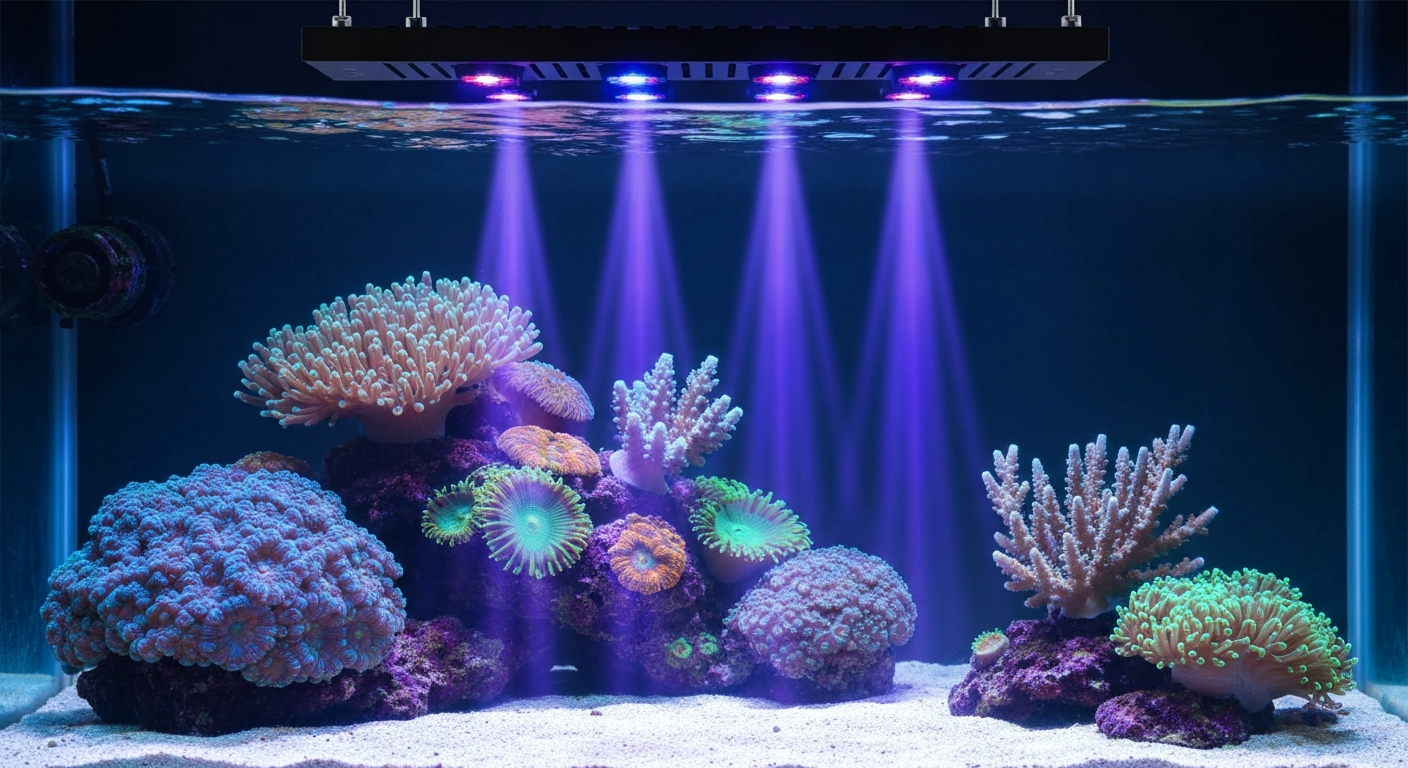
Most reef corals are not doing their own photosynthesis directly. They host microscopic algae called Symbiodinium (commonly called zooxanthellae) living inside their tissue. These algae capture light, run photosynthesis, and pass a large portion of the sugars they produce back to the coral as an energy source. The coral's job, in terms of lighting, is essentially to act as a transparent housing that lets light reach those algae. That relationship is called a mutualistic symbiosis, and it means that when you are choosing a light for coral, you are really choosing a light for zooxanthellae.
Zooxanthellae have their own specific absorption spectra, meaning they respond better to certain wavelengths than others. This is where the difference between coral lighting and plant lighting really starts to matter. Terrestrial plants have strong chlorophyll peaks in the red (around 660 to 680 nm) and blue (around 430 to 450 nm) ranges, which is why most plant grow lights stack their output in those bands. Zooxanthellae also absorb blue light strongly, but they rely far more heavily on the blue, violet, and UV end of the spectrum than typical land plants do, partly because those are the wavelengths that actually penetrate deep into seawater.
PAR and PUR: two numbers that both matter
PAR stands for Photosynthetically Active Radiation and refers to light in the 400 to 700 nm wavelength range. It is measured as Photosynthetic Photon Flux Density (PPFD) in micromoles of photons per square meter per second (µmol/m²/s). That number tells you how much total light is landing on a surface. PUR, or Photosynthetically Usable Radiation, goes one step further: it is PAR weighted by the actual absorption spectrum of the organism. In other words, PUR describes how much of that light the coral's zooxanthellae can actually use.
Why does this distinction matter in practice? Research using programmable light engines has shown that corals exposed to the same PAR reading but from different spectral compositions produced statistically different photosynthetic rates and electron transport rates. PUR was a better predictor of coral photosynthetic efficiency than raw PAR alone. The takeaway for anyone shopping lights: a fixture delivering 200 µmol/m²/s of warm white and red-heavy light will underperform a fixture delivering 200 µmol/m²/s of blue, violet, and targeted white, even though the PAR meters read identically. Spectrum is not cosmetic. It is functional.
The wavelengths corals actually use
Blue light in the 420 to 480 nm range is the workhorse for coral photobiology. It penetrates seawater well, drives zooxanthellar photosynthesis efficiently, and stimulates many of the coral's own fluorescent pigments that produce those vivid colors reef keepers love. Violet and near-UV output (roughly 380 to 420 nm) contributes meaningfully to both photosynthesis and pigmentation. Deep blue, around 450 nm, is considered the most critical single wavelength band for reef lighting.
Longer wavelengths (green, yellow, orange, red) are not useless to corals, but they are far less critical. Red light above 620 nm is absorbed and scattered rapidly as it passes through water, so in a natural reef environment corals in even moderate depths receive almost none of it. In shallow aquarium setups, red light does reach corals, and some research suggests it may contribute at low levels, but reef LEDs typically keep red output modest. This is the exact opposite design philosophy from plant grow lights, which deliberately maximize red output to feed chlorophyll peaks in terrestrial plants.
How depth, water clarity, and beam angle change things
Water is not a neutral medium for light. Field measurements on turbid coral-reef systems (e.g., the inner central Great Barrier Reef) document that both total PAR and spectral composition can vary over minutes–hours and with depth, exposing corals to highly variable spectra and intensities in situ (blank" rel="noopener noreferrer">Underwater Light Characteristics of Turbid Coral Reefs of the Inner Central Great Barrier Reef). Each wavelength has its own attenuation coefficient, meaning some colors lose energy faster than others as they travel through water. Laboratory and field measurements of blank" rel="noopener noreferrer">relative spectral attenuation coefficients K(λ) show rapid loss of red/long wavelengths with depth and farthest penetration of blue-violet light in clear seawater. Red light drops off dramatically in the first meter or two. Blue and violet light travels much further, which is why clear tropical ocean water looks blue rather than white. Even within an aquarium, a fixture that looks bright at the surface may be delivering far less usable light to corals placed 40 or 50 cm down, especially if the water is not pristine. Turbid water (heavy particulate load, yellowing from dissolved organics, or algae) can cut usable PAR dramatically within a short distance.
Beam angle is the other variable that often gets ignored. Many reef LED fixtures use tight-focus optics, sometimes as narrow as 60 to 90 degrees, to push light deep into the water column without losing intensity to horizontal spread. A wide-angle diffuse LED, like a typical plant light bar, spreads light efficiently across a flat canopy but may not punch deep enough into a tall reef tank. If you are mounting a fixture at 15 to 20 cm above the water surface, a wider beam is workable. At 30 cm or higher, tighter optics generally win for hitting corals placed mid-tank and below.
What different corals actually need: PAR ranges and photoperiods
Not all corals need the same intensity. Soft corals, large polyp stony corals (LPS), and small polyp stony corals (SPS) each sit in different zones of the light intensity spectrum. Placing a low-light mushroom coral under the same blast of light intended for Acropora will bleach it. Equally, running SPS colonies at soft coral intensities will slowly starve them. Here are the ranges that commercial growers, retailers, and hobbyist case studies have converged on:
| Coral Group | Examples | Target PAR (µmol/m²/s) | Daily Photoperiod | Placement Notes |
|---|---|---|---|---|
| Soft Corals | Mushrooms, leathers, zoanthids, xenias | 30 to 150 | 10 to 12 hours total | Mid to lower tank; shade-tolerant species can sit below overhangs |
| LPS (Large Polyp Stony) | Hammer, torch, brain, frogspawn | 50 to 200 | 10 to 12 hours total | Mid tank; moderate flow; watch for polyp retraction |
| SPS (Small Polyp Stony) | Acropora, Montipora, Pocillopora, Stylophora | 200 to 400+ | 9 to 11 hours total | Upper tank; strong flow; requires gradual acclimation |
Commercial coral grow-out operations like the EcoTech/Reef Wholesale Coral Lab have published specific PAR zoning for their LED-lit systems: an SPS zone 1 running around 300 µmol/m²/s, a zone 2 at roughly 225 µmol/m²/s, and outer/acclimation areas at around 150 µmol/m²/s. Their core photoperiod for grow-out is approximately 7 hours at peak intensity, with 1-hour ramp periods on each end. These numbers are a useful reference for anyone setting up an LED reef system from scratch.
Photoperiods, ramping, and moonlight: practical schedules
A standard reef LED schedule does not just flip on and off. The most effective approach mimics the gradual light changes of a tropical day: a slow ramp-up in the morning, peak intensity for a defined window, a gradual ramp-down in the afternoon, and a dim blue or moonlight period overnight. This reduces photoperiodic stress on corals and their zooxanthellae, supports natural spawning behaviors in some species, and gives you a clear way to acclimate new corals by starting them at a shorter peak window and expanding it over several weeks.
Here is a schedule I would use as a starting point for a mixed reef with both LPS and SPS:
- 7: 00 AM: Begin blue channel ramp from 0% to 40% over 60 minutes (dawn simulation)
- 8: 00 AM: Bring all channels to 60% of peak intensity (acclimation or low-demand period)
- 10: 00 AM: Ramp to 100% peak intensity over 30 minutes (full photoperiod starts)
- 4: 00 PM: Begin gradual ramp down to 60% over 30 minutes
- 6: 00 PM: Continue ramp down to blue-only at 20% over 60 minutes (dusk simulation)
- 7: 30 PM: Switch to moonlight setting (blue/violet at 1 to 3% or dedicated moonlight LEDs)
- 11: 00 PM: Full lights off until 7:00 AM
That gives a total photoperiod of roughly 12 hours including ramps, with about 6 to 7 hours at true peak intensity. For SPS-dominant systems, you can extend peak to 8 hours and push intensity higher. For soft coral or mixed lower-demand tanks, reducing the peak window to 5 to 6 hours and keeping intensity at 60 to 70% of max is often plenty. New corals should start at a reduced schedule (roughly 50% of target intensity and a 4 to 5 hour peak) and step up over 2 to 4 weeks as they show no signs of bleaching.
How reef LEDs are built differently from plant grow lights
This is the core comparison that matters most if you are considering repurposing a grow light for a reef tank. Modern reef-specific LED fixtures are engineered around coral photobiology in ways that general plant LEDs simply are not. The differences are not marketing fluff. They reflect genuinely different design goals.
Multi-channel tunability and spectrum control
Reef LEDs like the EcoTech Radion, AquaIllumination Hydra, and Kessil A360X are built with multiple independently controllable LED channels: deep blue (around 450 nm), royal blue (around 460 to 470 nm), violet or UV (around 380 to 415 nm), white (broad spectrum), and sometimes cyan or green channels for color balance. You can dial in the ratio of each channel and program it to change through the day. This matters because you can replicate the spectral shift of natural sunlight (bluer at noon, warmer at dawn/dusk) and because you can tune the output to match the PUR preferences of the specific species in your tank. Plant grow lights typically offer red and blue channels or simply a fixed-spectrum white, with no meaningful UV or violet component. If you’re wondering can reef lights grow plants, reef fixtures can support some aquatic plants but are optimized for coral photobiology rather than the red-heavy spectrum terrestrial plants prefer.
Beam optics and water penetration
Dedicated reef fixtures use tight-focus optics or secondary lenses to concentrate photons into a narrow, deep-penetrating beam. Kessil's pendant style, for example, uses a proprietary mixing optic that creates a diffuse but intense output without hard shadowing. High-end bar-style fixtures use individual reflectors over each LED cluster. Plant grow lights, especially panel and bar formats, are designed to spread light sideways across a canopy, not straight down through 30 to 50 cm of water. The result is that a plant light producing 400 µmol/m²/s at the water surface might deliver only 100 to 150 µmol/m²/s at typical coral placement depths.
Waterproofing and splash resistance
Reef tanks produce salt spray, evaporative moisture, and occasional splashing. Reef LEDs are rated for wet environments, typically with IP67 ratings or equivalent. Most plant grow lights are not designed for high-humidity marine environments and can fail, corrode, or create electrical hazards over time. This is not a minor consideration. Running a non-waterproofed fixture directly over an open marine aquarium is a real safety risk.
The comparison at a glance
| Feature | Reef LED (e.g., Radion, Hydra, Kessil) | Plant LED Grow Light | General Aquarium LED | Metal Halide / T5 (reference) |
|---|---|---|---|---|
| Blue/violet spectrum | Strong, dedicated channels | Limited, secondary to red | Variable, often minimal | Present in T5 actinic; MH full-spectrum |
| UV output | Often included (380-415 nm channel) | Rarely included | Rarely included | Some MH bulbs include near-UV |
| Red output | Low to moderate | High (primary channel) | Moderate | Full spectrum including red |
| Channel programmability | 3 to 7+ independent channels | 1 to 2 channels or fixed | Usually fixed or 2-channel | Not applicable (static spectrum) |
| Beam optics | Focused for water penetration | Wide diffuse spread | Wide to moderate | Reflector-dependent |
| Splash/waterproofing | IP67 or marine-rated | Typically not rated | Mixed (some aquarium-safe) | Fixture-dependent |
| PAR/PUR for SPS corals | Optimized | Poor PUR match | Suboptimal | Established benchmark |
When you might get away with a non-reef LED (and when you definitely won't)
I have seen hobbyists on forums successfully keep mushroom corals and some leathers under general-purpose LED strips, even the occasional plant grow light, especially in shallow nano tanks where the coral sits close to the surface and the water is very clear. At 30 to 50 µmol/m²/s of blue-heavy light, low-demand soft corals can survive and even extend their polyps. But survive is not the same as thrive, and results are inconsistent. The spectrum mismatch means PUR is lower than the PAR reading suggests, and without UV and violet output, color development in even soft corals is usually flat.
For anything in the LPS or SPS category, or for any coral you are trying to grow out rather than just keep alive, a purpose-built reef LED is not optional. The investment is real (quality reef fixtures run from $200 to $800+ depending on tank size), but the coral investment underneath is almost always worth more. Trying to save $150 on lighting while keeping $400 worth of Acropora frags is the wrong trade-off.
It is worth noting that some aquarium-specific lights sit in a middle ground. If you are already curious about how aquarium lights in general compare to dedicated plant or reef fixtures, that topic overlaps with questions about using regular aquarium lights as grow lights, which is a different scenario with its own set of trade-offs. For more on that overlap, see the separate discussion on can aquarium lights be used as grow lights for a direct comparison. See the related article can you use aquarium lights to grow plants for a comparison of aquarium lighting suitability for terrestrial plants versus aquatic photosynthetic organisms. For a focused look at whether an aquarium light can be used to grow marijuana, see the guide can i use an aquarium light to grow marijuanas. For analogous trade-offs in a different pet context, see guidance on using grow lights for reptiles. The short version for corals: standard fish-tank LEDs designed for fish visibility are not adequate for photosynthetic corals unless they specifically include high-output actinic or blue channels.
Setting up your reef LED: mounting, acclimation, and monitoring
Mounting height and intensity calibration
Most reef LED fixtures are designed to be mounted 15 to 30 cm above the water surface, though manufacturer recommendations vary by fixture. Higher mounting reduces intensity but improves coverage and evenness. Start with the manufacturer's recommended height for your tank footprint, then verify actual PPFD at coral placement depth using a PAR meter. A quantum PAR meter designed for aquatic use (the Apogee MQ-510 and similar models are hobbyist-accessible) is the only reliable way to know what your corals are actually receiving. Guessing based on the fixture's stated output is not enough because water clarity, tank depth, and glass thickness all affect the final number.
Acclimation steps for new corals
NOAA coral aquaculture guidance recommends conservative, stepwise light increases when introducing corals to a new lighting regime. The same logic applies whether you are adding a new coral to an established tank or transitioning a whole system from T5 to LEDs. Do not drop a new coral straight into your highest PAR zone. Here is a practical acclimation sequence:
- Week 1 to 2: Place new coral in the lowest PAR zone of your tank (or reduce fixture intensity to 50% of target). Target roughly 50 µmol/m²/s for soft corals and LPS, 100 to 150 µmol/m²/s for SPS during this phase.
- Week 3 to 4: Move the coral one position closer to the light or increase intensity by 20 to 30%. Watch daily for polyp extension, tissue recession, or early bleaching.
- Week 5 to 6: Step up again. Continue monitoring. Full extension and normal feeding response are your positive indicators.
- Week 7 and beyond: Move to final target position only once the coral shows stable, extended polyps and no signs of stress. A coral that is bleaching slightly should be moved back, not forward.
Monitoring tools worth having
- PAR meter (Apogee MQ-510 or rental via local reef club): verifies actual PPFD at coral depth
- Programmable timer or smart controller (most modern reef LEDs have built-in apps): enables ramping schedules and moonlight periods
- Temperature probe and controller: LEDs run cooler than MH but heat management still matters; keep water at 25 to 26°C for most reef species
- Alkalinity and calcium testing: light drives calcification, so SPS under strong LEDs will consume alk and calcium faster and need more frequent dosing
Water quality and flow: the variables lighting cannot fix
Even the best reef LED cannot compensate for poor water quality or inadequate flow. Zooxanthellae photosynthesis produces oxygen as a byproduct, and without good water movement to remove it and deliver fresh CO2 and nutrients, photoinhibition can occur even at moderate PAR levels. SPS corals under high-intensity light need high flow (typically 50 to 100 times tank volume per hour) to prevent stagnant boundary layers from forming around their tissue. LPS need moderate flow. Soft corals vary by species.
Water clarity is also a light variable. Dissolved organics, tannins, and fine particulate matter shift and attenuate the spectrum before it reaches corals. A tank with heavy organic load will deliver a different effective spectrum than the same fixture over clean, low-nutrient water. Regular water changes, quality mechanical filtration, and activated carbon or GFO use all affect how much of your LED's output actually reaches the coral in a usable form. If your corals look dull despite running strong LEDs, water clarity is worth checking before assuming the light is the problem.
Troubleshooting common LED reef problems
Bleaching
Bleaching means the coral is expelling its zooxanthellae, usually due to excess light, heat stress, or both. If corals bleach under LEDs, the first step is to reduce intensity (drop to 50 to 60% of your previous setting) and extend the acclimation timeline. Do not assume more light is always better. A bleaching coral that still has tissue can recover if you act quickly; one left in bleached conditions long enough will die.
Algae overgrowth
Long photoperiods combined with elevated nutrients are the main driver of nuisance algae in LED-lit reef tanks. Cutting photoperiod back by 1 to 2 hours and addressing the nutrient source (nitrate, phosphate) is usually more effective than reducing total intensity, which may harm corals. If algae is concentrated near the light (surface of the water or under the brightest beam), check for nutrient export issues first.
Color shift or loss of fluorescence
If corals lose their vivid colors under LEDs, the most common culprits are insufficient blue/violet channel output, too much white (especially warm white), or corals placed too deep for the fixture's beam to reach effectively. Try increasing the blue channel ratio, reducing white channel intensity, and verifying PAR at the coral's actual location with a meter.
Cost and realistic expectations
Quality reef LEDs are not cheap, but they compare favorably to the ongoing cost of running metal halides. A pair of 250W metal halide pendants over a 120-gallon tank can consume 500W continuously plus chiller load to manage the heat. A comparable LED setup (for example, two EcoTech Radion XR30 Pro units) draws around 130 to 160W at typical reef intensities and produces minimal heat transfer to the water. Over two years, that electricity saving is substantial. T5 fluorescent fixtures fall in between on energy use and are still a solid option, but LEDs have largely matched T5 performance for most coral types once properly tuned.
The tuning part matters. The commercial case study from Reef Wholesale using Radion LEDs showed that after months of spectrum and intensity adjustment, their LED-grown corals achieved equivalent or better growth and coloration compared to T5/MH. This took time and iteration. If you switch from T5 to LEDs and things look worse initially, that is normal. LEDs render color differently (they can look blue-heavy to the human eye at spectrum settings that are actually optimal for the corals) and it takes a few weeks of adjustment, both for you and the corals.
FAQ
Can you grow coral with LED lighting?
Yes — LEDs can and do grow corals when the fixture supplies the right intensity (PPFD/PAR), an appropriate usable spectrum (PUR) biased toward blue/violet, and you use conservative acclimation and good husbandry. Modern programmable reef LEDs routinely match or exceed T5/MH performance for most coral types when tuned and placed correctly; inexpensive plant or reptile LEDs may support low‑light soft corals and some LPS but usually lack the spectral quality for many SPS or color optimization.
What is the difference between PAR and PUR and why does it matter for corals?
PAR (Photosynthetically Active Radiation) is the photon flux between 400–700 nm commonly reported as PPFD (µmol·m⁻2·s⁻1). PUR (Photosynthetically Usable Radiation) is PAR weighted by the organism’s absorption/action spectrum — it reflects which photons the coral’s symbionts actually use. Two lights with identical PAR can give different coral responses if their spectra differ; therefore prefer fixtures and settings that provide high PUR for Symbiodinium (strong violet/blue bands and useful cyan/blue/short‑green energy).
What spectral bands are most important for coral symbionts?
Blue and violet (roughly 400–470 nm, with 410–430 nm especially useful) penetrate seawater best and drive Symbiodinium electron transport efficiently. Cyan/blue (470–500 nm) and some green help visual balance. Red/far‑red contribute little at depth because they attenuate rapidly in water; however, small amounts of longer wavelengths can aid coral tissue coloration and host pigments. Focus on a spectrum with strong blue/violet channels and tunable white/amber for color blending rather than heavy red output like plant LEDs.
What light levels (PPFD) and photoperiods are recommended for major coral groups?
General target PPFD (measure at coral tissue level) and photoperiod guidelines: - Soft corals (e.g., mushrooms, zoanthids, leathers): 30–150 µmol·m⁻2·s⁻1; photoperiod 8–10 h. - LPS (large‑polyp stony; e.g., Euphyllia, Acanthastrea): 50–200 µmol·m⁻2·s⁻1 depending on species; photoperiod 8–10 h. - SPS (small‑polyp stony; e.g., Acropora, Montipora): 200–400+ µmol·m⁻2·s⁻1 for many species; some high‑light Acropora may be 350–600 µmol·m⁻2·s⁻1 in shallow/high‑flow systems. Use shorter core photoperiod (~6–8 h at peak intensity) with ramping (1–2 h sunrise/sunset) if using very high PPFD. Adjust for spectrum/PUR, depth, and species sensitivity.
How do LEDs compare to T5 and metal halide (MH) for coral growth?
- Metal halide: strong continuum spectrum and high intensity historically best for SPS color/growth but high heat and electricity. - T5 fluorescents: broad spectrum, good spread, gentler heat; many reefkeepers used mixed T5 tubes to shape spectrum. - Modern reef LEDs: programmable channel spectra, high efficiency, lower heat, and can match MH/T5 when configured properly; give excellent PAR/PUR control and dynamic programs. LEDs are typically the best balance now, but quality and spectral control matter — cheap single‑channel white LEDs rarely match specialized reef fixtures.
Can I use plant or reptile LED fixtures for corals?
Sometimes for low‑light corals: plant LEDs emphasize red and deep red (useful for terrestrial plants) which attenuate rapidly in seawater and provide poor PUR for Symbiodinium. Reptile lights (full‑spectrum or UVB) are designed for terrestrial needs and often lack the blue/violet punch and channel control reef corals benefit from. Use plant/reptile LEDs only for soft corals or as temporary/low‑PAR supplements, not as primary lighting for SPS or for color/growth optimization.
Next Articles
Can Aquarium Lights Be Used as Grow Lights? Verdict & Tips
Can aquarium lights double as grow lights? Get a clear verdict, practical thresholds, setup tips, and when to upgrade.
Can Reef Lights Grow Plants? Guide for Hobbyists & Growers
Can reef aquarium LEDs grow plants? Clear, evidence-based yes/no by plant type, PAR targets, retrofit & safety tips.
Can You Use Grow Lights for Reptiles Safely?
Yes, you can use some grow lights for reptiles safely with correct spectrum, distance, intensity, and timers.