Most common indoor plants do well under grow lights, and many actually thrive better under a well-chosen LED fixture than they do sitting several feet from a dim apartment window. Low-light tolerators like pothos, snake plants, and ZZ plants can get by with just a few hours of modest supplemental light. Medium-light plants like pothos, peace lilies, and prayer plants prefer around 150–300 µmol·m⁻²·s⁻¹ of PAR light for 12–14 hours a day. And high-light plants like herbs, succulents, and fruiting vegetables really need 250–800 µmol·m⁻²·s⁻¹ across a longer photoperiod to do their best. The short version: if a plant can grow near a window, it can grow under a grow light.
What Indoor Plants Like Grow Lights: Quick Guide for Home
Marcus Holloway
13 Aug 2026
Can plants survive with only grow lights?
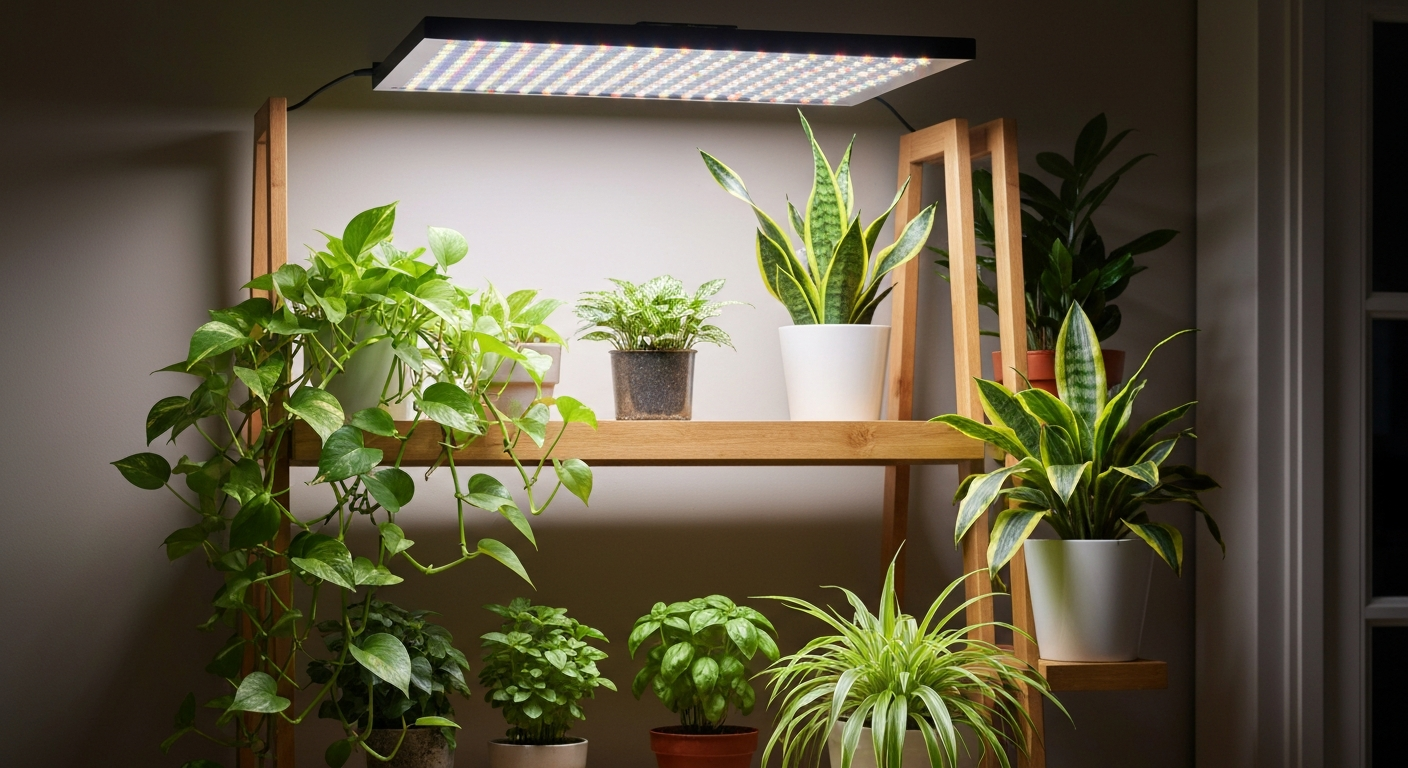
Yes, plants can survive and even complete their full life cycles using grow lights as their only light source. For a deeper guide on how and when plants can survive under artificial lighting, see our article on can plants survive with only grow lights. This is called sole-source lighting, and it is exactly how commercial indoor farms grow lettuce, herbs, strawberries, and tomatoes year-round without any sunlight. Research has confirmed full vegetative growth, flowering, and fruit production under sole-source LED setups when the intensity, spectrum, and photoperiod are dialed in correctly for the crop and its growth stage. The study “Growth, Flowering, and Fruit Production of Strawberry ‘Albion’ in Response to Photoperiod and Photosynthetic Photon Flux Density of Sole‑Source Lighting (Plants/MDPI)” demonstrates that sole‑source LED lighting can support complete vegetative growth, flowering, and fruit production in strawberry when PPFD, spectrum, and photoperiod are properly managed.
For the average home grower, sole-source lighting works very reliably for foliage houseplants, herbs, leafy greens, and seedlings. Where it gets trickier is with large fruiting crops like full-size tomatoes or peppers, which have very high light demands. You can do it, but the electricity cost and fixture investment climb quickly. For those plants, supplementing natural light with a grow light is often the more practical approach unless you are setting up a dedicated grow tent or shelving system. Most low-to-medium light houseplants, though, genuinely do not need any sunlight at all if your grow light setup is consistent and adequate.
Which houseplants genuinely thrive under grow lights
Almost every common houseplant responds positively to grow lights when the light level matches the plant's natural preference. For a quick guide to what plants like grow lights, see the what plants like grow lights overview. Here is a practical breakdown by light category, using the groupings that university extension programs commonly publish. For specific recommendations, see our curated list of plants that do well under grow lights that maps common species to the light categories above.
Low-light plants (DLI roughly 1–6 mol·m⁻²·d⁻¹)
These plants originally evolved in shaded understory conditions, so they do not need blinding intensity. A modest grow light, even a small panel LED, is enough to give them a good daily dose. They are the easiest wins for anyone new to grow lights.
- Pothos (Epipremnum aureum): incredibly forgiving, bright diffuse to moderate light
- Snake plant (Dracaena trifasciata): tolerates low to bright indirect, practically indestructible
- ZZ plant (Zamioculcas zamiifolia): very low light tolerant, slow grower
- Peace lily (Spathiphyllum): low to medium, blooms more reliably with a bit more light
- Cast iron plant (Aspidistra elatior): extremely low light tolerant
- Dracaena varieties: tolerant of low indirect light
Medium-light plants (DLI roughly 6–12 mol·m⁻²·d⁻¹)
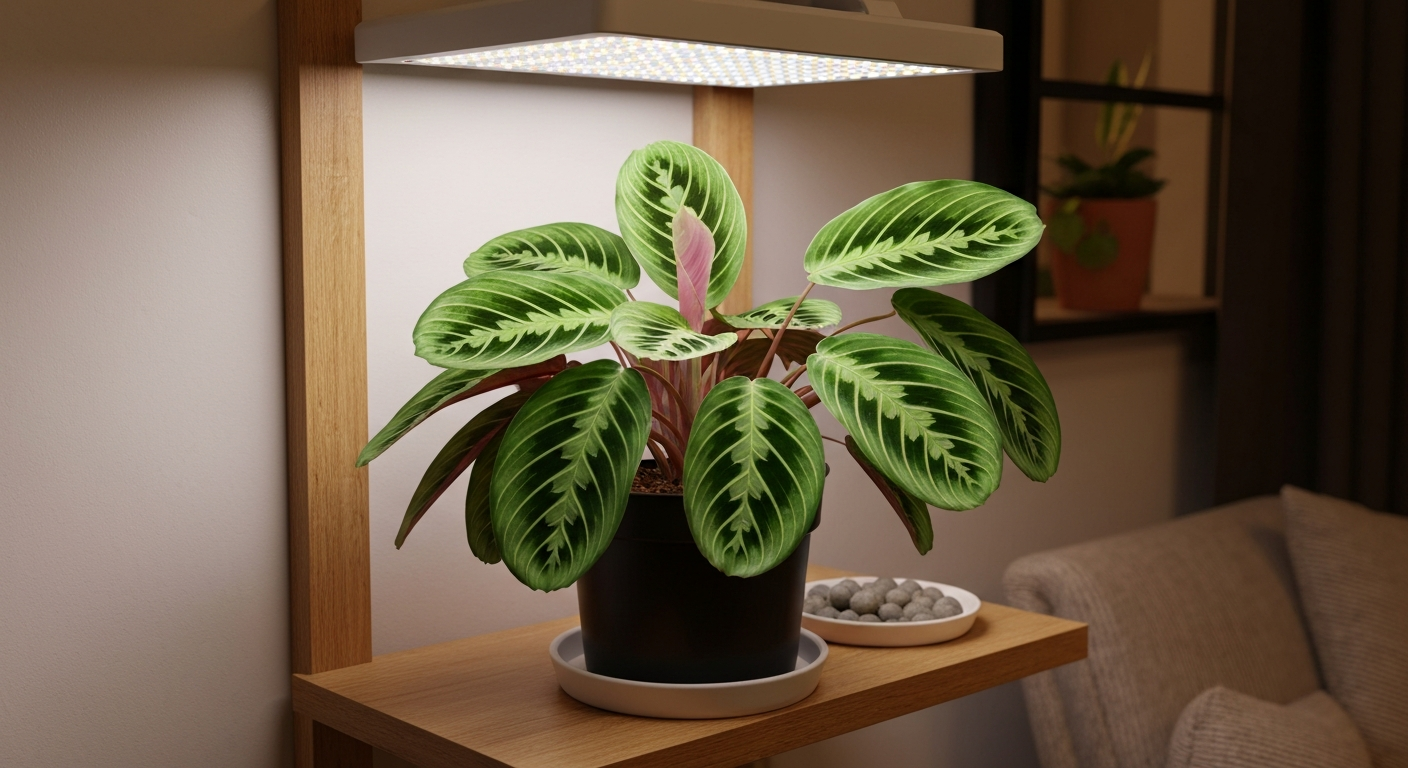
This is the sweet spot for a huge range of popular houseplants. Spider plants and prayer plants both fall into this category, and both respond very well to grow lights. Spider plants (Chlorophytum comosum) prefer bright, indirect light and show noticeably better color and more prolific pup production when grown under a full-spectrum LED at a consistent distance. Prayer plants (Maranta leuconeura) also benefit from steady, gentle grow light exposure, especially in winter when window light drops sharply. If you're wondering whether prayer plants like grow lights, see our guide do prayer plants like grow lights for specific light recommendations. Their leaf movements continue normally and their markings stay vivid under quality grow lights.
- Spider plant (Chlorophytum comosum): bright indirect, thrives under LED panels
- Prayer plant (Maranta leuconeura): medium indirect, does well with consistent supplemental light
- Pothos and philodendron (medium to bright indirect varieties)
- Peperomia: medium to bright indirect, compact and well-suited to shelf setups
- Boston fern: medium humidity-loving, benefits from overhead grow light panels
- African violet (Saintpaulia): medium light, one of the most-studied houseplants under grow lights
- Calathea and Stromanthe: similar to prayer plant, medium indirect preferred
- Most tropical foliage plants: Monstera, Alocasia, and related genera
High-light plants (DLI 12–20+ mol·m⁻²·d⁻¹)
These are your herbs, edibles, succulents, and flowering/fruiting plants. They need meaningfully more light than a dim apartment window can provide, which is exactly where grow lights earn their keep. Basil, for instance, performs well at PPFD values between 150 and 300 µmol·m⁻²·s⁻¹ over 14 to 20 hours (a DLI of around 7.5 to 21 mol·m⁻²·d⁻¹), with better biomass and flavor at the higher end of that range. Succulents and cacti want even more intensity to maintain their compact, vibrant form instead of going leggy.
- Basil and most culinary herbs: high DLI, 14–18 h photoperiods work well
- Lettuce and leafy greens: target PPFD ~250–350 µmol·m⁻²·s⁻¹, 14–16 h/day
- Succulents and cacti: need high intensity to avoid etiolation (leggy stretching)
- African violets and orchids: moderate-to-high for blooming
- Tomato and pepper seedlings: 250–800 µmol·m⁻²·s⁻¹ depending on stage
- Strawberries: can complete full fruit cycles under sole-source LED at appropriate PPFD
How to choose a grow light: what actually matters
The grow light market is crowded and the marketing is confusing. Here is what to actually focus on when choosing a fixture.
LED is the best choice for most home growers
Modern LEDs have largely replaced fluorescent T5s and HID (high-intensity discharge) lights for home use. They run cooler, last longer (typically 50,000+ hours), and are far more energy-efficient. For a single shelf or a few pots, a good LED panel or bar light is almost always the right call. T5 fluorescents are still acceptable for seedlings and low-light plants, but LEDs have become so affordable that it is hard to justify the older technology unless you already own it.
Spectrum: full-spectrum white LEDs vs. blurple lights
Plants primarily use blue light (400–500 nm) for compact vegetative growth and red light (600–700 nm) for photosynthesis efficiency. Far-red (700–750 nm) affects flowering timing and canopy penetration. The old-school purple/blue-red (blurple) LED panels deliver this in a narrow-band way, and they do work. But full-spectrum white LEDs, which include a broader spread of wavelengths, tend to outperform them for overall yield and quality in most horticultural research. They also make it much easier to see what is actually going on with your plants. A quality full-spectrum white LED with a decent red-to-blue ratio is the practical choice for nearly all home growers.
PPF and PPFD, not just wattage
Wattage tells you how much electricity a light uses, not how much usable light it delivers to your plants. The number you want is PPFD (photosynthetic photon flux density), measured in µmol·m⁻²·s⁻¹, which tells you how much photosynthetically active light is landing on a surface per second. A good manufacturer will publish PPFD maps for their fixtures at various mounting heights. PPF (photosynthetic photon flux) is the total light output of the fixture; PPFD is what the plant actually receives at a given distance. When comparing fixtures, look for published PPFD data at the mounting height you plan to use, not just wattage claims.
Fixture styles and their best uses
| Fixture Style | Best For | Coverage Area | Notes |
|---|---|---|---|
| Bar/strip lights | Shelves, seedling racks, propagation | 1–2 sq ft per bar, stack multiple | Low profile, easy to position, great for tight spaces |
| Panel/quantum board | Single shelves, small tents, 2–4 pots | 2×2 to 4×4 ft depending on wattage | Even coverage, most popular for home setups |
| Clip-on / gooseneck | Single pots, propagation trays | 1 pot to small tray | Portable and affordable, lower intensity |
| Full-fixture overhead LED | Dedicated grow tents, larger shelves | 4×4 to 5×5 ft | Higher output, better for fruiting/high-light crops |
| T5 fluorescent | Seedlings, low-light plants | 1–4 ft length, close mounting | Still works, less efficient than LED |
Light intensity, distance, and photoperiod: practical targets
These three things work together. A lower-intensity light can still deliver enough daily light if you run it longer. A very bright light run too long can stress a low-light plant. The metric that ties them together is Daily Light Integral (DLI), calculated as: DLI = PPFD × photoperiod (hours) × 0. Common PPFD targets used by extension and controlled-environment agriculture guides (low ~25–150 µmol·m⁻²·s⁻¹, medium 150–300 µmol·m⁻²·s⁻¹, high 250–800 µmol·m⁻²·s⁻¹) inform fixture wattage and run-time calculations, see PPFD and DLI for Houseplants, practical ranges (fernandshelf summary referencing extension literature) PPFD and DLI for Houseplants — practical ranges (fernandshelf summary referencing extension literature). 0036. So a light delivering 200 µmol·m⁻²·s⁻¹ run for 14 hours gives a DLI of about 10 mol·m⁻²·d⁻¹, which is a comfortable target for most medium-light houseplants.
| Plant Category | Target PPFD (µmol·m⁻²·s⁻¹) | Photoperiod (hours/day) | Target DLI (mol·m⁻²·d⁻¹) | Typical Fixture Distance |
|---|---|---|---|---|
| Low-light houseplants (pothos, snake plant, ZZ) | 25–150 | 10–14 | 1–6 | 12–24 inches |
| Medium-light houseplants (spider plant, prayer plant, peperomia) | 150–300 | 12–14 | 6–12 | 8–18 inches |
| Herbs and leafy greens (basil, lettuce, mint) | 200–400 | 14–18 | 10–20 | 6–14 inches |
| Succulents and cacti | 300–600 | 12–16 | 12–20+ | 4–12 inches |
| Fruiting crops (tomato, pepper, strawberry) | 400–800 | 14–18 | 18–30+ | 12–24 inches (higher-output fixture) |
Distance is the easiest dial to adjust. Moving a fixture closer increases intensity roughly following the inverse square law (double the distance, quarter the intensity). Start at the manufacturer's recommended distance for your plant category, then watch the plant for a week before adjusting. Most foliage plants are very forgiving. Succulents and high-light edibles often need to be closer than you would expect, especially with lower-wattage fixtures.
For photoperiod, most foliage houseplants do well at 10–14 hours per day. Leafy greens and herbs often benefit from 14–18 hours. If you are growing flowering crops, check whether your plant is a long-day, short-day, or day-neutral species before setting your timer, because getting this wrong can prevent flowering entirely. Use a simple outlet timer so the photoperiod stays consistent. Plants benefit from a regular dark period just as much as from the light itself.
Measuring light: lux meters, PPFD meters, and your phone
Knowing what light your plants are actually receiving takes some of the guesswork out of setup. There are a few ways to do it, ranging from free to fairly expensive.
Lux meters and why they are not the full story
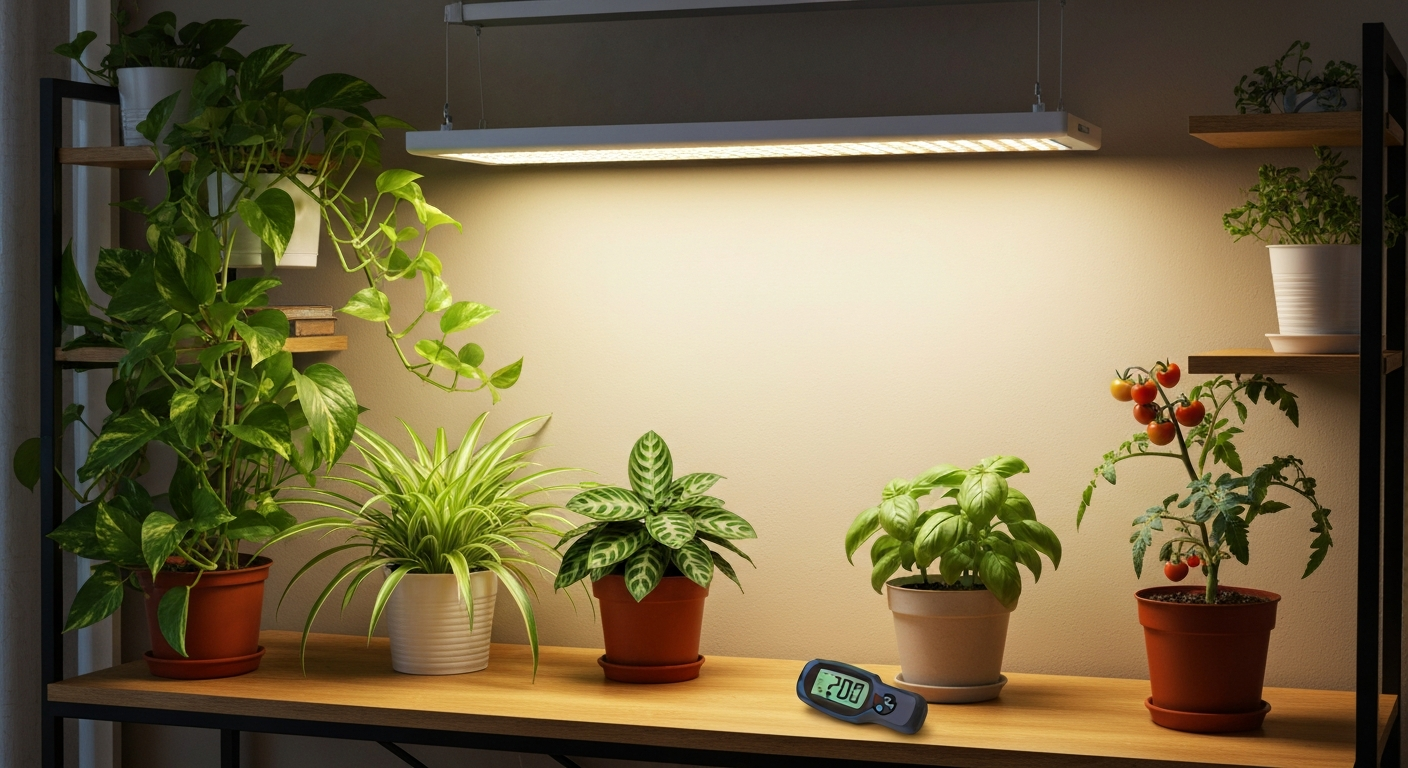
Lux meters measure light intensity weighted for human vision, not plant photosynthesis. For sunlight or broad-spectrum white light, lux gives a useful rough estimate: sunlight converts at roughly 54 lux per µmol·m⁻²·s⁻¹, and white LED fixtures typically fall somewhere between 60 and 80 lux per µmol·m⁻²·s⁻¹ depending on their spectrum. So if your white LED reads 10,000 lux, that is roughly 125–165 µmol·m⁻²·s⁻¹, putting you solidly in the medium-light range. But here is the catch: for narrow-band or blurple LED lights, lux readings are almost meaningless because the conversion factor shifts dramatically with spectrum. If you are using a non-white LED fixture, a lux reading can give you a false sense of how much photosynthetically useful light is landing on your plants.
PAR (quantum) meters for accurate PPFD
A PAR meter (also called a quantum meter) directly measures PPFD in µmol·m⁻²·s⁻¹. The Apogee MQ-500 and MQ-501 are popular choices among serious home growers and small-scale indoor farmers, and LI-COR sensors like the LI-190R are the standard reference instruments in research settings (with calibration uncertainties in the ±3–5% range). These are more expensive (the Apogee meters typically run $200–$400), but they give you genuinely accurate, actionable data. If you are investing in multiple fixtures or growing edibles seriously, a PAR meter pays for itself quickly by helping you avoid under-lighting or over-lighting mistakes.
Smartphone apps and what they can and cannot do
Several apps use your phone's ambient light sensor to estimate PPFD or lux. They are useful for rough ballpark estimates under white broad-spectrum light, but phone sensors are not calibrated for horticulture and vary widely between phone models. Treat smartphone readings as a directional guide only. If your app says 50 µmol, it might actually be anywhere from 30 to 100 depending on your phone and fixture spectrum. For exact settings, especially for edibles or if you are troubleshooting a struggling plant, invest in a dedicated PAR meter or at minimum a good-quality lux meter and apply a spectrum-appropriate conversion factor.
Practical measurement tips
- Measure at the canopy level (top of the plant or where leaves are), not at the fixture
- Take readings at multiple points across the growing area to map hot spots and dim edges
- Record readings with the fixture running for at least 5–10 minutes to allow warm-up stabilization
- If using lux, apply the right conversion factor for your fixture type (white LEDs: ~60–80 lux per µmol·m⁻²·s⁻¹; sunlight: ~54 lux per µmol·m⁻²·s⁻¹)
- For blurple or narrow-spectrum LEDs, use a PAR meter only — lux conversions will be unreliable
- Log your measurement alongside fixture height so you can reproduce good results
Signs your plant is getting too much or too little light
Plants communicate pretty clearly once you know what to look for. The most common mistake beginners make is assuming a struggling plant needs more water when the real issue is light. Here are the key signs to watch for, and what to do about them.
Too little light
- Leggy, stretched stems reaching toward the light source
- Pale or yellowing leaves, especially on newer growth
- Smaller-than-usual leaves on new growth
- Slow or stalled growth over several weeks
- Variegated plants losing their pattern and reverting to solid green
- Succulents going etiolated (tall and spindly instead of compact)
Too much light
- Bleached or washed-out leaf color, especially near the light
- Brown, dry leaf tips or edges (light burn, different from dehydration)
- Leaves curling upward or inward ('taco-ing')
- Crispy patches on upper leaves directly facing the fixture
- Stunted growth despite otherwise healthy conditions
Step-by-step troubleshooting
- Identify the symptom and determine whether it looks like under- or over-lighting based on the signs above
- Measure or estimate your current PPFD at canopy level using a meter or lux conversion
- Compare your reading to the target range for your plant category (see the table above)
- If under-lit: move the fixture closer by 2–4 inches, extend the photoperiod by 2 hours, or upgrade to a higher-output fixture
- If over-lit: raise the fixture by 2–4 inches, reduce the photoperiod by 1–2 hours, or add a diffuser layer
- Wait 7–10 days before making another adjustment — plants respond slowly and you need time to see the effect
- Eliminate other variables first: check that watering, humidity, and fertilization are appropriate before attributing all problems to light
- If symptoms persist after light adjustments, check root health and soil moisture as root issues can mimic light stress
A note on safety: grow lights are not dangerous to use
This comes up a lot, so let's address it directly. Standard horticultural LED grow lights do not emit meaningful UV radiation (most horticultural LEDs operate in the 400–700 nm visible range), do not produce a tan, and do not pose a cancer risk from normal use. They do not emit significant electromagnetic fields beyond what any other household appliance produces. The main practical hazard is staring directly into a very bright light at close range, which is uncomfortable and potentially harmful to your eyes just like staring at any bright light source. Use common sense: do not stare directly at operating fixtures, especially at close range, and consider basic UV-protective glasses if you are working for extended periods directly under high-output fixtures. Heat is the other thing to watch: LED fixtures run much cooler than old HID or incandescent grow lights, but any fixture should be mounted with adequate clearance from flammable materials and should not rest directly on wood shelves without airflow. That is it. Grow lights are about as hazardous as any other well-made household lighting, which is to say: not very.
Real-world setup examples
Seeing how others have put this all together makes the numbers much more concrete. Here are setups that reflect common home-grower scenarios.
Seedling rack
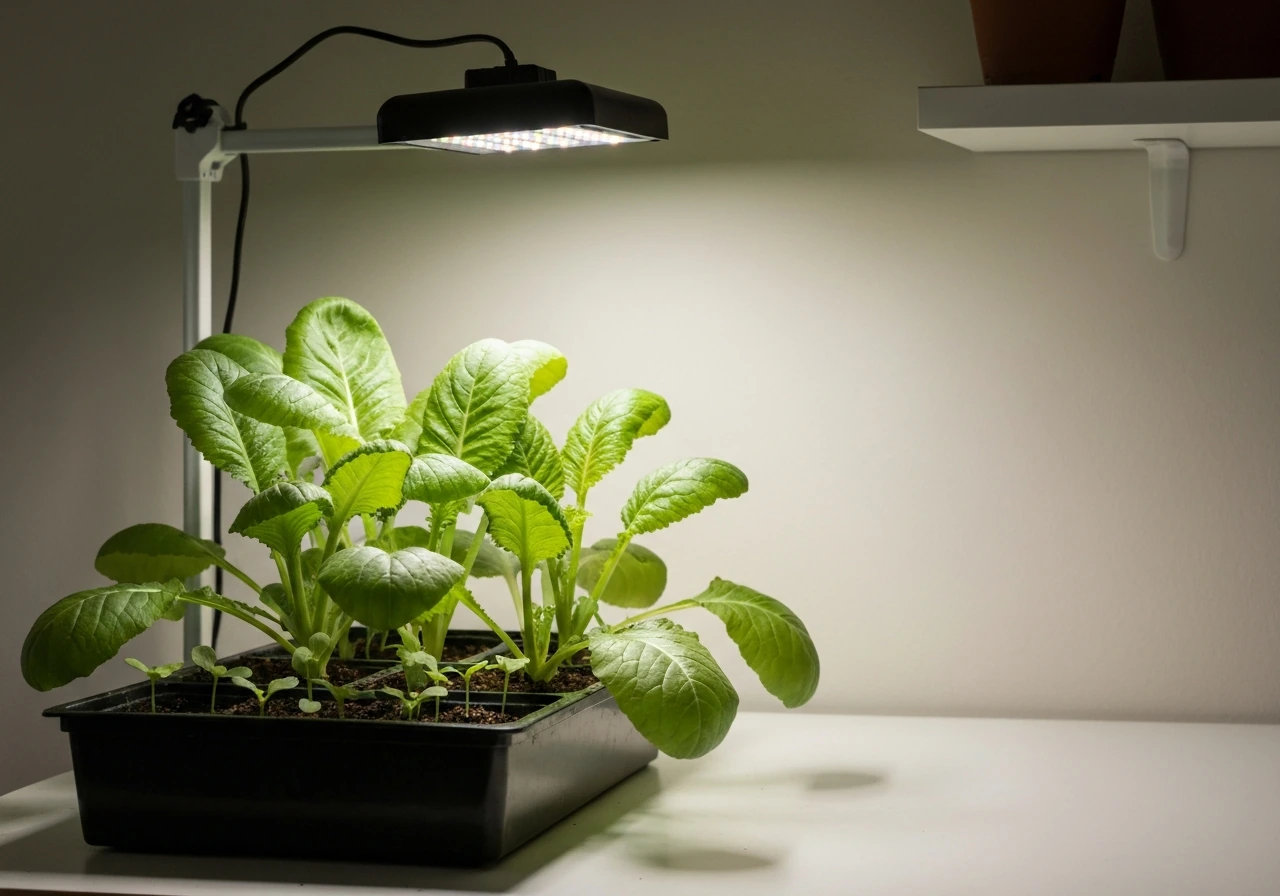
A wire utility shelf with three or four tiers works brilliantly as a seedling station. Mount LED bar lights or a T5 panel on the underside of each shelf, about 4–6 inches above the trays. Run lights for 16 hours a day on a timer. At that distance and with a quality LED bar, you will typically hit 150–300 µmol·m⁻²·s⁻¹ at the tray surface, which is well within the seedling target range. This setup handles dozens of seedling cells per tier and costs relatively little to run.
Apartment shelf for foliage houseplants
For a bookshelf or floating shelf displaying pothos, prayer plants, spider plants, and peperomia, a single full-spectrum LED panel (around 30–45 watts for a 2×2 ft area) mounted 12–18 inches above the plants on a 12–14 hour timer is usually enough. Spider plants and prayer plants in particular respond noticeably after a few weeks, with denser growth and better color than they show near a dim interior window. This is one of the best value-for-effort grow light applications.
Propagation station
Cuttings in water or perlite need gentle, consistent light to root without the stress of high intensity. A clip-on or small bar LED set to about 50–100 µmol·m⁻²·s⁻¹ at the cutting level, run 14–16 hours a day, is ideal. Keep the fixture further away (12–18 inches) and lower intensity than you would for a mature plant. Most stem cuttings root faster and more reliably under this setup compared to a low-light windowsill.
Herb kitchen garden
Basil, mint, parsley, and chives on a kitchen counter benefit enormously from a dedicated grow light. A 40–60 watt LED panel or a pair of bar lights mounted 8–12 inches above the pots, running 16 hours a day, delivers a DLI in the 12–18 mol·m⁻²·d⁻¹ range that keeps herbs growing vigorously all year. Basil especially rewards the attention with better flavor and density compared to a windowsill plant. Electricity cost for this kind of small setup typically runs a few dollars per month.
Flowering and fruiting crops (dedicated grow tent)
For tomatoes, peppers, or strawberries, a 2×4 ft grow tent with a 200–300 watt full-spectrum LED fixture is a solid starting point. Target 400–600 µmol·m⁻²·s⁻¹ at canopy level for vegetative growth, stepping up to 600–800 µmol·m⁻²·s⁻¹ during fruiting. Run 14–16 hours during vegetative growth, then adjust based on the plant's day-length requirements for flowering. Strawberries, which have been shown to complete full fruit production cycles under sole-source LED lighting in research trials, are a great beginner fruiting crop for home setups because they stay compact.
Single-pot setup
Sometimes you just want to keep one treasured plant alive through a dark winter. A simple clip-on LED grow light (10–25 watts, full-spectrum) positioned 12–15 inches above a single pot on a 12-hour timer will maintain most medium-light houseplants in good health. It is a low-cost, low-commitment starting point that proves the concept before you invest in anything larger.
Maintenance, running costs, and when you actually need a grow light
LED grow lights are genuinely low-maintenance. There are no bulbs to replace on a schedule, and well-made LEDs are rated for 50,000 hours or more. Wipe the lens occasionally to remove dust that accumulates and slightly reduces output. Check that mounting hardware stays secure over time. That is about all there is to it.
Running costs are easy to estimate: a 40-watt fixture running 14 hours a day uses 0.56 kWh daily. At a U.S. average electricity rate around $0.16 per kWh, that is about $0.09 per day, or roughly $2.70 per month. A larger 200-watt setup for fruiting crops costs around $13–14 per month at the same rate. These are real but very manageable costs for most home gardeners, especially compared to replacing dead plants or buying fresh herbs every week.
As for when you actually need a grow light: if your plants are growing fine near a bright south- or west-facing window, you probably do not need one. Grow lights earn their keep in winter when day length and light intensity drop, in apartments with north-facing or obstructed windows, in any room more than a few feet from the nearest window, and whenever you want to grow light-hungry plants like herbs or succulents in places where sun simply cannot reach. They are tools, not requirements, and knowing when to use them makes all the difference.
FAQ
Short answer: what indoor plants like grow lights?
Many common houseplants and edible greens do very well under grow lights. Foliage plants such as spider plants, pothos, philodendrons, snake plant, ZZ plant, prayer plant (Maranta), peperomia, ferns and African violets thrive on supplemental or sole‑source LED lighting at moderate intensities; herbs, lettuce and many seedlings/vegetables also perform strongly under properly specified grow lights. In short: low‑to‑medium‑light houseplants need lower PPFD/DLI, while light‑demanding edibles and flowering/fruiting crops require higher PPFD and/or longer photoperiods.
Which common houseplants and plant types thrive under grow lights?
Examples by general light category: Low‑light (tolerant): snake plant (Sansevieria/Dracaena trifasciata), ZZ plant (Zamioculcas), pothos (low end), cast iron plant, many ferns (lower light positions). Medium‑light (do very well under average LEDs): spider plant (Chlorophytum), prayer plant (Maranta), philodendron, peperomia, pothos (brighter spots), Boston fern, African violet. High‑light (need stronger light for best growth/flowering): succulents, cacti, most flowering/fruiting crops (tomato, pepper, strawberry), many herbs (basil, rosemary) and vegetable seedlings. Many species can be grown under sole‑source LEDs if intensity, spectrum and photoperiod match the species’ needs.
Can plants survive or complete life cycles on grow lights alone?
Yes. Controlled‑environment research and commercial practice show many plants (seedlings, leafy greens, herbs, ornamentals and some fruiting crops) will complete full life cycles under sole‑source LED lighting when PPFD, spectrum and photoperiod are appropriate for the species and growth stage. ‘Survive’ is different from ‘thrive’: low light plants tolerate lower DLI, but fruiting/flowering crops require higher DLI/PPFD and correct photoperiod to develop flowers and fruit.
How do I choose the right type of grow light? (LED types, spectrum)
LEDs are the practical choice for home growers due to efficiency, low heat and long life. Key selection points: Spectrum — choose full‑spectrum white LEDs or a blend with both blue (≈400–500 nm) and red (≈600–700 nm). Blue photons promote compact, healthy vegetative growth; red photons drive high photosynthetic efficiency; adding some far‑red (≈700–750 nm) can affect elongation and flowering but should be used carefully. Avoid relying solely on narrow‑band single‑color fixtures for general houseplant culture. Look for fixtures marketed for horticulture with a documented PPF (µmol·s⁻¹) or efficacy (µmol·J⁻¹) and a spectrum chart. For multi‑shelf or mixed plantings, full spectrum white or RBW fixtures give the most consistent results.
Recommended intensity (PPFD) and photoperiod ranges for low/medium/high light species
Use PPFD (µmol·m⁻²·s⁻¹) as the target and adjust photoperiod to reach a suitable DLI. Typical practical ranges: Low‑light species: PPFD ≈25–100 µmol·m⁻²·s⁻¹; photoperiod 10–14 h (DLI ≈0.9–5.0 mol·m⁻²·d⁻¹). Medium‑light species: PPFD ≈100–250 µmol·m⁻²·s⁻¹; photoperiod 10–16 h (DLI ≈3.6–14.4 mol·m⁻²·d⁻¹). High‑light / flowering & vegetable crops: PPFD ≈250–600+ µmol·m⁻²·s⁻¹ depending on crop and stage; photoperiod 12–18 h (DLI ≈10.8–38.9 mol·m⁻²·d⁻¹). These bands map to common DLI expectations used in extension/CEA guidance (low ≈1–6, medium ≈6–12, high ≈12–20+ mol·m⁻²·d⁻¹). Adjust upward for flowering/fruiting stages and downward for shade‑adapted plants.
How far should I hang grow lights (distance and intensity guidance)?
Distance depends on fixture output and beam spread. General rules: low‑output fixtures for foliage use 12–24 in (30–60 cm) above the canopy; medium fixtures 12–18 in (30–45 cm); high‑output fixtures for seedlings/vegetables often 12 in (30 cm) or less. Instead of fixed distances, set distance to reach the target PPFD for your plants (measure with a PAR meter) and raise/lower the fixture to keep PPFD in the recommended range. Always follow manufacturer recommendations for minimum fixture‑to‑plant distances to avoid hot spots or bleaching.
Next Articles
Plants That Do Well Under Grow Lights: Guide & Setup Tips
Plants that do well under grow lights: practical plant picks, light settings, setup tips, troubleshooting & care for DIY
Do Prayer Plants Like Grow Lights? LED Tips, PPFD & Setup
Do prayer plants like grow lights? Clear LED guidance: intensity (PPFD), spectrum, distance, runtimes & setup tips.
What Plants Like Grow Lights: Match Light to Your Needs
Find which plants thrive under grow lights, needed spectrum, intensity, and run-time, plus setup tips and safety myths.