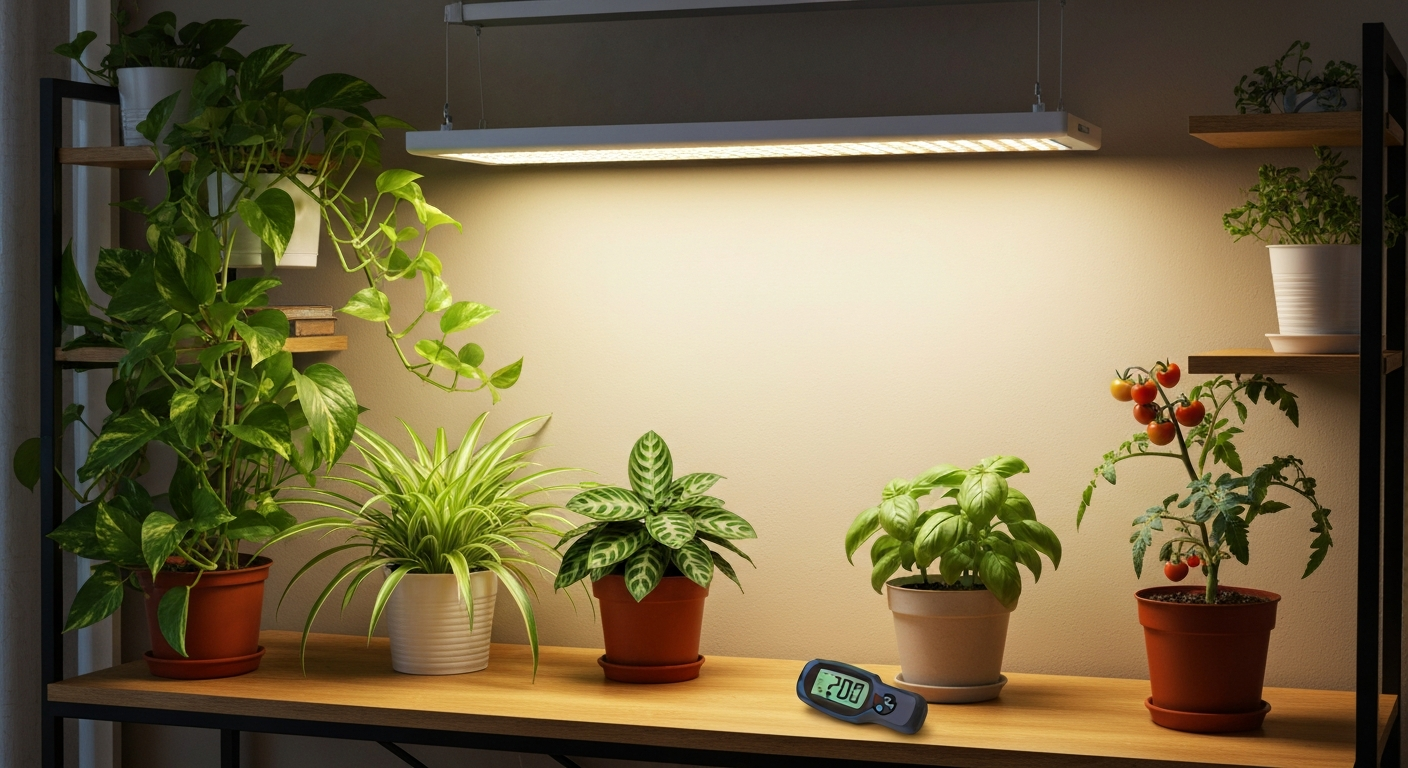
Yes, grow lights genuinely work for houseplants, and a surprisingly wide range of species do well under them. Herbs, leafy greens, tropical foliage plants, and even some flowering houseplants can thrive year-round under a decent LED fixture if you give them the right intensity, spectrum, and daily duration. The key is matching the light to the plant's actual needs rather than guessing. I have kept spider plants, prayer plants, pothos, basil, and cherry tomatoes under LEDs at the same time, and the results across those very different species taught me more about plant light requirements than years of windowsill growing ever did.
Plants That Do Well Under Grow Lights: Guide & Setup Tips
Marcus Holloway
18 Jul 2026
Which plants thrive under grow lights (quick reference)
If you just want a fast answer before diving into the details, here are the plant categories that consistently perform well under LED grow lights at home, grouped by how demanding they are. For a focused list of species and specific light recommendations, see what plants like grow lights.
| Category | Example plants | PPFD target (µmol/m²/s) | Daily light (DLI, mol/m²/d) | Ease under LEDs |
|---|---|---|---|---|
| Low-light foliage | Pothos, ZZ plant, cast iron plant, snake plant, peace lily | 50–150 | 2–8 | Very easy |
| Medium-light foliage | Spider plant, prayer plant, philodendron, dracaena, calathea | 150–300 | 8–16 | Easy to moderate |
| Herbs and greens | Basil, parsley, lettuce, spinach, mint | 200–400 | 12–18 | Easy |
| High-light flowering/fruiting | Tomatoes, peppers, strawberries, orchids, succulents | 300–600+ | 16–25+ | Moderate — needs the right fixture |
PPFD stands for Photosynthetic Photon Flux Density, measured in micromoles of photons per square meter per second. It is the correct metric for comparing grow light intensity to what plants actually use. That review reports that spectral mismatch, cosine error and angular incidence cause the largest real‑world errors in PAR meters under LED lighting, and recommends using a calibrated quantum sensor (or a spectroradiometer for spectral power distribution) and averaging measurements at multiple canopy points as best practice MDPI Remote Sensing (2024) — 'Advances in Research and Application of Techniques for Measuring Photosynthetically Active Radiation'. DLI (Daily Light Integral) is simply the total dose of those photons accumulated over a full day, and it is the number that best predicts plant growth outcomes across species. A meta-analysis published in New Phytologist (Poorter et al., 2019) confirmed that DLI, not lux or wattage, is the most reliable predictor of growth and reproductive performance across plant species.
How grow lights affect plant growth: light quality vs. quantity
There are two separate things to get right with grow lights: how much light you deliver (quantity, measured as PPFD and DLI) and what kind of light you deliver (quality, meaning the spectrum). Most beginners focus entirely on wattage, which is essentially irrelevant from the plant's perspective. A plant does not care how many watts your fixture draws. It cares how many usable photons land on its leaves per second.
The science behind this goes back to K.J. McCree's action spectrum work from the early 1970s, which mapped out exactly which wavelengths plants use for photosynthesis. The result, now called the McCree curve, shows two broad peaks: one in the blue range around 440 nm and one in the red range around 620–670 nm. This is why early LED grow lights used only red and blue LEDs (the so-called 'blurple' lights). The problem is that pure red-only light causes what researchers call 'red-light syndrome': stretched, abnormal growth and reduced photosynthetic capacity. Adding even a modest fraction of blue light, or using a broad-spectrum white LED, prevents this and usually produces healthier, more compact growth. Modern full-spectrum white LEDs or white-plus-red fixtures are much better choices for home use than the old blurple strips.
On the quantity side, University of Minnesota Extension and similar sources translate plant light needs into practical PPFD ranges: low-light species need roughly 50–150 µmol/m²/s, medium-light species need 150–300, and high-light or fruiting plants need 300–600 or more. Run those numbers through the DLI formula (PPFD multiplied by hours per day multiplied by 3600, divided by one million) and you get the daily dose. At 200 µmol/m²/s for 14 hours, for example, you are delivering a DLI of about 10 mol/m²/d, which is enough to flower most medium-light houseplants. MSU floriculture research consistently puts 10 mol/m²/d as the practical floor for quality flowering in ornamentals. See Erik Runkle / Michigan State University Extension, DLI guidance for floriculture and greenhouse crops for DLI maps and practical thresholds used in floriculture research Erik Runkle / Michigan State University Extension — DLI guidance for floriculture and greenhouse crops.
Distance matters more than most people realize
PPFD drops off fast as you move the fixture away from the plant. An LED panel that delivers 400 µmol/m²/s at 30 cm might only deliver 150 µmol/m²/s at 60 cm. Most manufacturers publish PPFD maps showing intensity at different distances, and it is worth checking those numbers before positioning your light. For low-light foliage, 40–60 cm above the canopy is usually fine. For herbs or fruiting plants that want higher intensity, 20–35 cm is more typical. Start at the manufacturer's recommended distance and watch the plant for the first two weeks.
How long to run your grow light each day
Most houseplants do well with 12–16 hours of grow light per day. Short-day flowering plants like poinsettias or chrysanthemums need a dark period to trigger blooming, so running your light for more than 14 hours can prevent flowering in those species. For foliage plants, herbs, and most fruiting vegetables, 14–16 hours is a practical sweet spot. A simple plug-in timer is all you need to get consistent photoperiods without thinking about it.
Low-light plants that perform well under grow lights
Low-light species are the easiest wins under grow lights because even a modest fixture easily exceeds what they receive near a dim window. The target PPFD range is 50–150 µmol/m²/s, which corresponds to a DLI of roughly 2–8 mol/m²/d over a 12–14 hour photoperiod. A basic single-bar LED grow light mounted 50–60 cm above these plants is more than sufficient.
- Pothos (Epipremnum aureum): extremely forgiving, grows vigorously under almost any LED spectrum, and shows noticeably faster trail growth under moderate grow light intensity compared to a dim corner
- Snake plant (Sansevieria/Dracaena trifasciata): tolerates very low PPFD and is almost impossible to overlight within the low-light range; grow lights are mainly useful for preventing the slow decline that happens in truly dark rooms
- ZZ plant (Zamioculcas zamiifolia): another near-indestructible option under grow lights; keep intensity moderate since the thick rhizomes store water and the plant does not want high evaporative demand
- Peace lily (Spathiphyllum): will actually flower reliably under grow lights once DLI reaches about 5–8 mol/m²/d, which is difficult to achieve near most windows in winter
- Cast iron plant (Aspidistra elatior): lives up to its name under artificial light; aim for 50–100 µmol/m²/s and it will stay healthy indefinitely
One thing worth noting: even 'low-light' plants are not 'no-light' plants. I have killed a pothos by leaving it in a room where the only light was a 40W incandescent three meters away. Grow lights fix that situation completely. Even a modest LED fixture gets these plants into a healthy DLI range.
Medium-light plants that perform well under grow lights
Medium-light plants are where grow lights really show their value for most home gardeners. These species want 150–300 µmol/m²/s, which translates to a DLI of 8–16 mol/m²/d. A north-facing window in winter rarely delivers that, but a mid-range LED panel at 40–50 cm hits it easily. This group includes some of the most popular houseplants, and most of them respond visibly to being placed under a proper grow light: denser growth, better color, and in some cases flowers.
- Spider plant (Chlorophytum comosum): tolerates a wide range but produces the best leaf width and plantlet runners at the upper end of medium light; more detail on this species in the section below
- Prayer plant (Maranta leuconeura): needs bright, diffuse, indirect light to maintain its distinctive leaf patterning and coloration; more detail in the dedicated section below
- Philodendron (heartleaf and split-leaf types): responds well to 150–250 µmol/m²/s with faster node production and larger leaves compared to low-light conditions
- Dracaena: a broad genus with varying tolerances, but most species produce fuller, better-colored foliage at the medium-light PPFD range under broad-spectrum LEDs
- Calathea: understory plants that need diffuse medium light; they are sensitive to heat and dryness, so keep the fixture far enough away that it does not raise leaf surface temperature
- Chinese evergreen (Aglaonema): adaptable but shows better color variegation with adequate light; 150–200 µmol/m²/s is a comfortable target
- Ferns (Boston, maidenhair): appreciate consistent medium light without the directional intensity of a window; grow lights are actually ideal because ferns hate drying hot sun but need decent PAR
High-light plants that perform well under grow lights
High-light plants need 300–600+ µmol/m²/s and a DLI above 16–20 mol/m²/d, which means you need a more capable fixture and likely a shorter mounting distance. This is where grow lights go from 'useful supplement' to 'essential tool,' especially in climates where outdoor growing is limited. Fruiting vegetables like tomatoes and peppers, most herbs, succulents, and orchids all fall into this category.
| Plant | Target PPFD (µmol/m²/s) | DLI (mol/m²/d) | Daily hours | Notes |
|---|---|---|---|---|
| Basil | 250–450 | 14–20 | 14–16 | Very responsive to blue-rich spectrum; compact growth, good oil production |
| Lettuce / spinach | 200–350 | 12–17 | 14–16 | Tolerates slightly lower DLI; bolts under excessive heat or very long days |
| Cherry tomatoes | 400–600 | 20–30 | 16–18 | Needs strong fixture; adding blue to predominantly red light increases yield |
| Peppers | 350–500 | 18–25 | 14–16 | Slow to fruit but reliable under high-output LED panels |
| Strawberries | 300–500 | 16–22 | 14–16 | Day-neutral varieties work best indoors without seasonal photoperiod cues |
| Succulents / cacti | 300–500 | 16–20 | 12–14 | Need high intensity to avoid etiolation; prone to stretch under weak light |
| Orchids (Phalaenopsis) | 150–300 | 10–15 | 12–14 | Lower end of high-light group; flowering triggered by cool nights, not just DLI |
Fruiting plants like tomatoes are where spectrum tuning pays off most. Research from Frontiers (summarized in several controlled LED crop trials) shows that adding blue light to predominantly red supplemental LED increases tomato biomass and yield, but only up to an optimum, after which additional blue provides no extra benefit. For home growers this means a broad-spectrum white LED with some red enhancement is a better all-round choice than a pure red fixture. You do not need to engineer a specific red-to-blue ratio, but you do want to avoid pure-red-only lights.
Spider plants under grow lights: what to expect
Spider plants (Chlorophytum comosum) are one of the most forgiving plants you can put under a grow light, which makes them a great starting point if you are new to indoor growing. UW-Madison Extension describes their light preference as bright, indirect to medium light, noting that low light causes legginess and reduces plantlet (runner) production. Under grow lights, a PPFD of 150–250 µmol/m²/s at the leaf level covers their needs comfortably, and a full-spectrum broad-spectrum LED produces noticeably better results than a blurple fixture. If you’re wondering whether spider plants like grow lights, the short answer is yes, they do well under moderate full‑spectrum LEDs at roughly 150–250 µmol/m²/s do spider plants like grow lights.
Controlled LED experiments published in MDPI Agronomy that included Chlorophytum in multi-species trials confirmed that spider plants respond to spectral differences: leaf pigment content and biomass both shift depending on whether the plants receive red-only, blue-only, or mixed-spectrum light. In practice this means a white or white-plus-red LED will give you denser, better-colored foliage compared to red-heavy blurple lights. A 14-hour photoperiod at moderate intensity also encourages runner production, which is the main aesthetic reason most people grow spider plants in the first place.
Practical setup tips for spider plants
- Mount your LED fixture 40–55 cm above the plant canopy and confirm PPFD is in the 150–250 range if you have a meter, or start at the manufacturer's recommended hanging height for medium-light plants
- Run the light for 14 hours per day on a timer; this also maintains a long enough photoperiod to promote plantlet runner production
- Use a full-spectrum white LED rather than a red-blue blurple light; the broader spectrum supports better leaf pigmentation and avoids the abnormal morphology associated with red-only light
- Watch the leaf tips: brown tips on spider plants most often signal dry air or fluoride in tap water, not light stress; do not move the light further away if you see tip burn without ruling out watering issues first
- If the central rosette is stretching upward and leaves are narrow and pale, increase light intensity by moving the fixture 10 cm closer or extending the photoperiod by one to two hours
Prayer plants under grow lights: keeping the patterns vivid
Prayer plants (Maranta leuconeura) are understory tropical plants adapted to filtered, diffuse light beneath a forest canopy. The RHS describes their requirement as bright, filtered or indirect light, and that description maps directly onto what a well-positioned grow light provides. Direct high-intensity light, from a window or a fixture set too close, will bleach and scorch the distinctive leaf markings that make Maranta worth growing in the first place. Under grow lights you have precise control over intensity, which is genuinely an advantage over a variable south-facing window.
Target PPFD for prayer plants is 150–200 µmol/m²/s, toward the lower end of the medium-light range. For a quick answer to whether prayer plants like grow lights, see do prayer plants like grow lights. Mount your fixture 50–65 cm above the plant, or use a fixture at a distance that you have verified gives moderate intensity at canopy level. A 12–14 hour photoperiod is appropriate. The nyctinasty behavior (the daily leaf-folding movement that gives the plant its common name) continues normally under artificial light as long as the photoperiod is consistent and the lights turn off fully at night. If your plants stop folding their leaves at night, check that there is no other light source, including ambient room light, reaching them during the dark period.
Practical setup tips for prayer plants
- Keep PPFD at 150–200 µmol/m²/s; if you do not have a meter, err toward placing the light higher rather than closer, since scorching the patterned leaves is much worse than slightly underlit growth
- Use a full-spectrum white LED; the broad spectrum supports the carotenoid and anthocyanin pigments responsible for the red veining and dark blotch patterns in Maranta leaves
- Run the light on a 12–14 hour timer and ensure the plant gets a genuine dark period; inconsistent photoperiods can cause erratic leaf folding behavior
- Maintain high ambient humidity (50–60% or above) near the plant; grow lights can lower relative humidity by gently warming the air around the fixture, which stresses moisture-loving Marantas
- If the leaf patterns are fading to solid green, the plant is likely getting too little light overall; move the fixture 10–15 cm closer and monitor the response over two to three weeks
Can plants survive with only grow lights, no windows at all?
Yes, many plants can survive and genuinely thrive with grow lights as their only light source, provided you dial in the right intensity, spectrum, and duration. Low and medium-light houseplants like pothos, spider plants, peace lilies, and prayer plants are all candidates for windowless rooms under capable LED fixtures. For a quick list of species and categories, see what indoor plants like grow lights for specific recommendations on low-, medium-, and high-light candidates. Herbs and leafy greens also do extremely well with grow lights as their sole light source, which is the entire basis of indoor vertical farming. The limiting factors are not the technology but the electricity cost, the quality of the fixture, and whether you maintain consistent photoperiods. See the section 'Can plants survive with only grow lights, no windows at all?' for a focused guide on using grow lights as the sole light source.
High-light fruiting plants like tomatoes and peppers can technically grow under lights alone, but they need a lot of photons: DLI values of 20–30 mol/m²/d require either very high-output fixtures or very long photoperiods, both of which add up on your electricity bill. It is worth being honest about the economics before setting up a fruiting crop in a basement with no natural light. For foliage houseplants and herbs, though, grow lights as a sole source are genuinely practical and common.
Spectrum, safety, and fixture basics: what to actually look for
When choosing a fixture, ignore marketing terms like 'full spectrum' used without any supporting data, and focus instead on a few concrete things. Look for fixtures tested to UL 8800 (the standard for horticultural lighting equipment) or listed on the DesignLights Consortium horticultural qualified products list. These certifications mean the fixture has been tested for electrical safety, IP rating (important if you mist your plants), and photon efficacy. The correct efficiency metric for grow lights is PPE (Photosynthetic Photon Efficacy), measured in micromoles per joule. Higher PPE means more plant-usable photons per watt of electricity. As of 2026, a good mid-range LED panel should achieve at least 2.0–2.5 µmol/J.
On the safety side, the main practical concerns with home grow lights are electrical safety (use fixtures from reputable brands with proper certifications, and do not daisy-chain cheap fixtures on undersized extension cords) and heat management. Modern LEDs run much cooler than HPS or fluorescent lights, but fixture housings still get warm. Keep them away from flammable materials and maintain adequate airflow. LED grow lights do not emit significant UV or infrared, and the claim that they cause cancer or give you a tan is not supported by evidence: the photon energies and irradiances involved in standard horticultural LEDs are far below any documented harmful threshold for incidental human exposure during normal tending.
Troubleshooting: common problems under grow lights
| Problem | Likely cause | What to do |
|---|---|---|
| Stems stretching tall, thin, pale leaves (etiolation) | PPFD too low for the species | Move fixture closer or increase photoperiod; verify intensity matches species target |
| Leaf tips or edges scorching, bleached patches | PPFD too high, fixture too close | Move fixture 10–15 cm further away; check canopy PPFD with a meter if possible |
| Leaves yellowing overall (not just lower) | DLI too low or wrong spectrum (red-only) | Increase light duration or switch to broad-spectrum white LED |
| Prayer plant stops folding leaves at night | Light bleed during dark period from room or other sources | Ensure full darkness during off hours; use a blackout curtain if needed |
| Spider plant tips browning while growth looks fine | Low humidity or fluoride in tap water, not light stress | Switch to filtered water; raise humidity; do not adjust light based on tip color alone |
| Slow or no flowering on peace lily or orchid | DLI below species flowering threshold (~5–10 mol/m²/d for peace lily) | Increase PPFD or extend photoperiod to hit minimum DLI; check species-specific requirements |
| Heat stress: wilting despite adequate watering | Fixture too close, raising leaf temperature | Increase fixture height; check that airflow is adequate around the canopy |
Quick fixture buying checklist
Before you buy, run through these practical criteria to avoid the most common mistakes.
- Check that the manufacturer publishes actual PPFD values at multiple distances, not just wattage or lux numbers
- Look for UL 8800 listing or DLC horticultural QPL listing for safety and efficiency verification
- Choose full-spectrum white or white-plus-red LED over red-blue blurple for better plant morphology and more natural appearance
- Match fixture coverage area to your growing area; PPFD drops sharply at the edges of most panels
- Confirm the PPE rating is at least 2.0 µmol/J for reasonable electricity efficiency
- Check the IP rating if you mist plants or grow in a humid space; IP44 or higher is appropriate
- Buy a simple plug-in timer if the fixture does not have a built-in scheduler
- Consider a basic quantum PAR meter (Apogee or similar) if you plan to grow multiple species at different light levels; it removes all the guesswork about whether your plants are actually getting the right dose
Realistic expectations: what grow lights will and will not do
Grow lights are genuinely excellent tools for keeping houseplants healthy through winter, growing herbs year-round, and giving shade-adapted tropicals consistent conditions. They are not magic. A plant that is root-bound, underwatered, or sitting in poor soil will not improve dramatically just because you added a grow light. Light is one input among several, and it is the one that grow lights solve. If your plants were struggling in a dim corner and you move them under a well-chosen LED panel, you will usually see a clear improvement in growth rate and leaf quality within four to six weeks. If they were already getting adequate window light, the marginal gain from supplemental LEDs will be smaller. Start with the plants that are clearly light-limited and go from there.
FAQ
Do grow lights work for houseplants and indoor farming?
Yes. Grow lights that deliver photons in the PAR range (400–700 nm) provide the energy plants use for photosynthesis. Decades of research (McCree, Poorter et al.) and practical experience show that delivering the right photosynthetic photon flux (PPFD) and daily light integral (DLI) reliably supports growth, flowering and fruiting across species when spectrum, intensity and photoperiod are matched to the plant’s needs.
What metrics should I use to choose and set up a fixture?
Use horticultural metrics, not lumens: PPF (µmol·s⁻¹) describes a fixture’s photon output, PPFD (µmol·m⁻²·s⁻¹) is photons arriving at the plant surface, and DLI (mol·m⁻²·d⁻¹) = PPFD × hours of light. Aim to measure PPFD with a calibrated quantum sensor; if you can’t, use manufacturer PPF, fixture spacing guides and conservative estimates. Follow standards/labels (ANSI/ASABE S640, IES RP‑45, DLC/UL8800) where available.
Which practical PPFD and DLI ranges correspond to low, medium and high light houseplants?
Common guidance (supported by extension and research): low‑light foliage: ~50–150 µmol·m⁻²·s⁻¹ (DLI ≈2–8 mol·m⁻²·d⁻¹). Medium: ~150–300 µmol·m⁻²·s⁻¹ (DLI ≈8–16). High/flowering/fruiting: ~300–600+ µmol·m⁻²·s⁻¹ (DLI >16–20). Use the lower end for shade‑adapted species and the upper end for sun‑loving flowering/fruiting crops.
Which houseplants reliably perform under LEDs (examples by light category)?
Low light (tolerant): snake plant, pothos, ZZ plant, cast iron plant, some philodendrons. Medium light (best appearance and occasional flowers): spider plant, peace lily, prayer plant (Maranta), most peperomias. High light (best with strong LEDs for flowering/fruiting): succulents, citrus seedlings, flowering begonias, fruiting herbs/tomatoes. Species vary—check individual needs before increasing intensity.
How do spider plants (Chlorophytum comosum) respond to grow lights?
Spider plants are broadly tolerant and do well under medium LED PPFD (~100–250 µmol·m⁻²·s⁻¹; DLI ≈4–12). Under adequate light they stay compact, produce plantlets and sometimes flowers. Under sustained low PPFD they become leggy, have fewer plantlets/flowers and slower growth. Spectra used in horticulture (broad white or mixed red/blue with some white/green) work fine—avoid extreme narrow red‑only spectra.
How do prayer plants (Maranta leuconeura) respond to grow lights?
Prayer plants are shade‑adapted and prefer medium, diffuse PPFD (≈100–200 µmol·m⁻²·s⁻¹; DLI ≈4–10). They dislike direct, high‑intensity light that causes leaf bleaching/edges to scorch. A broad/white or blue‑inclusive spectrum that mimics filtered daylight maintains leaf color and folding behavior; reduce intensity or raise fixture distance if leaves show bleaching or crisp margins.
Next Articles
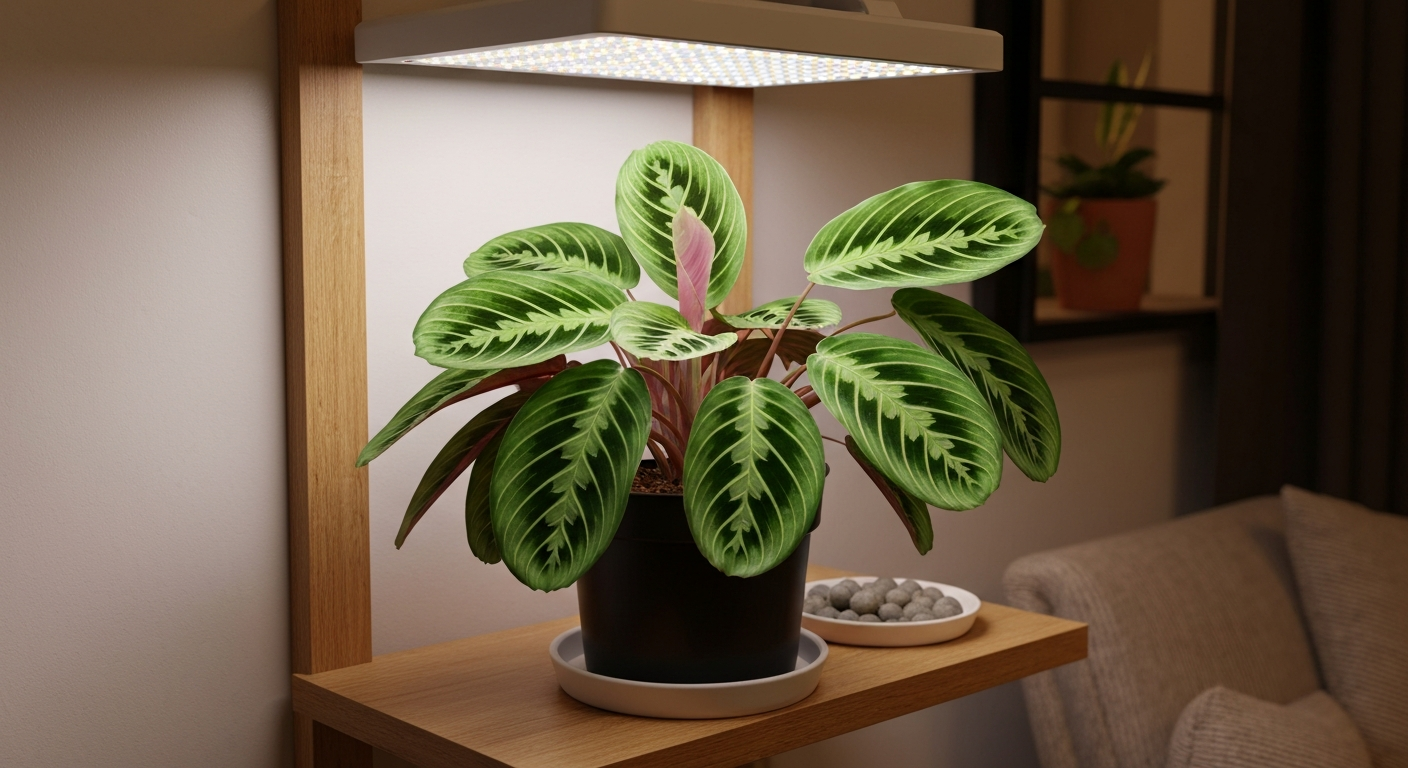
Do Prayer Plants Like Grow Lights? LED Tips, PPFD & Setup
Do prayer plants like grow lights? Clear LED guidance: intensity (PPFD), spectrum, distance, runtimes & setup tips.
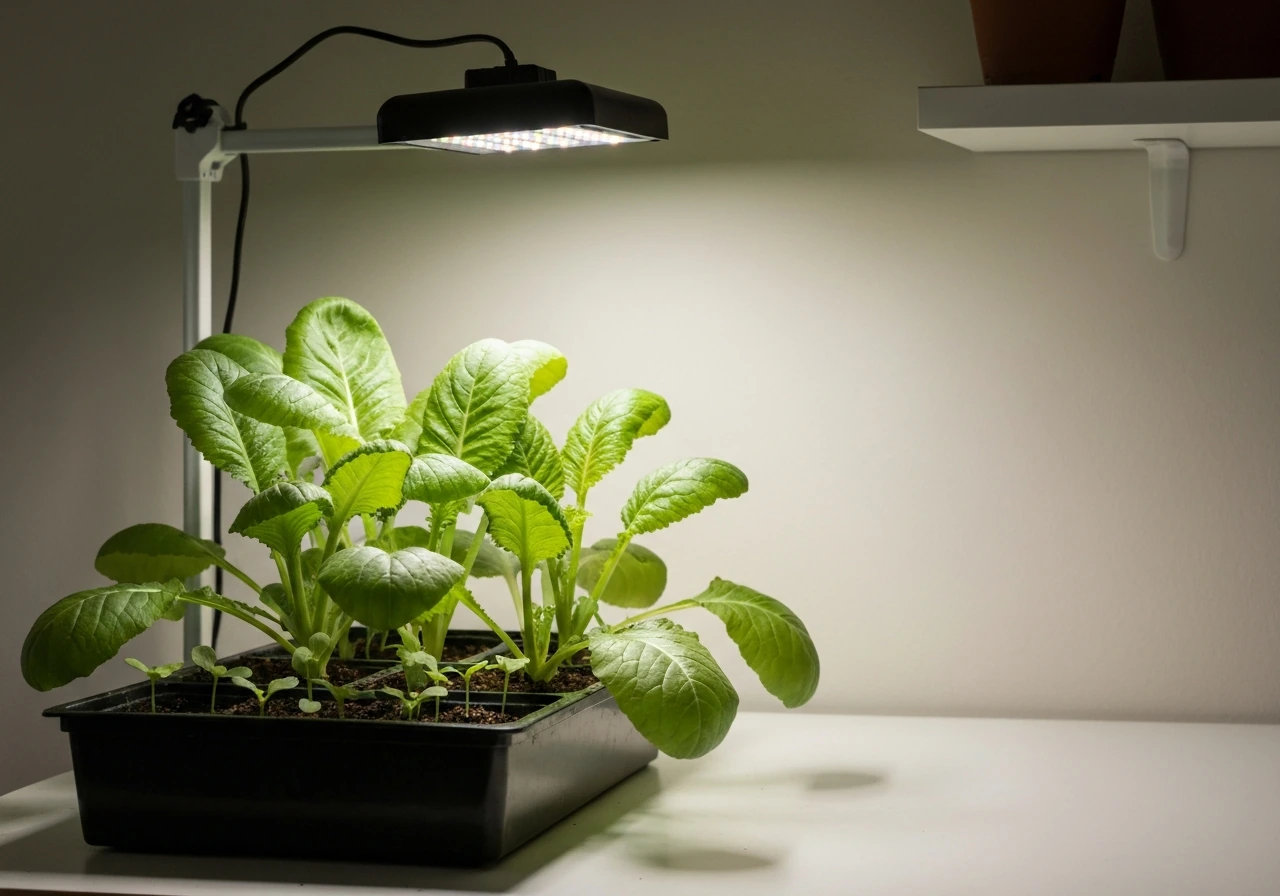
What Plants Like Grow Lights: Match Light to Your Needs
Find which plants thrive under grow lights, needed spectrum, intensity, and run-time, plus setup tips and safety myths.
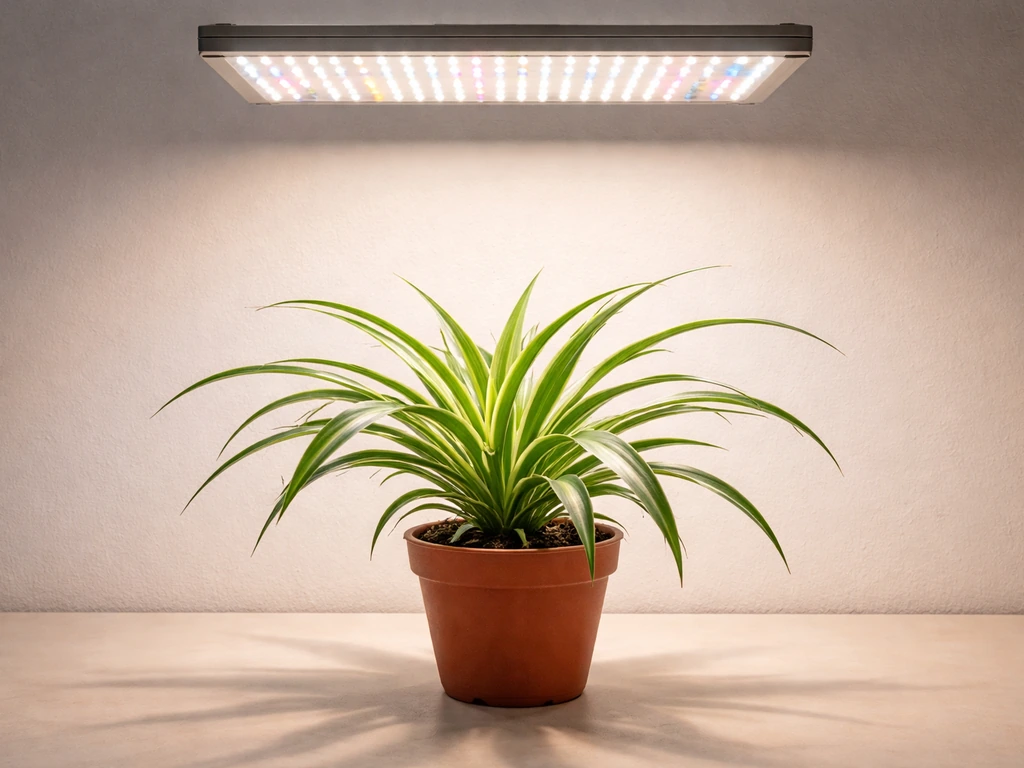
Do Spider Plants Like Grow Lights? How to Set Up LED
Yes, spider plants can use LED grow lights. Learn setup distance, timing, and fixes for leggy growth and leaf burn.