
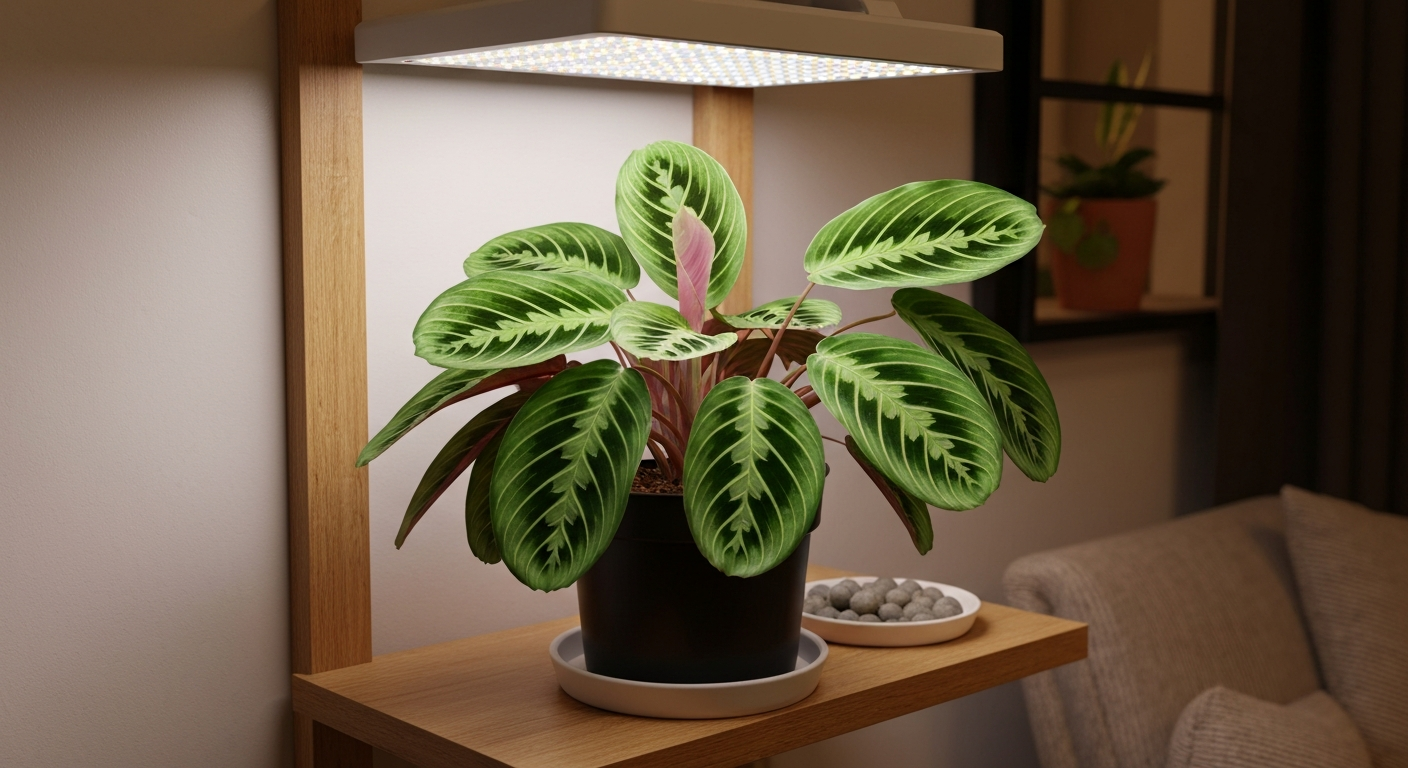
Yes, prayer plants (Maranta leuconeura) do well under grow lights, and in many home setups they actually thrive better under a well-dialed LED than on a dim windowsill. The key is keeping the intensity low to moderate. Aim for 50 to 200 µmol·m⁻²·s⁻¹ PPFD at leaf level, use a broad full-spectrum white LED, run it for 12 to 16 hours a day, and you will have a healthy, colourful Maranta even in a room with no usable natural light.
Do Prayer Plants Like Grow Lights? LED Tips, PPFD & Setup
Marcus Holloway
15 Jul 2026
How prayer plants use light in the wild (and why that matters indoors)
Maranta leuconeura comes from the floor of the Brazilian Atlantic rainforest. That means it evolved under a dense canopy where light arrives late, leaves early, and arrives filtered through multiple layers of bigger leaves above. The Royal Horticultural Society describes the ideal cultivation conditions as bright filtered or indirect light, and that description is not a vague suggestion. It is a direct translation of the plant's habitat. On a forest floor, measured PAR (photosynthetically active radiation) commonly ranges from around 50 to a few hundred µmol·m⁻²·s⁻¹ at leaf level, even on a sunny day. Those are genuinely low numbers compared to a sunny windowsill or an outdoor patio.
When people say 'indirect light' for houseplants, they usually mean no direct sun rays hitting the leaves. For Maranta, indirect is not just preferred, it is necessary. Place one in a south-facing window with unobstructed summer sun and you will watch the leaves bleach out and curl within days. The plant has almost no built-in tolerance for high-intensity direct light because it never needed to develop it. That same biology is why grow lights work so well here: a modest LED panel set at the right distance delivers exactly the soft, consistent, moderate light that Marantaceae plants are built around, without the intensity spikes of direct sun or the unpredictability of seasonal window light.
Measured light targets for Maranta: PPFD and lux explained
PPFD stands for photosynthetic photon flux density, and it is the number that actually tells you how much usable light is hitting your plant per second. It is measured in micromoles of photons per square metre per second (µmol·m⁻²·s⁻¹). Lux is a different unit, weighted to what the human eye sees, not what chlorophyll absorbs. That distinction matters because a warm-white LED can read impressively high in lux while delivering fewer photons in the red wavelengths that drive photosynthesis. If you want to measure accurately, use a PAR or quantum sensor (Apogee's SQ series and the LI-COR LI-190R are the standard tools), not your phone's lux app.
For Maranta specifically, research on closely related Calathea species (same family, Marantaceae) shows light compensation points around 50 to 100 µmol·m⁻²·s⁻¹ and photosynthesis that saturates well before the levels sun-loving plants need. University extension guidance for indoor foliage plants places a practical working range at 100 to 500 µmol·m⁻²·s⁻¹ for general houseplants, but shade-adapted species like Maranta sit at the lower end of that band. My own setup targets 100 to 150 µmol·m⁻²·s⁻¹ at canopy level, which produces compact, richly patterned growth without any stress symptoms.
| Growth goal | Target PPFD at canopy | Approximate DLI (14-hr day) | Notes |
|---|---|---|---|
| Minimum maintenance | 50–100 µmol·m⁻²·s⁻¹ | 2.5–5 mol·m⁻²·day⁻¹ | Slow growth, plant stays alive and presentable |
| Steady healthy growth | 100–150 µmol·m⁻²·s⁻¹ | 5–7.5 mol·m⁻²·day⁻¹ | Best all-round target for most home setups |
| Faster/robust growth | 150–200 µmol·m⁻²·s⁻¹ | 7.5–10 mol·m⁻²·day⁻¹ | Upper end; monitor for bleaching, acclimate slowly |
| Avoid | Above 300 µmol·m⁻²·s⁻¹ | — | Risk of photoinhibition, leaf bleach, curl |
If you only have a lux meter, you can do a rough conversion using source-specific factors published by Apogee Instruments. For a typical white LED, dividing your lux reading by approximately 54 gives you a rough PPFD estimate. That is not perfectly accurate (the conversion factor varies with the LED's spectrum), but it is useful as a starting check. For 100 µmol·m⁻²·s⁻¹ from a white LED, expect roughly 5,000 to 6,000 lux on your meter. If you are serious about dialling things in, a calibrated quantum sensor is worth the investment.
Can prayer plants survive on grow lights alone?
The short version: yes, but light is only one piece of the puzzle. Maranta leuconeura needs consistently warm temperatures (ideally 18 to 27°C), elevated humidity, and evenly moist but well-draining soil. Under grow lights, the air around the fixture can warm up and humidity can drop, especially in winter when indoor heating is running. If your prayer plant's leaf tips are going crispy brown under your LED, the light probably is not the problem. Low humidity almost always is. A pebble tray with water under the pot, a small humidifier nearby, or grouping plants together can help. The University of Florida's IFAS fact sheet on Maranta specifically flags low humidity as the main trigger for tip browning.
Watering also shifts under artificial light. When a plant is growing faster under a well-run LED, it uses water more quickly. But if your light is too dim and the plant is growing slowly, overwatering becomes a real risk. Check soil moisture by feel rather than running a fixed schedule. And remember that grow lights do not replace nutrients: if your plant has been in the same pot for over a year without fertilising, slow growth is as likely to be a feeding issue as a light issue. A half-strength balanced liquid fertiliser every two to four weeks during the active growing season handles that.
Other indoor plants that handle grow-light-only conditions well include pothos, snake plants, ZZ plants, and spider plants, which are all similarly low-to-moderate light species. If you want a broader list of what works under LEDs, the topic of plants that do well under grow lights covers a wider range of species with specific PPFD targets. For a broader list, see what indoor plants like grow lights (internal link: 3957b68d-e4f5-4317-bfac-b15e8b575f76). For a broader discussion of whether plants can survive with only grow lights, including species-specific PPFD targets, see can plants survive with only grow lights. For a broader list of plants that do well under LEDs and their typical PPFD targets, see what plants like grow lights.
LED basics for houseplants: spectrum, PAR, and colour temperature
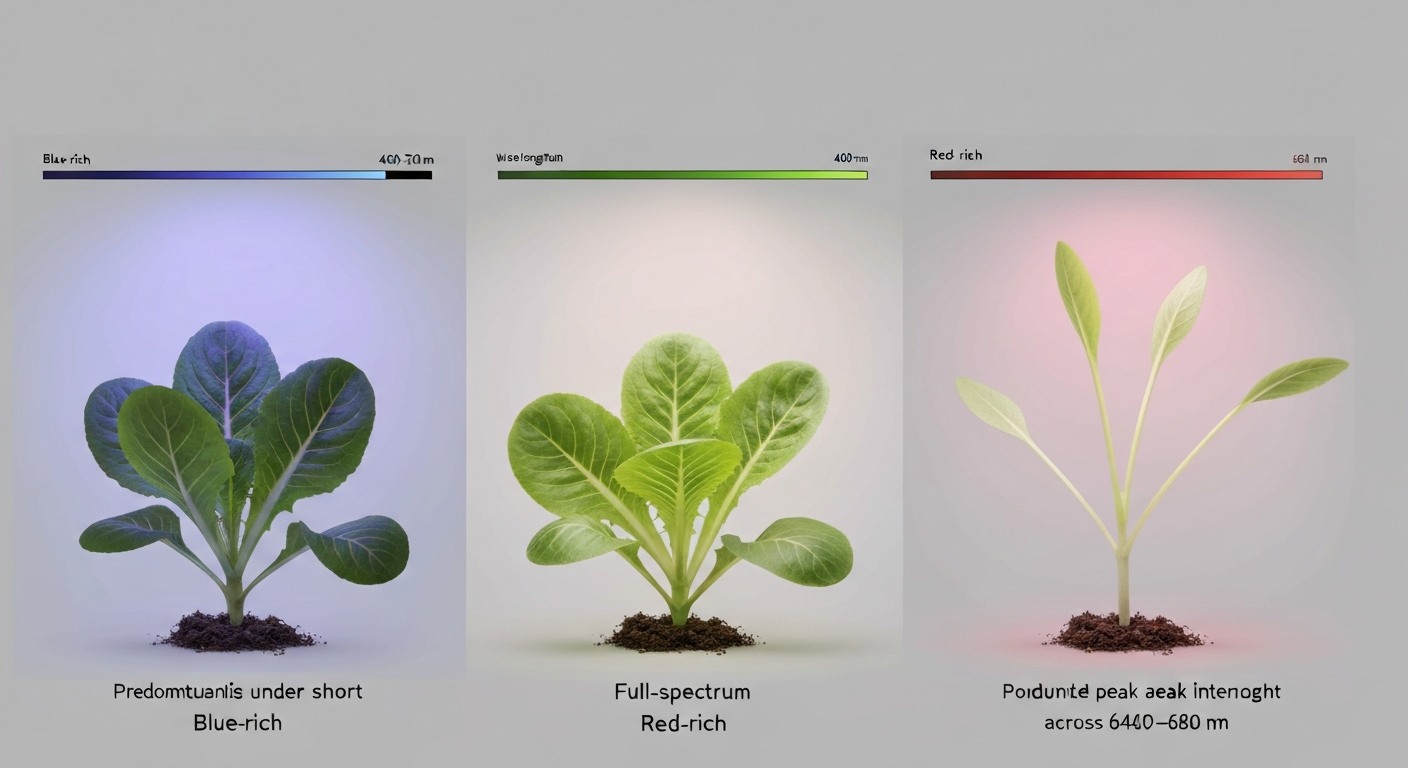
There is a lot of confusing marketing language around grow lights, so here is the practical version. Plants use light roughly in the 400 to 700 nanometre range (PAR, photosynthetically active radiation). Blue light (around 400 to 500 nm) drives compact, dense growth and helps regulate plant shape. Red light (around 600 to 700 nm) is the most efficient wavelength for photosynthesis at the chlorophyll level. Far-red light (700 to 750 nm) can boost photosynthetic efficiency through what is called the Emerson enhancement effect and influences how quickly a plant stretches or flowers.
For a foliage plant like Maranta, you do not need a specialised red-blue 'blurple' panel. Those were the first generation of grow lights and they work, but a modern broad-spectrum white LED with a colour temperature of 3000K to 5000K and a high CRI (colour rendering index above 80, ideally above 90) delivers a full spread of photons including green wavelengths, which research published in the Journal of Experimental Botany has shown can be just as effective as red or blue for driving plant biomass. A meta‑analysis published in the Journal of Experimental Botany (Green light is similarly effective in promoting plant biomass as red/blue light: a meta‑analysis, Journal of Experimental Botany (PMC)) found that green photons can be as effective as red and blue wavelengths for driving plant biomass and improving canopy penetration in some species Green light is similarly effective in promoting plant biomass as red/blue light: a meta‑analysis — Journal of Experimental Botany (PMC). Green light also penetrates deeper into the canopy, which matters if your Maranta is bushy. A white panel also makes it much easier to spot pest problems, yellowing leaves, and watering needs because the light looks natural.
| Spectrum/feature | What it does | Relevance for Maranta |
|---|---|---|
| Blue (400–500 nm) | Compact growth, stomatal control | Moderate amount needed; too much can stress shade plants |
| Red (600–700 nm) | Core photosynthesis driver | Important; full-spectrum whites include adequate red |
| Green (500–600 nm) | Canopy penetration, biomass | Beneficial; covered by any white LED |
| Far-red (700–750 nm) | Emerson effect, morphology shifts | Optional; some panels include it, not essential for foliage |
| Colour temp 3000–4000K | Warmer white, higher red ratio | Good all-round choice for foliage plants |
| Colour temp 5000–6500K | Cooler white, higher blue ratio | Fine but lean toward the lower end for Maranta |
What type of fixture to actually buy
The fixture category that makes most sense depends on how many plants you are running and your budget. Here is an honest breakdown of the main options.
LED bulbs and clip-on grow lights
A full-spectrum LED bulb in a standard lamp or a clip-on gooseneck grow light works well for a single Maranta on a shelf. A 10 to 15 watt full-spectrum bulb (around 3500K to 5000K) positioned 20 to 30 cm above the plant will typically deliver 50 to 100 µmol·m⁻²·s⁻¹ at leaf level, which sits comfortably in the maintenance-to-slow-growth zone. These are cheap (often under $20), easy to set up, and do not require any special mounting. The limitation is coverage: you are really illuminating one plant, not a shelf of six.
LED strip lights and bar arrays
LED strips and bar-style fixtures are excellent for shelf setups where you want even light across a longer row of pots. Mounted on the underside of the shelf above, a quality full-spectrum LED strip running the full width of the shelf can cover a line of plants uniformly. These work especially well for Maranta because the light comes from directly overhead at a consistent short distance, mimicking filtered overhead canopy light. Look for strips rated at 3000K to 4000K, and check whether the manufacturer provides a PPFD map or at least a lux output at distance.
Quantum board panels
If you are running a plant shelf or small growing area with multiple pots, a quantum board panel (brands like Spider Farmer and Mars Hydro make the most commonly reviewed options) is the most efficient choice. A 100 W true-draw panel is often overkill for Maranta alone but becomes sensible if you mix in other species with higher light needs. For a shelf dedicated to low-to-moderate light foliage plants, a smaller 30 to 45 W quantum board hung 40 to 60 cm above the canopy will sit in the right PPFD range. Always check the manufacturer's PPFD map rather than relying on wattage as a proxy for output.
Distance and coverage: how high to hang your light
PPFD drops fast as you move the fixture away from the plant. This is not linear: doubling the distance roughly quarters the PPFD for a point-like source (the inverse square relationship). In practice, most LED panels are not perfect point sources, so the drop is slightly less steep, but the principle holds. The only reliable way to know what PPFD your plant is actually getting is to measure it with a PAR sensor at canopy height, or to use the fixture's published PPFD map and hang at the distance that gives your target number.
| Fixture type | Typical hanging height above canopy | Expected PPFD range | Coverage area |
|---|---|---|---|
| LED bulb (10–15 W) | 20–30 cm | 50–100 µmol·m⁻²·s⁻¹ | One plant, roughly 20–30 cm diameter |
| LED strip / bar (full shelf width) | 15–25 cm | 60–150 µmol·m⁻²·s⁻¹ | 30–60 cm wide shelf row |
| Small quantum board (30–45 W) | 40–60 cm | 80–180 µmol·m⁻²·s⁻¹ | 0.3–0.6 m² footprint |
| Medium quantum board (100 W) | 60–90 cm | 100–250 µmol·m⁻²·s⁻¹ centre | 0.6–1.2 m² footprint |
For Maranta specifically, hanging a small panel higher rather than lower is a useful safety margin. If you are not sure whether 40 cm or 60 cm is right, start at 60 cm and measure. If you are coming in below 50 µmol·m⁻²·s⁻¹, drop it to 50 cm and measure again. Take readings at multiple points across the canopy, not just the centre, because PPFD falls off toward the edges and your outermost pots may be getting half the central intensity. For uniform coverage, keep plants within the centre two-thirds of the fixture's footprint.
How many hours a day: photoperiod and timer setup
Prayer plants are not photoperiod-sensitive in the way chrysanthemums or poinsettias are, meaning the length of the day does not trigger flowering or dormancy in a critical way. But they do need a dark period. Running lights 24 hours a day for extended periods disrupts circadian rhythms and carbohydrate partitioning, and I have seen plants grown under continuous light develop an unwell, washed-out look over time. University extension guidance recommends a dark period of at least six to eight hours per day for most foliage plants.
For Maranta under grow lights, 12 to 16 hours per day is the practical range. In winter when natural light is minimal, I run 14 to 16 hours. In summer when the plants are getting some ambient light from nearby windows, 12 hours is plenty. The consistent recommendation from extension sources is that 16 to 18 hours works well for vigorous vegetative growth under purely artificial conditions. Do not feel you need to hit 18 hours for a foliage plant that is not pushing fast growth anyway. Fourteen hours and a stable PPFD of 100 to 150 µmol·m⁻²·s⁻¹ will produce a DLI (daily light integral) of around 5 to 7.5 mol·m⁻²·day⁻¹, which is well within the healthy range.
Use a plug-in mechanical or digital timer. This is non-negotiable in my view. Relying on manually switching the light on and off means the schedule drifts, and inconsistent photoperiods produce inconsistent growth. A basic outlet timer costs under $10 and takes two minutes to set. Set it once, check it monthly, and the plant handles the rest.
| Scenario | Recommended daily runtime | DLI at 100 µmol·m⁻²·s⁻¹ | Notes |
|---|---|---|---|
| No natural light at all | 14–16 hours | 5–5.75 mol·m⁻²·day⁻¹ | Supplement with higher PPFD if you want faster growth |
| Some ambient window light (indirect) | 12–14 hours | 4–5 mol·m⁻²·day⁻¹ | Grow light fills the gap; natural light counts toward DLI |
| Winter, dark northern climate | 15–16 hours | 5.4–5.75 mol·m⁻²·day⁻¹ | Keep intensity steady; extend hours not PPFD |
| Summer, bright room | 10–12 hours | 3.6–4.3 mol·m⁻²·day⁻¹ | Plant likely getting natural DLI on top of this |
Acclimating your prayer plant and troubleshooting common problems
If you are moving a Maranta from a dim corner to a grow light setup, do not jump straight to your target PPFD. Sudden exposure to higher light intensity can cause photoinhibition, which is essentially damage to the plant's photosystem II from more photons than it can process. The result is leaf bleaching, pale patches, or a washed-out appearance that does not recover. The plant is not sunburned in the way we think of it, but the chlorophyll structures are genuinely damaged and those cells will not come back.
Acclimate over one to two weeks. Start with the fixture at a height that delivers around 50 µmol·m⁻²·s⁻¹ and move it gradually lower (or increase hours gradually) over the following days until you reach your target. Watch for pale, washed-out new growth or bleached patches on existing leaves as a signal to slow down. Healthy acclimation looks like deep green, patterned, compact new leaves. Signs of too little light are the opposite: long, thin stems between leaves (etiolation), fading of the decorative pattern, and the plant leaning toward any light source it can find.
Quick troubleshooting guide
| Symptom | Likely cause | Fix |
|---|---|---|
| Pale or bleached patches on leaves | PPFD too high, photoinhibition | Raise fixture, reduce hours, acclimate more gradually |
| Long stems, faded pattern, leaning | PPFD too low, etiolation | Lower fixture or increase hours; check actual PPFD |
| Brown crispy leaf tips and edges | Low humidity, not light | Add humidity tray, humidifier, or group plants |
| Yellow lower leaves | Overwatering or low light combined | Check soil drainage, reduce watering frequency |
| No new growth for months | Low DLI, nutrient deficiency, or cold | Check PPFD, fertilise, check temperature |
| Leaf curl during the day | Heat stress or very low humidity | Check air temp near fixture, improve air circulation |
Safety and common myths about grow lights
Two questions come up constantly: can grow lights cause cancer, and will they give you a tan? For full-spectrum white LEDs used for houseplants, the answer to both is no under normal use. These fixtures emit light in the visible spectrum (roughly 400 to 700 nm). They do not produce meaningful levels of UV-A or UV-B radiation, which are the wavelengths responsible for tanning and DNA damage from sun exposure. You would need a specialised UV-emitting fixture, which no common houseplant LED is. The photon intensity from a 30 to 100 W horticultural panel is also far lower than direct sunlight (which delivers around 2,000 µmol·m⁻²·s⁻¹, or 100,000+ lux), so the comparison to cancer-risk sun exposure simply does not hold.
That said, staring directly at any bright LED for extended periods is uncomfortable and can cause short-term eye strain, the same way looking at any bright light does. If you are working near your grow lights for long stretches, a pair of anti-glare or tinted glasses rated for LED light is a sensible and cheap precaution. They also make it easier to assess plant colour accurately without the blue-heavy tint skewing your perception. This is practical eye comfort, not radiation safety.
One genuine safety note: make sure your fixture is properly rated for its environment. If you are running a humidifier nearby (which is good for Maranta), use a fixture with an IP-rated enclosure or at least make sure no open connections are directly in the mist path. Mount fixtures with the correct hanging hardware and do not exceed the load rating of your shelf or hanging system. None of this is unique to grow lights: it is just basic electrical and structural common sense.
A simple setup for one to six prayer plants
If I were setting up a dedicated prayer plant shelf from scratch today, here is exactly what I would do. For one to two plants, a full-spectrum LED clip light or a 10 to 15 W bulb in a directional lamp, positioned 20 to 30 cm above the foliage and on a 14-hour timer, is all you need. Total cost: under $25.
For a shelf of three to six plants, an LED strip light or bar fixture mounted under the shelf above, running the full length of the row, set on a 14-hour timer, and positioned roughly 15 to 20 cm above the pot rims, will give consistent coverage. Check intensity at the ends of the row, not just the centre. If edge plants look weaker over time, shuffle their positions monthly or add a second strip.
For a serious indoor plant corner with Maranta alongside other moderate-light species like pothos, spider plants, or calathea, a small quantum board panel (30 to 45 W true draw) hung 50 to 60 cm above the shelf and verified with a PAR reading is the most efficient and consistent option. At that height, a quality panel will typically deliver 100 to 160 µmol·m⁻²·s⁻¹ across a 50 x 50 cm area, which is close to ideal for the whole group. Combine with a 14 to 16-hour timer, a humidity tray under the pots, and a fortnightly half-strength balanced feed during the growing season, and you have a complete system.
Prayer plants are genuinely rewarding under grow lights. The combination of stable light, controlled humidity, and consistent watering that a grow light setup naturally encourages tends to produce far better results than the inconsistent window conditions most people start with. Once you have measured your PPFD, set your timer, and watched the first set of new, deeply patterned leaves unfurl under your LED, the setup pays for itself in plant satisfaction pretty quickly. For another relevant comparison, see plants that do well under grow lights.
FAQ
Do Maranta (prayer plants) benefit from grow lights?
Yes. Prayer plants are tropical understory species that prefer bright, filtered light. Properly specified LED grow lights provide stable, controllable light that can improve leaf color, growth rate and health in low‑light homes. Aim for shade‑plant light levels (measured as PPFD) rather than full‑sun intensities to avoid leaf bleaching.
What measurable light intensity should I target for Maranta (PPFD and lux)?
Target roughly 50–200 µmol·m⁻²·s⁻¹ (PPFD) at the leaf/canopy. Convert approximately to lux only as a rough guide: for white LEDs use ~0.013–0.020 µmol·m⁻²·s⁻¹ per lux (typical factor ≈0.015). That means about 3,000–13,000 lux as a loose lux band. If you can, measure PPFD with a quantum sensor rather than rely on lux.
What daily light integral (DLI) should I aim for?
For Maranta aim for DLI ≈2–8 mol·m⁻²·day⁻¹ depending on desired growth: 2–4 mol·m⁻²·day⁻¹ for slow/low‑maintenance indoor conditions, 4–8 mol·m⁻²·day⁻¹ for healthier, more vigorous foliage. DLI = average PPFD (µmol·m⁻²·s⁻¹) × photoperiod (s) ÷ 1,000,000.
What spectrum (CCT and red/blue balance) is best for prayer plants?
Use a broad full‑spectrum white LED (high CRI ≥90 if possible) in the ~3000–5000 K range. Avoid extreme narrow red/blue panels designed for flowering crops. A balanced spectrum with moderate blue (10–20% of photons) and substantial green helps natural leaf color and canopy penetration. Far‑red is optional; low to moderate far‑red can alter morphology but is not required.
Which LED fixture types work well for a single Maranta or a small group?
Good options: (1) Small full‑spectrum LED panels or quantum‑board style panels for uniform coverage; (2) High‑quality grow LED bulbs/tubes for single‑shelf applications; (3) Multi‑bar fixtures if you need uniformity over a bench. Choose fixtures with published PPFD maps or firmware specs so you can set distance to hit target PPFD.
How far should lights be from the canopy?
Distance depends on fixture type and power. As a rule: start where the fixture's published chart indicates ~50–200 µmol·m⁻²·s⁻¹. For small panels this is often 12–36 in (30–90 cm); for compact bulbs 6–18 in (15–45 cm). Always measure PPFD at canopy and adjust—PPFD falls quickly with distance (inverse square behavior for compact sources).
Next Articles
What Plants Like Grow Lights: Match Light to Your Needs
Find which plants thrive under grow lights, needed spectrum, intensity, and run-time, plus setup tips and safety myths.
Do Spider Plants Like Grow Lights? How to Set Up LED
Yes, spider plants can use LED grow lights. Learn setup distance, timing, and fixes for leggy growth and leaf burn.
Why Do Plants Grow Best in Blue Light? Science & Practical Guide
Explore why blue light boosts vegetative growth, ideal blue:red ratios, PPFD, photoperiods, fixtures, and setup tips.