Yes, you should almost certainly use a grow light in the winter if you are growing seedlings, culinary herbs, or any vegetable indoors. For houseplants the answer depends on your window situation: a sunny south-facing window might carry low-light plants through fine, but anything sitting more than a metre back from a north or east window is likely starving for light by December. A basic LED panel costing $30 to $80 can make the difference between plants that survive winter and plants that actually grow through it.
Should I Use a Grow Light in the Winter? Guide & Schedules
Marcus Holloway
27 Jul 2026
Why winter light is so much weaker than you think
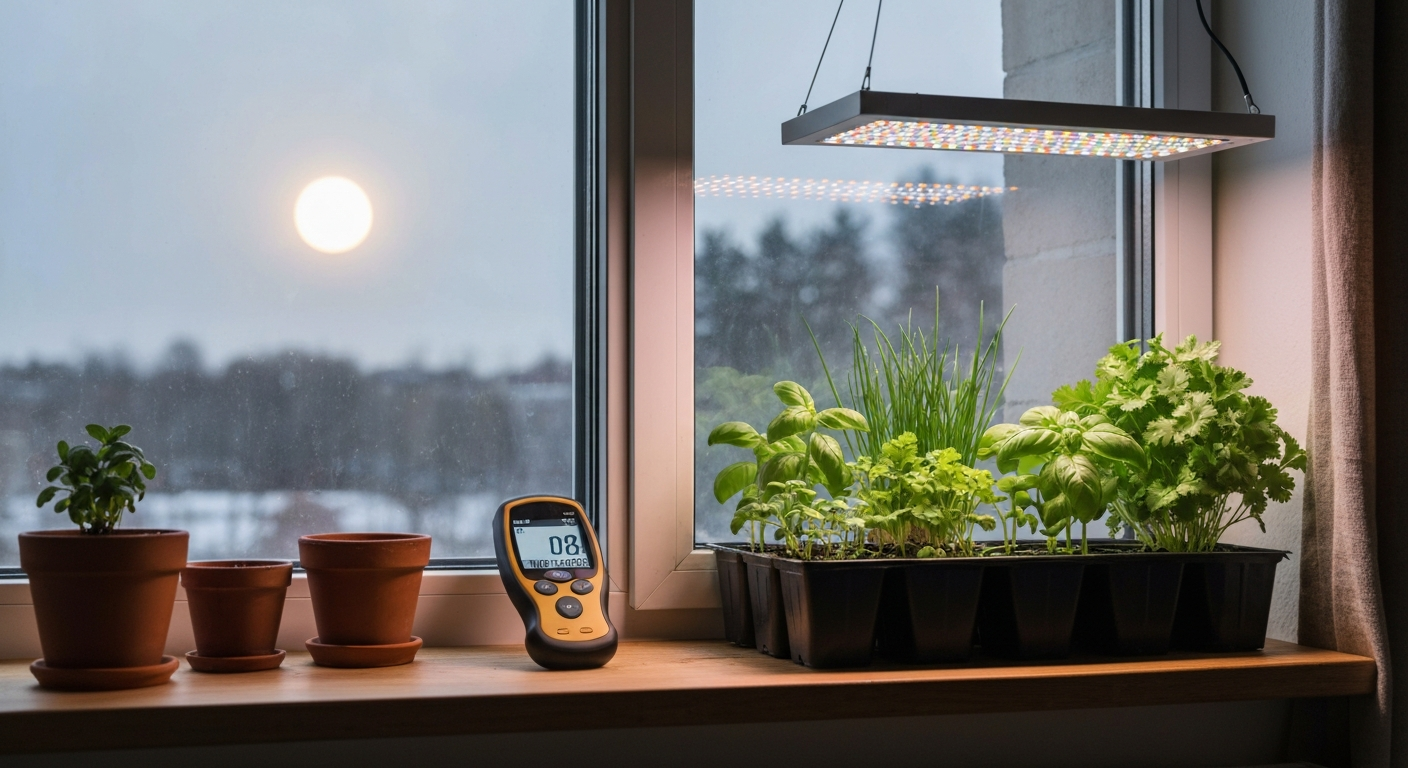
I used to assume my apartment got 'enough' light in winter because I could see perfectly well without turning lamps on. Turns out that is exactly the wrong way to judge it. Human eyes adapt brilliantly to low-light conditions, so a room that looks fine to you might be delivering almost nothing useful to a plant.
Here is what actually happens in winter. The sun tracks much lower across the sky, so even a south-facing window receives far fewer direct hours of light than in summer. On overcast winter mornings, interior illuminance measured in real buildings can sit as low as 30 to 200 lux. Simulation and field studies like Impact of Building Orientation on Daylight Availability and Energy Savings Potential in an Academic Classroom, MDPI Energies show orientation is a primary predictor of winter indoor lux, with north-facing or obstructed windows often delivering stable low diffuse illuminance (often <200 lx inside in winter) Impact of Building Orientation on Daylight Availability and Energy Savings Potential in an Academic Classroom — MDPI Energies. Even at midday on a clear day, you may only break 1,000 lux right at the glass on a south or west window. Step back 60 cm and that number drops fast because light intensity falls roughly with the square of distance from any compact source.
The metric horticulturists actually care about is Daily Light Integral (DLI): the total amount of photosynthetically active light delivered over a full day, measured in moles of photons per square metre per day (mol·m⁻²·d⁻¹). The formula is: DLI = PPFD × photoperiod in hours × 0.0036. PPFD is the light intensity in micromoles per square metre per second. A foliage plant needs at least 3 to 6 mol·m⁻²·d⁻¹ to stay healthy; most herbs and vegetables want more than 10 to 14 mol·m⁻²·d⁻¹. In a typical northern-hemisphere home in January, a north-facing window may deliver a DLI under 1, and even a decent south window often struggles past 3 to 5 on overcast days.
Do you actually need a grow light? A quick way to decide
Not every plant and every situation calls for one. Run through these questions and the answer becomes pretty clear. For a deeper guide on deciding setup and timing, see when to use grow lights indoors. For a quick checklist and more guidance on when to use grow light, see this resource.
- What are you growing? Seedlings, herbs (basil, cilantro, chives), leafy greens, or fruiting crops? These all need more light than a pothos or snake plant. If yes, add a grow light.
- Which direction does your window face? North-facing windows in winter consistently produce indoor light levels under 200 lux. East and west windows are better but still borderline. South-facing windows in a clear-sky climate can work for low-light plants placed right at the glass.
- Is anything obstructing the window? Trees, overhangs, a neighbouring building? Even a south window with obstructions may deliver less usable light than an unobstructed east window.
- Where are your plants sitting? More than 60 to 90 cm from the glass and you are in serious deficit territory for most plants, regardless of window direction.
- Are you seeing symptoms? Leggy, pale new growth, leaves reaching toward the window, slow or stalled growth, and dropping lower leaves are all signs your plant is light-starved.
If you ticked two or more of those boxes, a grow light will help. If your south window is clear, your plants are sitting right at the glass, and they are low-light species like pothos, ZZ plant, or cast iron plant, you can probably skip it and just keep the plants close to the glass through winter.
Measuring the light your windows actually deliver
You do not have to guess. A quantum PAR meter gives you a direct PPFD reading in µmol·m⁻²·s⁻¹, which is the number you need to match to a plant's requirements. Decent handheld PAR meters start around $50 to $80 for hobbyist models. If you want to spend nothing, a free lux-meter app on a smartphone (search 'lux meter' in your app store) gives a rough indication, though phone sensors are not calibrated for horticultural precision.
Converting lux to PPFD is not perfectly precise because it depends on the light source's spectrum. For natural daylight and white broad-spectrum sources, a practical approximation is to multiply lux by 0.0185 to get PPFD. So 500 lux from a window works out to roughly 9 µmol·m⁻²·s⁻¹, which is very low. For narrow-band or coloured LEDs this conversion breaks down, so use a PAR meter when precision matters.
| Reading at plant location | Approximate PPFD | What it means |
|---|---|---|
| Under 200 lux | Under ~4 µmol·m⁻²·s⁻¹ | Critically low for almost any plant, grow light strongly recommended |
| 200–500 lux | ~4–9 µmol·m⁻²·s⁻¹ | Marginal for low-light houseplants only, grow light recommended for anything else |
| 500–2,700 lux | ~9–50 µmol·m⁻²·s⁻¹ | Low-light houseplants may manage; medium and high-light plants still deficient |
| 2,700–13,500 lux (~250–1,000 fc) | ~50–250 µmol·m⁻²·s⁻¹ | Acceptable for medium-light houseplants near glass; insufficient for herbs and seedlings |
| Above 13,500 lux (1,000+ fc) | 250+ µmol·m⁻²·s⁻¹ | Adequate for high-light houseplants; herbs and seedlings may still benefit from supplemental light |
University extension guidance uses these approximate thresholds: low-light plants need roughly 50 to 150 µmol·m⁻²·s⁻¹, medium-light plants want 150 to 250 µmol·m⁻²·s⁻¹, and high-light plants need 250 to 450+ µmol·m⁻²·s⁻¹. If your window reading falls below your plant's category, you need supplemental light.
What different plants actually need in winter
This is where it gets specific. I find it helpful to group plants by how demanding they are, so you can decide whether your existing window situation is salvageable or whether a light is a must.
Low-light houseplants
Plants like pothos, snake plant, ZZ plant, peace lily, and heartleaf philodendron tolerate DLIs of 3 to 6 mol·m⁻²·d⁻¹. A clear south or west window with the plant right at the glass can sometimes keep these alive and slowly growing through winter without a grow light. If they are in a darker spot or you notice stalled growth and pale leaves, a low-intensity LED running 12 to 14 hours a day will fix things quickly.
Medium to high-light houseplants
Monsteras, fiddle-leaf figs, most succulents, cacti, and citrus all want significantly more light than a typical winter window delivers. Succulents and cacti especially tend to etiolate (stretch and go pale) without strong light. These plants benefit from a grow light from roughly October through March in most of the northern hemisphere.
Culinary herbs
Basil is the most demanding common herb, with an optimal DLI of around 12 to 13 mol·m⁻²·d⁻¹. To hit that from a grow light at say 200 µmol·m⁻²·s⁻¹ you need about 16 hours of light per day. Parsley, cilantro, and mint are a bit more forgiving but still want 10 to 12 mol·m⁻²·d⁻¹. Chives are the most tolerant of the common culinary herbs. Without a grow light, windowsill herbs in winter typically become thin, floppy, and flavourless within a few weeks.
Seedlings and transplants
Seedlings are non-negotiable. They need 100 to 400 µmol·m⁻²·s⁻¹ at the canopy for 16 to 18 hours a day. No window in winter will do this. I learned this the hard way trying to start tomatoes on a windowsill: they came up pale, stretched toward the glass, and were so leggy they fell over before I even got to transplanting. A grow light set close to the seedling tray from the moment of germination is the standard approach for indoor seed starting in winter.
Winter vegetables: lettuce, spinach, microgreens
Lettuce production commonly targets a DLI of around 14 mol·m⁻²·d⁻¹, often achieved with 200 to 300 µmol·m⁻²·s⁻¹ for 14 to 16 hours. Spinach is slightly more tolerant. Microgreens are often grown at 14 to 16 hours of moderate light (100 to 250 µmol·m⁻²·s⁻¹) and do very well under grow lights, typically ready to harvest in 7 to 14 days. These crops are essentially impossible to produce at a useful rate in a winter window; a grow light is the whole game here.
Grow light schedules and settings by plant type
These are practical starting points, not rigid rules. The key numbers are daily photoperiod (how many hours the light runs) and PPFD at the canopy (how intense the light is where it hits the leaves). For practical timing advice, see guidance on when to turn on grow lights to set an appropriate daily photoperiod for your plants. Knowing when to turn on your grow lights and how long to run them is something worth dialling in once you have measured your window baseline.
| Plant type | Target PPFD at canopy | Daily photoperiod | Target DLI | Expected outcome with correct settings |
|---|---|---|---|---|
| Low-light houseplants (pothos, ZZ, snake plant) | 50–150 µmol·m⁻²·s⁻¹ | 12–14 hours | 3–6 mol·m⁻²·d⁻¹ | Stable healthy foliage, no etiolation |
| Medium/high-light houseplants (monstera, fiddle-leaf, succulents) | 150–300 µmol·m⁻²·s⁻¹ | 12–16 hours | 7–12 mol·m⁻²·d⁻¹ | Active growth, good colour, no stretching |
| Seedlings (tomatoes, peppers, flowers) | 100–300 µmol·m⁻²·s⁻¹ | 16–18 hours | 6–14 mol·m⁻²·d⁻¹ | Compact, sturdy transplants; no leggy stems |
| Culinary herbs (basil, parsley, cilantro) | 150–250 µmol·m⁻²·s⁻¹ | 14–16 hours | 10–13 mol·m⁻²·d⁻¹ | Dense bushy growth, good flavour and yield |
| Leafy greens (lettuce, spinach, arugula) | 200–300 µmol·m⁻²·s⁻¹ | 14–16 hours | 12–16 mol·m⁻²·d⁻¹ | Harvestable leaves in 3–6 weeks |
| Microgreens | 100–250 µmol·m⁻²·s⁻¹ | 14–16 hours | 6–10 mol·m⁻²·d⁻¹ | Ready to harvest in 7–14 days |
One important principle: plants need a dark period. Do not run grow lights 24 hours. The 6 to 8 hours of darkness that comes with a 16 to 18 hour photoperiod is part of normal plant physiology, supporting respiration and in many species triggering hormonal processes. Running lights around the clock can actually stress plants rather than help them.
If your plants also get meaningful window light during the day, you can subtract those hours from the grow light schedule or reduce the intensity. For example, if a plant near an east window gets two to three hours of decent morning sun, running a grow light for 10 to 12 hours rather than 14 to 16 is often enough to hit the DLI target.
Setting up your grow light the right way
Fixture types and what to buy
For most home situations, an LED panel or LED bar fixture is the right call (more on why in the comparison section below). For a single shelf of seedlings or herbs, a two-bulb T5 fluorescent strip or a T8 LED tube strip works fine and costs very little to run. For a larger setup or for growing light-hungry vegetables, a dedicated LED grow panel with a PPFD map from the manufacturer gives you real data to work with rather than guesswork.
Mounting distance and why it matters
Light intensity falls off quickly with distance. This is why mounting height matters so much and why the manufacturer's PPFD map (sometimes called a footprint chart or LM-79 report) is the most useful document they can give you. Virginia Tech Extension's Calculating and Using Daily Light Integral (DLI), Virginia Tech Extension (notes on distance/PPFD) recommends using the manufacturer's PPFD map and measuring PPFD at the canopy with a quantum sensor, and notes that intensity falls rapidly with distance for compact fixtures blank" rel="noopener noreferrer">Calculating and Using Daily Light Integral (DLI) — Virginia Tech Extension (notes on distance/PPFD). A fixture might deliver 300 µmol·m⁻²·s⁻¹ at 30 cm but only 100 µmol·m⁻²·s⁻¹ at 60 cm. Always check the PPFD at the mounting distance you plan to use, not the peak number plastered on the marketing copy.
As a rough starting guide for home setups: seedlings and low-light plants under a compact LED panel typically do well at 30 to 45 cm above the canopy. Medium-light plants can sit 30 to 60 cm from the fixture. High-intensity fixtures (those designed for fruiting crops) often want 45 to 90 cm of clearance. When in doubt, start higher and move the light closer gradually while watching for bleaching or leaf curl.
Raising the light as plants grow
This is the one thing beginners consistently forget. Once you set a grow light at the right height, it is right for that day. As seedlings stretch upward over the following weeks, the canopy moves closer to the fixture, intensity increases, and you risk light burn (bleached, whitened leaf tips or centres). Check the distance once a week and raise the fixture to maintain your target PPFD. See when to raise grow lights for guidance on timing and signs that it's time to lift the fixture. Adjustable ratchet hangers or a simple adjustable rope clip make this trivial; fixed mounting is something you will regret.
Timers and placement
Use a mechanical or digital outlet timer. This is genuinely non-optional: no one can manually turn a light on and off at 5am and 9pm every day reliably. A basic mechanical timer costs $8 to $12 and will pay for itself in plant health within the first week. Set the light to run during daytime hours when possible, since this aligns with natural plant rhythms and avoids annoying bright light at night. For seedlings under supplemental light only, timing matters less as long as the dark period is consistent.
On safety: use a UL or ETL-listed fixture. If your setup is near a humidifier or above a plant tray that gets splashed, choose a fixture with an IP44 or IP65 rating. Use properly rated extension cords (not thin lamp cords) and use a GFCI outlet or adapter anywhere near water. These are basic precautions, but I have seen people overlook them completely.
What does it cost to run?
Running costs are lower than most people expect. A 40-watt LED running 16 hours a day uses 0.64 kWh per day, about 19.2 kWh per month. At the current U.S. average residential electricity rate of roughly $0.188 per kWh (as of early 2026), that is about $3.61 per month. A larger 100-watt fixture on the same schedule costs around $9 per month. That is pretty reasonable for a full winter of fresh herbs or a tray of seedlings. Calculate your own: watts ÷ 1,000 × daily hours × days × your local $/kWh.
Which grow light type should you choose?
The market has narrowed considerably. For home indoor growing in winter, LEDs are the default choice for almost everyone. For guidance on choosing and timing LEDs, see when to use LED grow lights. Here is how they stack up against the older options.
| Light type | Efficacy (µmol/J) | Heat output | Lifespan | Upfront cost | Best for |
|---|---|---|---|---|---|
| Modern horticultural LED | 2.5–4.0+ | Low | 50,000+ hours | Moderate to high | All home growing scenarios; best long-term value |
| T5/T8 fluorescent tubes | 1.0–1.5 | Moderate | 10,000–20,000 hours | Low | Seedlings and low-light plants on a tight budget |
| CFL (compact fluorescent) | 0.9–1.3 | Moderate | 8,000–15,000 hours | Very low | Very small-scale or supplemental spot lighting only |
| HID / HPS (high-pressure sodium) | 1.6–2.1 | Very high | 10,000–24,000 hours | Moderate | Larger dedicated grow rooms; overkill for home windowsills |
| T5 LED replacement tubes | 1.8–2.5 | Low | 30,000–50,000 hours | Low to moderate | Seedling shelves and herb stations; good budget option |
Modern horticultural LEDs now routinely achieve efficacies above 2.5 µmol per joule, with the best commercial fixtures reaching 3.0 to 4.0 µmol per joule. Compare that to HPS at 1.6 to 2.1 and fluorescents at 1.0 to 1.5, and it becomes clear that LEDs deliver substantially more light per watt of electricity. They also run cool enough to mount closer to plants without heat stress, last far longer, and do not require ballast replacements.
The one scenario where fluorescent tubes still make sense is a shoestring-budget seedling shelf. A two-tube T5 HO strip light costs very little and produces perfectly usable light for starting seeds, as long as you hang it just 5 to 10 cm above the seedling tray. If you are setting up something more permanent, buying LEDs from the start is better economics over a two-to-three year horizon.
Avoid blurple (red/blue only) cheap LED panels for general home use. They work biologically but the pink/purple light makes it very hard to visually assess plant health, and modern full-spectrum white LEDs outperform them in most practical tests. Spend a little more for a full-spectrum fixture with a published PPFD chart.
Troubleshooting common winter grow-light problems
Leggy, stretching growth
If your seedlings or herbs are stretching toward the light with long gaps between leaves, the light is either too far away, running too few hours, or both. Move the fixture closer (measure the PPFD if you can) and bump the photoperiod up by two hours. If you are already at 16 to 18 hours for seedlings, the problem is intensity, not duration.
Bleached or burned leaf tips
Whitened leaf centres or bleached tips mean the light is too intense at the canopy, too close to the fixture, or both. Raise the fixture by 10 to 15 cm and see if new growth comes in normally. Also check if the plant has grown into the fixture since you last adjusted.
Slow or no growth even with the light on
First check that the timer is actually working and the light is running the hours you set. Then verify your PPFD at the canopy with an app or meter. Also consider temperature: many plants stall below 15°C regardless of light. Check that the roots are not waterlogged, since overwatering is often blamed on light when water is the real culprit.
Yellowing lower leaves
Lower leaves yellowing while upper growth looks fine is often a natural leaf senescence response accelerated by low light reaching the lower canopy. Improve light penetration by raising the intensity slightly or adding a side reflector, and remove yellowed leaves to keep the plant tidy and reduce disease risk.
FAQ
Should I use a grow light in the winter?
Short answer: Maybe — use a grow light if your plants aren’t getting the light they need indoors. If natural winter light in your plant’s location provides the species’ required Daily Light Integral (DLI) or adequate midday PPFD, you can often skip or minimize supplements. If winter DLI/PPFD is below the crop or species target (see criteria below) you’ll see slow growth, legginess or poor flowering and should add supplemental light.
How do I know whether winter daylight is sufficient for my plants?
Measure or estimate light and compare to species targets: 1) Use a PAR/quantum meter to read PPFD (µmol·m⁻²·s⁻¹) at canopy during the brightest part of day and estimate DLI (PPFD × hours of effective daylight × 0.0036). 2) If you don’t have a meter, use a lux meter and convert approximately depending on fixture/spectrum (sun ≈0.018–0.019 µmol·s⁻¹ per lux; many white LEDs ≈0.013–0.017) — be cautious of error. 3) Rule‑of‑thumb thresholds: DLI <3–6 mol·m⁻²·d⁻¹ is low for most foliage plants; many flowering/fruiting crops need >10–14 mol·m⁻²·d⁻¹. If measured/estimated winter DLI is below your plant’s target, add supplemental lighting.
Simple decision flow: When should I install a grow light this winter?
Decision flow (quick): 1) Identify plant type and DLI/PPFD need (seedlings>herbs>leafy greens>flowering crops). 2) Measure/estimate available winter light at canopy. 3) If available DLI/PPFD meets or is near target, no extra light or only short supplemental periods. 4) If available light is insufficient, choose a fixture and set photoperiod and intensity to supply the missing DLI. 5) Monitor plant response and adjust. If in doubt or growing seedlings/herbs/produce, err to adding controlled supplemental LED light.
What daily hours (photoperiod) and intensity (PPFD or footcandles) should I use?
General targets: - Foliage houseplants: 50–150 µmol·m⁻²·s⁻¹ (≈50–250 fc) for 10–14 h, depending on species. - Seedlings/young transplants: 100–400 µmol·m⁻²·s⁻¹ for 16–18 h. - Herbs/leafy greens (production): aim for DLI ~10–15 mol·m⁻²·d⁻¹ (e.g., 200–300 µmol·m⁻²·s⁻¹ for 16 h ≈11.5–17.3 DLI). - Flowering/fruiting crops: often >400 µmol·m⁻²·s⁻¹ during key stages, depending on crop. Use photoperiod recommendations (seedlings 16–18 h; microgreens 14–16 h; foliage plants 12–14 h) and calculate DLI = PPFD × hours × 0.0036 to hit species targets.
How do I choose mounting distance and adjust as plants grow?
Mount by using the fixture’s PPFD map or manufacturer LM‑79/PPFD report. If unavailable, start with manufacturer suggested distances and measure PPFD at canopy. Remember intensity falls quickly with distance (approx. inverse‑square for compact sources). Mount low enough to reach target PPFD but high enough to avoid hot spots and leaf burn. Raise lights gradually as plants get closer: check PPFD after each move and maintain roughly the same canopy PPFD target.
Which light type is best for winter indoor supplemental lighting?
LEDs are generally the best choice for most home gardeners: high electrical efficacy (less kWh per mole), long life, low heat output, and selectable spectra. Use full‑spectrum or white horticultural LEDs for general plant growth; narrow‑band colored LEDs are useful but require more care. Fluorescent (T5) can still be fine for small setups and seedlings; HPS/CMH are typically overkill for household uses due to heat and inefficiency. Always prefer fixtures with published photon output (PPF/PPFD maps) and safety listings (UL/ETL).
Next Articles
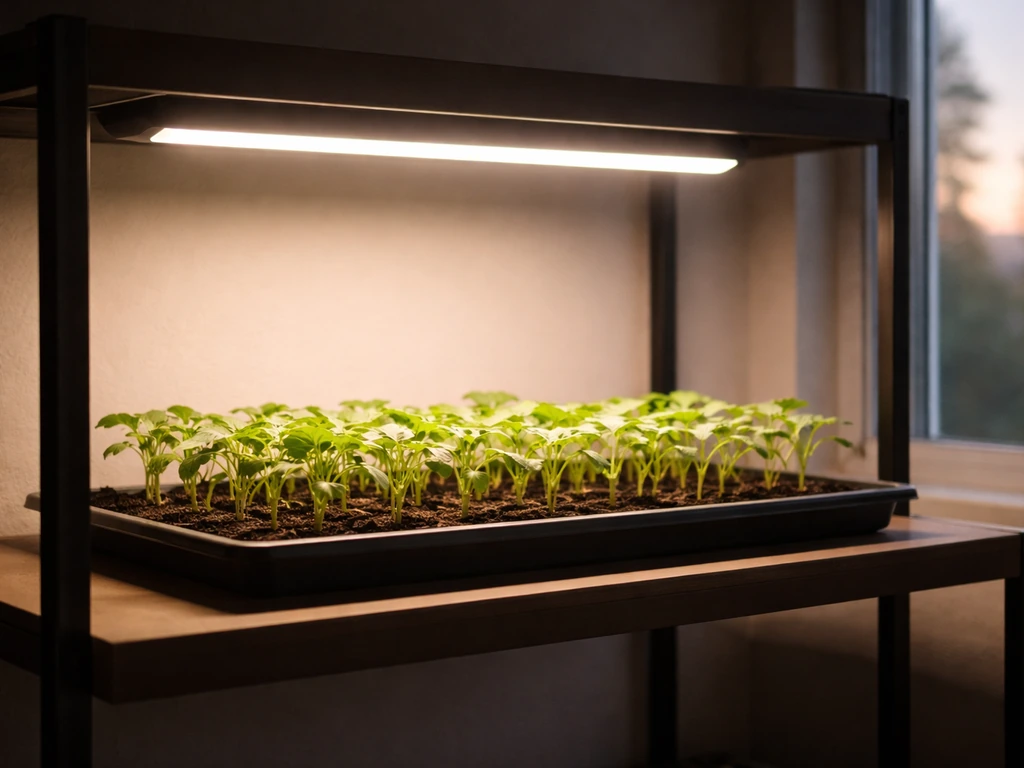
When to Turn On Grow Lights and When to Turn Off
Learn when to turn on and off grow lights by plant stage, with schedules and fixes for distance, intensity, and timing.
When to Use Grow Light: Signs, Timing, and Setup Tips
Learn when to use grow lights indoors, spot light-stress signs, and set timing, placement, and distance for healthier gr
When to Turn On Grow Lights for Indoor Plants: A Guide
Clear schedule for when to turn on grow lights, by plant, light type, season, distance, and troubleshooting signs indoor