
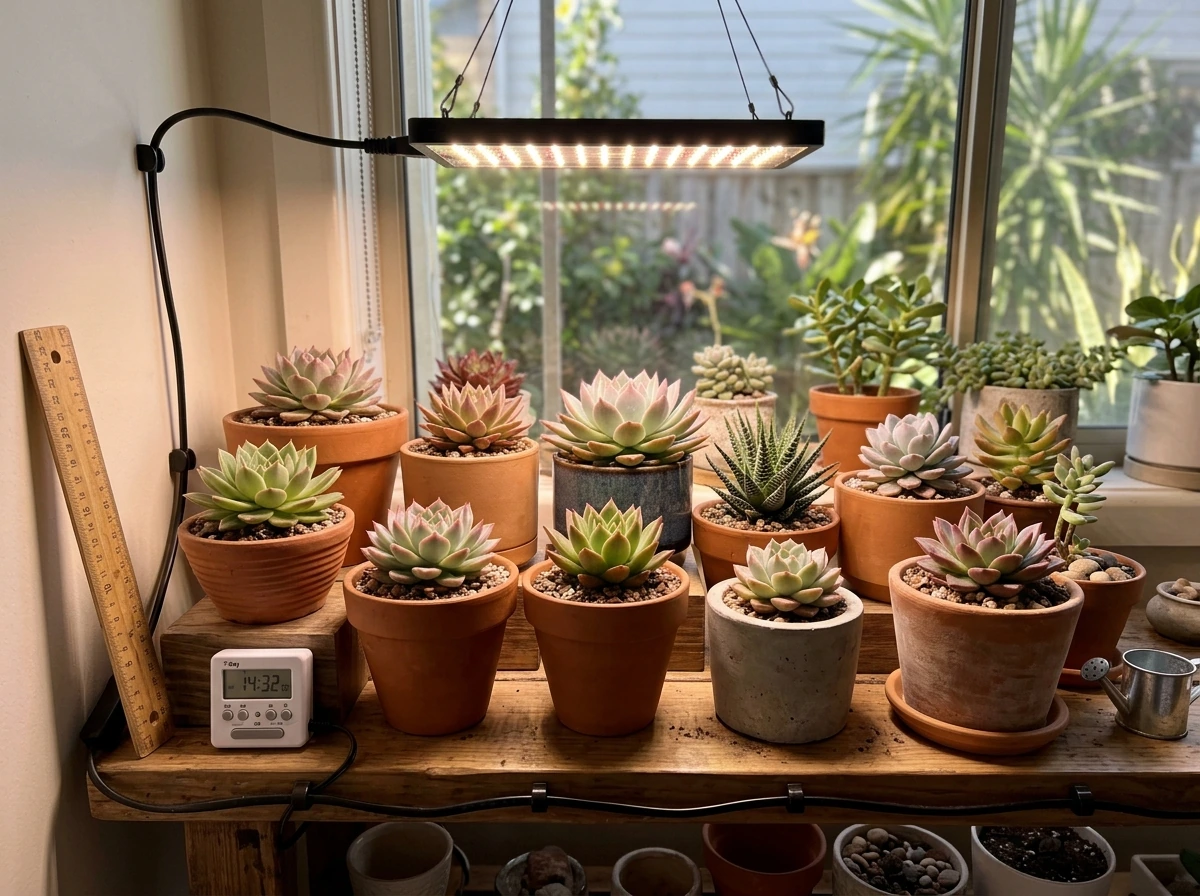
For most indoor succulents under grow lights, running the lights for running the lights for 12 to 14 hours per day is the right starting point. is the right starting point. That range comes from university extension recommendations and lines up with what I've found works in practice. It gives succulents enough light to grow compactly and stay colorful without crossing into overexposure territory. If you want a single number to plug into your timer today, start with 12 hours on and 12 hours off, then adjust from there based on how your plants respond.
How Long to Leave Grow Lights On Succulents Daily
Marcus Holloway
24 Mar 2026
Your daily grow light schedule for succulents
Twelve hours is a solid default because it mirrors a natural day length that sits comfortably between too little and too much. Fourteen hours is better when you're dealing with a weaker light source, a fixture positioned farther away, or succulents that are pushing out new growth and need more fuel. I'd keep the absolute ceiling at 16 hours, and honestly I rarely go above 14 even for hungry growers.
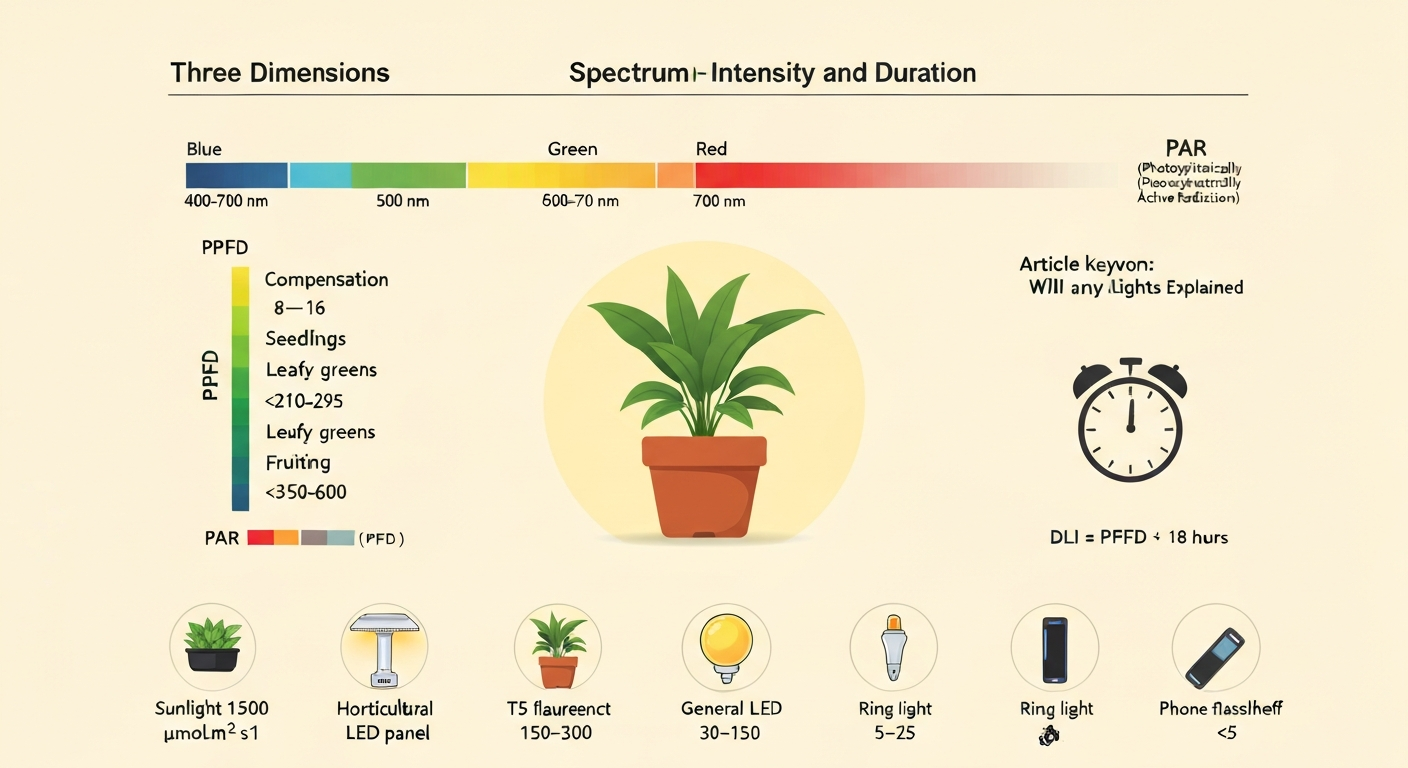
The number of hours matters, but it's really a proxy for something more important: the total amount of light your plant gets in a day, which scientists call the Daily Light Integral, or DLI. Think of DLI like a daily water budget for your plant, except instead of water it's photons. You can fill that budget slowly over more hours with a dim light, or quickly over fewer hours with a bright one. The goal is hitting the right daily dose, not just hitting a specific clock time.
Succulents generally want a moderate-to-high DLI compared to low-light houseplants like pothos or snake plants. A reasonable indoor target is somewhere between 12 and 20 mol/m²/day. Virginia Cooperative Extension and Virginia Tech also illustrate DLI-based supplemental lighting with an example where lights ran for about 11 hours per day to reach a desired DLI target of roughly 15 mol·m⁻²·d⁻¹ blank" rel="noopener noreferrer">an example where supplemental lighting operated for about 11 hours/day to reach a desired DLI target. If your fixture is a low-powered clip-on LED sitting 12 inches away, you'll likely need the full 14 hours to get there. If you have a higher-output panel-style light at the same distance, 12 hours might be more than enough.
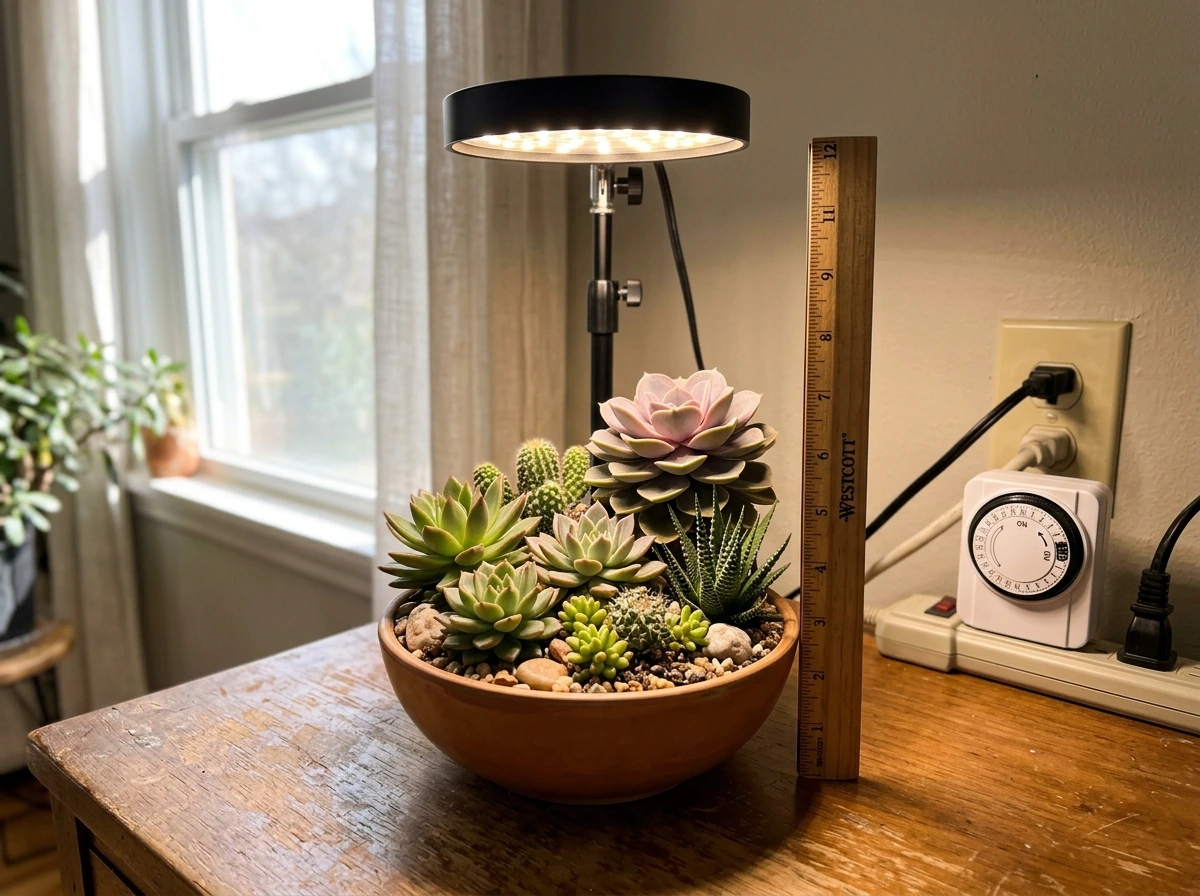
Set your timer before you even put the plants under the light. I've made the mistake of manually switching lights on and off and gradually drifting toward inconsistent schedules. Succulents, like most plants, respond better to a consistent rhythm. An inconsistent photoperiod can slow growth and cause confusion in flowering cycles. A basic outlet timer costs a few dollars and removes all the guesswork.
How light distance and intensity change the equation
Distance is one of the most underestimated variables in indoor growing. Moving a grow light just a few inches closer to your succulents dramatically increases the light intensity hitting the leaves. Moving it farther away does the opposite. This matters because it means you have two ways to increase your plants' daily light dose: run the light longer, or move it closer. Both work, but they come with different tradeoffs.
One important caveat about moving lights closer: the closer the fixture, the smaller the footprint of usable light it throws. A light hung at 18 inches might cover a shelf 3 feet wide, but drop it to 8 inches and you might only be hitting the plants directly underneath. So if you lower your light to increase intensity, check that all your succulents are still getting even coverage. The ones at the edges can end up stretching toward the center if they're not getting the same intensity.
A general starting point for most LED grow lights with succulents is 12 to 18 inches between the fixture and the tops of the plants. Closer to 12 inches for low-output lights, closer to 18 for higher-output panels. Compact fluorescent (CFL) bulbs can go as close as 6 inches without heat risk, but full-spectrum LEDs at that distance from a powerful fixture can cause bleaching or scorching. Start at a conservative distance, watch your plants for a week, and adjust from there.
| Light Type | Recommended Distance | Suggested Daily Runtime | Notes |
|---|---|---|---|
| Low-output LED panel or clip-on | 6–12 inches | 13–14 hours | May need longer hours to compensate for lower intensity |
| Mid-range full-spectrum LED bar | 12–18 inches | 12–13 hours | Good all-around option for most succulent setups |
| High-output LED grow panel | 18–24 inches | 10–12 hours | Reduce hours if leaves bleach or show stress |
| Compact fluorescent (CFL) | 4–8 inches | 14–16 hours | Lower heat risk; weaker intensity requires more time |
| T5 fluorescent tube | 6–12 inches | 13–14 hours | Even light spread; works well for shelves |
Adjusting for seasons, natural light, and growth stage
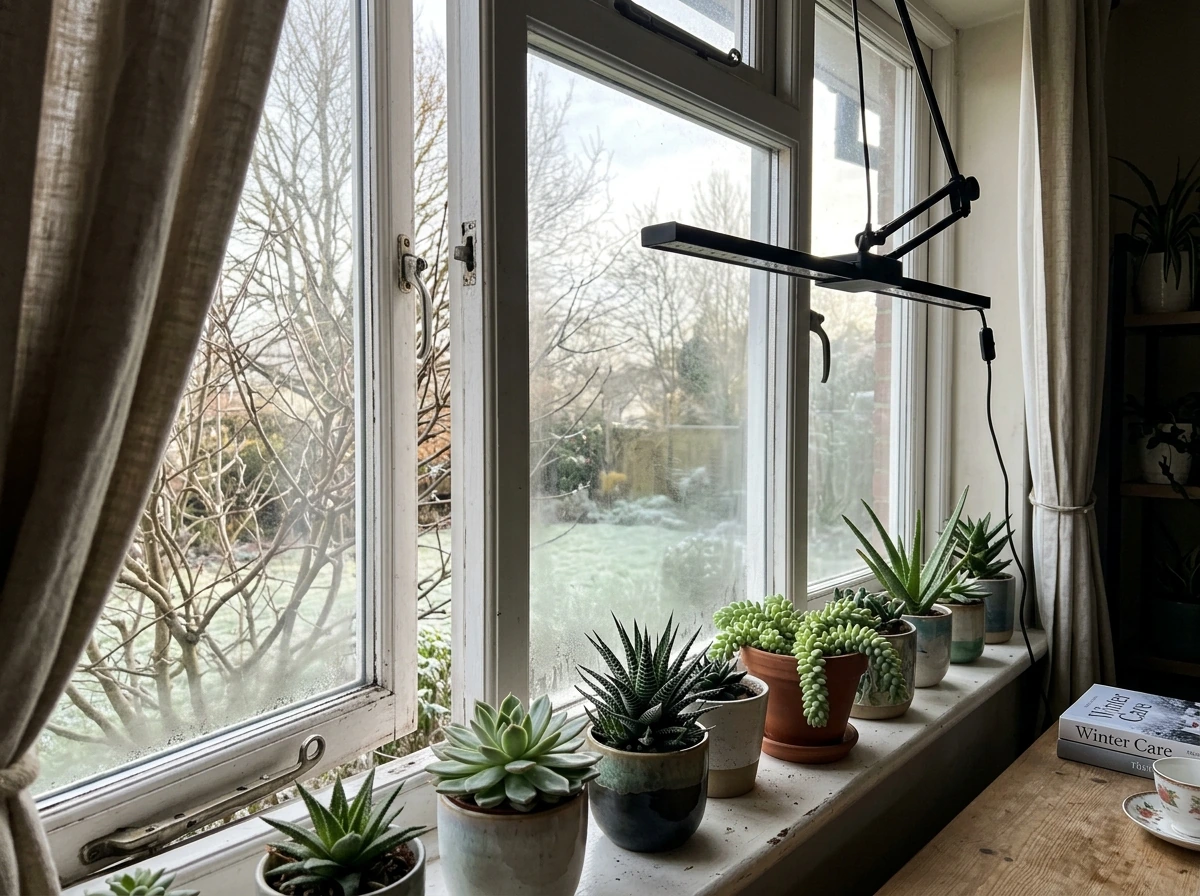
If your succulents sit near a window, the amount of natural light they get changes significantly between summer and winter. In summer, a south- or west-facing window might already be contributing several hours of decent light before the grow light even turns on. In winter, that same window might give almost nothing useful on cloudy days. This means you can't just set your timer once and forget it all year.
In winter, when days are short and ambient light is weak, I lean toward the higher end of the range, closer to 14 hours, so if you're wondering how long to leave grow lights on in winter, start there and then adjust based on what your plants do.
If you want a quick baseline for your setup, you can also use the standard runtime ranges for succulents and then fine-tune from there how long should grow lights be on. You can also compensate by moving the light a little closer rather than running it longer. Either approach increases the daily light dose. The key is to adjust deliberately rather than randomly.
When daylight hours shift in fall or spring, change your timer by an hour or two at a time rather than jumping from 12 to 16 hours overnight.
Growth stage also matters. Succulents that are actively pushing out new rosettes or being coaxed out of dormancy benefit from being on the higher end of the runtime range. A plant sitting in a stable, established state doesn't need as much pushing. For newly propagated leaves or pups, I give them a bit more light duration early on to encourage root development, but I'm careful not to blast them with full intensity right away.
Speaking of new plants: if you're moving a succulent from low-light conditions (like a dim corner) to a grow light setup, don't go straight to 12 or 14 hours at full intensity. Give the plant an acclimation window of about 2 to 4 weeks. Start with 6 to 8 hours a day at a conservative distance, then gradually increase the duration and move the light closer over a few weeks. This prevents the kind of sudden light shock that causes bleaching, which can look alarming and is very avoidable.
What your succulents are telling you
Your plants will give you clear signals if the light schedule isn't right. Learning to read those signals is more reliable than any timer setting, because every setup is different. Here's what to look for and what it means.
Signs your succulents need more light
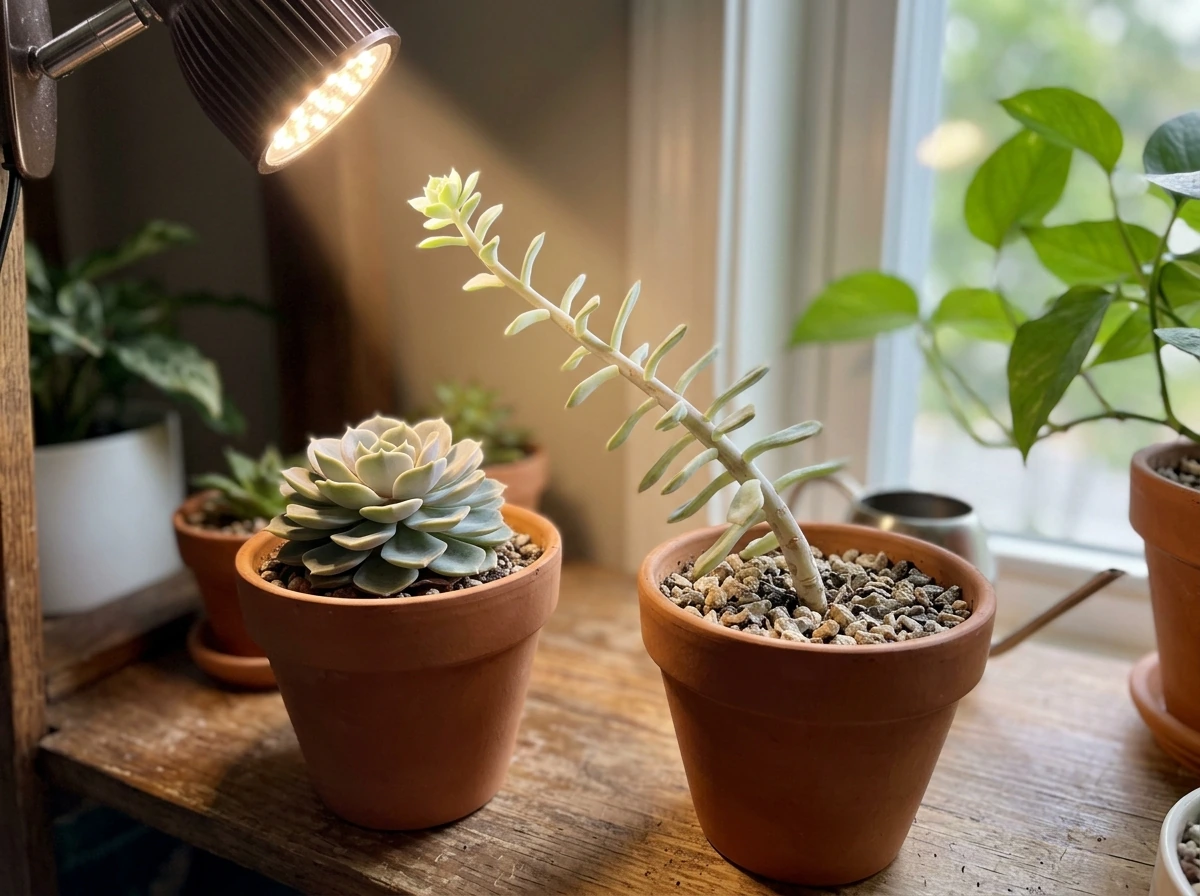
- Etiolation (stretching): the stem elongates and the leaves spread farther apart than normal, with the plant literally reaching toward the light. This is the clearest sign of light deficiency.
- Pale or washed-out color: succulents that normally show deep greens, purples, or reds start looking faded or dull yellow-green.
- Weak, floppy growth: new leaves that feel thin or soft rather than firm and plump.
- Slow or stalled growth: even during what should be a growing period, the plant just sits there.
When you see stretching starting, act quickly. The fix is more light, and the fastest way to deliver it is to move the fixture closer rather than immediately adding hours, since proximity increases intensity. If the stretch has already happened, that stem shape is permanent, but you can stop further stretching right away.
Signs your succulents are getting too much light
- Bleaching or whitening: leaves lose pigment and turn pale white or yellow, especially in the center of the rosette closest to the light.
- Brown, crispy patches: actual tissue damage (sunburn/scorch) on the top surface of leaves, often appearing as dry brown spots.
- Curling or cupping leaves: the plant is trying to reduce its exposed surface area.
- Shriveling despite adequate watering: light stress can cause dehydration symptoms even when the soil isn't dry.
If you see bleaching without actual brown dead tissue, it's usually reversible. Back off the intensity or reduce hours by a couple, and the coloring often recovers once the plant is under appropriate light. Brown scorched tissue won't heal, but the plant will grow new healthy leaves if you correct the setup. The moment you see either symptom, reduce light duration or raise the fixture, don't wait to see if the plant 'adjusts.'
Setup mistakes that mess with your schedule
I've made most of these mistakes myself, so consider this a shortcut past the trial-and-error phase.
- Skipping the timer entirely: manually switching lights on and off leads to drift. Some days 10 hours, some days 15. Plants respond better to consistency. Buy a timer on day one.
- Setting the timer and never revisiting it: your setup in July is not the same as your setup in January if there's any natural light involved. Revisit your schedule at least once each season.
- Relying on hours alone without thinking about intensity: 14 hours under a dim bulb from 24 inches away might deliver less usable light than 10 hours under a strong panel at 12 inches. Time is only one half of the equation.
- Placing the light too far away to avoid heat, then compensating with extra hours: this is a common overcorrection. If heat is a concern, get a light that runs cooler rather than backing off to a distance where intensity is inadequate.
- Uneven coverage: one plant under the center of the light thrives while the plants on the edges stretch. If you see inconsistent growth across a group of succulents, it's almost always a coverage issue. Move the plants around regularly or raise the light to widen the spread.
- Forgetting that reflective surfaces matter: a white or foil-lined shelf bounces light back onto the plants and effectively increases their light exposure. A dark shelf absorbs it. This can mean plants on different shelves need different runtimes even under identical fixtures.
- Running lights 24 hours thinking more is always better: succulents need a dark period. Running lights around the clock doesn't speed up growth and can actually disrupt the plant's metabolic rhythm. Stick to a max of 16 hours with at least 8 hours of darkness.
Keeping it safe: eyes, skin, UV, and heat
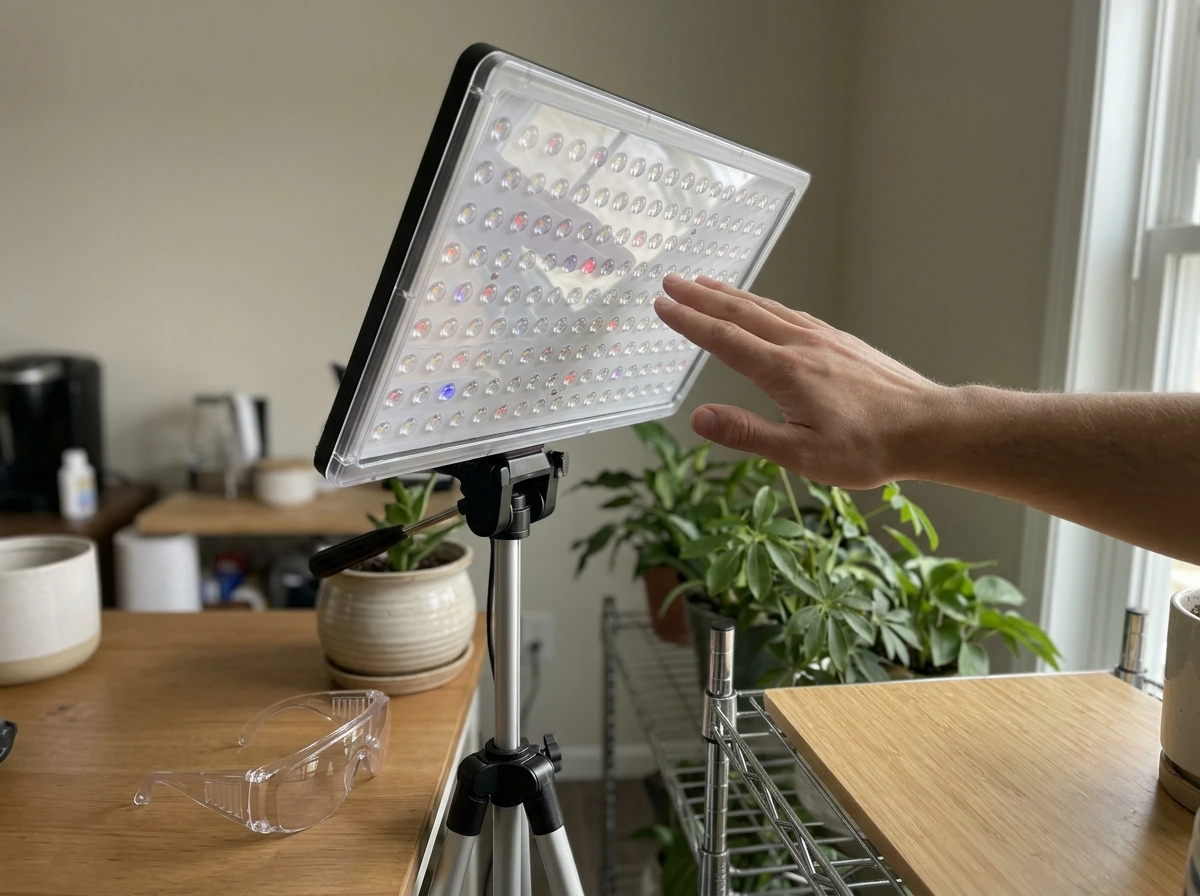
Grow lights designed for plants are not the same as tanning beds, and using them indoors for succulents isn't going to give you a tan or pose a UV radiation health risk under normal home use. Most consumer LED grow lights emit very little UV-A and essentially no UV-B. That said, it's still worth being sensible about a few things.
Looking directly into a high-intensity LED panel is uncomfortable and can cause temporary visual disturbance, similar to looking at any very bright light source. If you're working around your grow lights regularly, especially with high-output fixtures, wearing basic protective eyewear is a reasonable precaution. You don't need specialized gear for a small succulent shelf, but for a larger setup with powerful panels, it's worth the investment. Don't make a habit of staring directly at the light when checking on your plants.
Heat is the more practical concern for most home setups. LED grow lights run much cooler than older HID or incandescent setups, but they still generate some warmth, especially when mounted close to plants in an enclosed space like a cabinet or shelf unit. Make sure there's airflow around the fixture. If you're growing in a closed shelf, a small fan helps prevent heat buildup that can dry out leaves and soil faster than expected, which gets misread as a watering problem.
For electrical safety, plug your grow light and timer into a GFCI-protected outlet, especially if there's any chance of moisture nearby, like misting your plants or spilling water during watering. Most modern outlet timers plug directly into the wall and the light plugs into the timer, so the whole chain should run through a GFCI outlet. This is standard good practice for any electrical device near water, not something specific to grow lights.
Finally, don't position a bright grow light where it shines into a living area as unwanted glare during evening hours. Aside from being annoying, bright light in your field of vision in the evening can interfere with your own sleep cycle. Use a timer that turns the light off before you settle in for the night, or position the setup so the direct glare is not visible from where you sit or sleep.
Your next steps right now
Here's the short version of everything above turned into action. Set your timer for 12 hours on, 12 hours off to start. Position your light at 12 to 18 inches from the plant tops, depending on your fixture type. Check your plants after the first week for any stretching (needs more light) or bleaching/curling (needs less).
If you notice stretching, move the light 2 to 3 inches closer before adding more hours. If you see bleaching, raise the light or reduce the runtime by an hour or two. Revisit the timer setting with each change of season if your plants are near a window. And get a timer if you don't already have one.
That single step will do more for your succulents than any other adjustment you make.
For more on how runtime guidelines apply across different plant types, it's worth looking at how the 12-to-14-hour framework shifts for For more on how runtime guidelines apply across different plant types, it's worth looking at how the 12-to-14-hour framework shifts for vegetables or for general indoor plants, since the same DLI-based logic applies but the targets change. or for general indoor plants, since the same DLI-based logic applies but the targets change. Succulents sit on the higher end of the light-need spectrum compared to most foliage houseplants, so the schedules you'd use for a low-light plant won't serve them as well.
FAQ
Should I run grow lights on succulents 12 to 14 hours straight, or can I split it into two sessions during the day?
For succulents, it is usually better to keep a single consistent block of light rather than splitting it. If you do split it, keep the total within your 12 to 14 hour target and avoid long dark gaps that create irregular rhythms. If you notice stretching or color loss, switch back to one steady photoperiod.
Do succulents need a completely dark period, or is some ambient light okay during the off hours?
Some ambient room or window light during the off period is fine, it does not typically harm succulents. The key is avoiding very inconsistent darkness, because changing the day-night pattern can confuse growth response. Use your timer to ensure your grow light itself truly turns off on schedule.
What should I do if my timer can only handle one on/off time and my household schedule changes?
Use the most stable schedule you can and adjust gradually when needed. If you must shift the time, move it by about 30 to 60 minutes per adjustment day or two, rather than jumping several hours. This reduces stress and makes it easier to tell whether changes are coming from lighting or routine changes.
How do I tell whether I need more hours versus moving the light closer?
Start with movement first when you see stretching, because increasing intensity by lowering distance is the fastest lever. Use hours adjustments more cautiously, especially if your light is already close to the top of the plant. If you adjust distance, re-check coverage at the edges, then fine-tune runtime by about 1 to 2 hours.
Can I use a very strong LED at a short distance, like 6 inches, without damaging my succulents?
Sometimes, but it is higher risk. The closer you go, the more likely you are to get bleaching or scorching, and the light footprint shrinks, leaving edge plants underlit. Start conservatively around the recommended distance for your fixture type, then inch closer while watching leaf color and any curling.
If my succulent is growing, but it is still stretching, should I immediately increase the light time?
Not necessarily. Stretching usually means the daily light intensity is still too low at the leaf level, so check distance and overlap first. Often a small move closer (a couple inches) fixes the issue before you extend the timer. Also confirm that the plant is actually receiving light from the fixture, not from a gap or shadow.
Do I need to reduce grow light hours if I water more often or if the leaves look soft?
Soft or translucent leaves can be caused by watering issues, not light. Before changing the timer, compare leaf symptoms with light symptoms: stretching generally points to too little light, while bleaching points to too much. If soil stays wet or leaves turn mushy, focus on watering and airflow, not runtime.
How should I adjust grow lights for winter if my succulents are near a window but still get some sun?
Account for the extra natural light rather than assuming winter equals zero light. If you notice the plants look similar to fall, you can stay near the lower part of the range, then adjust upward in steps. If window light is weak on cloudy days, lean toward the higher end and, if needed, move the fixture slightly closer to maintain your daily light dose.
What if only a few plants in a group are stretching, while others look fine?
That usually means uneven coverage rather than an overall runtime problem. Rotate the plants, check whether some are taller and blocking others, and verify the fixture height and beam spread. You may need to lower the light slightly or move the plants so their leaf tops sit within the usable coverage area.
How long should I leave grow lights on newly propagated succulents or rooted cuttings?
Give them an acclimation period instead of starting at your full schedule. Use a shorter day length first (often around 6 to 8 hours) at a conservative distance, then increase over a few weeks. Once you see stable, non-bleached new growth, you can move toward your 12 to 14 hour baseline.
Is it okay to leave grow lights on longer than 16 hours if my succulents are not thriving?
Exceeding about 16 hours is not a good first fix. If they are not thriving after you reach the usual range, the more common causes are insufficient intensity (distance or weak fixture), uneven coverage, poor ventilation, or watering problems. Make one change at a time and cap runtime to avoid triggering bleaching.
Do I need to worry about UV or eye safety when checking on succulents under grow lights?
Most consumer grow lights emit very little UV, so health risk is usually low under normal indoor use. The more practical issue is glare and staring at high-output LEDs, which can cause temporary visual discomfort. If you work near powerful panels, use basic protective eyewear to reduce strain.
Next Articles
Why Do Plants Grow Best in Blue Light? Science & Practical Guide
Explore why blue light boosts vegetative growth, ideal blue:red ratios, PPFD, photoperiods, fixtures, and setup tips.
What Artificial Light Will Grow Plants: Best Lights Guide
What artificial light will grow plants: practical guide to LED, CFL, HID spectra, PPFD targets, setup, cost & tips.
Will Any Light Grow Plants? Guide for Indoor Growers
Can any light grow plants? Clear yes/no, science-backed light specs, setup tips, and which household lights work.