In winter, most indoor plants need grow lights on for 12 to 16 hours per day. That's the honest starting point. But the exact number depends on what you're growing, how bright your light is, and whether it's supplementing a window or doing all the work on its own. If you nail the hours but get the distance wrong, your plants will still struggle. So let's work through all of it. how long to keep grow lights on indoor plants
How Long to Leave Grow Lights On in Winter: A Guide
Marcus Holloway
24 Mar 2026
How winter changes your plants' light needs
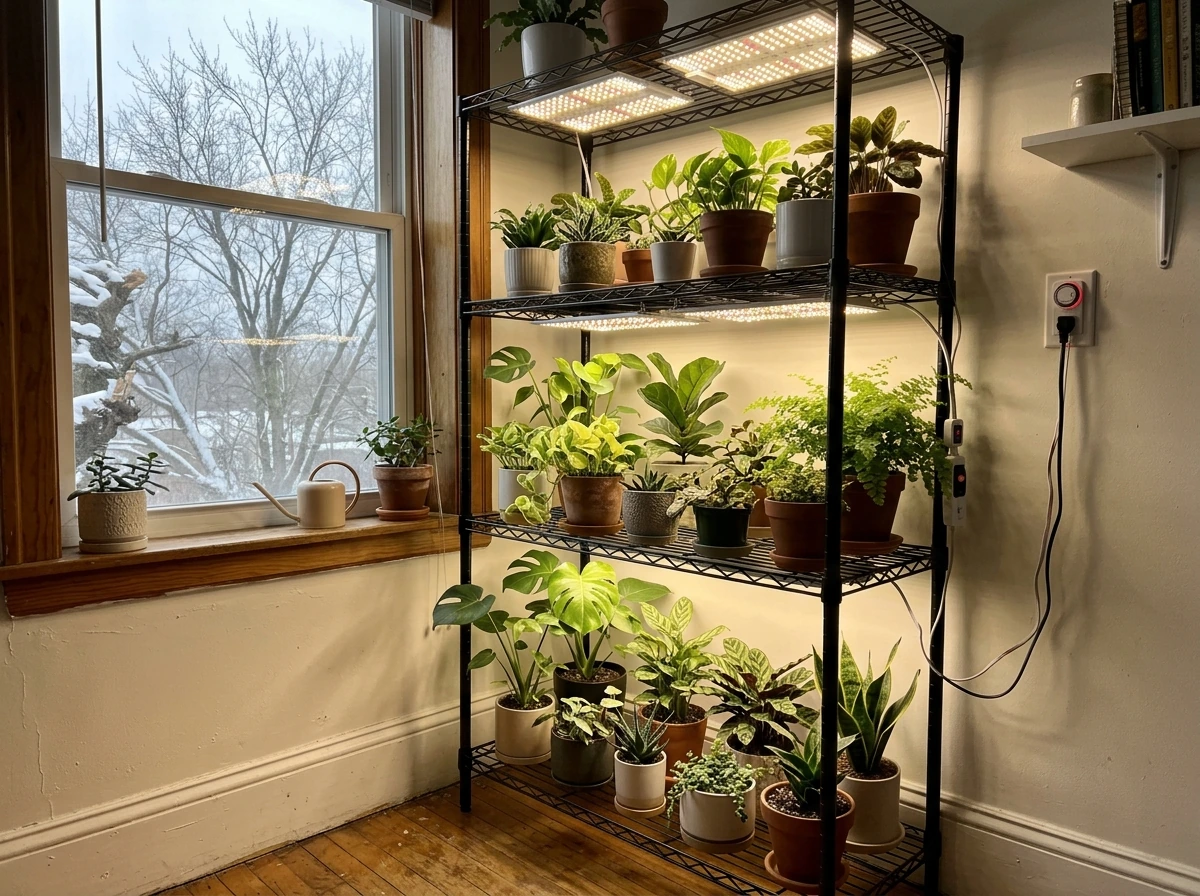
In December and January, even a south-facing window in most of the northern hemisphere delivers weak, low-angle light for only 8 to 10 hours a day. Compare that to June, when that same window gets 14 or more hours of intense sun. Most tropical houseplants evolved near the equator where they get consistent 12-hour days year-round, so winter is genuinely a problem for them. They're not just getting fewer hours, they're getting lower intensity too, because the sun sits lower in the sky and the light has to travel through more atmosphere to reach you. The result: slow growth, yellowing leaves, leggy stems reaching toward the window, and root rot from soil that stays wet too long because the plant isn't actively growing.
A grow light fixes this by adding back the hours and intensity your plants are missing. But it only works if you run it long enough and position it at the right distance. Too short a session or a lamp hung too high and you're just creating a placebo. Too long and you stress the plant in the other direction.
How many hours per day to run grow lights (quick rules)
Here's the practical breakdown I use as a starting point every winter. These numbers assume a decent modern LED grow light or full-spectrum fluorescent positioned at an appropriate distance (more on that below).
| Plant Type | Hours Per Day | Notes |
|---|---|---|
| Low-light houseplants (pothos, snake plant, ZZ) | 10–12 hours | Supplement window light; don't overdo it |
| Medium-light plants (peace lily, philodendron) | 12–14 hours | Good baseline for most tropical foliage |
| High-light plants (herbs, citrus, fruiting plants) | 14–16 hours | Full replacement for window light in winter |
| Seedlings (starting from seed) | 14–16 hours | Higher end; intensity matters as much as duration |
| Succulents and cacti | 12–14 hours | Need intensity, not just duration; keep light close |
If you're completely replacing natural light (a basement setup with no windows, for example), lean toward the higher end of each range. If you're supplementing a decent window, the lower end is usually fine. When in doubt, start at 14 hours and adjust based on how your plants respond over two to three weeks.
Adjusting for plant type and growth stage (seedlings vs mature plants)
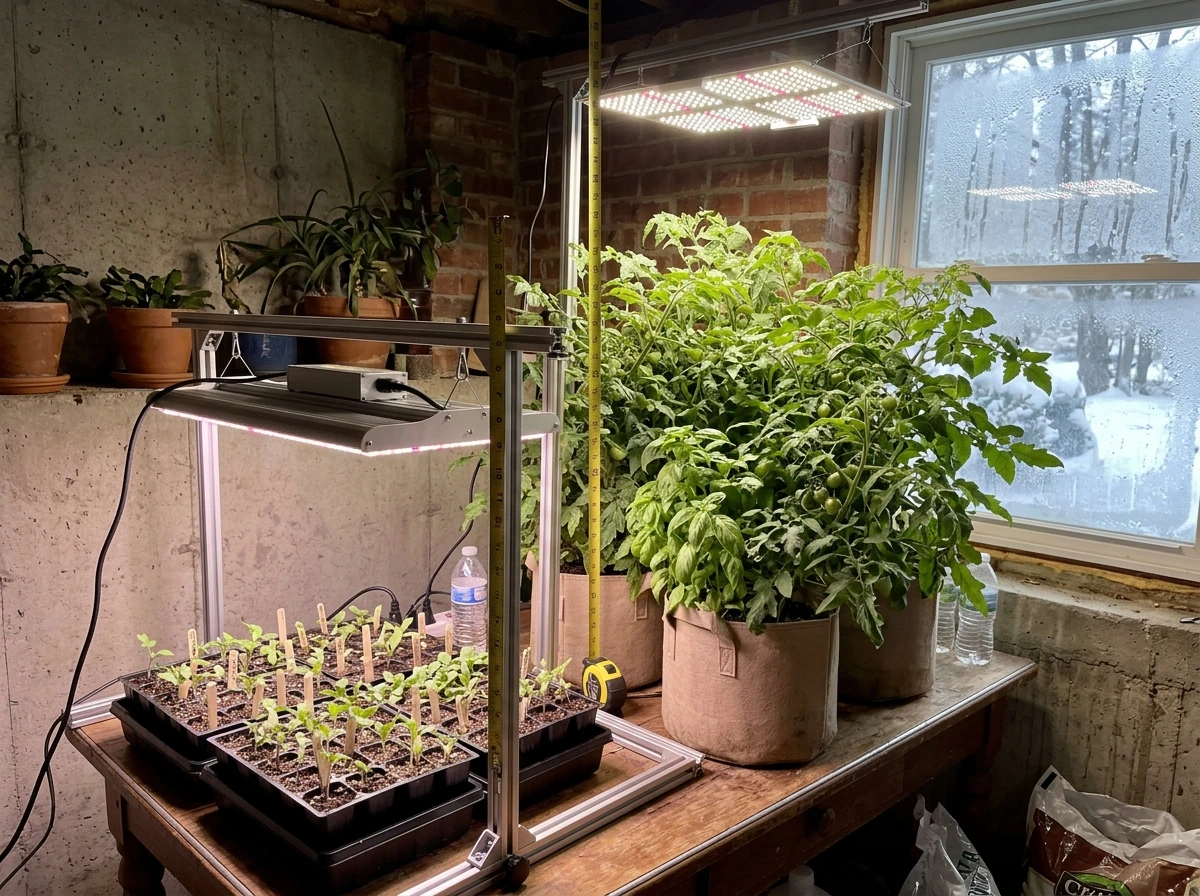
Seedlings are the most demanding plants you'll grow under lights. They're tiny, they're trying to build an entire root and shoot system from scratch, and they stretch aggressively toward any light they find. Seedlings are the most demanding plants you'll grow under lights. For sun-loving vegetable and herb seedlings, the University of New Hampshire Extension recommends running fluorescent lights for up to 22 hours a day to hit an ideal daily light integral (DLI) That sounds extreme, and with a modern bright LED you probably won't need to go that far, but the point stands: seedlings need a lot of light, and 12 hours under a dim bulb won't cut it. I run my seedlings at 14 to 16 hours under a high-output LED panel positioned close, and that works well.
Mature houseplants in a maintenance phase (you're just keeping them alive and reasonably happy through winter) are far more forgiving. A pothos or snake plant at 10 to 12 hours under a modest grow light will do fine. On the other hand, if you're trying to get a tomato plant or a pepper to flower and fruit indoors in winter, treat it more like a seedling in terms of intensity and hours. Fruiting plants need high light levels to set fruit, and duration alone won't compensate for a lamp that isn't bright enough.
One thing that trips people up: growth stage matters more than the calendar date. A plant you just repotted or propagated needs more light than the same species sitting in a stable pot it's been in for two years. If you're actively pushing growth, add hours and raise intensity. USU Extension also notes that actively growing seedlings generally benefit from about 12, 14+ hours of light per day, though light intensity still matters actively growing seedlings generally benefit from about 12–14+ hours of light per day. If you're in maintenance mode, back off a little.
Distance, intensity, and overlap with daylight (PPFD and foot-candles basics)
This is where most beginners go wrong. They buy a grow light, hang it somewhere vaguely above their plants, and run it for 14 hours wondering why nothing is improving. The problem is usually distance. Light intensity drops off fast as you move away from the source. This is basic physics (the inverse square law), and it means a lamp that's 12 inches from your plant delivers roughly four times the light of the same lamp at 24 inches. The University of Maryland Extension specifically flags this: intensity in foot-candles decreases rapidly as distance increases.
Foot-candles are a simple way to think about light intensity. Low-light plants like pothos and ZZ plants are comfortable around 50 to 150 foot-candles. Medium-light plants need roughly 150 to 500 foot-candles. High-light plants like herbs, vegetables, and most flowering plants want 500 to 1,000 foot-candles or more. You can measure this with a cheap lux meter app on your phone (divide the lux reading by about 10.76 to convert to foot-candles). It's not perfectly accurate, but it gives you a useful ballpark.
PPFD (Photosynthetic Photon Flux Density) is the more precise measurement used on most LED grow light spec sheets, measured in micromoles per square meter per second (µmol/m²/s). For most houseplants, you're targeting 100 to 300 µmol/m²/s. Seedlings and fruiting plants want 400 to 600+. If your light's spec sheet lists PPFD at different distances, use that to figure out where to hang it. A practical tip from the University of Missouri Extension: make your fixture height adjustable so you can keep the distance consistent as plants grow.
On overlap with daylight: if your plants get any natural window light, count that as part of their daily light budget. On a bright winter day near a south-facing window, your plants might get 3 to 4 hours of useful light. In that case, you only need to supplement with 10 to 12 hours of grow light time rather than running it all day. This also saves electricity.
A practical daily schedule and timers (morning vs evening, photoperiod consistency)
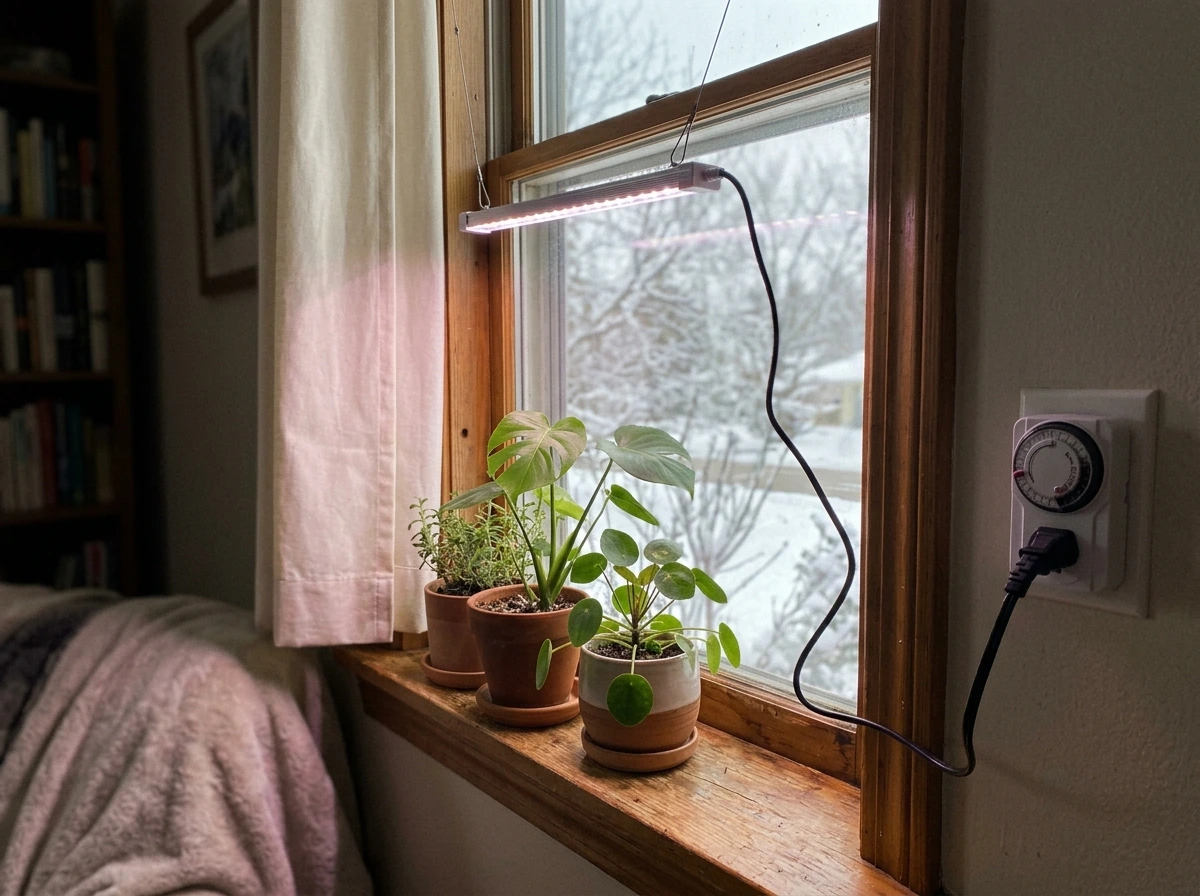
Consistency matters more than the specific timing. Plants track day length using an internal clock, and if the photoperiod (the number of hours of light they get) jumps around from day to day, it confuses them. For flowering plants especially, an inconsistent schedule can prevent them from blooming or trigger them to bloom at the wrong time. Get a simple plug-in timer, set it, and leave it.
As for morning versus evening: I prefer to run lights starting in the morning to mimic natural dawn. For a 14-hour schedule, I'd set lights on at 6 a.m. and off at 8 p.m. If you're supplementing window light, run the grow light in the morning and evening to bracket the natural daylight period, rather than stacking all your artificial hours on top of the sun's hours. For example, with 4 hours of good window light from 11 a.m. to 3 p.m., you might run the grow light from 6 a.m. to 11 a.m. and again from 3 p.m. to 9 p.m. for a total of 14 hours combined.
If you're running lights only (no window light), a clean 14 to 16 hour on-period with the remaining hours as darkness is all you need. Most plants need at least 6 to 8 hours of darkness for proper rest and cellular repair. Running lights 24 hours a day is rarely beneficial and can stress many plants.
How to tell if you're under- or over-lighting (signs to watch)
Your plants will tell you if something is off. You just need to know what to look for. Under-lighting is more common in winter setups, but over-lighting is a real issue too, especially if you move a light closer without reducing the hours.
Signs you're not giving enough light
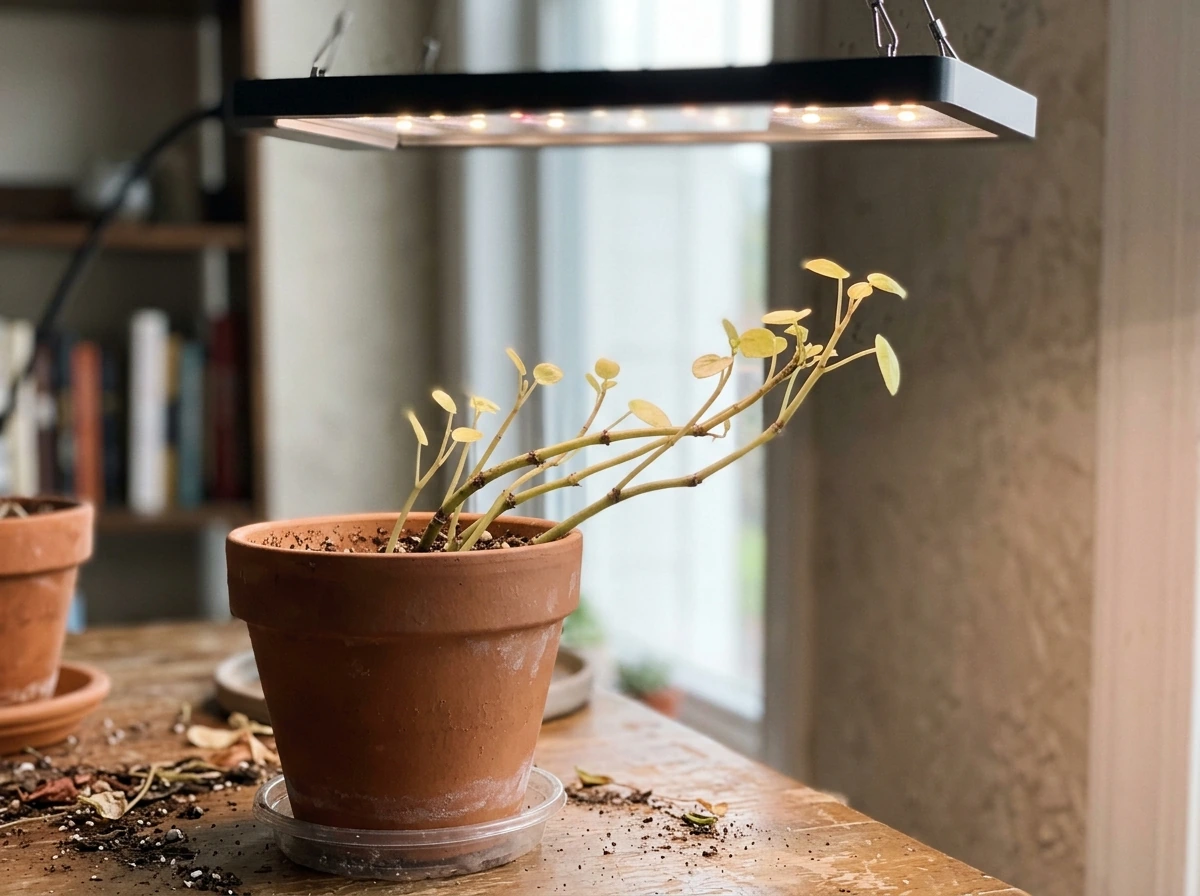
- Leggy, stretched stems reaching toward the light source
- Small, pale, or widely spaced new leaves
- Slow or no new growth over several weeks
- Yellowing of lower leaves on otherwise healthy plants
- Seedlings that fall over or look weak at the base (etiolation)
Signs you're giving too much light (or the lamp is too close)
- Leaf edges or tips turning brown and crispy (heat or light burn)
- Leaves curling upward or cupping, especially near the top of the plant
- Bleached or washed-out patches on leaves, often directly under the light
- Wilting even when the soil is moist
- Stunted growth combined with hardened, tough-looking leaves
When you spot these signs, adjust one variable at a time. If plants are stretching, try moving the light closer before adding hours. If you see burning or bleaching, raise the light a few inches before reducing run time. Changing one thing at a time makes it much easier to figure out what actually fixed the problem. Give the plant at least two weeks to respond before making another adjustment.
Safety considerations: heat, glare, and eye/skin myths
LED grow lights run cool compared to older high-intensity discharge (HID) or incandescent fixtures. That said, any lamp directly over a plant for 14 hours a day will add some warmth, and a cheap LED panel with poor heat dissipation can still get hot enough to damage leaves if it's placed too close. Touch the underside of your fixture after it's been running for an hour. If it's uncomfortably hot, either raise it higher or look for a light with a better heatsink. Always ensure there's some airflow around the fixture.
On the eye and skin questions: grow lights will not give you a tan, and they will not cause cancer with normal household use. These are genuinely common concerns I see come up, and they're understandable given how bright some grow lights look. Full-spectrum LED grow lights are not UV tanning beds. The UV output from most consumer grow lights is minimal and nowhere near the levels emitted by the sun or tanning equipment. You should not stare directly into any bright light source, and if you're working very close to a high-intensity commercial-grade LED array for extended periods, basic eye protection makes sense. But for a home setup with a standard grow light panel, the risk is glare discomfort, not eye damage or skin harm.
One real concern: positioning lights over flammable materials or in enclosed spaces without airflow. Keep lights away from curtains, and don't enclose them in a tight cabinet without ventilation. Use quality fixtures from reputable brands, not the cheapest no-name units with unknown electrical specs.
Common troubleshooting: lamp type, coverage, and when to extend hours
LED vs fluorescent: what actually matters in winter
Modern full-spectrum LEDs are the most practical choice for most home growers in 2026. They're energy-efficient, they run cool, and the good ones deliver solid PPFD at a reasonable distance. Fluorescent T5 or T8 fixtures are still useful, especially for seedlings, but they need to be positioned very close to plants (under 12 inches) to deliver enough light, and they cover a smaller area. UNH Extension’s fact sheet on starting plants from seed advises suspending fluorescent lights about 6 to 12 inches above the seeds for reliable supplemental light positioned very close to plants (under 12 inches). The old-style 'blurple' LEDs (the pink and purple ones) are less efficient than modern white full-spectrum LEDs and tend to underperform despite looking bright. If you're using one and your plants are stretching, the light output may just not be enough, and switching to a full-spectrum white LED panel is worth it.
Uneven coverage
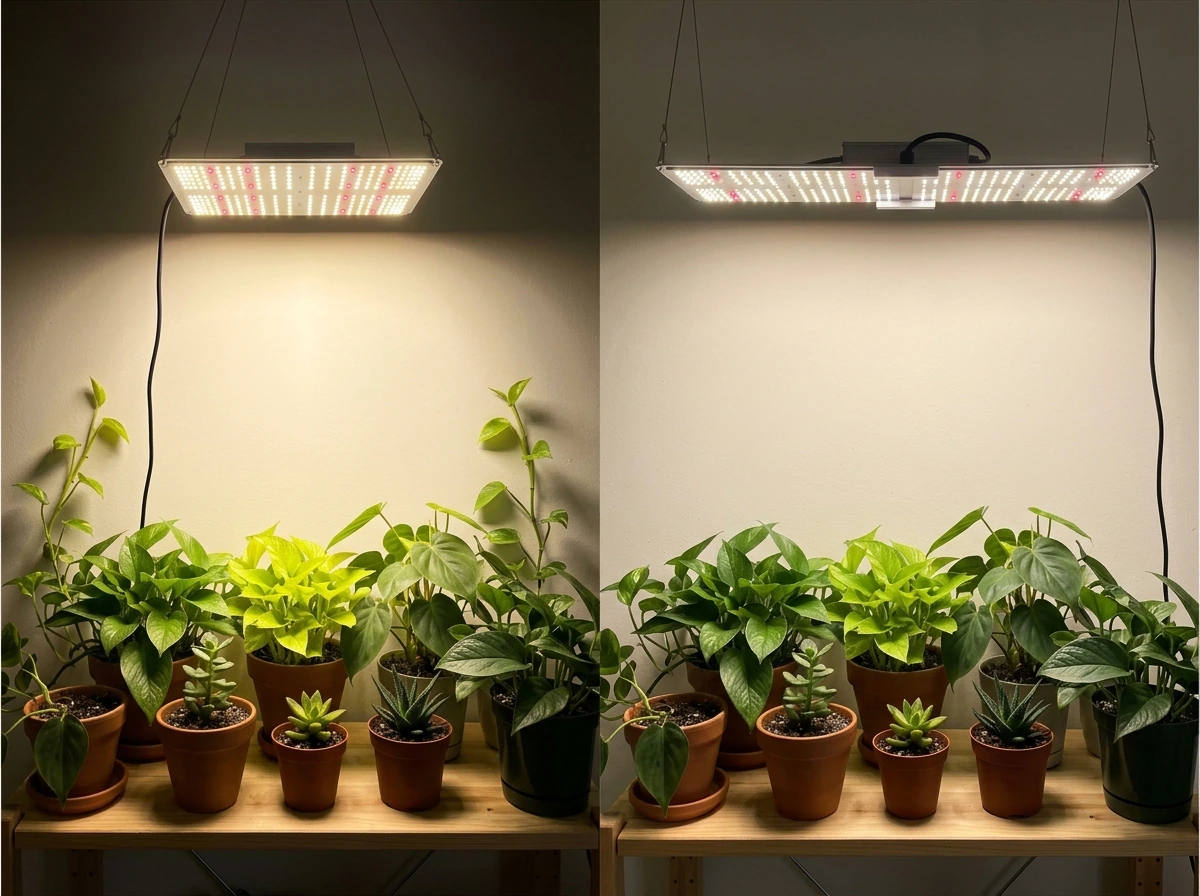
A single grow light hung above one spot will create a hot zone directly underneath and dim zones at the edges. Plants on the periphery will stretch toward the center. The fix is either to use a wider-coverage light (check the manufacturer's coverage area at the recommended hanging height), use multiple lights, or rotate your plants every week or two. Reflective surfaces (white walls, mylar, or even white foam board propped around your plant shelf) can help bounce light back toward the edges and improve coverage without adding another fixture. Missouri Botanical Garden specifically notes the value of reflective surfaces for improving effective light delivery.
When to extend (or cut back) your hours
If your plants have been under lights for three weeks at 14 hours and you're still seeing slow growth or stretching, try increasing to 16 hours before buying a new light. If that doesn't help after another two weeks, the problem is almost certainly intensity or distance, not duration. Move the light closer in 2-inch increments until you either see improvement or start seeing stress signs. On the flip side, if you're seeing bleaching or burn and the light is already at the manufacturer's recommended height, reduce hours by two per day before raising the fixture further. Sometimes trimming from 16 to 14 hours resolves minor light stress without losing much growth benefit.
A simple next-step plan
- Set your timer for 14 hours per day as a starting point for most plants (12 for low-light species, 16 for seedlings).
- Position your light at the manufacturer's recommended distance, or start at 12 inches for LEDs and 6 to 8 inches for fluorescents.
- Use a lux meter app to check foot-candles at the plant surface and adjust height until you're in the right range for your plant type.
- Run the lights consistently every day (a timer makes this automatic), starting in the morning to mimic natural dawn.
- Wait two to three weeks and observe your plants: look for leggy growth (not enough light) or burning and curling (too much).
- Adjust one variable at a time: distance first, then duration, then consider whether you need a brighter fixture.
Winter indoor growing is very manageable once you stop treating light as a simple on/off switch and start thinking of it as a dial with two settings: duration and intensity. Get both roughly right, stay consistent, and most plants will reward you with steady growth even in the darkest months of the year.
FAQ
Is it better to run grow lights longer, or ensure they get enough darkness in winter?
Most plants want a clear darkness window, even in winter. If you are running 14 to 16 hours of light, aim for at least 8 hours completely off. If your setup forces shorter dark periods, expect slower growth and higher odds of leaf yellowing, especially for plants in maintenance mode.
What should I do if my lights shut off unexpectedly during the winter schedule?
Do not rely on the timer alone. A power outage or unplug can create random day length changes, which is especially disruptive for plants you want to flower. If outages happen, use a timer with a “battery backup” or plug the timer into a controlled outlet so schedules resume automatically.
Can I push beyond 16 hours for winter growth, and how should I ramp up safely?
Yes, but do it carefully. Increase light hours gradually, typically by 1 to 2 hours every few days or weekly, rather than jumping straight to 18 to 20 hours. Also re-check distance, because raising hours without adjusting height can push the plant into stress faster than you expect.
How can I tell whether the problem is too little light time versus too little light intensity?
Watch the newest growth and leaf posture. Stretching plus pale, slower growth usually means intensity is too low, not just the hours. If leaves look healthy but growth stays slow, your issue is often distance (under the light) or total intensity, not a need for more photoperiod.
Should I adjust grow light hours on cloudy days during winter?
It depends on your plant type, but a common winter approach is to keep total daily light consistent and avoid wide swings. For example, if you add 2 hours on cloudy days, remove 2 hours on sunny ones so the 12 to 16 hour target stays steady. Sudden photoperiod jumps can confuse flowering plants.
What is the quickest way to respond if I see bleaching, leaf burn, or whitening?
Lowering intensity can be as simple as raising the fixture, but do it in small steps. If you see bleaching or crisping, reduce by about 2 hours first only if the fixture is at the recommended height. If the light is already at spec height, then raise it a few inches and keep hours the same rather than cutting hours more.
How accurate are lux meter apps or smartphone readings for winter grow light setup?
For most home setups, measure at plant height and keep that measurement consistent as the plants grow. If you use a lux meter app, note that phone sensors can vary and results are approximate. When in doubt, prioritize the fixture’s PPFD spec at distance, and treat lux only as a rough check.
How should I combine window light and grow light time without overdoing it?
When a plant is near a window plus lights, daylight can add meaningful usable photons. If your window light is strong, you can reduce grow light runtime so you do not exceed the plant’s needs. A practical approach is to keep the total “on” schedule at your target and shorten the artificial portion only after you observe the plant holding steady.
When should I reduce grow light time as seedlings grow into mature houseplants?
It depends on the stage, for seedlings keep intensity and hours higher and reduce only when they begin to slow or look stressed. For mature plants in maintenance mode, you can often use the lower end of the 12 to 16 hour range. A good rule is to adjust one variable, then wait 2 to 3 weeks before changing again.
My plants at the edges stretch, but the center looks fine. Is rotation enough?
If you are using a compact light, a single spot will usually create a bright center and dim edges. Rotating the plants weekly helps, but for uneven coverage you will get better results by choosing a fixture with a wider coverage area at your hanging height or using multiple smaller lights.
Can I split my grow light schedule into two sessions at night and still get good results?
Yes, but count practical photoperiod changes. If you turn lights off and on in the middle of the night, you create uneven day length and can harm flowering behavior. If you split the schedule, keep the off window continuous and align it so the overall daily light period remains consistent.
What options do I have besides moving the light when I need to fine-tune intensity?
If your light has a dimmer or controllable driver, you can fine-tune intensity without changing height. In winter, this is useful when plants are close to the light and you want to correct mild stress. If you lack a dimmer, distance changes are your primary tool, adjust in small increments.
Next Articles
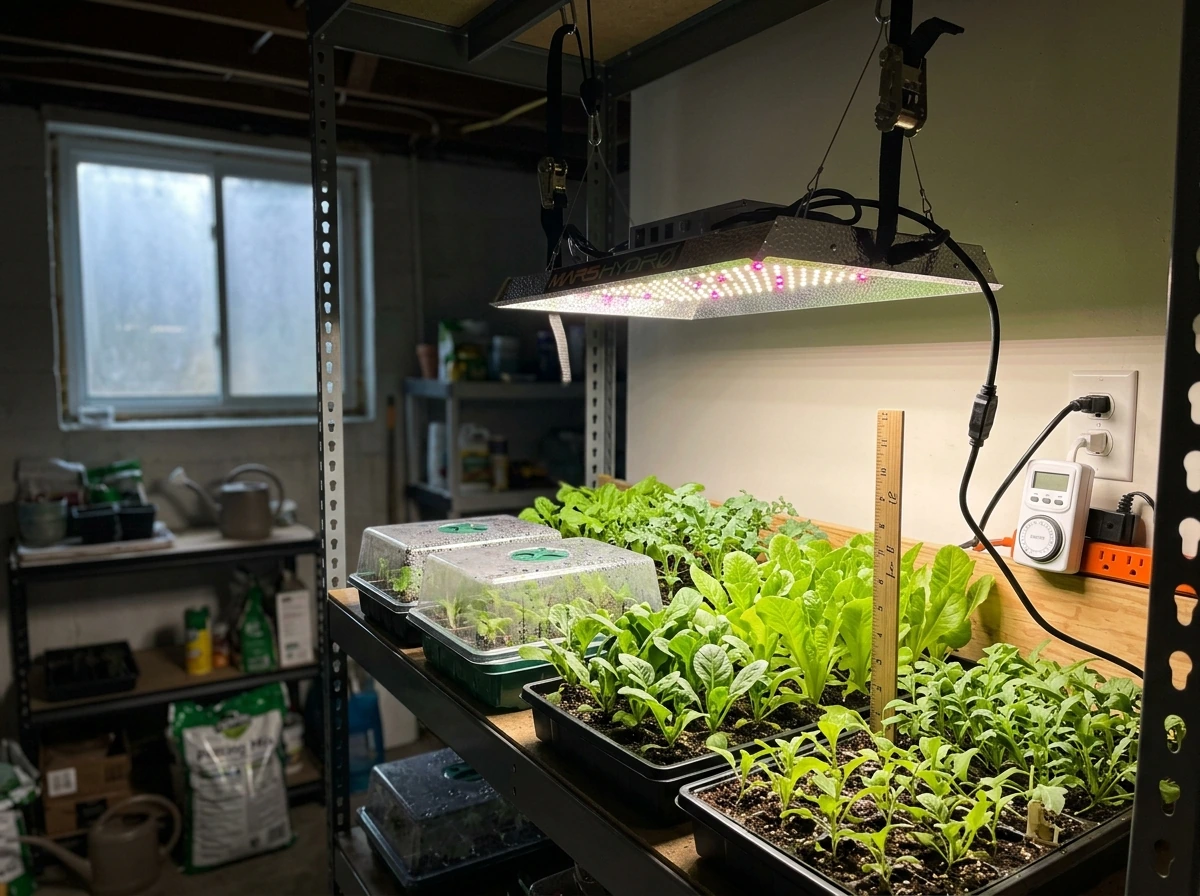
How Long Should Grow Lights Be On for Vegetables
Learn how many hours per day to run grow lights for vegetables, adjusted by crop stage, intensity, distance, and window
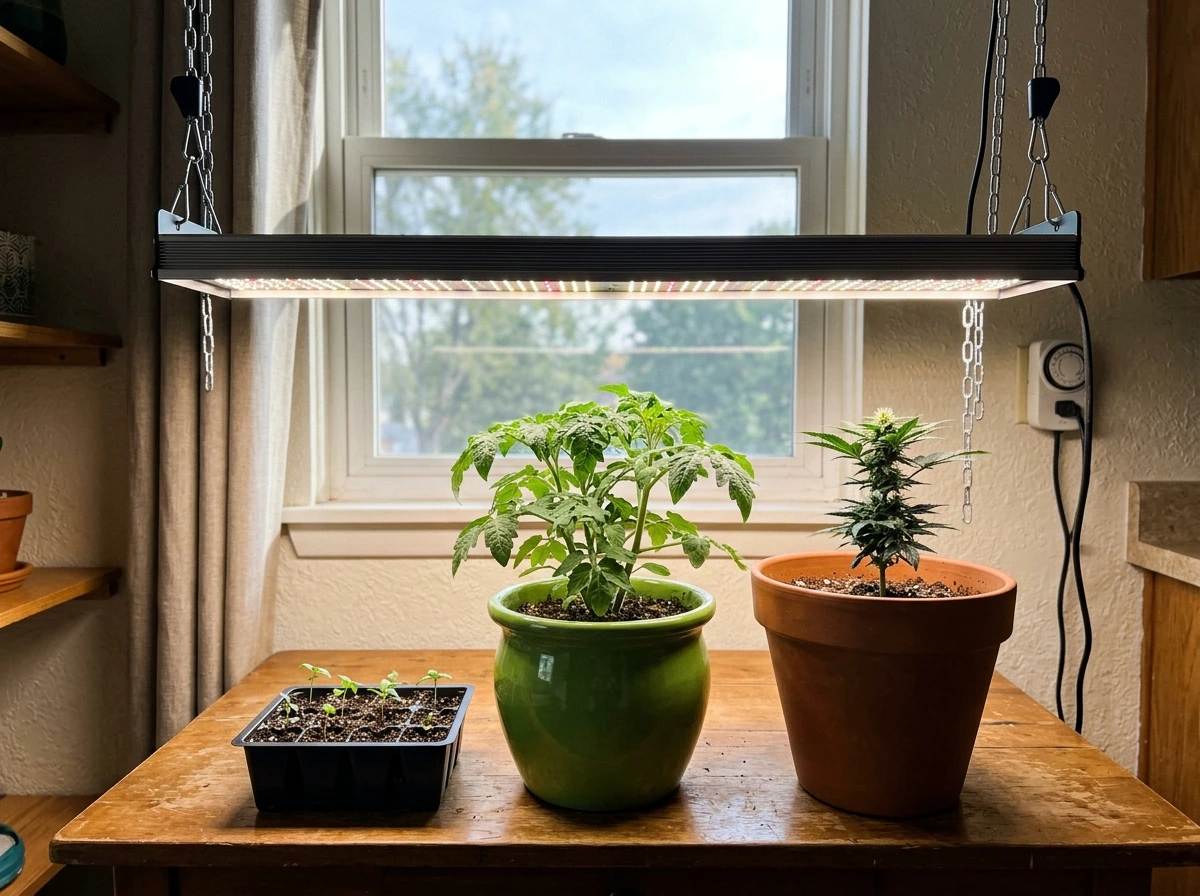
How Long Should Grow Lights Be On Each Day? (Guide)
Daily grow light timing for seedlings, veg, and flowering, plus rules to adjust for distance and intensity.
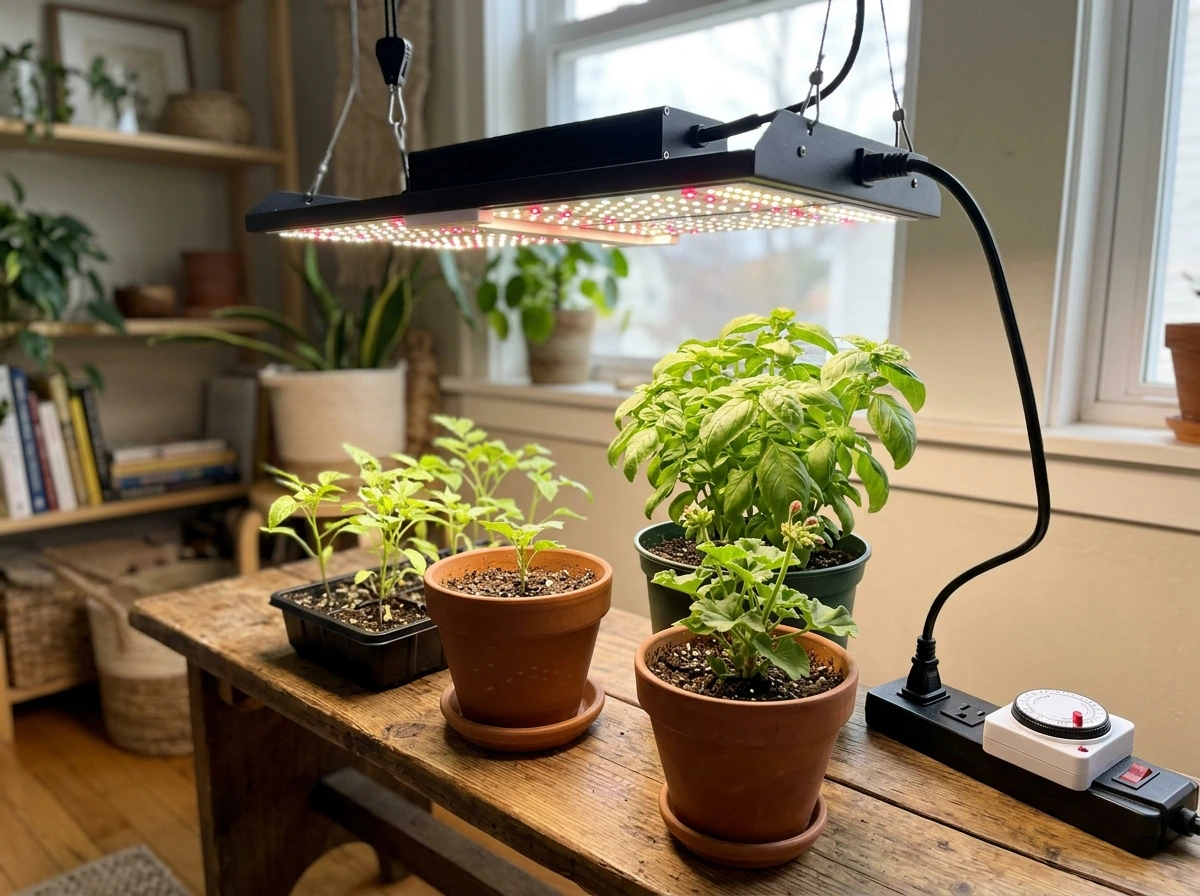
How Long to Keep Grow Lights On Indoor Plants
Daily grow light hours for indoor plants, how to set timers, adjust intensity by distance, and spot under or overlightin