Yes, T8 fluorescent tubes can grow plants, and they genuinely do a decent job for seedlings, leafy greens, and herbs when you set them up correctly. They are not a high-performance grow light, and they will not push fruiting crops or cannabis through a productive flowering cycle, but for a seed-starting tray or a kitchen herb shelf they are one of the most forgiving and affordable tools you can grab. The catch is in the details: you need the right color temperature, the right distance, and realistic expectations about which plants will thrive versus which will struggle.
Can I Use T8 Bulbs to Grow Plants? Practical Guide for Home Gardeners
Marcus Holloway
11 Aug 2026
How T8 fluorescent tubes actually work for plants
A T8 tube is a linear fluorescent lamp 1 inch (25.4 mm) in diameter (that is what the "8" means: 8 eighths of an inch). Standard lengths are 2 ft (600 mm) and 4 ft (1200 mm), and they run on a ballast, either the older magnetic type or the far more common modern electronic type. Electronic ballasts are worth seeking out: they drive the lamp at frequencies above 40 kHz, which virtually eliminates flicker, improves lamp efficacy, and runs cooler and quieter than magnetic ballasts. Most T8 shop-light fixtures sold today come with an electronic ballast built in.
For plant growth the two specs that matter most on the tube itself are color temperature (CCT) and spectral power distribution (SPD). Color temperature is the shorthand: a 4000 K or 5000 K "cool white" or "daylight" T8 skews more blue-heavy and is genuinely better for vegetative growth than a warm 2700 K tube. A 6500 K "daylight" T8 is the most commonly recommended off-the-shelf option for plants because it has a broader blue output that loosely aligns with chlorophyll absorption peaks. Some manufacturers sell purpose-built plant-growth tubes, like Sylvania's legacy Gro-Lux line, which are engineered with an SPD weighted toward the blue (around 430–450 nm) and red (around 640–680 nm) peaks that drive photosynthesis most efficiently. General-purpose cool-white T8s still contain photosynthetically useful wavelengths across the 400–700 nm PAR range, just not as efficiently weighted toward those peaks.
Why PAR and PPFD matter more than lumens
Lumens measure how bright a light looks to a human eye, not how useful it is to a plant. The human eye peaks in sensitivity around 555 nm (yellow-green), so a light engineered for high lumen output looks very bright to us but may not be delivering much energy at the blue and red wavelengths plants actually use for photosynthesis. PAR stands for Photosynthetically Active Radiation, which is the band of wavelengths from 400 to 700 nm that drives the photosynthetic reactions. PPFD (Photosynthetic Photon Flux Density) is the measurement you actually want: it counts the number of photons in the PAR range landing on a square meter per second, expressed as µmol·m⁻²·s⁻¹.
Lux is simply lumens per square meter, and it has the same human-eye bias as lumens. You can convert lux to an approximate PPFD, but only if you know the SPD of your specific lamp, because the conversion factor shifts with spectrum. A rough rule of thumb for a 5000 K white fluorescent source is that 1 lux is roughly equal to 0.0146 µmol·m⁻²·s⁻¹, but treat that as an approximation, not a precise figure. The practical takeaway is this: if someone tells you a T8 produces 3,200 lumens, that tells you almost nothing useful about whether it will grow your basil. The PPFD at canopy level is what you need, and that number is almost always lower than you hope.
What a typical T8 tube actually puts out
A standard 32 W, 4-foot T8 tube produces roughly 2,800 to 3,200 lumens at rated output, depending on the manufacturer and color temperature. A 2-foot, 17 W T8 produces around 1,200 to 1,500 lumens. In terms of photosynthetic efficacy, white fluorescent lamps including T8s typically land around 0.8 to 1.2 µmol·J⁻¹, compared with modern horticultural LEDs that routinely deliver 2.0 to 3.0 µmol·J⁻¹ or higher. That gap is not trivial: at the same wattage a good LED fixture can deliver roughly twice the plant-usable photons of a T8. A review titled "From physics to fixtures to food: current and potential LED efficacy, Horticulture Research (review of efficacy trends)" reports that commercial horticultural LEDs routinely exceed about 2.0–3.0 µmol·J⁻¹, while legacy fluorescent fixtures typically deliver roughly 0.8–1.2 µmol·J⁻¹ From physics to fixtures to food: current and potential LED efficacy — Horticulture Research (review of efficacy trends).
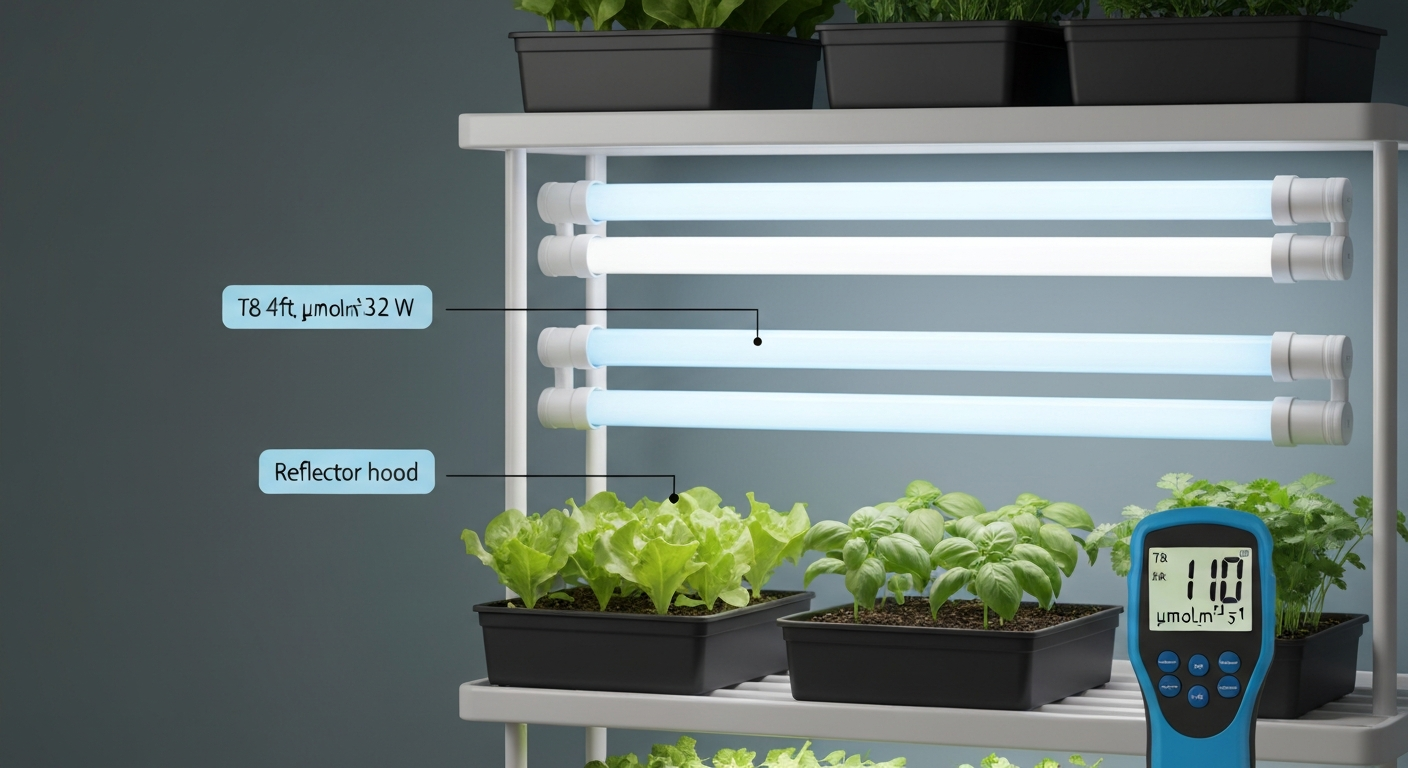
A real-world data point worth keeping in mind: a controlled lettuce propagation study using 32 W Philips T8 fluorescent tubes measured about 110 µmol·m⁻²·s⁻¹ at canopy level inside a small enclosed chamber with the tubes positioned close to the plants. That is a meaningful figure because it shows what a well-configured T8 setup can realistically achieve in practice, not just in theory. It is enough for leafy greens and seedlings. It is not enough for fruiting crops.
| Tube Type | Wattage | Approx. Lumens | Typical CCT | Est. PPFD at 4 in (10 cm) | Best Plant Use |
|---|---|---|---|---|---|
| T8 4 ft standard | 32 W | 2,800–3,200 lm | 4000–6500 K | 80–130 µmol·m⁻²·s⁻¹ | Seedlings, leafy greens, herbs |
| T8 2 ft standard | 17 W | 1,200–1,500 lm | 4000–6500 K | 50–90 µmol·m⁻²·s⁻¹ | Small seed trays, low-light plants |
| T8 Gro-Lux type | 32 W | ~1,600 lm (plant-weighted SPD) | Broad red/blue | Comparable PAR, better spectrum | Seedlings, vegetative herbs |
| T5 HO 4 ft | 54 W | 5,000 lm | 5000–6500 K | 150–250 µmol·m⁻²·s⁻¹ | Seedlings, herbs, compact veggies |
| T12 4 ft | 40 W | 2,800–3,350 lm | 4000–6500 K | 60–100 µmol·m⁻²·s⁻¹ | Only seedlings; largely outdated |
Realistic expectations by plant type and growth stage
Seedlings and cuttings
This is where T8s genuinely shine. Seedlings need low-to-moderate light intensity, a long photoperiod, and cool temperatures near the lamp so you can get the fixture close without burning them. University extension services routinely recommend positioning fluorescent tubes just 2 to 6 inches (5 to 15 cm) above seedling trays, and that close placement is exactly why T8s work so well here: the low heat output means you can practically touch the tube to the canopy before heat becomes a problem. At 2 to 4 inches away a 4-foot, 32 W T8 with a reflector will comfortably hit the 80 to 130 µmol·m⁻²·s⁻¹ range that seedlings need.
Leafy greens and lettuce
Lettuce, spinach, arugula, and similar crops have relatively low light requirements. Research consistently puts their optimal PPFD in the range of 150 to 250 µmol·m⁻²·s⁻¹ with a daily light integral (DLI) around 12 to 17 mol·m⁻²·d⁻¹. A two-tube T8 fixture positioned 3 to 6 inches above a 12 to 18 inch wide tray, run for 16 hours per day, can realistically hit the low end of that DLI range. Results will not be as impressive as a purpose-built LED panel, but you will grow edible lettuce. I have done it with a basic two-lamp shop fixture and it works.
Culinary herbs
Basil, cilantro, parsley, and chives sit in a similar light range to leafy greens, roughly 12 to 18 mol·m⁻²·d⁻¹ DLI. T8s can maintain established herb plants indoors through winter or dark seasons if you run them 14 to 16 hours a day and keep the fixture within 4 to 8 inches of the plant tops. Basil in particular gets leggy fast if light is too low or too far away. Keep the tubes close and keep trimming the plant for a compact, bushy shape.
Fruiting crops and cannabis: honest limits
Tomatoes, peppers, cucumbers, and cannabis need much higher light than a T8 setup can deliver. Cannabis yield studies have demonstrated meaningful dose responses across PPFD levels from 150 to 700 µmol·m⁻²·s⁻¹, with flowering plants requiring DLIs in the range of roughly 25 to 40+ mol·m⁻²·d⁻¹ for good flower production. That is well beyond what even a bank of T8 tubes can produce over a realistic grow area. You can use T8s for cannabis seedling starts and early vegetative clones, which is a legitimate and common practice, but attempting to flower cannabis under T8s alone will produce disappointingly small, airy buds. For a quick primer on whether common household bulbs can support cannabis growth, see can you grow cannabis with normal light bulbs. If cannabis is your goal, this is the right moment to look at purpose-built horticultural LEDs or at least a T5 high-output fixture as a bare minimum.
Light targets to aim for at each stage
If you have a PAR meter, these are the PPFD targets to use as a benchmark. If you do not have a PAR meter, the lumen-based rules of thumb below will get you in the right ballpark for most low-to-medium-light crops.
| Growth Stage / Crop | Target PPFD (µmol·m⁻²·s⁻¹) | Target DLI (mol·m⁻²·d⁻¹) | Photoperiod | T8 Achievable? |
|---|---|---|---|---|
| Seedlings / germination | 50–150 | 6–12 | 16 h | Yes, easily |
| Leafy greens / lettuce | 150–250 | 12–17 | 16 h | Yes, at close range |
| Culinary herbs | 150–250 | 12–18 | 14–16 h | Yes, with 2+ tubes |
| Cannabis vegetative | 200–400 | 18–25 | 18 h | Marginally, low end only |
| Cannabis flowering | 500–700+ | 30–45+ | 12 h | No, insufficient |
| Fruiting crops (tomato etc.) | 400–600+ | 25–35+ | 16 h | No, insufficient |
If you are working without a PAR meter, a practical lumen-based rule of thumb is to aim for at least 2,000 to 3,000 lumens per square foot of growing area for seedlings and leafy greens, and closer to 3,000 to 5,000 lumens per square foot for herbs that need a bit more intensity. A single 32 W, 4-foot T8 produces around 3,000 lumens total, and that light spreads over a wide area, so concentrate it with a reflector and keep the fixture close.
Setting up your T8 fixture the right way
Fixture and ballast choices
A standard two-lamp or four-lamp T8 shop fixture with an electronic ballast is all you need. Electronic ballasts are far better than magnetic: they run the lamp at over 40 kHz, improving lamp efficacy and eliminating visible flicker, and they tend to be more energy efficient. Manufacturers’ ballast spec guides report >90% ballast efficiency, lamp drive frequencies above 40 kHz, lower total harmonic distortion, and selectable ballast factors for T8 electronic systems (see Ballast specification guide (electronic T8 ballast performance and benefits vs magnetic)). Look for a ballast factor at or slightly above 1.0 if you want to push the tubes to their rated output. Most modern T8 shop fixtures from hardware stores ship with an electronic ballast already installed, so this usually takes care of itself.
Reflectors make a bigger difference than you'd think
A bare T8 tube wastes a huge fraction of its light by directing photons upward toward the ceiling rather than down toward your plants. A simple white or specular aluminum reflector hood redirects that upward light back down, meaningfully increasing usable PPFD at the canopy without any extra electricity. Most shop light fixtures include a basic reflector, but if yours is just an open strip fixture, adding a white-painted or foil-lined hood can noticeably improve your results. It is one of the cheapest upgrades you can make.
Distance and mounting
For seedlings and cuttings: hang the fixture 2 to 4 inches (5 to 10 cm) above the canopy. At this distance the low heat output of T8s is an advantage over hotter sources like halogen or HID: you can get very close without burning soft seedling leaves. For leafy greens: 3 to 6 inches (8 to 15 cm) is a good starting point. For herbs that have grown taller and woodier: 4 to 8 inches (10 to 20 cm). Use adjustable chains or a simple hook-and-chain system so you can raise the fixture as plants grow. A key rule: if your plants are stretching toward the light with elongated, pale stems (a condition called etiolation), the fixture is too far away.
Photoperiod recommendations
- Seedlings: 16 hours on, 8 hours off. This is long enough to maximize growth without stressing very young plants.
- Leafy greens: 16 hours on, 8 hours off. Many lettuce varieties are day-neutral and tolerate up to 18 hours without bolting.
- Herbs: 14 to 16 hours on. Basil in particular can bolt under continuous light, so 14 to 16 hours is safer.
- Cannabis vegetative (T8-appropriate stage): 18 hours on, 6 hours off, though be honest about the light limits discussed above.
- Always use a timer. Manual switching is unreliable and plants respond badly to inconsistent photoperiods.
Coverage rules: how much area one T8 tube will light
A single 4-foot, 32 W T8 tube in a reflector fixture will usefully illuminate a strip roughly 4 feet long by 12 to 18 inches (30 to 45 cm) wide for seedlings and low-light crops. That is approximately 4 to 6 square feet (0.37 to 0.56 m²) at intensity levels useful for seedlings and leafy greens. For herbs that need slightly more intensity, target the center 12 inches (30 cm) directly under the tube as the usable zone. A two-tube, 4-foot fixture roughly doubles this: you can cover a tray up to 24 inches (60 cm) wide with two tubes side by side in a single reflector.
If you need to light a larger area, run multiple fixtures side by side and arrange them so their beams overlap slightly at the edges to avoid dark spots between tubes. A 2-by-4-foot (60 cm x 120 cm) seed-starting setup is well served by a two-lamp T8 shop fixture. A full 4-by-4-foot (120 cm x 120 cm) grow space would need at least four side-by-side 4-foot fixtures to provide even, adequate coverage for leafy greens. At that point the energy cost and fixture count start to make a purpose-built LED panel look increasingly sensible.
Measuring and verifying your light output
PAR meters
A PAR meter (also called a quantum sensor or PPFD meter) is the most accurate tool for measuring plant-usable light. It directly measures photons in the 400 to 700 nm range and gives you a real µmol·m⁻²·s⁻¹ reading at your canopy. The downside is cost: a decent handheld PAR meter starts at around $250 to $400 for a reasonably accurate unit. For most home gardeners growing seedlings or herbs under T8s, this level of precision is not strictly necessary, but if you are serious about getting results and troubleshooting problems, it is the only truly reliable measurement.
Lux meters
A lux meter is a much cheaper alternative, often under $20 for a basic digital unit. It measures illuminance in lux, which you can then convert to approximate PPFD. For a 5000 to 6500 K cool-white or daylight T8, a rough conversion factor is around 0.013 to 0.015 µmol·m⁻²·s⁻¹ per lux (that is, a reading of 10,000 lux from a daylight T8 corresponds to roughly 130 to 150 µmol·m⁻²·s⁻¹). Remember: this conversion shifts with the lamp spectrum, so do not apply a value calculated for one light source to a completely different one. For within-source comparisons and consistency checks, a lux meter is perfectly practical.
Smartphone apps
Free lux-meter apps using your phone camera are widely available and can give you a rough directional measurement, but their accuracy is poor for horticultural purposes. The camera sensor is designed for photography, not photometry, and different phone models give wildly different readings. They are fine for a quick gut check (is this corner of the grow shelf much darker than the center?) but not for dialing in PPFD targets. If you are going to bother measuring, spend the $15 to $20 on a dedicated lux meter instead.
Quick conversion tips for T8 setups
- Lux to PPFD for 5000–6500 K T8: multiply lux reading by ~0.013 to 0.015 to get approximate PPFD in µmol·m⁻²·s⁻¹.
- To calculate DLI from PPFD: multiply PPFD (µmol·m⁻²·s⁻¹) × photoperiod in seconds ÷ 1,000,000. Example: 150 µmol·m⁻²·s⁻¹ × 57,600 seconds (16 h) ÷ 1,000,000 = 8.6 mol·m⁻²·d⁻¹.
- If your lux reading at canopy is below 8,000 lux with a cool-white T8, you are likely below 100 µmol·m⁻²·s⁻¹ and need to move the fixture closer or add more tubes.
- Measure at multiple points across the tray, not just the center. Edge readings are often 30 to 50% lower than center readings under a single tube.
T8 vs other light sources: how do they compare?
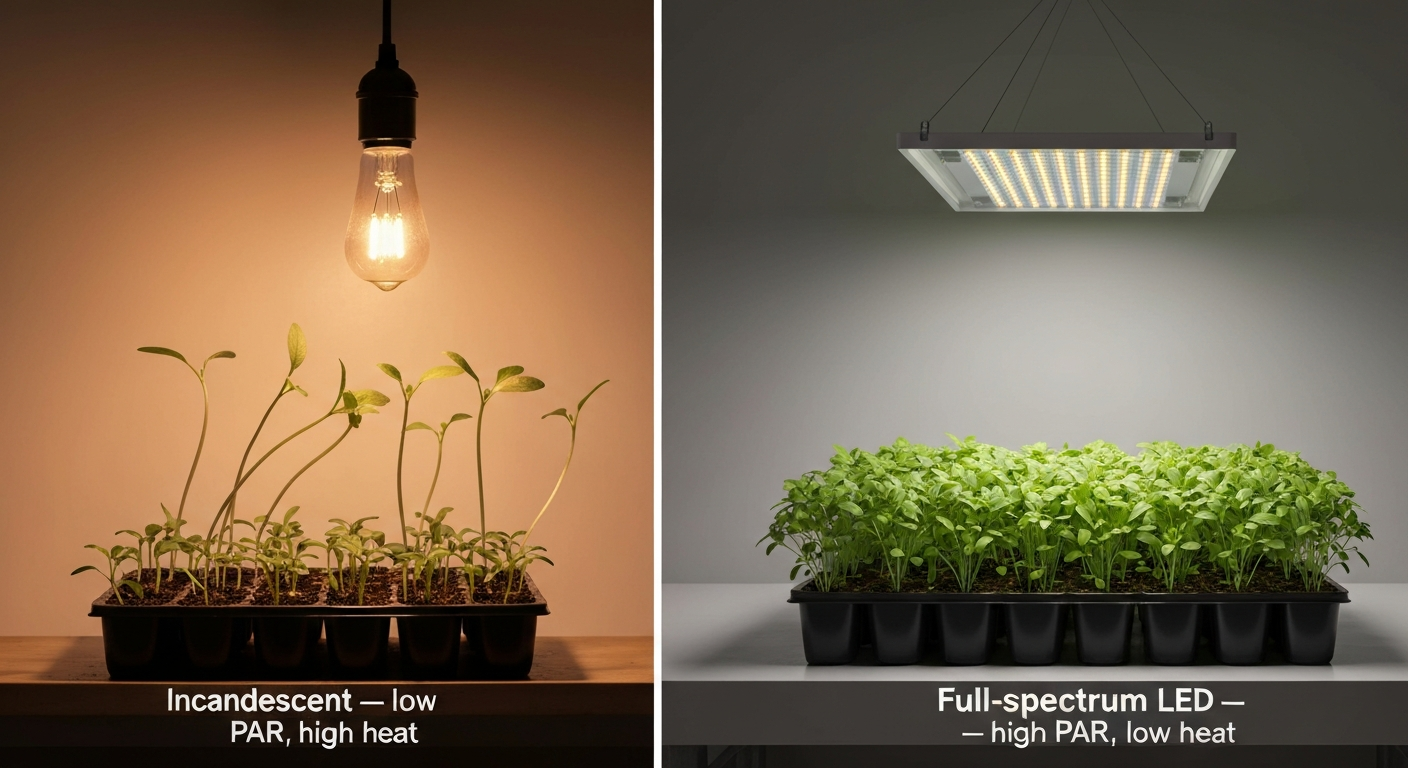
It helps to place T8s in context with the other options you are likely to consider. Fluorescent tubes in general, including T5 high-output and T8, are much better for plant growth than standard incandescent A19 bulbs or halogen lamps. If you’re wondering whether halogen lights will grow plants, see the article titled will halogen lights grow plants for a concise explanation of their spectrum, heat issues, and practical limits. If you’re wondering can normal light bulb grow plants, the short answer is no for most serious growing, incandescent and halogen bulbs are poor choices compared with fluorescents or LEDs. Normal incandescent and halogen bulbs waste most of their energy as heat and produce a heavily red-biased spectrum that lacks the blue wavelengths plants need for compact, healthy vegetative growth. T8s run cooler and have a far more useful spectrum for the same wattage. T12 tubes are the older, slightly thicker cousin of T8s: they are less efficient and largely obsolete, though they work on the same basic principle.
Compared with T5 high-output fluorescents, T8s are the weaker option. A 54 W T5 HO tube produces roughly 5,000 lumens and delivers noticeably higher PPFD at comparable distances, making T5 HO fixtures a meaningfully better choice if you are serious about growing herbs or compact vegetables. The trade-off is cost and energy use. Compared with modern horticultural LEDs, T8s fall behind on every technical metric: efficacy (µmol·J⁻¹), heat output per watt, lifespan, and spectrum tunability. However, a basic T8 shop fixture costs a fraction of a quality LED grow panel, and for low-intensity applications like seed starting it delivers adequate results at a very low price point.
| Light Source | Approx. Efficacy (µmol·J⁻¹) | Heat Output | Spectrum for Plants | Best Use Case | Relative Cost |
|---|---|---|---|---|---|
| T8 fluorescent | 0.8–1.2 | Low | Decent (6500 K) | Seedlings, leafy greens, herbs | Very low |
| T5 HO fluorescent | 1.0–1.4 | Low-medium | Good (6500 K) | Seedlings, herbs, compact veg | Low-medium |
| T12 fluorescent | 0.6–0.9 | Low | Acceptable | Seedlings only | Very low |
| CFL (compact fluorescent) | 0.7–1.1 | Low-medium | Decent (6500 K) | Small single-plant setups | Very low |
| Incandescent / halogen | 0.1–0.3 | Very high | Poor (red-heavy) | Not recommended | Very low |
| Horticultural LED | 2.0–3.0+ | Very low | Excellent (tunable) | All stages and crops | Medium-high |
| Purpose-built grow bulb | 0.9–1.5 | Low-medium | Good (red/blue weighted) | Seedlings, herbs | Low |
Energy use, running costs, and heat
A single 32 W T8 tube running for 16 hours a day uses about 0.51 kWh per day. Two tubes in a shop fixture use about 1.0 kWh per day. At an average U.S. electricity rate of around $0.16 per kWh (as of mid-2026), that is roughly $0.16 per day or about $4.80 per month for a two-tube fixture running 16 hours daily. That is cheap. A four-fixture bank (eight 32 W tubes) would run closer to $19 per month for the same photoperiod, which is still competitive with other low-power grow light options for that scale. The heat output is low enough that it is rarely a temperature management issue in home grow setups, unlike HID or high-wattage LEDs.
Safety and disposal
T8 fluorescent tubes contain a small amount of mercury vapor, typically around 3 to 5 mg per tube in modern low-mercury formulations. This is worth knowing for two reasons. First, if you break a tube, ventilate the room, avoid touching the debris with bare hands, and clean up carefully: the mercury quantity in a single tube is small but not trivial. Second, and more importantly, do not throw spent T8 tubes in the regular trash. Take them to a hardware store or recycling center that accepts fluorescent lamps, many of which have free take-back programs. The ballast itself does not contain hazardous materials in modern electronic versions, though older magnetic ballasts from fixtures made before the 1980s may contain PCBs and should be handled accordingly.
From a UV exposure standpoint, standard T8 tubes produce negligible UV output behind the glass envelope. They will not give you a tan or cause UV-related skin damage under normal use. The light is bright and you should avoid staring directly at a lit tube at close range (common sense), but there is no meaningful UV or cancer risk from using T8 grow lights in a home garden setup.
When T8s are the right call, and when to upgrade
T8 tubes are the right choice when you are starting seeds in late winter, overwintering low-light houseplants, growing a small tray of lettuce or herbs on a shelf, or working with a very tight budget and minimal space. If you're wondering whether "do grow bulbs work" for your project, this guide shows when they make sense and when to choose alternatives. They are easy to find, cheap, and produce genuinely adequate light for the low end of the plant light spectrum. The setup is simple enough that even a first-time indoor gardener can get it working in an afternoon.
Upgrade away from T8s when you are trying to grow fruiting or flowering crops, when your growing area exceeds a couple of square feet and you are stacking multiple fixtures, when you want to maximize yield per watt, or when you are growing cannabis beyond the seedling and early vegetative stage. At that point the efficiency gap between T8s and modern LED grow panels is large enough to matter in your electricity bill and in your harvest. The T8 has a legitimate place in home growing, it just needs to stay in its lane.
Troubleshooting common T8 grow light problems
- Leggy, stretched seedlings: the fixture is too far away. Move it to within 2 to 4 inches of the canopy immediately.
- Pale or yellowing leaves with enough light: check if the tube is old (T8 lumen output drops significantly after 10,000 to 15,000 hours), or check for nutrient deficiency rather than light deficiency.
- Uneven growth across the tray: the edges are getting less light than the center. Rotate the tray 180 degrees every few days, or add a second fixture.
- Plants not growing at all under T8s: verify the color temperature is 4000 K or higher (warm 2700 K T8s are much less effective for vegetative growth), and confirm the photoperiod is actually running as programmed on your timer.
- Ballast buzzing or flickering: replace the ballast or the fixture. A failing ballast reduces lamp output significantly before it fails entirely.
FAQ
Can T8 fluorescent tubes be used to grow plants?
Yes. T8 fluorescent tubes can support propagation and low‑to‑moderate‑light crops (seedlings, herbs, leafy greens) if installed correctly. They produce usable photosynthetic photons, but their photosynthetic photon efficacy (µmol·J⁻¹) and maximum PPFD are lower than modern horticultural LEDs or purpose‑built fixtures, so expectations and crop choices should be adjusted accordingly.
Which plants and growth stages are realistic with T8s?
Good fits: seedlings/clones, microgreens, herbs (basil, cilantro), leafy greens (lettuce, spinach) at small scale. Marginal/poor fits: high‑light fruiting/flowering crops (tomato, pepper) and commercial cannabis flowering—these require much higher PPFD/DLI than typical T8 setups deliver.
What light levels (PPFD/DLI) can I expect from typical 32 W T8 tubes?
A common measured result in small trays: 32 W T8 tubes can deliver on the order of ~50–150 µmol·m⁻²·s⁻¹ at seedling canopy height depending on fixture, reflector, number of tubes and distance. That corresponds to daily DLIs around 6–20 mol·m⁻²·d⁻¹ with 12–16 h photoperiods—suitable for seedlings and many leafy greens but below typical targets for fruiting crops.
How should I position T8 tubes above plants (distance and mounting)?
Keep tubes close to the canopy for best PPFD: seedlings ~5–15 cm (2–6 in) above, leafy greens ~15–30 cm (6–12 in). Use fixtures with reflectors and place tubes horizontally over benches or trays. Maintain enough clearance to avoid plant contact; T8s run relatively cool so close placement is safe if plants don’t touch the glass.
What photoperiods (hours per day) should I run T8s for common crops?
Seedlings/clones: 14–16 hours. Leafy greens/herbs: 14–16 hours is common; some growers use 12–18 depending on target DLI. For crops with day/night requirements, follow crop‑specific guidance (e.g., short‑day or long‑day plants). Longer photoperiods raise DLI without increasing instantaneous PPFD.
How can I estimate PPFD from lumens/lux for T8s?
Conversion depends on tube spectrum (SPD). A rough practical rule for cool/daylight fluorescents is: 1 lux ≈ 0.01–0.015 µmol·m⁻²·s⁻¹. For planning, use 0.01–0.015 as a ballpark; for accuracy measure PPFD with a quantum sensor or use the manufacturer's SPD to compute the conversion.
Next Articles
Do Grow Bulbs Work? A Practical Guide for Home Gardeners
Which grow bulbs work? Guidance on LEDs, fluorescents, halogen; setup, costs, and best picks for seedlings & flowering.
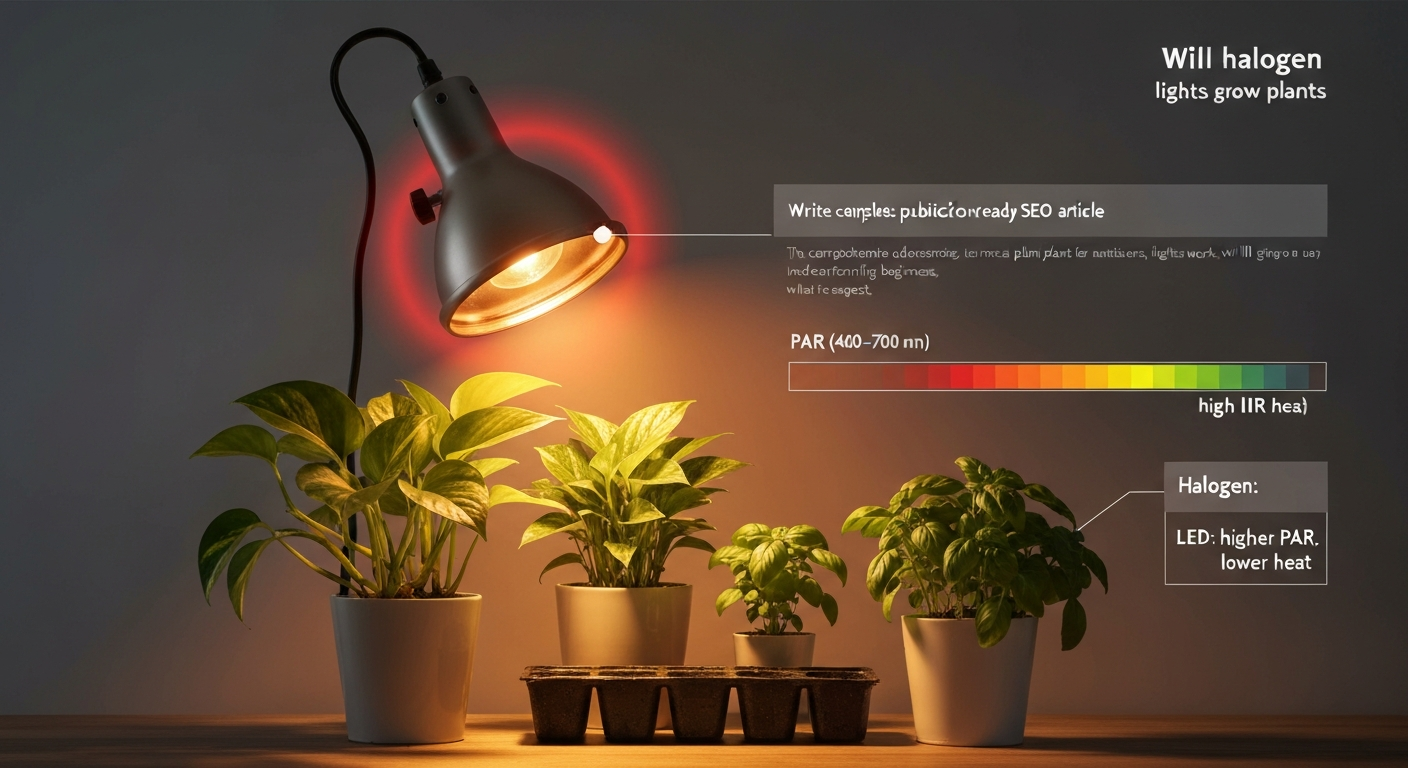
Will Halogen Lights Grow Plants? Guide for Home Gardeners
Can halogen lights grow plants? Evidence-based guide on spectrum, wattage, heat, runtimes, and when to use other lights.
Can Normal Light Bulb Grow Plants? What to Expect and How
Can a regular household bulb grow plants? Learn spectrum limits, safe setup, positioning, hours, and realistic results.