Yes, grow bulbs work, and they work well when you match the right bulb type to the right plant and set it up correctly. A quality LED grow light over a tray of lettuce seedlings will produce healthy, compact plants that a windowsill simply cannot match in winter. That said, not all bulbs marketed as 'grow lights' are equally effective, and a regular incandescent bulb or a dim halogen from your hardware store will mostly disappoint. The difference comes down to three things: light spectrum, intensity (measured in PPFD, not just watts or lumens), and how many hours per day your plants receive it.
Do Grow Bulbs Work? A Practical Guide for Home Gardeners
Marcus Holloway
10 Aug 2026
How plant light actually works: spectrum, intensity and photoperiod
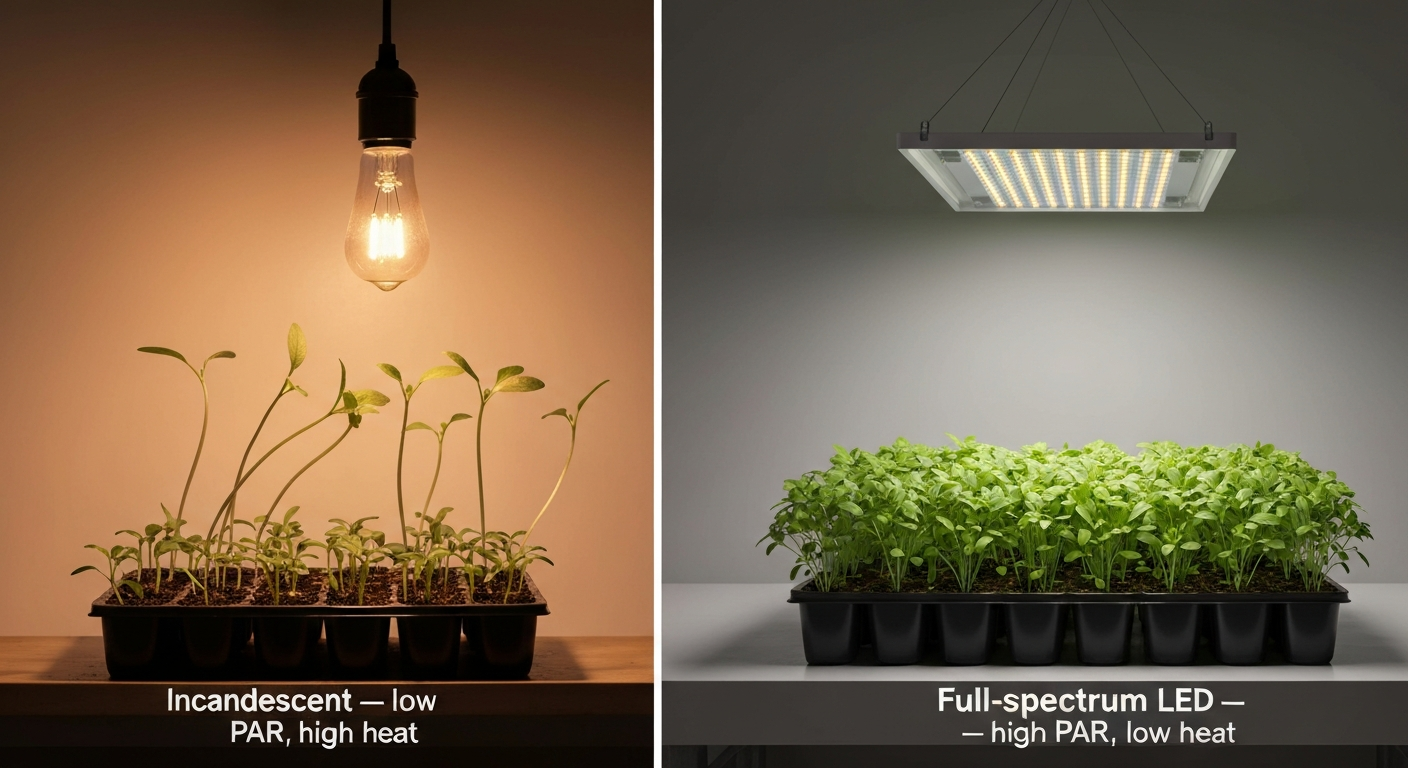
Plants do not care about brightness the way our eyes do. They care about photons in a specific energy range, roughly 400 to 700 nanometres, called photosynthetically active radiation, or PAR. This is the band mapped by agronomist K.J. McCree in the early 1970s across 22 crop species, and it still underpins every serious grow-light metric used today. The intensity of PAR hitting a leaf surface is measured in PPFD (photosynthetic photon flux density, in µmol/m²/s), and the daily total a plant receives is called DLI (daily light integral, in mol/m²/day). Lumens and lux, by contrast, describe brightness as the human eye perceives it, which is weighted toward green and yellow light. A lamp can look dazzlingly bright to you while delivering very little useful PAR to a plant.
Spectrum matters beyond just photosynthesis. Blue light (roughly 400 to 500 nm) drives compact, bushy growth through receptors called cryptochromes and phototropins, and keeps seedlings from stretching. Red light (roughly 600 to 700 nm) is the most efficiently used wavelength for photosynthesis itself. Far-red light and UV signals affect flowering timing, secondary compounds, and plant shape. This is why a white-spectrum LED that blends all these wavelengths tends to outperform a single-colour red lamp even at the same PPFD number.
Photoperiod, meaning how many hours of light per day, is the third lever. Most leafy greens and seedlings do well on 14 to 16 hours. Flowering plants, including cannabis, use photoperiod as a trigger: many varieties flower only when nights get long enough (12 hours of darkness or more). Getting the duration wrong can prevent flowering entirely, regardless of how good your bulb is.
The main types of grow bulbs explained
LED grow lights
Modern horticultural LEDs are the current gold standard for most home growers. The best units on the market today achieve 2.5 to 3.2 µmol per joule of photon efficacy (PPE), meaning they convert more of every watt drawn from the wall into usable plant photons than any competing technology. They run cool relative to their output, last 50,000+ hours, and are available in full-spectrum white or red-blue configurations. LED chips like Samsung's LM301H, rated at around 3.10 µmol/J, represent the kind of efficiency that trickles down into mid-range consumer fixtures. The main downside is upfront cost, though that gap versus fluorescent has closed significantly.
Fluorescent bulbs: CFL and T8/T5
Compact fluorescents and T8/T5 tube fixtures have a long track record for seedlings and low-light houseplants. Their PPE sits around 0.8 to 1.0 µmol/J, which is meaningfully lower than LEDs, but they are cheap, widely available, and easy to rig up. Their weakness is intensity: you can rarely get enough PPFD from fluorescents to satisfy fruiting crops or cannabis at serious yields. For starting seeds and growing lettuce under supplemental light, they are a legitimate budget option.
Incandescent and halogen bulbs
Standard incandescent and halogen bulbs produce very little PAR relative to the heat and electricity they consume. Most of their energy output is infrared heat, not plant-useful light. They will not grow most plants effectively, and positioning them close enough to raise PPFD to useful levels would burn the foliage from heat before it helped with photosynthesis. They are not a practical grow-light solution.
HID specialty bulbs: HPS, metal halide and CMH
High-intensity discharge lamps, including high-pressure sodium (HPS), metal halide (MH), and ceramic metal halide (CMH, also called LEC), are the traditional workhorses of commercial cannabis and tomato cultivation. Double-ended HPS reaches around 1.7 to 2.1 µmol/J, and CMH sits at roughly 1.4 to 1.6 µmol/J. They produce a lot of photons per fixture, which makes them effective at scale, but they also generate significant heat, require ballasts, and draw serious power. For a home grower with a small tent, a good LED panel has largely replaced them on a cost-per-photon basis.
Head-to-head: how the main grow bulb types compare
| Bulb Type | PPE (µmol/J) | Heat Output | Energy Use | Lifespan | Upfront Cost | Best Use |
|---|---|---|---|---|---|---|
| Full-spectrum LED | 2.5 – 3.2 | Low | Very low | 50,000+ hrs | Medium–High | All stages, all crops, small to large spaces |
| T5/T8 Fluorescent | 0.8 – 1.0 | Low–Medium | Moderate | 10,000–20,000 hrs | Low | Seedlings, leafy greens, clones, low-light houseplants |
| CFL | 0.8 – 1.0 | Low–Medium | Moderate | 8,000–15,000 hrs | Very Low | Small seedling trays, supplemental light |
| HPS (DE) | 1.7 – 2.1 | Very High | High | 10,000–24,000 hrs | Medium | Large flowering spaces, commercial veg/flower |
| CMH/LEC | 1.4 – 1.6 | High | High | 10,000–20,000 hrs | Medium–High | Full-cycle growing, decent spectrum quality |
| Incandescent | < 0.2 (est.) | Very High | Very High | 1,000–2,000 hrs | Very Low | Not effective for plant growth |
| Halogen | < 0.3 (est.) | Very High | High | 2,000–5,000 hrs | Low | Not effective for plant growth |
The recommendation here is clear: if you are buying something new for plants, a reputable full-spectrum LED is the best starting point for most home growers. It beats every other option on the combined scorecard of efficiency, heat, lifespan, and flexibility. Fluorescent tubes remain a reasonable budget choice for low-demand plants and seedlings. HID lamps still have a role in large, ventilated spaces where you need maximum raw photon output per fixture.
Can normal light bulbs grow plants? What about halogen and ordinary household bulbs?
This is one of the most common questions I see from beginners, and the honest answer is: not really, at least not for anything demanding. See our detailed discussion on whether normal light bulbs can grow plants for practical guidance. A standard A19 incandescent or a halogen spot produces most of its energy as heat and infrared, not PAR photons. The small amount of visible light it emits is weighted toward the red and yellow wavelengths our eyes find comfortable, but without meaningful blue-spectrum output and with negligible photon intensity, plants under these bulbs typically stretch toward any other light source, stay pale, and fail to thrive. You might keep a tough, low-light plant like a pothos barely alive, but you will not grow seedlings, herbs, or flowering plants successfully with regular household bulbs.
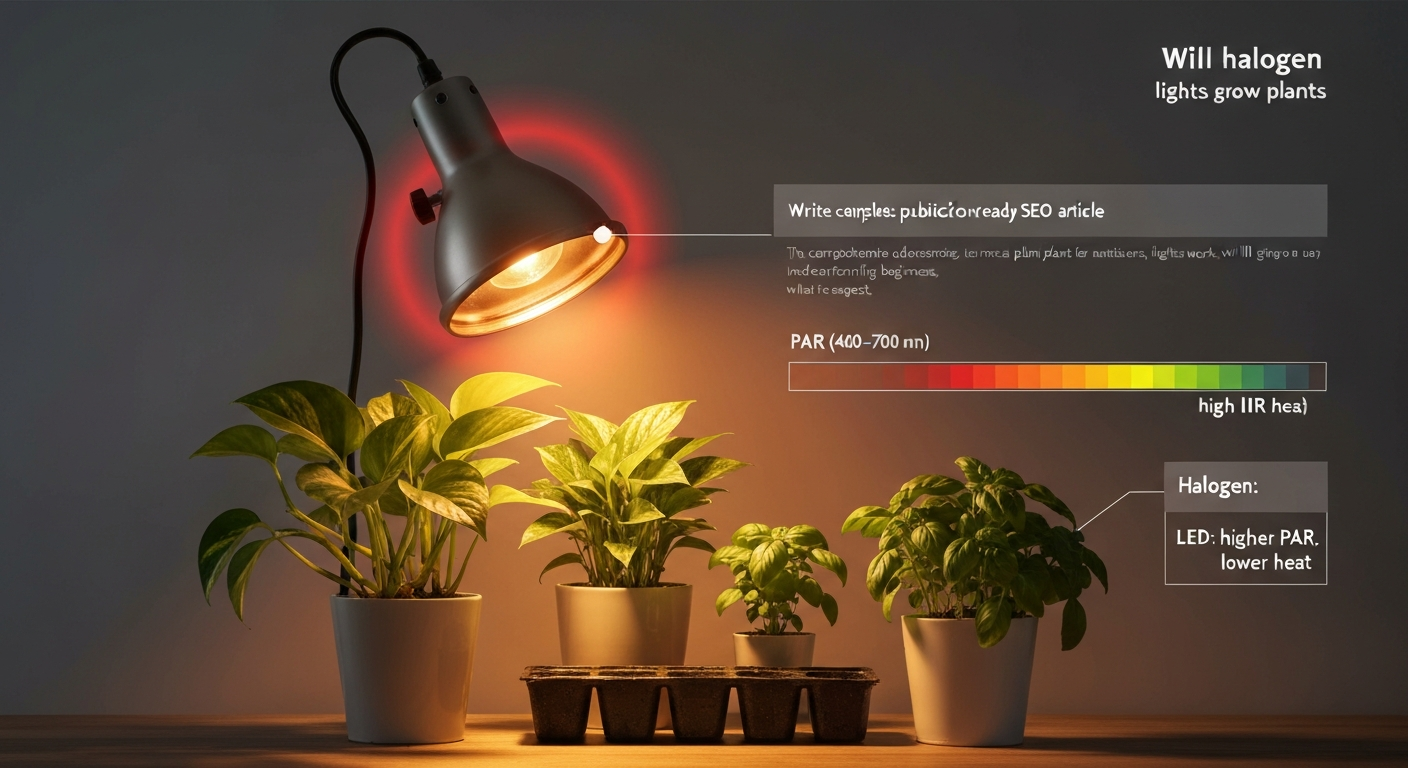
Halogen bulbs are only marginally better. They run hotter per lumen than incandescents, which creates a real leaf-scorch risk if placed close enough to matter for growth. The heat problem essentially rules them out as a practical option. See will halogen lights grow plants for a focused discussion on their effectiveness and heat risks. If you are curious about whether ordinary bulbs can substitute in a pinch, the short version is: they cannot replace a proper grow light for any plant that needs more than minimal supplemental light.
Do fluorescent lights and T8 bulbs actually grow plants?
Fluorescent tubes, including T8 and T5 formats and spiral CFLs, genuinely do support plant growth, with some important caveats. If you're wondering "can I use T8 bulbs to grow plants": yes, T8 fixtures can support seedlings and leafy greens effectively, but they usually cannot provide enough intensity for large flowering or fruiting crops. Their spectrum covers the PAR range reasonably well, particularly grow-specific tubes labelled 6500K (blue-heavy, good for vegetative growth) or 3000K (warmer, better for flowering encouragement). Do fluorescent lights grow plants? In short, yes, fluorescent tubes and CFLs can grow seedlings and low-light greens effectively when used and positioned correctly. The real limitation is intensity. A T8 shop-light fixture positioned 5 to 10 cm above a seedling tray will deliver workable PPFD for germination and early growth, but at 30 cm it drops off fast, and a mature tomato plant or a cannabis plant in flower needs far more light energy than fluorescents can economically deliver.
In a controlled growth-chamber study, polychromatic LED fixtures delivered equivalent PPFD to fluorescent tubes while consuming roughly 38% of the energy, which illustrates exactly why fluorescents, though usable, are increasingly a compromise rather than a recommendation. For seed starting, lettuce, spinach, herbs, and leafy greens in a small space, T8 or T5 fixtures with grow-specific or daylight tubes are a legitimate budget option. For anything flowering, fruiting, or large-scale, they will leave you wanting more.
Growing cannabis with household bulbs: what to realistically expect
Cannabis is a high-light crop that commercial growers target at a DLI of 20 to 35 mol/m²/day in vegetative growth and 35 to 50+ mol/m²/day in flower. To put that in perspective, achieving a DLI of 40 mol/m²/day over an 18-hour photoperiod requires a sustained PPFD of around 617 µmol/m²/s at canopy level. A standard household bulb delivers a tiny fraction of that. See can you grow cannabis with normal light bulbs for a focused discussion on household bulbs and cannabis cultivation. Even a modest CFL setup used by early DIY growers can manage seedlings and very small clones, but the yields from serious flowering plants under household-type bulbs are so small that most growers consider it impractical.
The practical reality is that cannabis grown under incandescent or halogen bulbs will stretch severely, flower poorly if at all, and produce minimal yields. Even fluorescent setups, while better, are generally limited to the vegetative stage of very small plants. For anyone serious about growing cannabis indoors, a purpose-built LED or HID fixture is not optional; it is the foundation of a workable result. A budget quantum-board LED from a reputable brand will outperform any collection of household bulbs you can rig together, at a lower electricity cost.
What about health risks? Grow lights, cancer, tans and eye safety
I want to address this directly because the questions come up constantly: no, sitting near a standard LED grow light will not give you a tan, and it will not cause cancer under normal home-growing conditions. IARC does classify ultraviolet radiation as a Group 1 carcinogen, but that classification applies to UV exposure broadly, primarily solar UV. Most horticultural LED fixtures emit very little UV-B (280 to 315 nm), if any at all. The ones that do include UV are tested to IEC 62471 and UL 8800 photobiological safety standards, which classify blue and UV hazard levels into risk groups and require that consumer products not fall into the highest risk group (RG3). A lamp certified to these standards under normal use poses no meaningful UV cancer risk.
Eye comfort is a more practical concern. High-intensity grow lights, especially those with strong blue output, can be uncomfortable or fatiguing to look at directly. Wearing basic UV-blocking glasses when working under high-power fixtures for extended periods is sensible, not because the fixture is dangerous in a clinical sense, but simply for comfort. The blue-rich spectrum that benefits plants is the same one that suppresses melatonin in humans, so avoid running high-intensity grow lights in sleeping areas during night hours.
Setting up your grow lights for real results
Mounting distance and PPFD targets by plant type
The single biggest setup mistake I see is hanging the light too high or too low. Too high and PPFD drops dramatically (intensity follows the inverse square law, so doubling your distance quarters your intensity). Too low and you risk heat stress or light burn. LED fixtures generally mount much closer to the canopy than HID lamps because they generate less radiant heat. Extension guidance, greenhouse lighting design, DLI/PPFD calculations and placement/ventilation recommendations provides practical setup recommendations including designing to crop DLI, prioritizing PPFD uniformity, mounting LEDs closer to the canopy than HIDs, and using timers, dimming and ventilation to manage heat Extension guidance — greenhouse lighting design, DLI/PPFD calculations and placement/ventilation recommendations. As a starting guide, most full-spectrum LED panels can safely sit 30 to 60 cm above seedlings and 15 to 45 cm above mature leafy greens, though you should always check the manufacturer's PPFD map for your specific fixture.
| Plant / Stage | Target PPFD (µmol/m²/s) | Target DLI (mol/m²/day) | Photoperiod (hrs/day) |
|---|---|---|---|
| Germination / seedlings | 50 – 150 | 3 – 7 | 16 – 18 |
| Leafy greens (lettuce, spinach) | 150 – 300 | 12 – 17 | 14 – 16 |
| Herbs (basil, parsley) | 200 – 400 | 12 – 18 | 14 – 16 |
| Tomatoes / fruiting crops | 400 – 700+ | 20 – 30+ | 14 – 18 |
| Cannabis vegetative | 400 – 600 | 20 – 35 | 18 – 20 |
| Cannabis flowering | 600 – 900+ | 35 – 50+ | 12 |
Timers, fixtures and reflective surfaces
A simple plug-in mechanical or digital timer is one of the best investments a home grower can make. Consistent photoperiods matter more than most people expect, and manually switching lights is unreliable. Set the timer when you set up the fixture, and do not change it unless you are intentionally shifting a plant into flowering. For fixtures, a dedicated grow tent with mylar interior walls will reflect stray light back toward the canopy and meaningfully increase effective PPFD without any extra electricity. If you are not using a tent, hanging flat white paint or emergency blankets behind your plants does much the same job. Ventilation matters especially for HID setups: high canopy temperature (above about 28 to 30°C) reduces photosynthetic efficiency even with perfect light.
Measuring your light properly
Do not trust the watt rating or lumen figure on the box to tell you what PPFD your plants are actually receiving. Lux meters read visible brightness, not plant-useful photons, and conversion factors vary wildly between lamp types. For example, 1 µmol/m²/s equals roughly 54 lux for sunlight but a very different number for HPS or fluorescent. The correct tool is a quantum PAR sensor (brands like Apogee and LI-COR make well-validated ones). If buying a dedicated sensor is out of budget, look for grow-light brands that publish independently verified PPFD maps at multiple mounting heights, and use those maps as your setup guide.
Troubleshooting: stretching, burn and poor flowering
- Stretching / leggy seedlings: almost always caused by insufficient PPFD or light that is mounted too far away. Move the fixture closer or increase the duration. Insufficient blue-spectrum light also contributes, so if you are using a warm-white or red-heavy fixture, supplement with a cooler-spectrum source.
- Leaf burn or bleaching at the top of the canopy: the light is too close or too intense for that plant at that stage. Raise the fixture by 5 to 10 cm at a time and observe for 48 hours. Cannabis tops are particularly prone to bleaching under high-power LEDs mounted too close.
- Poor or no flowering: check photoperiod first. Short-day plants like cannabis need uninterrupted dark periods of at least 12 hours. Even a small light leak during the dark period can delay or prevent flowering. Spectrum matters too: a light heavy in blue and deficient in red will keep some plants in a vegetative state.
- Slow growth despite correct PPFD: check temperature, CO2, watering, and nutrition before blaming the light. A grow light can only do its job if the rest of the environment supports it.
- High electricity bills: this points to an older or inefficient fixture. LED panels with PPE above 2.0 µmol/J will deliver more photons per watt than anything older. The DOE estimated that a theoretical all-LED shift in horticultural lighting could cut sector lighting electricity use by around 34%.
Quick buying guidance
When shopping for a grow bulb or fixture, ignore watt equivalency claims and marketing language. Look for published PPF (total photon output, in µmol/s) or PPFD maps at your intended mounting height, and a PPE figure above 2.0 µmol/J for a modern LED. If the brand cannot provide those numbers, that is a red flag. For seedlings and leafy greens on a tight budget, a T5 or T8 fluorescent grow fixture still works and costs very little upfront. For anything fruiting or flowering, invest in a reputable LED quantum-board panel. Fixtures listed under the DesignLights Consortium (DLC) Horticulture program have independently verified PPF and PPE data, which takes most of the guesswork out of comparing products.
FAQ
Do grow bulbs work — will artificial bulbs let me grow healthy plants indoors?
Yes. Grow bulbs that deliver adequate photosynthetic photon flux (PAR, 400–700 nm) and the right light dose (PPFD × hours → DLI) reliably support plant growth. Modern horticultural LEDs and properly specified fluorescent/HID systems produce usable PAR efficiently. Ordinary incandescent bulbs and most consumer halogens produce very little PAR per watt and are poor choices except for tiny, low‑light houseplants.
Which bulb types are effective for plant growth (LED, fluorescent/T8/CFL, HID, incandescent/halogen, specialty)?
Best: purpose‑built horticultural LEDs (high PPE, long life, tunable spectrum). Good: commercial fluorescent tubes (T5/T8) and CFLs for seedlings, herbs and low‑DLI leafy greens at low heights. HID (HPS, ceramic metal halide) deliver high PPFD for large fruiting crops but are less energy‑efficient and hotter. Poor: incandescent and consumer halogen — low PAR efficacy and high heat. Specialty bulbs with added UV or far‑red can be useful if controlled and tested.
How does light spectrum affect plants — what wavelengths matter?
PAR (400–700 nm) provides photons for photosynthesis. Blue (≈400–500 nm) promotes compact growth, leaf formation, stomatal opening and chlorophyll; red (≈600–700 nm) drives photosynthesis efficiently and influences flowering/photoperiod with phytochromes; far‑red (700–750 nm) alters shade responses and flowering timing; UV‑B (280–315 nm) can stimulate protective secondary metabolites at low doses. Use broad white LEDs or mixed red/blue spectra depending on crop and stage.
What are PAR, PPFD and DLI and why do they matter?
PAR = photosynthetically active radiation (400–700 nm). PPFD = photosynthetic photon flux density (µmol·m⁻²·s⁻¹) — photons arriving at the canopy per second. DLI = daily light integral (mol·m⁻²·d⁻¹) — total PAR photons delivered per day. Crop growth correlates with DLI and PPFD; design lighting to meet crop‑ and stage‑specific DLI targets for good yield.
Can I use normal household light bulbs to grow plants (including cannabis)?
Short answer: not effectively. Household LEDs or incandescents are designed for human vision (lumens), not PAR. They may keep tolerant low‑light houseplants alive but lack intensity/spectrum for vigorous growth or flowering in most crops, including cannabis. Cannabis and other high‑DLI, flowering crops require dedicated horticultural fixtures (high‑output LEDs or HID) to reach recommended DLI for good yields.
Do fluorescent lights or T8/T5 bulbs work for seedlings and leafy greens?
Yes—T5/T8 fluorescent tubes and compact fluorescent lamps (CFLs) work well for seedlings, microgreens, herbs and some leafy greens at small scale. They give reasonably broad spectrum and low heat, but are less energy‑efficient and have shorter lifespans than modern LEDs. For higher DLI crops or larger installations, LEDs are usually a better energy and maintenance choice.
Next Articles
Will Halogen Lights Grow Plants? Guide for Home Gardeners
Can halogen lights grow plants? Evidence-based guide on spectrum, wattage, heat, runtimes, and when to use other lights.
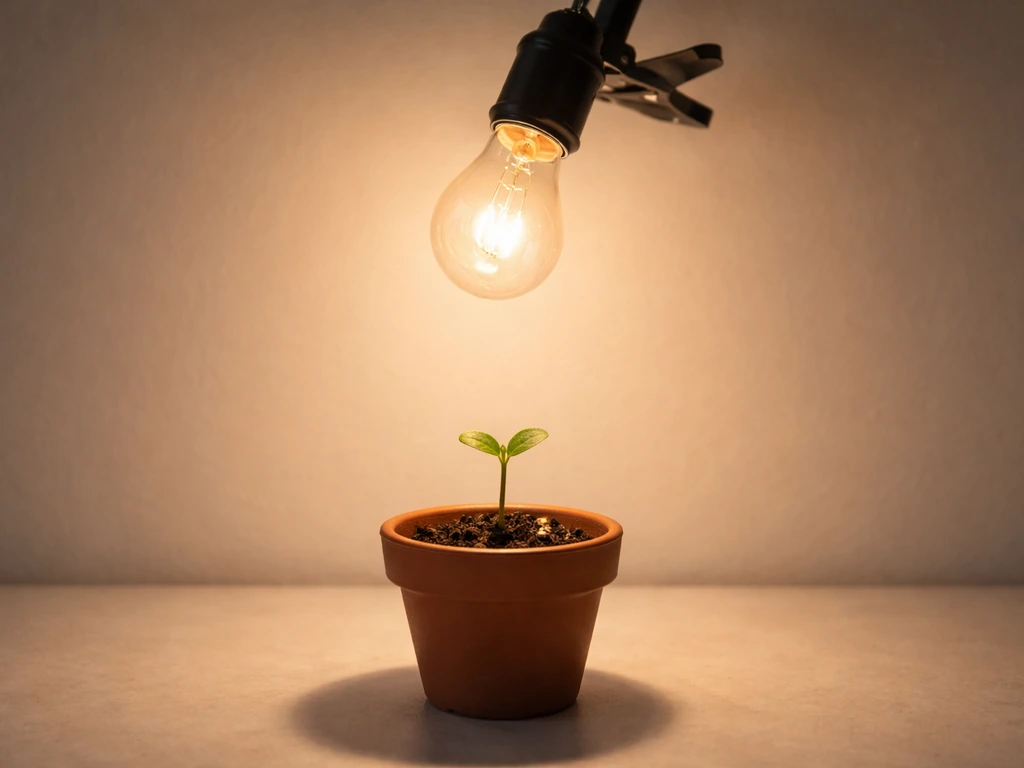
Can Normal Light Bulb Grow Plants? What to Expect and How
Can a regular household bulb grow plants? Learn spectrum limits, safe setup, positioning, hours, and realistic results.
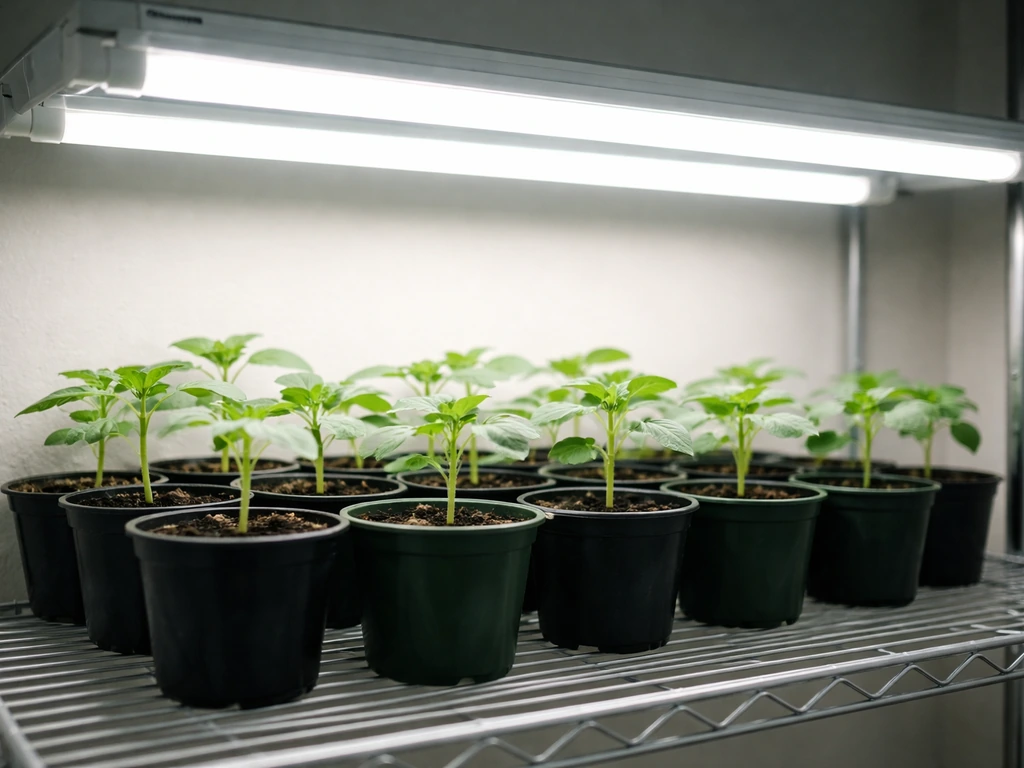
Do Fluorescent Lights Grow Plants? How to Use Them
Yes, fluorescent lights can grow plants. Learn which bulbs to use, setup distance and hours, and limits for best results