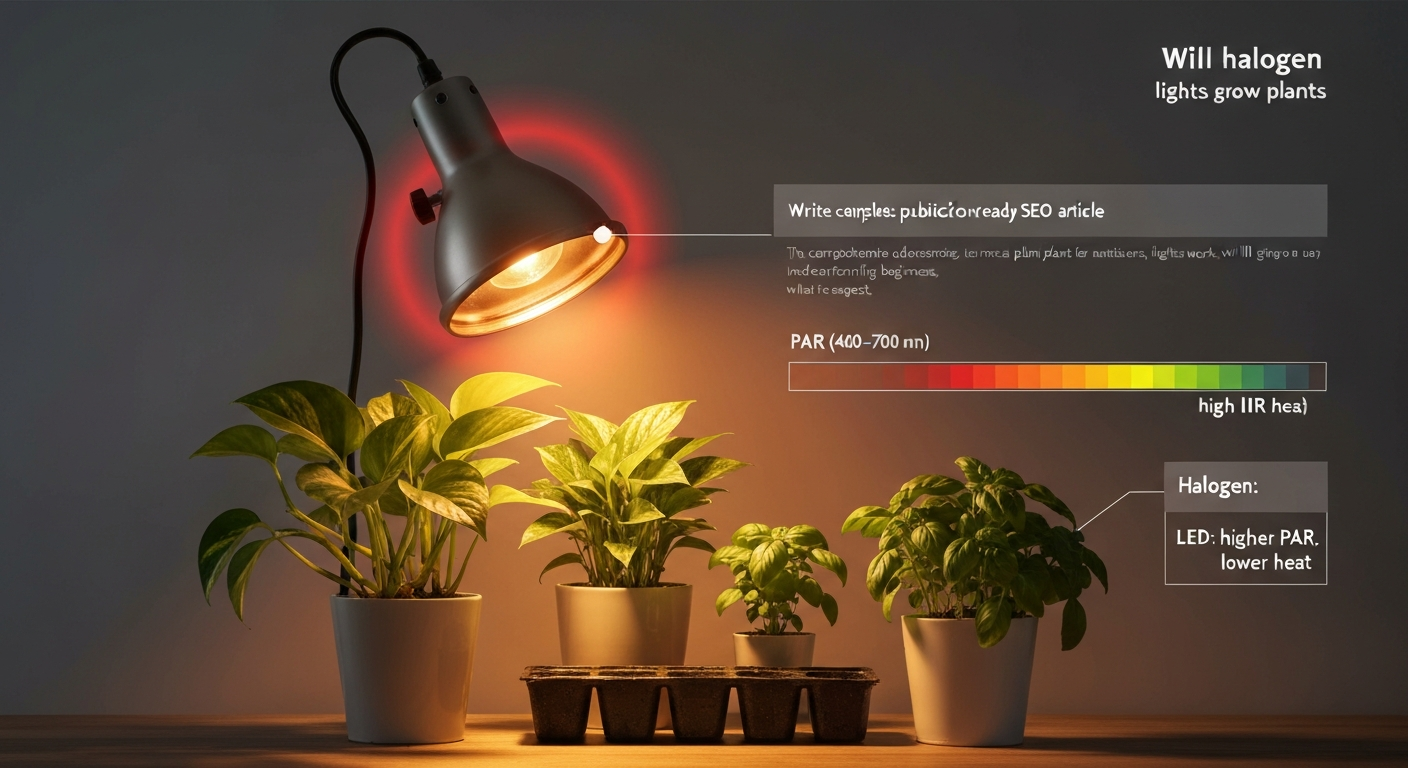
Halogen lights can technically support plant growth in a narrow set of circumstances, but they are a poor choice for almost every indoor gardener. They produce usable light in the red and some blue wavelengths that plants need, but the vast majority of their energy comes out as heat and infrared radiation that plants cannot use at all. The result is a light source that runs hot, burns through electricity, and delivers far fewer photosynthetically active photons per watt than almost any dedicated alternative. A 39 W halogen reflector lamp delivers an estimated 22 μmol/s of plant-usable light, while a comparably priced LED grow bulb at the same wattage can deliver four to six times that. Halogens can keep low-light houseplants alive or supplement a dim windowsill, but they cannot reliably grow seedlings, herbs, or flowering plants on their own without significant fire risk and a surprisingly high electricity bill.
Will Halogen Lights Grow Plants? Guide for Home Gardeners
Who this guide is for
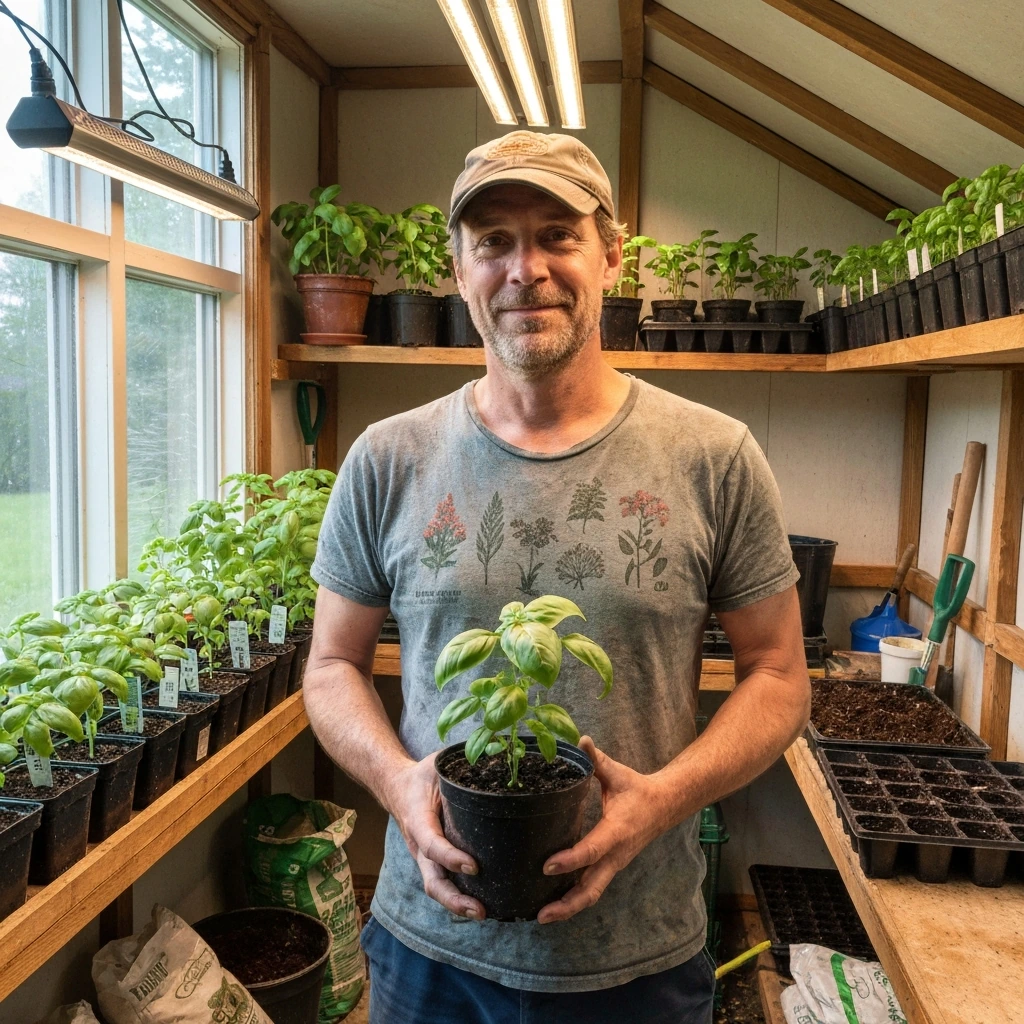
If you have a halogen lamp sitting in your house and you are wondering whether to point it at your plants, this article is for you. The same goes for anyone who has heard conflicting advice about "any warm light" working for plants and wants a straight answer grounded in actual measurements. I am coming at this as a home gardener who has tried a few ill-advised setups (including a very warm halogen desk lamp over a seed tray that did not end well) and later dug into the technical data to understand why. You will find plain explanations of the science, practical wattage and distance guidance, a side-by-side comparison of halogens versus other common options, and honest advice about when it is simply not worth the effort.
How plants actually use light
Plants do not use all light equally. Photosynthesis responds mainly to photons in the 400 to 700 nanometer range, which researchers call photosynthetically active radiation, or PAR. Within that band, chlorophyll a and b absorb most strongly in the red (around 630 to 680 nm) and blue (around 430 to 450 nm) regions, though the orange and some green wavelengths contribute too. Light outside PAR, especially infrared beyond 700 nm, mostly just warms the leaf rather than driving photosynthesis.
The practical measurement you want to know is PPFD: photosynthetic photon flux density, measured in micromoles of photons per square meter per second (μmol/m²/s). Think of it as the number of useful photons landing on your plant every second. University of Minnesota Extension guidance groups indoor plants into rough PPFD needs: low-light plants (pothos, peace lily) do fine at 50 to 150 μmol/m²/s, medium-light plants like herbs and lettuce want 150 to 250 μmol/m²/s, and high-light plants such as tomatoes and peppers want 250 to 450 μmol/m²/s or more. You can also think in terms of daily light integral (DLI), which is just PPFD multiplied by hours of light and a conversion factor. Lettuce targets around 12 to 17 mol/m²/day; fruiting crops like tomatoes need 22 to 30 mol/m²/day.
Lux, which you will see on many general-purpose lighting spec sheets, measures brightness as the human eye perceives it. It is not a reliable proxy for plant growth because it weights green light (which the eye is most sensitive to) heavily and weights red and blue (which plants use most) less. A lamp that looks bright to your eye may be delivering fewer useful PAR photons than a dimmer-looking LED. Always look for PPFD data when evaluating any grow light.
What halogen bulbs actually are
Halogen lamps are a refined version of the incandescent bulb. A tungsten filament sits inside a small quartz envelope filled with a halogen gas (usually iodine or bromine). The gas recycles evaporated tungsten back onto the filament, which allows the filament to run hotter and brighter than a standard incandescent. That higher filament temperature nudges the color temperature up to around 2,900 to 3,200 K compared to the 2,700 K of a typical incandescent, and it produces a continuous, warm-white spectrum.
The problem is that a tungsten filament, even at its best, emits most of its radiant energy as infrared. For a 3,150 K blackbody (roughly what the OSRAM 64516 300 W halogen operates at), the peak emission is around 920 nm, well outside the PAR window. Only a fraction of the total radiant output falls in the 400 to 700 nm band. Using the conversion factor from Lighting Analysts' ElumTools reference (20. Lighting Analysts' ElumTools, Appendix G: Light for Plants (PPF conversion factors including CIE A = 20.3) lists a PPF conversion factor for CIE A (incandescent spectrum) of 20.3 μmol/s per kilolux, used to estimate PAR output from kilolux values ElumTools — Appendix G: Light for Plants (PPF conversion factors including CIE A = 20.3). 3 μmol/s per kilolux, applied to incandescent-type spectra), a 300 W halogen rated at 7,800 lumens delivers an estimated PPF of about 158 μmol/s. That sounds reasonable until you realize that same 300 W is also pumping out roughly 1,020 BTU/hour of heat into your growing space (300 W × 3.41 BTU/h per watt). That heat is not just an inconvenience; it is a fire and leaf-scorch hazard.
Halogen lamps come in several common forms for home use: PAR20 and PAR30 reflector lamps (39 W and 53 W are typical retail wattages), double-ended linear halogens used in work lights, and single-ended capsule types. The PAR-style reflector versions are the most practical for plant use because the reflector concentrates light downward rather than letting it scatter in all directions.
The efficiency problem, by the numbers
Photosynthetic photon efficacy (PPE) is the number of PAR photons delivered per joule of electricity used, expressed in μmol/J. It is the clearest way to compare light sources for plant growing. Halogen and incandescent lamps typically land in the 0.2 to 0.8 μmol/J range depending on the bulb and how well the fixture focuses light. Modern horticultural white LEDs commonly achieve 2.5 to 3.8 μmol/J, and even decent HPS fixtures reach 1.5 to 1.8 μmol/J. In plain terms, for every watt of electricity you spend on a halogen, an LED grow light gives you roughly four to six times as many plant-useful photons.
| Light source | Typical PPE (μmol/J) | Spectrum quality for plants | Heat output | Lamp life | Energy cost (monthly, 300 W equiv., 16 h/day at $0.18/kWh) |
|---|---|---|---|---|---|
| Halogen | ~0.2–0.8 | Warm white, red-heavy, low blue | Very high | 75–4,400 h (varies widely) | ~$26 |
| Standard incandescent | ~0.15–0.5 | Very warm, red-heavy, very low blue | Extremely high | ~1,000 h | ~$26 |
| Fluorescent / T8 | ~1.0–1.6 | Full visible spectrum, decent blue and red | Low-moderate | ~20,000–30,000 h | ~$5–$8 (equiv. PAR output) |
| HPS (high-pressure sodium) | ~1.5–1.8 | Orange-red dominant, lower blue | High | ~10,000–24,000 h | ~$9–$11 |
| Horticultural LED | ~2.5–3.8 | Targeted spectrum, strong red and blue | Low | ~36,000–50,000+ h | ~$4–$7 |
Running a 300 W halogen for 16 hours a day uses 4.8 kWh per day, which at the 2026 U.S. average residential electricity rate of around $0.18/kWh comes to about $0.86/day or roughly $26/month. Because so much of that energy is wasted as infrared heat, the actual cost per useful PAR photon delivered is far higher than any of the alternatives in the table above.
Honest verdict: when halogens can (and cannot) grow plants
There is no single yes or no here. Whether halogens help your plants depends on what you are growing, how much natural light is already available, and how you manage the heat. Here is how I would break it down.
Where halogens can do the job
- Supplementing a dim but not completely dark windowsill for low-light houseplants (pothos, peace lily, snake plant) that need only 50 to 150 μmol/m²/s — a 50 W halogen PAR reflector placed 20 to 25 cm away can hit that low end.
- Short-term emergency backup if a dedicated grow light fails and you need to keep delicate seedlings alive for a few days.
- Very small-scale herb maintenance on a countertop where a halogen desk lamp is already present and you just want to give basil a bit more light than the room provides.
Where halogens fall short
- Seed starting: seedlings need 16 to 18 hours of light per day and at least 150 to 250 μmol/m²/s. Sustaining that with halogens means running hot lamps very close to young plants — a recipe for heat stress and fire risk.
- Herbs and leafy greens in full indoor production: they need 12 to 18 mol/m²/day DLI, which requires sustained medium-to-high PPFD. You would need multiple high-wattage halogens, creating a serious heat problem.
- Flowering and fruiting crops (tomatoes, peppers, cannabis): these need DLI targets of 22 to 30 mol/m²/day. Halogens cannot get there safely or economically.
- Any setup where the lamp cannot be mounted with adequate clearance and airflow — an enclosed shelf, a tent, or a closet.
Setting up halogens safely: wattage, fixtures, and reflectors
If you do decide to use a halogen light for plants, the fixture choice matters as much as the bulb. blank" rel="noopener noreferrer">OSRAM's own datasheet for high-wattage halogen lamps explicitly states that these lamps must be operated only in suitable luminaires with protective shields and proper clearances. Do not use bare-socket setups, paper reflectors, or any housing not rated for the lamp wattage. For plant use, PAR20 (39 W) and PAR30 (53 W) halogen reflector lamps in standard track lighting or adjustable clamp fixtures are the most manageable options. The built-in reflector helps direct light downward rather than losing half the output sideways.
Avoid work-light-style double-ended linear halogens near plants. These run extremely hot, are designed for large open spaces, and are harder to position safely. If you are considering a 300 W or higher halogen for plant production, I would strongly recommend reconsidering: the heat output (over 1,000 BTU/hour) will raise ambient temperatures significantly in small grow spaces and can scorch leaves or dry out soil in minutes at close range.
Never place a halogen lamp in a recessed fixture that is not IC-rated (insulation contact rated) and never position it near combustible materials. This is not just a gardening tip, it is a fire safety issue cited consistently in electrical code guidance and manufacturer safety notes.
Mounting distances, coverage, and PPFD estimates
Light intensity falls off with the square of the distance from the source (the inverse-square law). This matters a lot with halogens because the heat also falls off with distance, so you are always balancing usable light against burn risk. The estimates below use a calculated PPE of approximately 0.5 μmol/J for a halogen reflector lamp, which is a reasonable mid-range figure based on the ElumTools CIE-A conversion applied to manufacturer lumen data.
| Lamp wattage | Estimated PPF (μmol/s) | Distance from canopy | Estimated PPFD (μmol/m²/s) | Suitable plant stage | Heat caution |
|---|---|---|---|---|---|
| 39 W PAR20 | ~20 | 15 cm (6 in) | ~140 | Low-light houseplants (maintenance) | Surface can reach 120°C+ — check with thermometer |
| 39 W PAR20 | ~20 | 30 cm (12 in) | ~35 | Below threshold for most active growth | Safer distance but light too low for seedlings |
| 53 W PAR30 | ~27 | 15 cm (6 in) | ~190 | Low-light herbs (marginal) | Too close for extended use — leaf scorch likely |
| 53 W PAR30 | ~27 | 25 cm (10 in) | ~69 | Low-light supplemental only | Manageable heat at this distance |
| 100 W halogen (bare or PAR38) | ~50 | 20 cm (8 in) | ~99 | Low-medium light plants (short sessions) | High heat — monitor leaf temperature closely |
| 100 W halogen (bare or PAR38) | ~50 | 50 cm (20 in) | ~16 | Below useful threshold | Heat less of a concern at this distance |
A practical rule of thumb: hold the back of your hand at canopy level for 30 seconds. If it feels uncomfortably warm, the lamp is too close. Leaf surface temperature over roughly 30 to 35°C will start to stress most plants, and halogen lamps can cause leaf scorch within minutes at close range. Keep a small thermometer at canopy level for the first few sessions.
Coverage area is limited with small halogen reflectors. A 39 W PAR20 at 20 cm will light a circle roughly 20 to 25 cm in diameter at useful intensity. For a standard 10-cell seedling tray, you would need multiple lamps, multiplying both the cost and the heat load.
Run times by growth stage
Using University of Minnesota Extension photoperiod guidelines as a starting point: seedlings benefit from 16 to 18 hours of light per day, hydroponic lettuce and herbs from 12 to 14 hours, and flowering houseplants from 14 to 16 hours. To work out whether your halogen setup can meet these needs, plug your estimated PPFD into the DLI formula: PPFD × hours × 0.0036 = DLI in mol/m²/day. For example, a 53 W PAR30 delivering 69 μmol/m²/s at 25 cm for 14 hours gives a DLI of only about 3.5 mol/m²/day, well below the 12 to 17 mol/m²/day that lettuce needs. Even running it 18 hours only gets you to 4.5 mol/m²/day. That is the core problem with halogens: the PPFD is too low at safe distances to accumulate an adequate daily light dose.
Heat, fire risk, and safety steps
This section is worth taking seriously. Halogen bulbs run genuinely hot. A 100 W halogen produces about 341 BTU/hour of heat (using the NIST conversion of 1 W = 3.41 BTU/hour). A 300 W unit produces over 1,000 BTU/hour. That is roughly the same heat output as a small space heater. Confined in a grow tent or on a shelf, this will rapidly raise air temperature, stress roots, and dry out growing medium.
- Always use a fixture specifically rated for the halogen wattage you are running — do not improvise with generic lamp sockets.
- Ensure at least 30 to 50 cm of clear air space above and around the lamp with no combustible materials nearby.
- Run a small fan to move air between the lamp and the canopy. This reduces leaf surface temperature and lowers the effective heat load on the plants.
- Use a timer so lamps are never left on unattended for long periods, especially in enclosed spaces.
- Check canopy temperature with a cheap infrared thermometer before leaving the setup running for hours.
- Never mount halogens in an enclosed fixture or recessed housing that is not IC-rated.
- Replace lamps at or before their rated life — a failing halogen can arc and overheat.
Troubleshooting common halogen grow light problems
Leggy, stretched seedlings
If seedlings are tall, thin, and leaning toward the light, they are not getting enough PPFD. With halogens, the safe distance is usually too far for adequate intensity. Move the lamp closer if heat allows, add more lamps, or switch to a fluorescent or LED source that can deliver higher PPFD without the heat penalty.
Leaf scorch or brown tips
This almost always means the lamp is too close or the canopy temperature is too high. Increase the distance, add a fan, or reduce the run time. If leaves nearest the light are wilting while others are fine, heat stress rather than light intensity is the issue.
Soil drying out much faster than normal
The infrared and radiant heat from halogens evaporates moisture from the soil surface quickly. Check moisture more frequently than you would under cooler light sources, and consider covering the soil surface between waterings.
No visible growth improvement after a few weeks
If plants are not responding after two to three weeks of halogen supplementation, the PPFD at canopy level is probably below the plant's compensation point. Measure or estimate PPFD more carefully and compare it against the targets in the section above. For most active-growth scenarios, you need a different light source.
Myths about grow lights and your health
A few fears come up repeatedly when people start looking into any kind of grow light, including halogens. Halogen lamps do not emit meaningful levels of UV radiation. Standard quartz-halogen lamps emit a small amount of near-UV (around 320 to 400 nm), but not enough to cause a sunburn or a tan, and far less than sunlight. The idea that sitting near a halogen grow light will give you a tan is a myth. Similarly, there is no credible evidence that the light from halogen or LED grow lights causes cancer at normal indoor exposure levels. The wavelengths involved (visible light and near-infrared) are non-ionizing, meaning they do not have the energy to damage DNA the way UV-B or X-rays do. The real health considerations with halogens are practical ones: burn risk from touching the bulb or positioning plants too close, and fire risk from improper fixtures.
How halogens compare to your other options
If you are weighing halogen against other common options you might already have at home, the picture is fairly consistent. Standard incandescent bulbs (normal light bulbs) are slightly worse than halogens for plant growth: lower filament temperature means less blue light and even lower PPE, typically under 0.5 μmol/J. Fluorescent lamps, including T8 tubes, are noticeably better: their PPE is roughly double to triple that of halogens, they run much cooler, and their spectrum includes more of the blue range that drives vegetative growth. For a deeper comparison of how fluorescent lights perform for growing plants, see our guide titled "do fluorescent lights grow plants.". T8 fixtures can sustain seedlings and herbs across full photoperiods without the fire and heat concerns. For detailed guidance on using T8 fixtures for seedlings and herbs, see the guide titled "can i use t8 bulbs to grow plants" for setup tips and performance expectations. Dedicated grow bulbs (LED-based grow bulbs designed for plant production) step things up further with targeted red and blue spectrum output and PPE values well above 2. For a deeper look at whether do grow bulbs work for different plants and setups, see the guide on do grow bulbs work. 0 μmol/J in many cases.
The bottom line on alternatives: if you already have fluorescent shop lights or T8 fixtures, those will outperform halogens for plants in almost every scenario. If you are buying something new, a basic LED grow light or grow bulb will cost less to run, last much longer, and deliver four to six times the useful light per watt. A 300 W halogen running 16 hours a day costs about $26/month in electricity. A comparable LED fixture delivering the same PPFD would typically consume 60 to 80 W and cost $3 to $5/month.
My honest recommendation
Use a halogen only if it is genuinely the only option you have right now and you are maintaining low-light houseplants, not trying to grow something actively. Position it no closer than 20 to 25 cm from the canopy, run a fan, check leaf temperature, and use a timer. Do not expect dramatic growth. If you are starting seeds, growing herbs for harvest, or attempting flowering plants without any natural light, a halogen will frustrate you. For specific guidance on whether ordinary household bulbs can support cannabis growth, see our article titled "can you grow cannabis with normal light bulbs.". Even a cheap fluorescent shop fixture or a basic LED grow bulb will serve you dramatically better for the same or lower electricity cost. The halogen's one genuinely useful trait for indoor gardeners, its continuous, warm-white spectrum, is outweighed at every turn by its heat output, low PAR efficiency, and short lamp life compared to modern alternatives.
FAQ
SEO title
Will Halogen Lights Grow Plants? Evidence-based Guide for Home Gardeners
160-character description
Can halogen bulbs grow plants? Clear verdict, science (spectrum, PPFD), wattages, distances, runtimes, heat/safety tips, comparisons to LED/HPS/T8, and next steps.
Core answer: Will halogen lights grow plants?
Short verdict: Yes — halogen bulbs can support basic plant growth (seedlings and foliage) in small, low‑light setups, but they are inefficient and often inadequate for vigorous flowering or commercial yields. Explanation: halogen (tungsten‑halogen) lamps emit a continuous, near‑blackbody spectrum that includes usable PAR (400–700 nm) but puts a large portion of energy into infrared/heat. Their photosynthetic photon efficacy (PPE) is typically low (~0.2–0.8 μmol·J⁻¹), so they produce fewer photosynthetic photons per watt than modern LEDs or good HPS fixtures. For occasional home use or supplementing natural light they are workable; for reliable flowering, high yields, or energy‑efficient production, better alternatives exist.
How do halogen spectra and light quality affect plants?
Halogens emit a broad continuous spectrum biased toward red and infrared (warm color temperature ~2800–3200 K). Plants use photons in 400–700 nm (PAR); halogens provide PAR but with relatively less blue per watt than white LEDs and a lot of IR heat. Blue light (400–500 nm) promotes compact growth and strong leaf development; red (600–700 nm) drives stem elongation and flowering responses. Halogens supply both but in ratios and efficiencies that limit their effectiveness compared to purpose‑built grow lights optimized for PAR.
What about light intensity — PPFD and distance?
Halogen lamps behave approximately like point sources: PPFD falls roughly with the inverse square of distance. Typical small reflector halogen (e.g., 39 W PAR20) may produce tens of μmol·m⁻²·s⁻¹ at 20–30 cm and drop quickly with distance (e.g., <20 μmol·m⁻²·s⁻¹ at 50 cm). Large high‑power halogens (e.g., 300 W) can produce several hundred μmol·s⁻¹ total PPF, but to get medium PPFD bands (150–250 μmol·m⁻²·s⁻¹) you must mount them very close — which increases burn/fire risk. Always measure PPFD with a PAR meter where possible; otherwise assume rapid falloff and plan closer mounting for seedlings and low beds only.
Recommended wattages, mounting distances, and expected PPFD (practical guidance)
Practical examples: - Small reflector (35–50 W PAR): mount 20–30 cm above seedlings → expect ~20–60 μmol·m⁻²·s⁻¹ (useful for low‑light houseplants/seedlings). - Medium lamp (100 W bare or reflector): mount 20–30 cm → roughly 80–120 μmol·m⁻²·s⁻¹ at center; at 50 cm it falls <25 μmol·m⁻²·s⁻¹. - High‑power studio halogen (200–300 W): at 20 cm you can approach 200–300 μmol·m⁻²·s⁻¹ at the hotspot, but heat is very high and bulb/fixture temperatures are dangerous. Use these only with protective fixtures and distance adjustments. Note: these are estimates — actual PPFD depends on lamp optics; measure when possible.
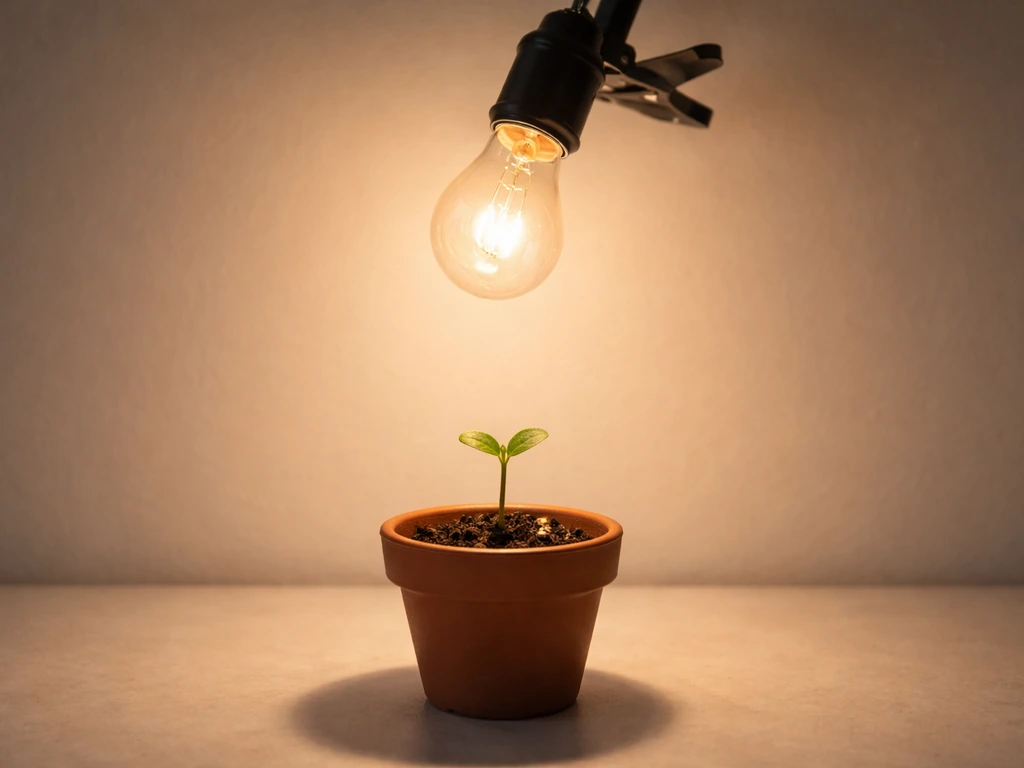
Can a regular household bulb grow plants? Learn spectrum limits, safe setup, positioning, hours, and realistic results.
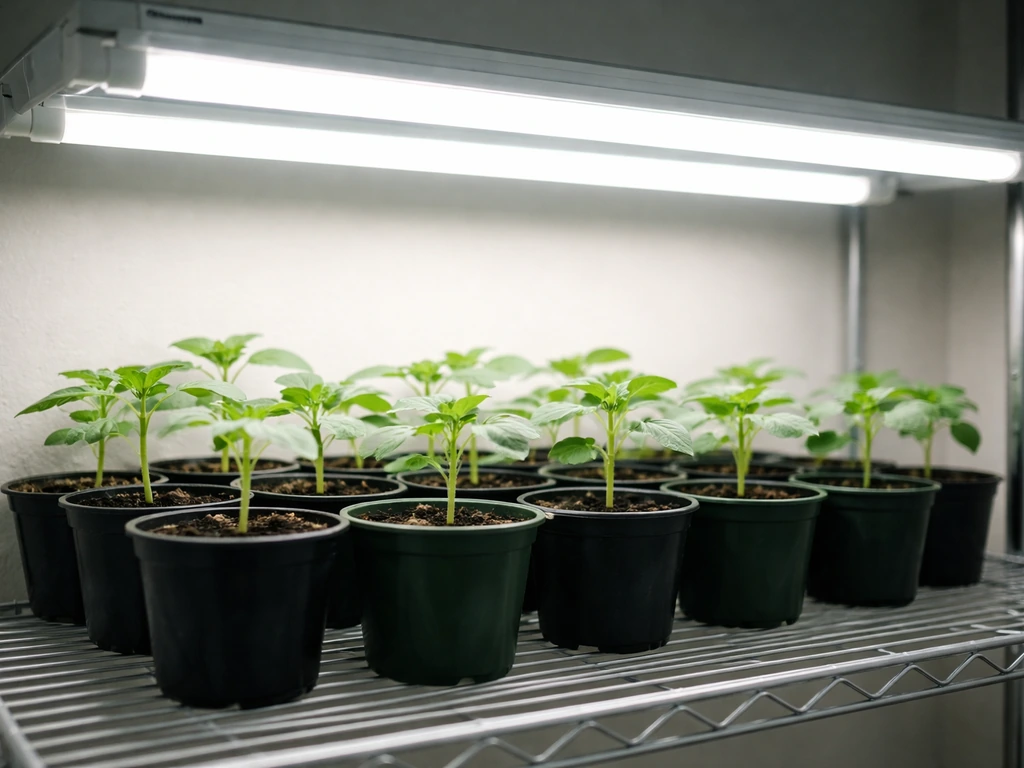
Yes, fluorescent lights can grow plants. Learn which bulbs to use, setup distance and hours, and limits for best results
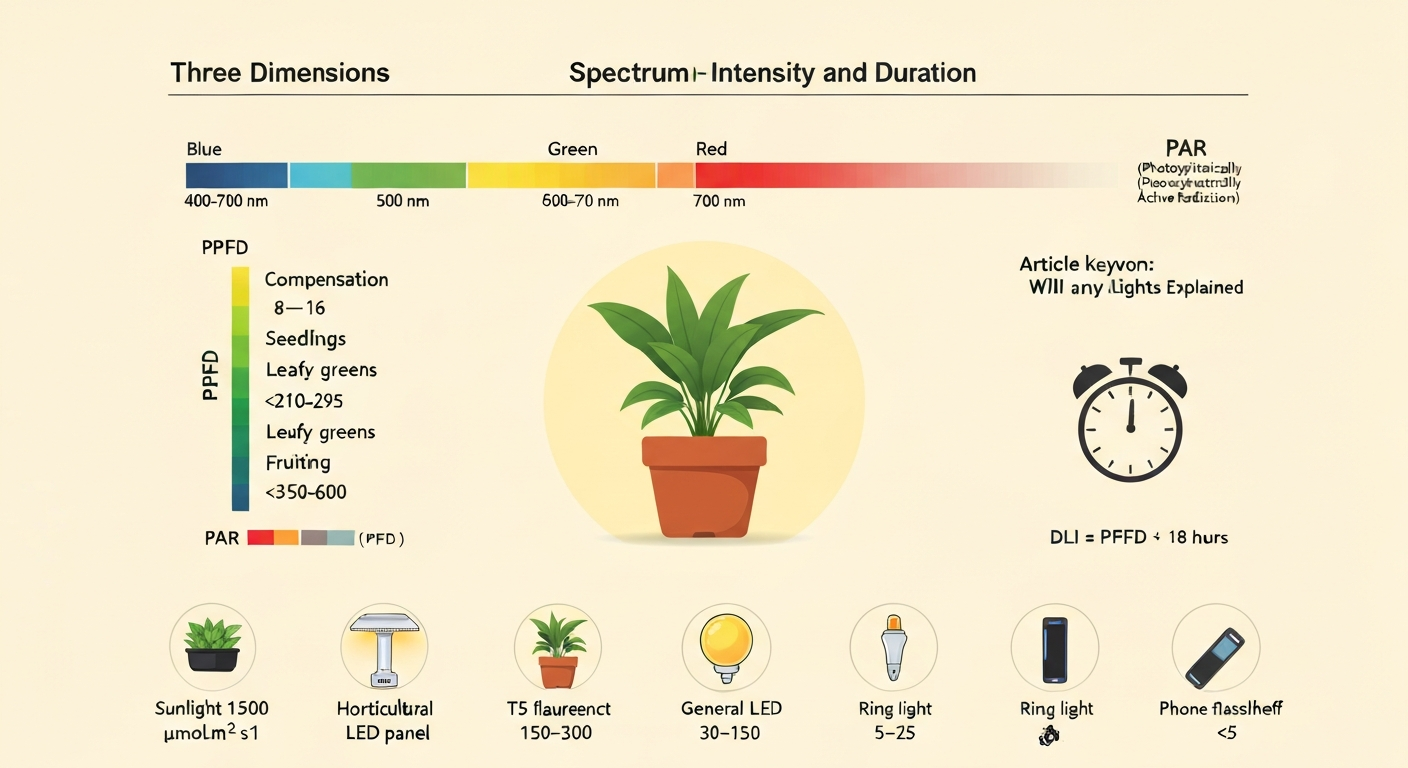
Can any light grow plants? Clear yes/no, science-backed light specs, setup tips, and which household lights work.