Grow lights genuinely work, and the main benefits are straightforward: they let you grow plants year-round regardless of window placement, they eliminate the leggy, pale stretching that happens when indoor plants don't get enough light, and they give you real control over what your plants receive every single day. I've grown herbs, seedlings, and flowering houseplants under supplemental lighting for years, and the difference between a plant sitting three feet from a north-facing window versus one sitting under a quality LED fixture is not subtle. Leaf color deepens, growth rate picks up, and plants that were struggling to hold their shape start actually thriving.
Benefits of Grow Lights for Indoor Plants: When & How, Guide & Buying Tips
Marcus Holloway
29 Jul 2026
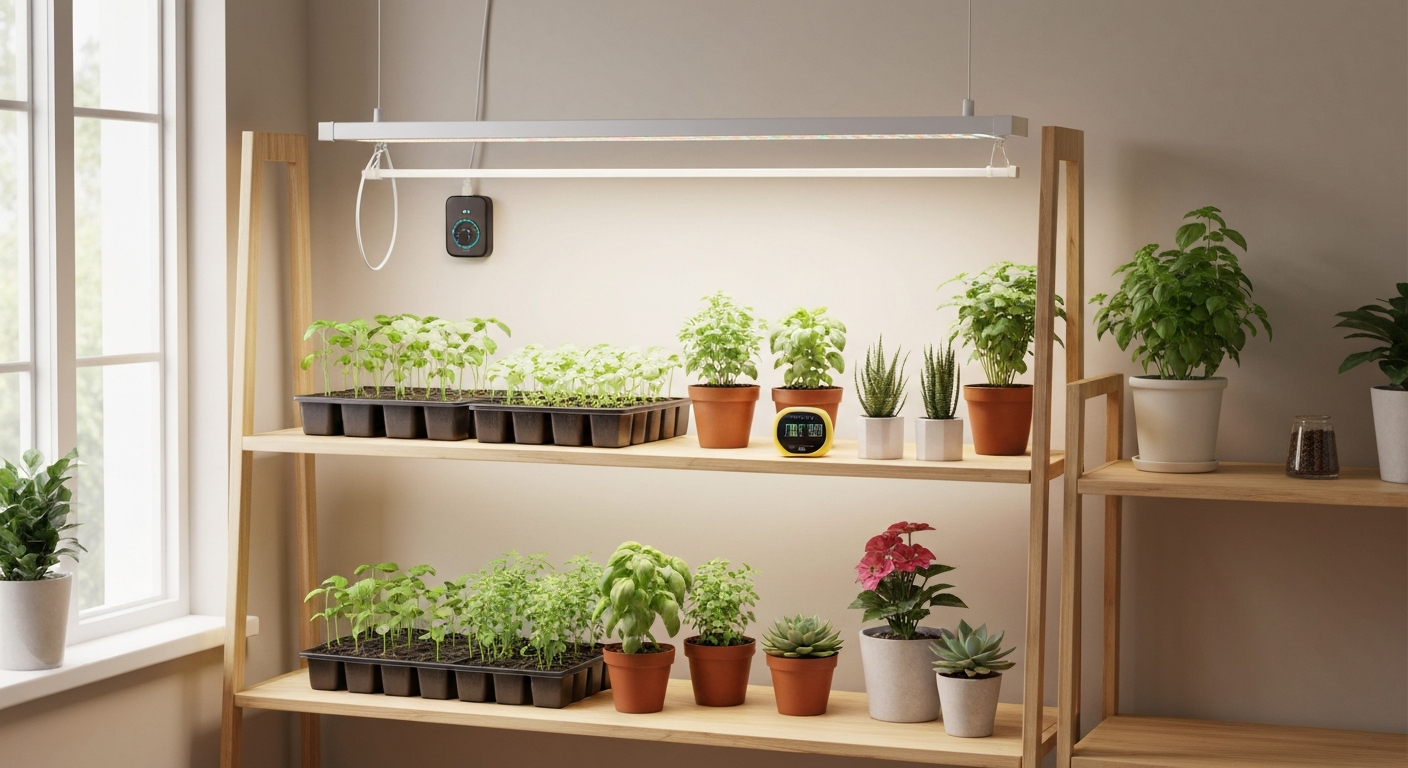
Do grow lights actually work?
Yes, and it's not marketing hype. For a practical overview that directly answers the question "do grow lights work for indoor plants," see this detailed guide. The underlying science is well-established: plants convert light energy into sugars through photosynthesis, and the rate at which they can do that is directly tied to how many photons in the right wavelength range hit the leaf surface each second. Photosynthetically Active Radiation, or PAR, is defined as electromagnetic radiation in the 400 to 700 nanometer waveband, and the practical unit for measuring it is Photosynthetic Photon Flux Density, PPFD, reported in micromoles of photons per square meter per second (µmol·m⁻²·s⁻¹). The Illuminating Engineering Society defines Photosynthetically Active Radiation (PAR) as electromagnetic radiation in the 400–700 nm waveband, with Photosynthetic Photon Flux Density (PPFD) reported in µmol·m⁻²·s⁻¹ as the standard operational measurement blank" rel="noopener noreferrer">Photosynthetically active radiation (PAR) — Illuminating Engineering Society. When a grow light delivers adequate PPFD to your plant's canopy, photosynthesis runs faster, growth accelerates, and plants stop the energy-wasting behaviors (like stem elongation toward a distant light source) that come with chronic light deficiency.
The skepticism usually comes from people who tried cheap, underpowered panel lights and saw little change. That's a fixture problem, not a physics problem. A properly specified light delivering 150 to 300 µmol·m⁻²·s⁻¹ at canopy level will outperform any household lamp. Controlled research consistently confirms this: grow lights improve dry weight, leaf area, flowering rate, and nutritional content in herbs and vegetables when they supply adequate photon dose. The evidence is solid enough that commercial greenhouse operations around the world use supplemental LEDs as a core production tool.
How plants actually use light: PAR, PPFD, spectrum, and daily dose
Plants don't care about lumens or lux. Those are human vision units, weighted toward the yellow-green wavelengths our eyes are most sensitive to. A plant is most photosynthetically active in the red (around 630 to 680 nm) and blue (430 to 470 nm) regions of the spectrum. For a practical guide, see what type of light do plants need to grow indoors. Lux meters will systematically underestimate how useful a red-heavy grow light is, because our eyes barely register deep red. That's why the industry uses PPFD: it counts photons in the 400 to 700 nm band equally, regardless of color, and tells you how many are arriving at a specific point each second.
The cumulative daily dose is called the Daily Light Integral, or DLI. The formula is simple: DLI (mol·m⁻²·d⁻¹) equals PPFD multiplied by photoperiod in hours, multiplied by 0.0036. So a fixture delivering 200 µmol·m⁻²·s⁻¹ for 16 hours gives a DLI of about 11.5 mol·m⁻²·d⁻¹. Most houseplants need somewhere between 5 and 15 mol·m⁻²·d⁻¹, herbs and fast-growing vegetables want 12 to 20, and high-light crops like tomatoes or peppers want 20 to 30 or more. DLI is useful because it shows you that you can partially compensate for lower intensity by running the light longer, which is handy when you're trying to keep electricity costs down.
Spectrum matters beyond just driving photosynthesis. Blue light fraction affects leaf thickness, stomatal behavior, and photosynthetic efficiency: classic dose-response experiments in cucumbers showed that varying the proportion of blue light under equal PPFD produced measurable differences in leaf morphology and stomatal conductance. Far-red light (700 to 750 nm), which sits just outside the traditional PAR band, promotes stem extension and canopy light capture through phytochrome effects, and recent research confirms it contributes meaningfully to whole-canopy growth even though individual leaves use it less efficiently than PAR photons. Light‑Quality Manipulation to Control Plant Growth and Photomorphogenesis in Greenhouse Horticulture, review (Journal of Plant Growth Regulation) summarizes how spectral composition (red:blue ratios, inclusion of far‑red, green and UV) produces predictable photomorphogenic responses, including effects on stem elongation, leaf morphology, flowering induction, and secondary metabolite profiles Light‑Quality Manipulation to Control Plant Growth and Photomorphogenesis in Greenhouse Horticulture — review (Journal of Plant Growth Regulation). Green light (500 to 600 nm) penetrates deeper into the canopy and is not wasted the way early grow light marketing implied. For practical purposes, a full-spectrum LED that covers 400 to 700 nm broadly, with decent red and blue peaks, serves most indoor growers very well.
Does your plant actually need a grow light?
Not every indoor plant needs supplemental lighting, but most do benefit from it to some degree. If you're asking whether do my plants need a grow light, there's a practical checklist and quick diagnostic guide that helps you decide based on species, window exposure, and symptoms. If you're asking "do I need a grow light for houseplants", use the simple diagnostic above to determine whether supplemental lighting will help your specific plants. For a focused discussion on whether and how indoor lighting helps plants grow, see the guide does indoor lighting help plants grow. The honest diagnostic is to look at what your plant is telling you and measure what your window is actually delivering. For a concise checklist that answers the common question “do i need grow lights for indoor plants,” see our focused guide. A lux meter is the cheapest starting point, even though lux isn't a perfect unit. As a rough guide, a south-facing window on a clear day in summer might deliver 2,000 to 5,000 lux at the sill, dropping to 500 lux or less just a few feet back. Converting lux to PPFD is source-specific, but for daylight, roughly 54 lux per µmol·m⁻²·s⁻¹ is a commonly used approximation. That puts a 2,000-lux reading at around 37 µmol·m⁻²·s⁻¹, which is barely enough for shade-tolerant foliage plants and far below what herbs or seedlings need.
Use this checklist to decide if supplemental lighting makes sense for your setup:
- Stems are elongating and reaching toward the window (etiolation), with long internodal spacing
- Leaves are paler than normal, yellowing, or smaller than expected for the variety
- Seedlings are falling over or becoming spindly within days of germination
- Flowering plants refuse to bloom or drop buds prematurely
- Succulents are losing their compact shape and color, stretching upward
- Your room orientation is north-facing, or windows are obstructed by overhangs, trees, or neighboring buildings
- It's winter and your latitude is above roughly 35 degrees north, where photoperiod and sun angle sharply reduce natural DLI
- You're starting seeds indoors and want high germination and compact transplants
If two or more of those apply, a grow light will almost certainly produce visible improvement within two to four weeks. If your plant is sitting in a bright south window all day in summer and growing compactly, you probably don't need one.
Which plants benefit the most
Seedlings
Seedlings are where grow lights deliver the most obvious return. A windowsill start in late winter produces weak, leggy seedlings that struggle after transplanting. The same seeds started under a T5 or LED panel at 200 to 400 µmol·m⁻²·s⁻¹ for 16 hours a day produce compact, dark-green transplants with strong root systems. The difference in transplant survival rate is significant. If you do nothing else with a grow light, starting seeds under one is the highest-impact use.
Herbs
Basil, parsley, cilantro, mint, and thyme are medium-to-high light plants that rarely get enough from a typical kitchen window year-round. Under supplemental LED lighting at 200 to 300 µmol·m⁻²·s⁻¹ for 14 to 16 hours a day, basil in particular grows vigorously, produces larger and more flavorful leaves, and delays flowering. I've harvested fresh basil from a countertop LED setup through January, which would be completely impossible without supplemental light in my climate.
Flowering houseplants
African violets, orchids, peace lilies, and anthuriums need more light to bloom reliably than most indoor environments provide. African violets respond especially well to fluorescent or LED panels positioned 6 to 12 inches above the leaves, blooming more continuously with consistent 12 to 14 hour photoperiods at 100 to 200 µmol·m⁻²·s⁻¹. Photoperiod-sensitive plants like Christmas cactus need careful scheduling, since extra light at the wrong time can delay flowering, but most tropical flowering houseplants just need more total photons.
Succulents and cacti
Succulents and cacti are high-light plants that almost universally suffer indoors without supplemental lighting. Their compact, colorful forms are a stress response to intense, direct sun. Indoors, they stretch and lose their color quickly. A grow light delivering 300 to 500 µmol·m⁻²·s⁻¹ for 12 to 16 hours will keep most succulents compact and maintain their coloration. These are not shade plants, despite being sold in dim retail environments.
Low-light foliage plants
Pothos, snake plants, ZZ plants, and peace lilies are genuinely tolerant of low light, but 'tolerant' doesn't mean 'thriving.' Even these plants will grow faster and look better with supplemental lighting at modest levels (50 to 150 µmol·m⁻²·s⁻¹). If you have a windowless bathroom or an interior shelf collection, a small LED panel on a timer makes a real difference in long-term plant health.
Grow light types compared: LED, fluorescent, HID, and others
The market for grow lights is dominated by four main technologies. Here's an honest comparison to help you decide what to buy:
| Type | PPE (µmol·J⁻¹) | Heat output | Lifespan | Upfront cost | Best for |
|---|---|---|---|---|---|
| LED (horticultural) | 2.0–3.5 | Low (cool to touch) | 50,000+ hours | Medium to high | Most home growers; all plant types |
| T5 Fluorescent | ~1.0–1.4 | Low to moderate | 10,000–20,000 hours | Low | Seedlings, cuttings, low-light plants |
| CMH / LEC (ceramic metal halide) | ~1.6–2.0 | Moderate to high | 10,000–24,000 hours | Medium | Flowering plants, small veg gardens |
| HPS (high-pressure sodium) | ~1.0–1.8 | Very high | 10,000–18,000 hours | Low to medium | Largely superseded; some large indoor farms |
| CFL (compact fluorescent) | ~0.5–1.0 | Low | 6,000–15,000 hours | Very low | Single plants, clones, tight budgets |
Photosynthetic Photon Efficacy (PPE), measured in µmol·J⁻¹, is the key efficiency number: it tells you how many photosynthetically useful photons you get per joule of electricity consumed. Modern commercial horticultural LEDs typically land between 2.0 and 2.8 µmol·J⁻¹ in real-world measurements, with top-tier fixtures exceeding 3.0. HPS fixtures historically maxed out around 1.8 µmol·J⁻¹. That difference is meaningful over a full growing season when you're paying for electricity.
For most home growers, a quality LED panel is the right choice. The lower heat output means you can position it closer to plants without heat stress, running costs are lower over the long term, and modern full-spectrum LEDs cover the wavelengths plants actually use. T5 fluorescents are a legitimate, lower-cost option for seedlings and cuttings where you don't need deep canopy penetration. HPS is largely a legacy technology for home use at this point.
When comparing fixtures, look for independent test data. IES LM-79 reports (electrical and photometric testing) and IES TM-21 projections (long-term lumen maintenance) are the industry-standard evidence that a fixture actually does what the datasheet claims. The DesignLights Consortium (DLC) Horticultural Qualified Products List is the primary third-party verification program in North America: fixtures on the QPL have been independently tested for PPF, PPE, and longevity claims. If a fixture isn't on the DLC list and doesn't have published LM-79 data, treat the claimed numbers skeptically.
Choosing spectrum and power: full-spectrum, red and blue, and reading the spec sheet
The old advice to use pure red/blue 'blurple' lights has been largely superseded. Those narrow-band fixtures were built on the idea that only red and blue wavelengths matter, but we now know that green and far-red photons contribute to whole-plant growth, especially at the canopy level. More practically, plants grown under pure red/blue light look purple and unnatural, which makes it hard to spot pest damage, nutrient deficiencies, or other problems by visual inspection. Full-spectrum LEDs that mimic a broad daylight spectrum, including white wavelengths and red peaks around 660 nm, are easier to work with and produce equivalent or better results for most home applications.
For flowering-stage plants, a light with a stronger red component (or a dedicated bloom spectrum) can help, but the effect is often smaller than manufacturers suggest for typical home growing. The bigger lever is usually total PPFD and duration, not fine-tuning the red-to-blue ratio.
Color Rendering Index (CRI) matters for your eyes, not directly for the plants. A high-CRI white LED (80+) makes visual plant inspection easier but doesn't inherently mean more plant-usable photons. What matters for the plant is PPE and the delivered PPFD at canopy level, not CRI.
On the spec sheet, the numbers that actually matter are: PPF (total photon output of the fixture in µmol·s⁻¹), PPE (efficiency in µmol·J⁻¹), and ideally a PPFD map showing how intensity varies across the coverage area at a specific mounting height. Be cautious of wattage claims: some manufacturers list 'max equivalent wattage' rather than actual draw. Actual draw is what determines your electricity cost.
PPFD and wattage targets by plant type
These targets are practical starting points. Actual requirements vary by species, growth stage, CO2 level, and temperature. Start at the lower end of any range and observe your plants before increasing intensity.
| Plant type / stage | Target PPFD (µmol·m⁻²·s⁻¹) | Daily photoperiod | Approx. DLI (mol·m⁻²·d⁻¹) | Typical LED actual draw per m² |
|---|---|---|---|---|
| Low-light foliage (pothos, snake plant, ZZ) | 50–150 | 12–14 hours | 2–8 | 20–60 W/m² |
| Flowering houseplants (African violet, orchid) | 100–200 | 12–14 hours | 4–10 | 40–80 W/m² |
| Herbs (basil, parsley, cilantro) | 200–300 | 14–16 hours | 10–17 | 80–120 W/m² |
| Seedlings / cuttings | 200–400 | 16–18 hours | 11–26 | 80–160 W/m² |
| Succulents / cacti | 300–500 | 12–16 hours | 13–29 | 120–200 W/m² |
| Vegetative growth (tomato, pepper, lettuce) | 300–500 | 14–18 hours | 15–32 | 120–200 W/m² |
| Fruiting / flowering stage (tomato, pepper) | 500–800+ | 12–14 hours | 22–40 | 200–320 W/m² |
The wattage per square meter column assumes a fixture PPE of around 2.0 to 2.5 µmol·J⁻¹, which is realistic for a decent mid-range LED. If you have a higher-efficiency fixture, actual draw will be lower for the same PPFD. Always verify canopy PPFD with a quantum sensor or PAR meter if precision matters; manufacturer PPFD maps are a starting point, not a guarantee.
Setting up your grow light: placement, height, and timing
Fixture height is one of the most common things people get wrong. PPFD follows the inverse square law: double the distance between the light and the plant, and you quarter the intensity. Most LED panels are designed to be used at 12 to 24 inches above the canopy for typical home applications. Start at the higher end of the manufacturer's recommended range and gradually lower it if plants show no signs of light stress (bleaching, cupping, or upward leaf curl). If you're growing seedlings, start at 18 to 24 inches and watch for the first true leaves before adjusting.
A mechanical or smart plug timer is essential. Plants need a consistent dark period, and running lights 24 hours a day is not beneficial for most species and can actively disrupt flowering in photoperiod-sensitive plants. A 16 hours on / 8 hours off schedule works well for seedlings and most herbs. Flowering houseplants often do best at 12 to 14 hours. Set your timer so the light period overlaps with daylight hours where possible to maintain a natural rhythm, and keep the schedule consistent: irregular photoperiods stress plants.
What it actually costs to run a grow light
Running costs are lower than most people assume, especially with modern LEDs. The math is straightforward. Take the fixture's actual draw in watts, multiply by hours per day, divide by 1,000 to get kilowatt-hours, and multiply by your electricity rate. The U.S. national average retail electricity price was around 13.8 cents per kWh as of mid-2026. A 60-watt LED panel running 16 hours a day consumes 0.96 kWh per day, costing roughly 13 cents a day, or about $4 a month. Even a 200-watt setup running 16 hours a day comes to around $13 to $14 per month at that rate. For a vegetable garden or serious herb production, that's usually well within budget compared to grocery costs.
Efficiency matters here. A fixture with a PPE of 2.5 µmol·J⁻¹ delivers 25% more photons per dollar of electricity than one rated at 2.0 µmol·J⁻¹. Over a full season, that difference adds up. This is why PPE is worth checking before you buy, not just wattage or lumen output.
Safety and health: what you actually need to worry about (and what you don't)
The short answer on the most common fears: no, grow lights will not give you cancer, and no, they will not give you a tan under normal home-growing conditions. The concerns around UV exposure apply to lights specifically designed to emit significant UV (germicidal lamps, tanning beds), not to standard horticultural LED fixtures. Most horticultural LEDs emit negligible UV and are well within safe exposure limits for incidental use.
The real safety consideration with grow lights is eye comfort and blue-light exposure during extended direct staring. Photobiological safety for lamps is governed by IEC 62471, and most commercial horticultural fixtures are tested against those standards. The practical advice is simple: don't stare directly at an operating LED panel, the same way you wouldn't stare at any bright light source. Working around grow lights without looking directly at them is completely safe. High-CRI white LEDs look less harsh than blurple lights and make it easier to work in the grow space without discomfort.
Heat is the more realistic safety concern. LED fixtures run cooler than HPS or HID lights, but any electrical fixture should be kept clear of flammable materials, used with properly rated cords and sockets, and not covered or enclosed without ventilation. Check that fixture mounting hardware is rated for the weight.
Troubleshooting: when things go wrong
Most grow light problems fall into three categories: too little light, too much light, or wrong timing. Here's how to diagnose each one:
| Symptom | Likely cause | Fix |
|---|---|---|
| Leggy, elongated stems reaching toward light | PPFD too low; light too far away | Lower fixture height or increase intensity; aim for 200+ µmol·m⁻²·s⁻¹ for most plants |
| Pale, washed-out leaves or bleached patches | PPFD too high; light too close | Raise fixture height; check manufacturer's recommended distance |
| Leaf edges curling upward or cupping | Heat or light stress | Raise fixture; check for hot spots with a PAR meter |
| Slow growth despite adequate light | Short photoperiod or low DLI | Extend daily hours; calculate DLI and compare to plant targets |
| Flowering plant won't bloom | Too long a photoperiod for short-day plant, or too low PPFD | Check species' day-length requirements; increase intensity for long-day plants |
| Seedlings still leggy under grow light | Light too far away, or running fewer than 14–16 hours | Lower to 4–6 inches for T5; 12–18 inches for LED; extend photoperiod |
| Succulent losing color / etiolating | PPFD too low for high-light species | Increase to 300–500 µmol·m⁻²·s⁻¹; most succulents need much more than typical houseplant levels |
What results to realistically expect
Grow lights are not magic, and the timeline for seeing results depends on what you're growing and what the baseline was. Seedlings under adequate light show compact, strong growth within the first week. Herbs recovering from a dim windowsill start showing improved color and new growth within two to three weeks. Succulents stop etiolating quickly, but reversing existing stretch takes months of new compact growth. Flowering plants may take a full growth cycle before you see blooms responding to better light.
The clearest wins are with seedlings and herbs, where the improvement is fast and obvious. Low-light foliage plants will look healthier and grow more vigorously, but the change is less dramatic because these species just aren't high-light plants. Managing expectations matters: a grow light is not a substitute for addressing other limiting factors like soil quality, watering frequency, humidity, or temperature. But when light genuinely is the limiting factor, which it often is in typical indoor environments, a good grow light resolves it reliably.
FAQ
What core scientific definitions and measurements must an evidence‑based article on grow lights include?
Define PAR (400–700 nm) and PPFD (µmol·m⁻²·s⁻¹) as the operational photon flux metric; explain DLI (mol·m⁻²·d⁻¹) and the conversion from PPFD × hours. Cite McCree’s action spectrum to justify the PAR band and include a short primer on quantum sensors and calibration practices. Link to a PAR/PPFD primer for deeper reading.
Which primary peer‑reviewed studies and reviews should be cited about spectrum effects on plant physiology?
Include McCree (action spectrum) and Hogewoning et al. (blue‑light dose responses). Add reviews summarizing red/blue/far‑red/UV effects and photomorphogenesis (e.g., plant growth regulation reviews). Use recent empirical work on far‑red contributions to canopy growth to discuss tradeoffs of including 700–750 nm.
What measurement standards and instrument guidance are necessary to support claims about delivered light?
Reference IES/Laboratory standards (LM‑79, LM‑80, TM‑21) for fixture test data, and quantum sensor manuals (LI‑COR, Apogee) for PPFD measurement protocols, calibration and cosine correction. State acceptable reporting tolerance (±~10%) and the need for traceable reference sensors. Link to a PAR sensor guide.
Which industry verification programs and datasheet metrics should readers be taught to look for when buying fixtures?
Recommend fixtures with independent LM‑79/LM‑80 + TM‑21 reports and DesignLights Consortium (DLC) Horticultural QPL listing when available. Key datasheet metrics: PPF (µmol·s⁻¹), PPE (µmol·J⁻¹), spectral power distribution (SPD) or delivered spectrum chart, measured PPFD maps at mounting heights, L90/Lx maintenance projections, input watts, and IEC 62471 photobiological classification. Link to an LED buying guide.
What practical measurement/diagnostic tools should be mentioned and why?
Recommend a calibrated quantum sensor (PPFD meter) for canopy mapping, spectroradiometer or manufacturer SPD for spectrum checks, and an illuminance meter only with caveats (lux ≠ PPFD; conversions are source‑dependent). Cite LI‑COR application notes explaining why lux conversions are unreliable.
What criteria should be given for deciding whether plants need supplemental lighting?
Provide clear, measurable criteria: target crop DLI ranges (give typical DLI by plant type), measured average canopy PPFD vs. target, and seasonal/daylength gaps. Advise owners to measure existing PPFD at canopy level across the canopy and compute current DLI; recommend adding supplemental lighting if measured DLI is below crop target by >10–20%.
Next Articles
Does Indoor Lighting Help Plants Grow? How to Set Up
Yes, but normal indoor light often falls short; learn when LEDs help, how to set spectrum, intensity, and timers for gro
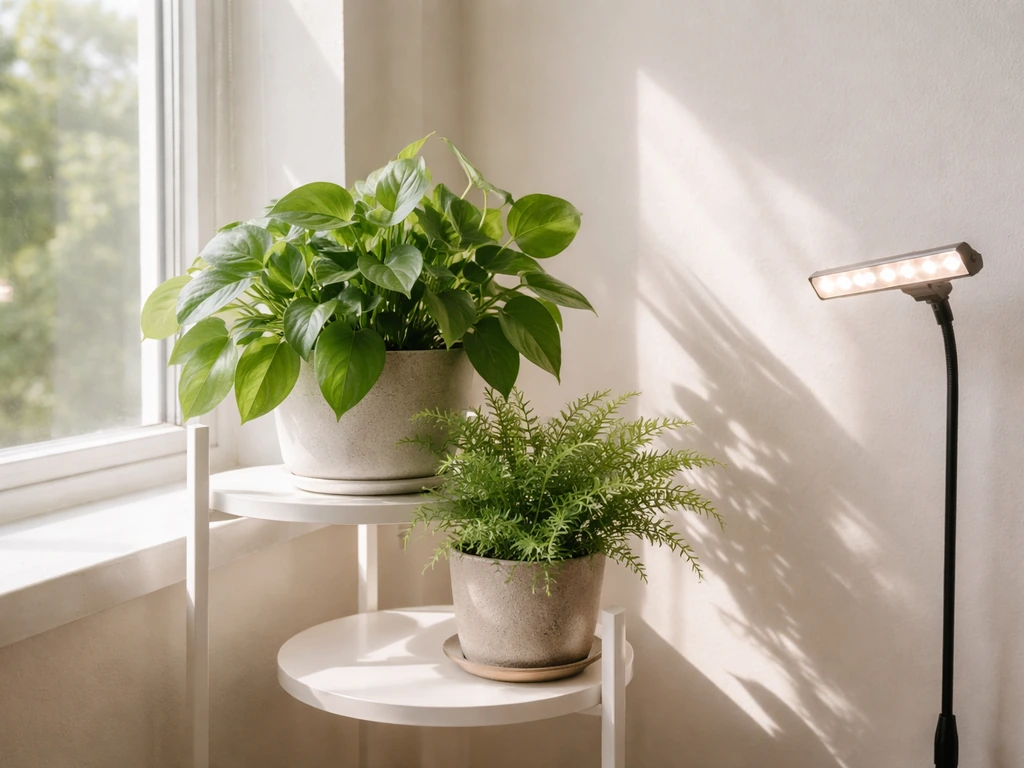
Do I Need Grow Lights for Indoor Plants? A Quick Guide
Get a fast decision guide on whether indoor plants need grow lights, plus setup, safety, and choosing the right type.
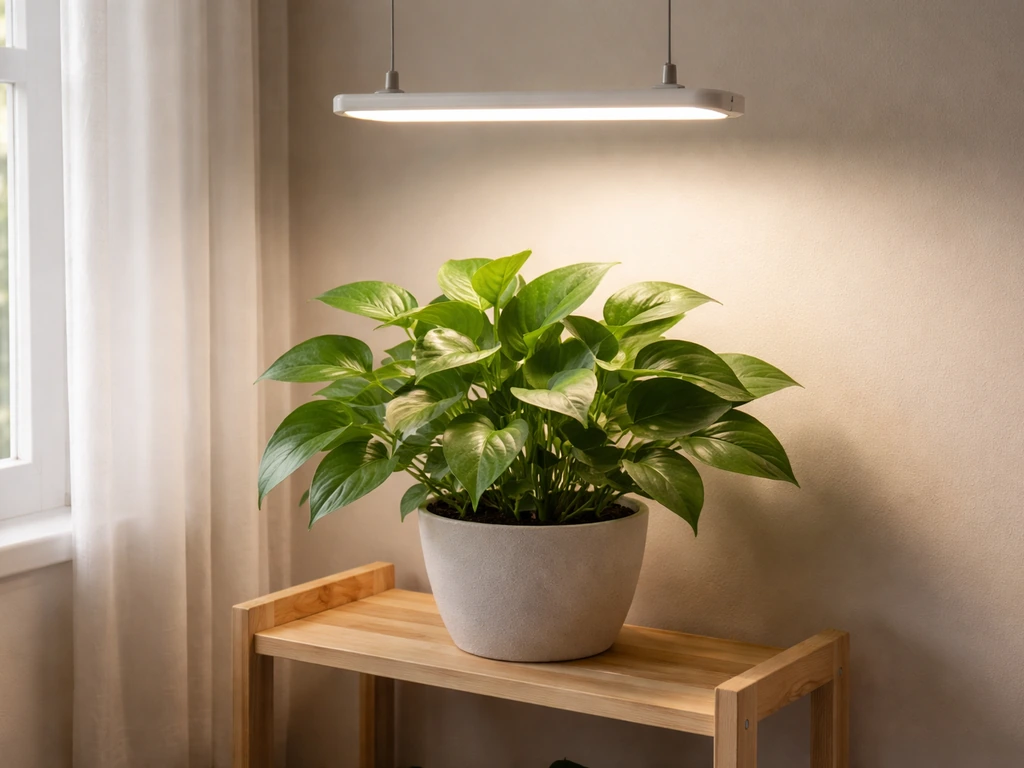
Do Grow Lights Work for Indoor Plants? How to Know and Set Up
Yes, grow lights can power indoor photosynthesis. Learn how to choose, set distance and schedule, and troubleshoot resul