You can put a lampshade on a grow light, but whether you should depends almost entirely on the bulb type, the shade material, and how much light your plants actually need. A clear glass or thin acrylic diffuser over an LED grow bulb? Usually fine, with only a modest PAR loss. An opaque fabric shade over a hot HID or incandescent grow lamp? That is a fire hazard and a plant-starving combination you want to avoid. The short version: diffuse and translucent materials are conditionally acceptable; dense, dark, or enclosed shades are not.
Can You Put a Lampshade on a Grow Light? Safety & Tips
Marcus Holloway
16 Jul 2026
Decision checklist: when a shade is safe, useful, or counterproductive
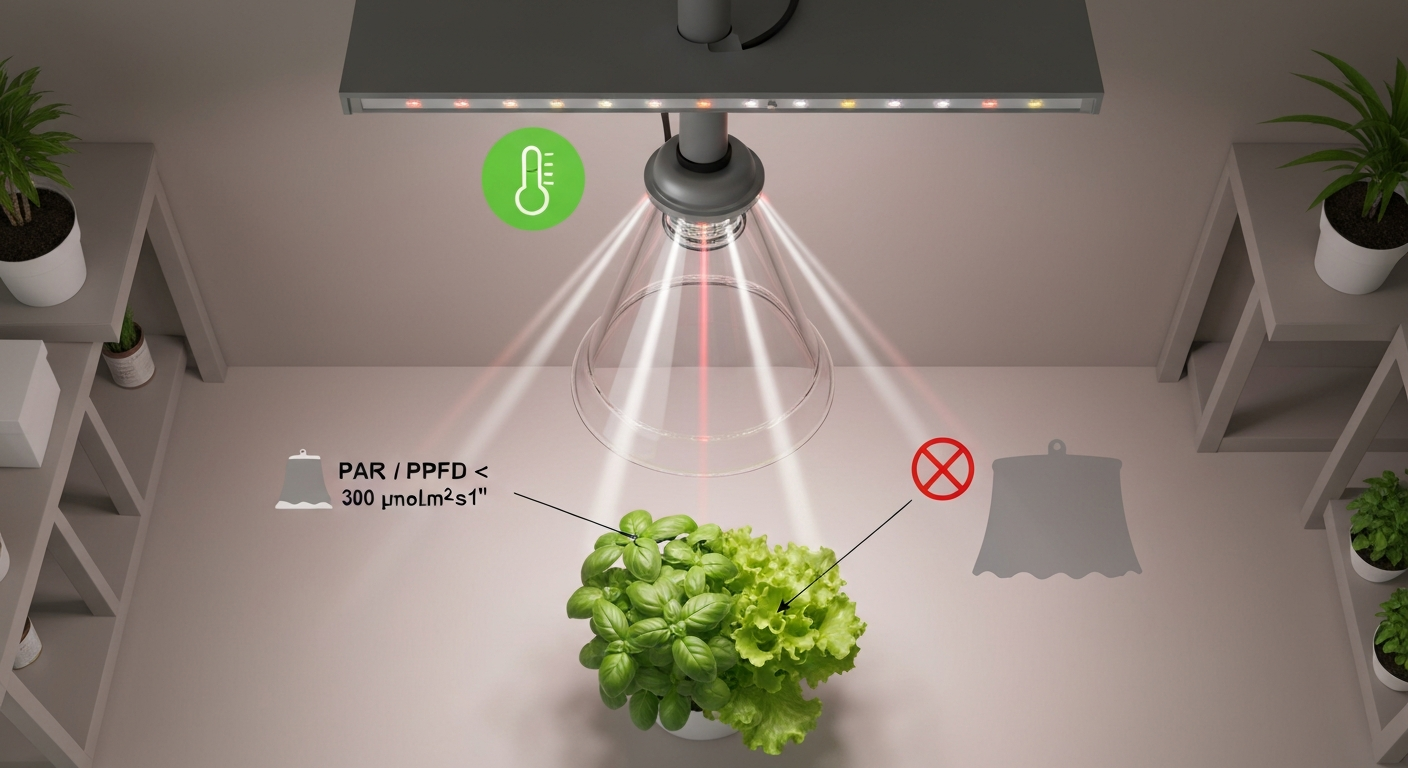
Before you reach for that lampshade, run through these questions. I have made the mistake of assuming any shade would be harmless, and I ended up with both a stressed plant and a warm fixture that was running well above its comfort zone. This checklist covers what I now go through every time.
- Is the shade material translucent (clear glass, acrylic, frosted glass) or opaque (fabric, paper, metal)? Translucent materials can be workable; opaque ones block so much light they are usually counterproductive for plants.
- What bulb type is inside? LEDs and CFLs run cool enough that a shade may be safe if it does not trap heat. Incandescent, halogen, and HID lamps generate envelope temperatures that can exceed 250°C and should never be enclosed by a shade.
- Does the fixture label say 'do not use in totally enclosed fixtures'? If it does, any shade that restricts airflow around the bulb voids the warranty and creates a fire risk.
- Is the shade rated for the wattage of the bulb? Most decorative lampshades are rated for 60W or less. Grow bulbs often run at higher wattages.
- How much light do your plants need? If they are already on the low end of their PPFD requirement, losing even 15–20% PAR through a diffuser can push them into light starvation.
- Can you compensate by lowering the fixture or increasing exposure time? If yes, a mild diffuser may still work. If you are already at maximum hang height and duration, skip the shade.
- Are you considering a shade to reduce glare or spread light more evenly? A white reflective shade or a frosted diffuser can genuinely help canopy uniformity, which is a legitimate reason to use one.
- Is the fixture a recessed can, ceiling fan housing, or enclosed lamp? Each of those has specific compatibility rules (more on that below) that matter before you add any covering.
How lampshades change light for plants: PAR, PPFD, and spectrum
Plants do not care about lumens, which is what your eye perceives as brightness. They care about PAR (Photosynthetically Active Radiation), the band of light between 400 and 700 nanometers that drives photosynthesis. For a quick comparison between SAD lamps and grow lamps and when each is appropriate, see sad lamp vs grow lamp. The intensity of that light at the plant canopy is measured as PPFD (Photosynthetic Photon Flux Density) in micromoles per square meter per second. When you put any material between your grow light and your plant, two things happen: the total PPFD drops, and the spectral balance can shift.
The spectral shift is the part most people overlook. A material that looks completely clear to your eye can still block a disproportionate amount of UV (below 400 nm) or far-red (above 700 nm). Polycarbonate, for example, transmits only about 18% of UV while passing roughly 83% of PAR. Rutgers' Horticultural Engineering material PAR/UV/IR transmittance table reports similar spectral-transmission values: clear glass ~70% UV, acrylic ≈44% UV, and polycarbonate ≈18% UV (Horticultural Engineering, material PAR/UV/IR transmittance table (Rutgers)) Horticultural Engineering — material PAR/UV/IR transmittance table (Rutgers). That matters for certain crops that respond to UV for secondary metabolite production (think basil flavor or lettuce pigmentation), but it is less critical for basic vegetative growth. If your grow light is specifically designed to deliver a full spectrum including UV, a polycarbonate shade will quietly strip most of that UV out.
There is a silver lining to diffusing materials, though. Horticultural research consistently shows that diffuse light penetrates plant canopies more evenly than direct beam light. A frosted or twin-wall diffuser over a point-source grow light can improve vertical PPFD uniformity, meaning lower leaves get more light relative to the top canopy. In some scenarios this improves overall light-use efficiency enough to partially offset the raw transmission loss. The key word is 'partially.' If your PPFD is already marginal, diffusion helps canopy distribution but cannot replace the photons you lose.
Typical light loss from diffusers vs opaque shades
Here is a practical breakdown of what different materials do to your PAR. Greenhouse glazing material properties, UC Davis (Lieth) lists typical PAR transmissions: clear glass ≈90%, acrylic (PMMA) ≈86%, polycarbonate ≈83%, and polyethylene films <80% blank" rel="noopener noreferrer">Greenhouse glazing material properties — UC Davis (Lieth). These figures come from greenhouse engineering and horticultural materials research, and they give you a realistic expectation rather than marketing language.
| Material | Approx. PAR Transmission | UV Transmission | Notes |
|---|---|---|---|
| Clear glass | ~90% | ~70% | Best translucent option; minimal PAR loss |
| Acrylic (PMMA) | ~86% | ~44% | Good transmission; significantly cuts UV |
| Polycarbonate (single wall) | ~83% | ~18% | Durable but strips most UV |
| Light satin frosted glass | ~80–85% | Reduced (varies) | Adds diffusion; modest PAR loss |
| Medium/industrial frosted glass | ~60–80% | Low | Noticeable PAR loss; heavy diffusion |
| Twin-wall / diffuse polycarbonate | ~72–79% | Very low | Good diffusion; meaningful transmission drop |
| Polyethylene film | <80% | Low | Varies widely by product and thickness |
| White fabric/paper shade (opaque) | <50% usable (reflectance-dependent) | Near zero | Relies on lining reflectance (~85% white lining); most light lost |
| Dark or soiled fabric shade | <30–50% | Near zero | Worst case; significant light loss; avoid entirely |
The opaque fabric shade numbers deserve extra explanation. These shades do not really transmit light to the plant at all; instead, the plant gets whatever bounces off the shade's inner lining and comes out the bottom opening. A white-lined shade with roughly 85% reflectance is the best-case scenario, but once you factor in geometry (most of that reflected light goes sideways, not down to the canopy), the effective PAR reaching your plant can easily drop by more than 50%. An ivory lining drops to about 75% reflectance, a tan lining to around 61%, and anything darker or dirty falls below 50%. For a plant that needs 200 PPFD minimum, that math gets bad fast.
Differences by bulb type: LED, CFL, HID, and incandescent
The bulb type is probably the single most important factor in deciding whether a shade is safe at all, before you even think about light loss. Each technology has a different heat profile, different spectral characteristics, and different optics that interact with a shade in very different ways.
LED grow lights
LEDs are the most shade-compatible option, but they are not immune to heat problems. LED emitters themselves run relatively cool at the light-emitting surface, but they rely on heatsinks and passive or active airflow to move heat away from the driver and circuit board. Many LED retrofit bulbs and fixtures explicitly state 'do not use in totally enclosed fixtures' precisely because blocking that airflow raises junction temperatures, shortens lifespan, and in extreme cases creates a fire risk. A loose, open shade that sits above the bulb without trapping air is generally safer than a tight, enclosed one. If the shade acts like a dome that seals around the base, treat it the same as an enclosed fixture and assume it is not safe. If you were wondering 'can you use a "grow light" for gel nails', note that LED grow lights are not designed or tested for curing nails and may not emit the specific UV/LED spectrum or intensity required for safe, effective gel curing.
CFL grow lights
Compact fluorescent grow bulbs run warmer than LEDs but cooler than HIDs. They do produce some UV in their spectrum, so a polycarbonate shade will strip that component. Heat-wise, a shade that allows reasonable air circulation is usually tolerable, but CFLs have ballasts built into the base that generate meaningful heat. Avoid any shade that sits tightly around the bulb body or traps heat near the base.
HID grow lights (MH, HPS)
High-intensity discharge lamps, including Metal Halide (MH) and High-Pressure Sodium (HPS), run extremely hot. The arc tube inside these fixtures can reach temperatures that would melt or ignite most decorative shade materials. These fixtures are designed with purpose-built reflector hoods for a reason: heat management is engineered in. If you are using HID lighting, you should not be putting a decorative lampshade anywhere near it. Use the manufacturer-rated hood and reflector, full stop.
Incandescent and halogen grow bulbs
These are the most dangerous combination with a lampshade. Halogen envelope temperatures commonly exceed 250°C during normal operation. Standard fabric and paper lampshades are rated for much lower temperatures. Even glass shades can crack if they contact or closely surround a halogen bulb. Incandescent grow bulbs are largely obsolete at this point, and if you are still using them I would strongly suggest switching to LED equivalents. Until you do, no lampshade.
| Bulb Type | Typical Heat Risk | Shade Compatible? | Best Approach |
|---|---|---|---|
| LED | Low (surface), medium (driver/heatsink) | Conditionally yes, if ventilated | Open, non-enclosing diffuser; check fixture label |
| CFL | Medium | Conditionally, with airflow | Avoid tight-fitting shades near base |
| HID (MH/HPS) | Very high | No | Use manufacturer reflector hood only |
| Incandescent/Halogen | Very high (>250°C envelope) | No | Replace with LED; no shade under any circumstances |
How to install a lampshade on a grow light safely
If you have worked through the checklist above and decided a shade is appropriate for your setup, here is how I would approach the installation. These steps assume you are working with an LED or CFL grow bulb in a standard table lamp or pendant fixture, not a dedicated HID or enclosed grow-light system.
- Turn off and unplug the fixture before doing anything. This is not optional. Even low-voltage LED setups can surprise you.
- Check the fixture's maximum wattage rating (printed on the socket or inside the canopy). Your grow bulb must not exceed this number. Many decorative lamps are rated for 40–60W; many grow bulbs run at higher effective wattages.
- Check the bulb or fixture datasheet for 'enclosed fixture' restrictions. If the label says 'do not use in totally enclosed fixtures,' choose an open shade style (like an open-bottom drum or cone) rather than a globe or bowl that fully surrounds the bulb.
- Choose your shade material. For plant growth, clear glass or light-frost glass transmits the most PAR (roughly 80–90%). White-lined open shades are acceptable for aesthetic purposes but expect to lose more than 50% of effective canopy PPFD.
- Measure the shade's temperature rating. Standard fabric shades are commonly rated for 60W incandescent, which corresponds to much lower real heat than a 60W HID or halogen. Match the rating to your actual bulb type, not just wattage.
- Attach the shade with the correct fitter (spider, UNO, or clip) for your fixture. A loose or poorly fitted shade can shift, contact the bulb directly, or fall — all of which are fire or damage risks.
- Leave at least 2–3 cm of clearance between the bulb surface and any part of the shade interior. Direct contact between a warm bulb and a shade material can cause discoloration, melting, or ignition over time.
- Plug in and run the fixture for 15–20 minutes, then carefully check the shade temperature with your hand (not directly on the bulb). If any part of the shade feels uncomfortably hot, the ventilation is insufficient. Remove the shade.
- Recheck your plant's PPFD. If you have a PAR meter, take a reading at canopy level with and without the shade. If you do not have a meter, compensate for estimated losses by lowering the fixture height or extending daily photoperiod by 1–2 hours.
- Document the configuration. If you are running a setup that modifies a manufacturer's tested design, note what you changed so you can troubleshoot heat or growth issues later.
Ventilation, heat, and fire risk: what to watch for
Heat is where lampshade decisions stop being about plant performance and start being about safety. I want to be direct about this: a grow light that is improperly enclosed or covered is a fire risk, not just an inefficiency. The combination of a high-wattage bulb, an enclosed shade, and flammable material (fabric, paper, dry plant matter) is genuinely dangerous.
For LED fixtures specifically, manufacturer manuals commonly report maximum allowed surface temperatures in the range of 85–100°C for some components. Those temperatures are reached under normal open-air operation. Add a shade that restricts airflow and those temperatures climb further. Elevated junction temperatures do not just increase fire risk; they accelerate lumen depreciation, meaning your grow light dims faster and delivers less PPFD over time even if it does not fail outright.
For HID and halogen bulbs, the risk is more immediate. Halogen envelope temperatures commonly exceed 250°C. The ignition temperature of paper is around 233°C and most fabric lampshade materials are not rated above 90–100°C. This is not a theoretical concern; fixture fires from improperly paired shades and bulbs are a documented cause of residential fires. Always match shade materials to bulb type, and when in doubt, leave the shade off.
- Check for heat by touch after 15–20 minutes of operation. If the shade exterior is too hot to hold your hand against for 5 seconds, remove it.
- Never leave a new shade-and-bulb combination unattended for the first few hours of use.
- Keep dry plant matter, paper pots, and other flammable materials away from the shade perimeter.
- Do not use fabric or paper shades with bulbs rated above 60W equivalent unless the shade is explicitly rated for higher wattages.
- Inspect shades periodically for discoloration, warping, or scorch marks. These are early warning signs of thermal stress.
- Never cover ventilation openings on the fixture body itself, even if the shade does not directly contact the bulb.
Fixture compatibility and electrical ratings: what the labels actually mean
Whether you are working with a regular table lamp, a ceiling fan fixture, or a recessed can light, the fixture rating determines what you can safely do to it. This is where a lot of people get into trouble, because decorative shades seem innocuous compared to, say, rewiring a fixture. But modifying how heat and light escape from a rated fixture is a real change to its operating conditions.
Regular table and floor lamps
Standard table lamps are the most forgiving of the three fixture types. They are open by design, so a shade that sits on a harp above the bulb generally preserves reasonable airflow. The key constraints are wattage rating (check the socket label) and the shade's own heat tolerance. If you are running a grow bulb in a regular lamp, which is entirely doable for smaller plants, a standard open shade is usually compatible as long as wattage limits are respected. This is closely related to the question of using grow bulbs in regular lamps more generally, which is its own topic worth exploring.
Ceiling fan fixtures
Ceiling fans add a vibration variable that table lamps do not have. A shade attached to a ceiling fan fixture experiences constant low-frequency vibration that can loosen fittings, crack glass shades, and cause bulbs to work loose from their sockets. Beyond vibration, ceiling fan fixtures are often enclosed bowl-type designs that already restrict airflow. Adding a second layer of coverage (or replacing a thin globe with a more opaque shade) compounds the heat-trapping problem. If you are thinking about putting grow lights in a ceiling fan fixture, the shade question is secondary to whether the fixture design itself is compatible with grow-bulb heat output.
Recessed can lights and IC ratings
Recessed lighting has a specific and important rating system you need to understand before adding any covering. Fixtures are tested and listed under UL 1598 as either IC-rated (Insulation Contact) or non-IC-rated. An IC-rated fixture (sometimes labeled ICAT, meaning IC-rated and airtight) is safe to have insulation or other materials in contact with it. A non-IC fixture must have a minimum clearance from insulating materials. This rating system was designed for ceiling insulation, but the principle applies to any covering, including decorative trim that traps heat around the fixture. Adding a diffuser panel or shade to a non-IC-rated recessed fixture can push it outside its tested safe operating conditions. The fixture's labeling is the authoritative guide here, not general assumptions.
Do's and don'ts by fixture type
| Fixture Type | Do | Don't |
|---|---|---|
| Regular table/floor lamp | Use open shade styles; respect wattage rating; choose translucent materials | Exceed socket wattage rating; use enclosed globe shades with grow bulbs; use fabric shades with incandescent/halogen grow bulbs |
| Ceiling fan fixture | Confirm vibration-resistant shade fitting; use LED bulbs only; check enclosed-fixture compatibility | Use glass shades prone to cracking from vibration; run high-wattage grow bulbs in enclosed fan bowls; ignore manufacturer max wattage |
| Recessed can light | Check IC vs non-IC rating on fixture label; use IC-rated fixtures if any covering is planned; use trim kits rated for the fixture | Cover non-IC-rated fixtures; add diffusers to fixtures rated for open-air only; assume all recessed cans are the same |
| Dedicated HID grow fixture | Use only manufacturer-rated reflector hoods; follow installation manual for clearances | Use decorative lampshades; cover any part of the fixture body; modify the optics without replacement rated parts |
One more thing worth flagging on electrical compatibility: adding a shade or diffuser to a fixture changes the configuration from what was tested under ANSI/IES LM-79 photometric standards, which is how grow-light manufacturers publish their PPF and PPFD maps. That published PPFD data no longer applies the moment you add an uncertified optic in front of the fixture. For home gardeners this is mostly a practical concern (your plants may get less light than you think), but if you are ever troubleshooting why a plant is underperforming, a shade-related PPFD reduction is worth recalculating.
Finally, a word on warranty. Most LED grow-light manufacturers explicitly state in their installation manuals that use outside the tested configuration, including in enclosed fixtures or with non-rated diffusers, voids the warranty. If your fixture fails and the manufacturer finds evidence of a non-standard covering, you are unlikely to get coverage. That is worth knowing upfront, especially for more expensive purpose-built grow lights.
FAQ
Short answer: can you put a lampshade on a grow light?
Conditional yes — but only when the shade and fixture are compatible. A translucent/diffusing shade designed for lighting that allows sufficient PAR (photosynthetically active radiation) through, provides ventilation or is rated for the lamp type, and does not trap heat or touch hot surfaces can be used. Opaque or dark shades, shades that block vents, or untested coverings over high‑temperature bulbs (incandescent/halogen/HID) are unsafe and/or will severely reduce plant light. Always follow the fixture and lamp manufacturer’s instructions; using non‑rated covers or enclosing fixtures can void warranties and create fire/overheat risks.
How do lampshades affect plant light (PAR/PPFD) and spectrum?
Shades change three things: total PAR transmitted (reduces PPFD at the canopy), light distribution (diffusion increases uniformity), and spectral balance (materials can absorb UV/IR or some visible bands). Clear glass or thin acrylic transmit ~80–90% PAR; polycarbonate and twinwall diffusers often transmit ~72–83% PAR; frosted glass or diffuser plastics commonly transmit 60–85% depending on thickness and finish. Opaque fabric/paper shades commonly cut >50% of usable light. Some plastics strongly cut UV or far‑red while leaving visible light relatively intact, altering photoreceptor exposures.
Typical percent light loss from common shade/diffuser materials?
Approximate ranges (typical industry/extension values): clear glass ≈90% PAR transmission; acrylic ≈86%; polycarbonate ≈80–83%; twin‑wall diffusing polycarbonate ≈72–79%; frosted/diffuse glass ≈60–85% depending on frost level; opaque fabric/paper shades often reduce usable light by >50% (often 60–90% loss through dark/lined shades). These are material ranges — actual values depend on thickness, color and finish.
Does diffusing light with a shade always reduce plant performance?
Not necessarily. Small reductions in measured PAR can be partly offset by improved vertical distribution and canopy light‑use efficiency under diffuse light, especially for tall or multi‑layer crop canopies. However, if the shade reduces PAR substantially (e.g., >20–30%) or your setup is already light‑limited, yields/growth will decline. In low‑light systems or when plants require high PPFD, avoid diffusers that cut large fractions of PAR.
How do different bulb types behave with shades (LED vs CFL/HID/incandescent)?
Incandescent/halogen and HID (HPS/MH) run very hot; covering them or placing shades close to the envelope is a high fire/ignition risk and strongly discouraged. CFLs run cooler but have hot spots at the ballast and can be sensitive to enclosed fixtures. LEDs generally run cooler at the light output surface but rely on heatsinks and airflow; enclosing an LED can raise case and junction temperatures, reducing lifetime, lumen output, and possibly creating a hazard if ventilation is blocked. Always check the lamp/fixture datasheet: many LEDs carry explicit ‘do not use in totally enclosed fixtures’ warnings.
Ventilation, heat, and fire risks to consider
Key risks: heat buildup if vents are blocked or shade touches hot surfaces; higher case/junction temperature for LEDs leading to accelerated lumen depreciation or failure; extremely high envelope temperatures for halogen/HID that can ignite fabrics or nearby materials. Use only shades rated for that lamp type, maintain recommended clearances, avoid enclosing non‑IC rated recessed fixtures, and do not allow fabric/paper shades to touch hot bulbs/hoses/ballasts.
Next Articles
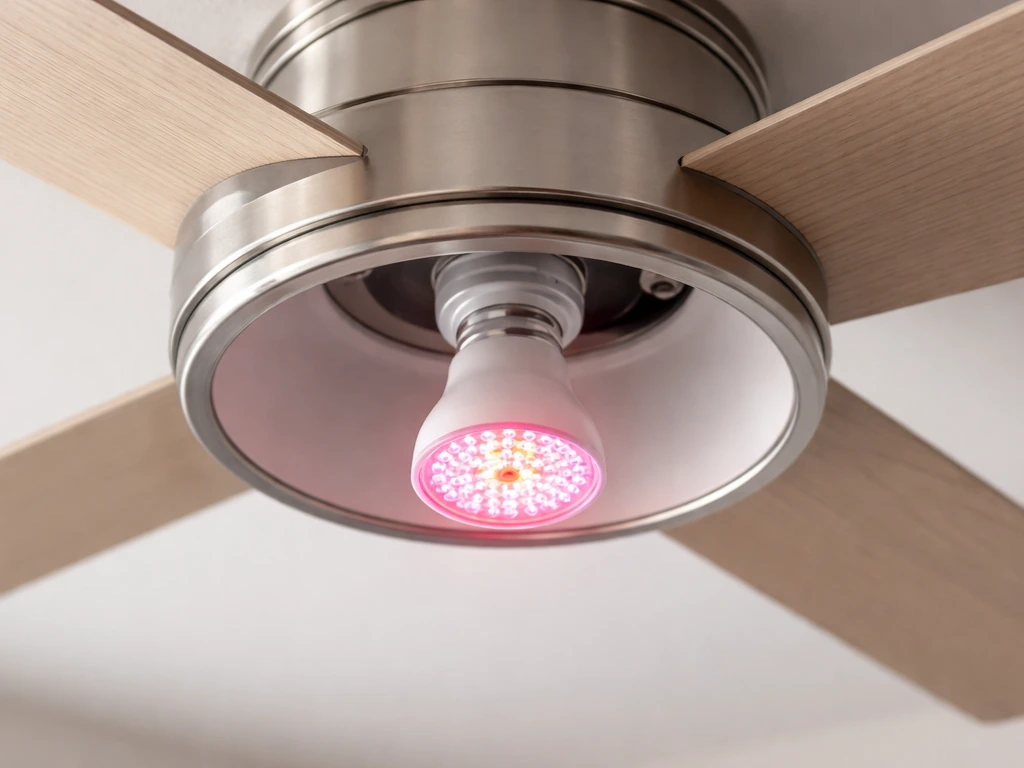
Can I Put Grow Lights in My Ceiling Fan Safely?
Yes, if rated wiring, clearances, airflow and LED heat control fit; otherwise use safer overhead bars or clip panels.
Can You Put a Grow Light in a Regular Lamp? Yes
Yes, if the bulb fits the socket and wattage safely. Learn setup, distance, hours, spectrum, and troubleshooting.
What Type of Light Do Plants Need to Grow Indoors
Pick the right grow light indoors by spectrum, brightness, and placement so plants grow well, bloom, and stay healthy.